

The B2B lead generation strategies that work in 2026 all concentrate effort on one small group: the roughly 5% of your market that is in a buying window this quarter, a share measured by the Ehrenberg-Bass Institute for the LinkedIn B2B Institute. The other 95% will buy eventually, and no sequence length fixes the timing. Every strategy below is a way to find that 5% earlier, reach them with something relevant, and book the meeting before a competitor does.
TL;DR: Summary
- Only about 5% of B2B buyers are in market in a given quarter, so timing beats volume. Buying signals are how you find that 5%.
- Segment the list before you scale it. A 500-contact list split by persona and signal outperforms a 10,000-contact list on one sequence.
- Run cold email, LinkedIn and cold calling as one sequence against the same account list, not as three separate campaigns.
- Enrich and verify every contact before it enters a sequence. Bounces cost sending reputation, which costs every later campaign.
- Automate the first touch. Write the follow-up by hand, because that is where the meeting is usually won.
- Measure positive reply rate and meetings booked. Open rates stopped being reliable after mail privacy protection.
- Reachly runs this as a managed service from $3,500 a month, with first qualified meetings in weeks 5 to 7. See outbound lead generation services.
What makes a B2B lead generation strategy work in 2026?
A strategy answers three questions: who you target, when you reach them, and what you say. A tactic is one action inside that answer, such as a subject line test or a Clay table. Most teams have a pile of tactics and no strategy connecting them, which is why their results move with effort rather than compounding.
Why timing outranks volume
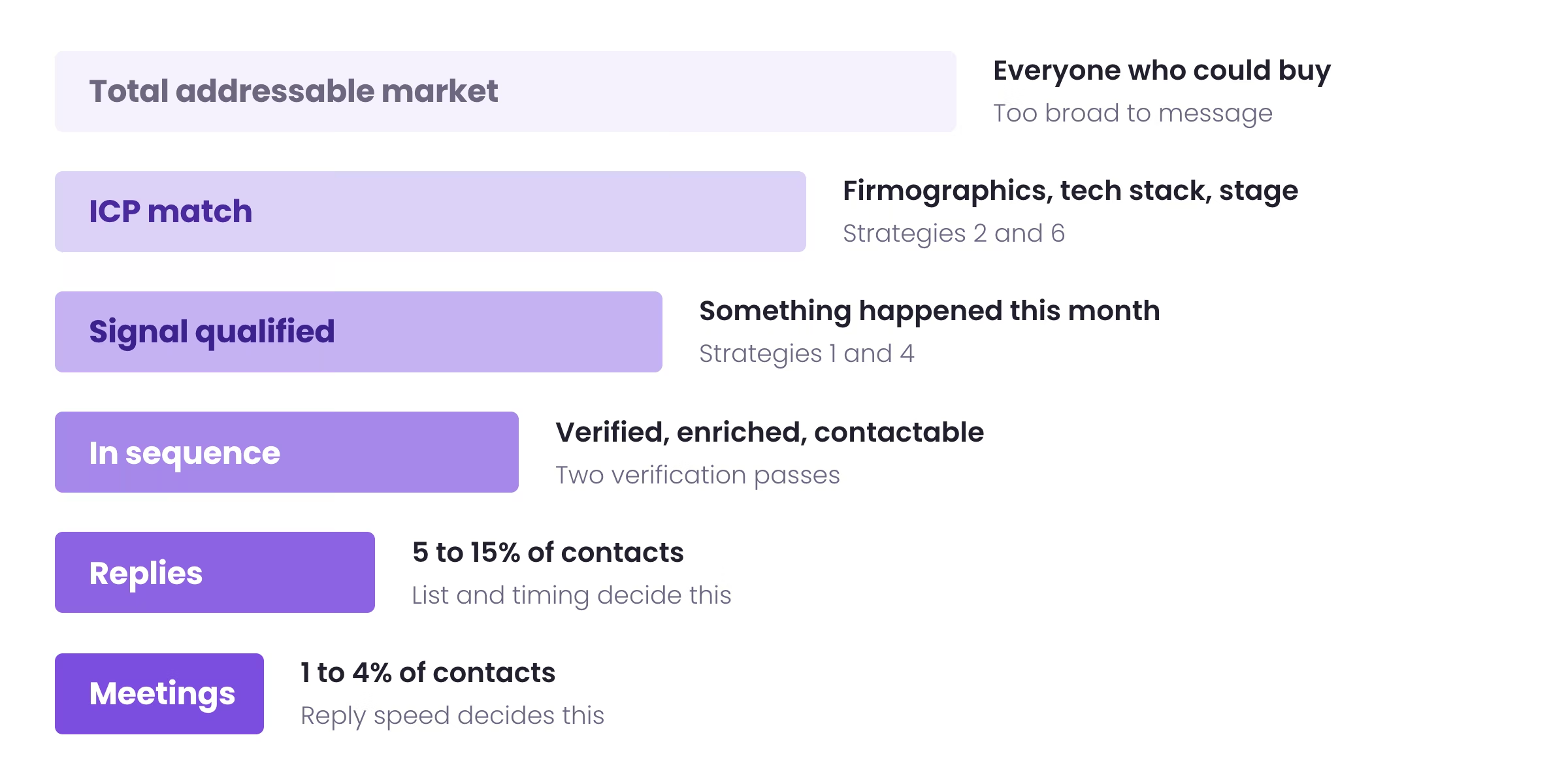
The 95:5 research is the most useful number in B2B lead generation. If 5% of your market is in a buying window this quarter, then a 10,000-contact blast reaches around 500 people who could act and 9,500 who cannot, and it burns your sending reputation on both. Cutting the list and timing the send against a real trigger reaches a smaller number of people at the moment the message is relevant.
The three levers you actually control
Targeting decides who hears from you. Signals decide when. Offer and copy decide whether they answer. When a campaign underperforms, the order of diagnosis matters: check the list first, the timing second, the copy third. Rewriting copy on a badly built list is the most common wasted month in outbound.
| Layer | The question it answers | Example |
|---|---|---|
| Strategy | Who we target, through which channels, with what positioning | Series B SaaS in APAC, signal-triggered, multichannel |
| Play | Which repeatable motion we run against that segment | Funding-round campaign, case-based campaign, site-visitor follow-up |
| Tactic | The specific action inside a play | A subject line, a Clay enrichment column, a call script |
How do you build the foundation before any strategy works?
Most B2B lead generation fails before the first send, on a purchased list and a generic sequence. The foundation is three pieces of work: a specific ICP, contact data you have verified, and a signal layer that tells you when to move.
Define the ICP tightly enough to exclude people
Your Total Addressable Market is every company that could buy. Your Ideal Customer Profile is the much smaller set that gets the most value, stays longest, and refers you. Build it from your best current customers rather than from ambition. A working ICP reads like a filter, for example: APAC fintech companies with 100 to 500 employees that hired a Head of Growth in the last quarter and run Salesforce.
| Dimension | What to define | Example |
|---|---|---|
| Firmographics | Industry, headcount, geography, funding stage | Series B SaaS in APAC, 50 to 200 employees |
| Technographics | CRM, sales engagement stack, adjacent tools | Runs HubSpot, recently added a sales engagement platform |
| Pain points | The problem they had the month before they bought | Inconsistent pipeline, SDRs lost in manual research |
| Buying triggers | The event that started the search | New VP of Sales, funding round, new market entry |
Source and verify contact data before it costs you a domain
A raw export from any database is never fully accurate. People change jobs, companies get acquired, and addresses go stale. Sending into bad addresses raises your bounce rate, and a high bounce rate is the fastest way to lose inbox placement for every campaign that follows. Reachly runs a waterfall inside Clay so that each contact is found twice and verified twice before it enters a sequence.
| Step | Tool | What it does |
|---|---|---|
| 1 | Apollo | Builds the account and contact list from ICP filters |
| 2 | Clay | Enriches each record with funding, headcount, tech stack and LinkedIn activity |
| 3 | Icypeas | Primary work email discovery |
| 4 | LeadMagic | Fallback discovery when step 3 returns nothing |
| 5 | MillionVerifier | First verification pass |
| 6 | ZeroBounce | Second verification pass |
| 7 | BetterContact | Phone enrichment for the calling step |
The whole workflow runs inside Clay with no manual steps. If you want the build rather than the summary, our Clay lead generation workflow covers the tables and the columns, and the B2B lead generation tools guide compares the platforms at each step.
Track the signals that tell you when to send
A clean list tells you who. Signals tell you when. These are the eight we watch across client campaigns, with the angle each one gives the first email.
| Signal | What it tells you | Outreach angle |
|---|---|---|
| Funding round | Budget released, growth targets just moved | Pipeline capacity against the new plan |
| Sales or marketing hiring spike | The GTM team is scaling and process is behind | Speed to ramp, capacity before the new hires land |
| New leadership hire | Fresh budget authority inside a first 90 days | Reach out before the stack is locked in |
| LinkedIn post about a pain | They are thinking about the problem this week | Reference the post, add one view, make the ask |
| New tool adopted | A platform next to yours just went in | Integration angle or the gap the new tool leaves |
| Tool churned | They are in evaluation mode | Position as the replacement, lead with migration |
| Market expansion | New geography with no pipeline in it | Local network and market knowledge as the hook |
| Site visit, deanonymized | They already know who you are | Match the message to the page, send the same day |
Signal coverage is the part teams underbuild. Our B2B buying signals guide lists every signal type we track, where each one is sourced, and how quickly it decays.
Which 15 B2B lead generation strategies actually book meetings?
These are ordered by how quickly they move pipeline for a team that already has a product and a few customers. The first five are the core motion. The rest compound once the core is running.
1. Trigger every campaign on a buying signal
Signal-based outbound is the shift that separates a working 2026 campaign from a 2019 one. You send because something happened that makes your offer relevant this week, not because the sequence fired on schedule. Funding, a leadership hire, a hiring spike, a tool swap, a post about the exact pain you solve. Each one gives the first line of the email a reason to exist, and the reader can tell in about four seconds whether that reason is real.
Start with two signals you can source reliably rather than twelve you cannot. Coverage matters more than breadth: a signal you catch three weeks late is a cold email with extra steps.
2. Segment the list before you scale it
Teams build a 10,000-person list, send one sequence, see a 1% reply rate, and conclude that outbound is finished. The list was the problem. Split it before any send: by industry, by headcount, by persona, by the pain that group carries, by the signal that put them on the list. Each segment gets its own angle. A VP of Sales at a 50-person Series A company and a VP of Sales at a 500-person enterprise share a title and nothing else.
| Segment by | What it improves | Build effort |
|---|---|---|
| Company size | Offer fit and pricing angle | Low |
| Industry | Pain relevance | Low |
| Persona | Message angle and how hard the ask can be | Medium |
| Buying signal | Timing | Medium |
| Tech stack | Integration positioning | High |
| Growth stage | Urgency and budget fit | High |
3. Run cold email, LinkedIn and cold calling as one sequence
Single-channel outbound is a bet that every prospect answers on the one channel you picked. Some reply to email, some only answer on LinkedIn, and some need a call before anything moves. Running the three against the same account list, in one narrative, is what turns a day 12 call into a warm call: by then you have appeared in their inbox twice and on their profile once. The day-by-day structure is in the next section, and the calling step is worth staffing properly rather than bolting on.
4. Follow up on the people who already visited your site
Someone at a target account read your case studies page and left without filling in a form. Deanonymization tools such as RB2B identify the company, and sometimes the person. You reach out the same day with a message that matches whatever they were reading: a result from their industry if they were on case studies, cost and payback if they were on pricing. Do not tell them you saw the visit. Let the signal shape the message and leave it there.
5. Automate the first touch, write the follow-up by hand
AI writes a decent first email when the enrichment behind it is real, and it writes thousands of them. That is the right job for it. By touch three the prospect has either ignored you twice or is half interested, and the next move depends on what they did. A person should make that call. We flag every positive and every non-committal reply for a human to answer, because that is the message that books the meeting.
6. Enrich every contact before it enters a sequence
A 10,000-contact list with no enrichment is a list of names. A 500-contact list carrying tech stack, hiring activity, funding history and recent LinkedIn posts is a set of openings. Enrichment is also what makes personalization survive volume, because the variable is already in the row before the copy is written.
7. Give away a teardown instead of a gated PDF
A gated guide collects addresses from people who will never buy. A short audit of the prospect's own setup earns a conversation, because you show competence rather than claim it. The ones that work in outbound are small and specific: a cold email teardown, an ICP audit against their customer list, a deliverability check on their sending domains, a sequence review that maps the cadence and names the gaps.
8. Build campaigns around one client result
Case studies sitting on a website do nothing for pipeline. Pick one result, find the prospects who match that client on industry, size and role, and write the story in two sentences with a low-friction ask. Our Primal campaign line ran close to: we helped Primal book 85 qualified sales calls in six months without adding an SDR, and they were in a similar position to where you are now. That campaign family carried an 8% positive reply rate.
9. Publish your own benchmark data
Original numbers pull a different quality of reader than opinion posts. Reply rates by industry, by sequence length, by signal type, by channel mix. You do not need a research budget for this. Ten clients and six months of campaign data is enough to publish something specific that nobody in your niche can copy, and the people who look up benchmarks are the people who take pipeline seriously.
10. Partner with non-competing B2B brands
Most service companies sit next to three or four businesses selling to the same buyer without competing: the CRM consultant, the branding studio, the fractional CFO. One reciprocal referral agreement can outperform a quarter of cold outreach, because the introduction arrives with trust attached. Start with one conversation and one named introduction in each direction rather than a formal program.
11. Use short personalized video on high-value accounts
A 60 to 90 second video is hard to mistake for a template. Keep it off the product: reference something specific about their company, state one observation about their situation, ask one small question. Record with their site or profile on screen so the personalization is visible in the first second. Use it on the accounts worth the minutes, not on the whole list.
12. Run a niche newsletter
A newsletter is the one touchpoint your ICP opts into. The mistake is writing it broad. Marketing news competes with a hundred others, outbound playbooks for B2B teams expanding across APAC competes with almost nobody. Two thousand subscribers who are all in your ICP is worth more than fifty thousand who vaguely like the topic.
13. Hand buyers the business case
Your champion has to convince a CFO after the call. An ROI or cost-per-meeting calculator does that work for them, in their own numbers, without you in the room. Reachly publishes one for exactly this reason, and what a lead generation agency costs is the article buyers send to their finance lead.
14. Work with practitioner voices in your niche
In niche B2B the useful voices are rarely the largest accounts. They are practitioners with five to twenty thousand followers posting daily about the problem your ICP has. One respected voice, a podcast host or a community moderator, puts you in front of a pre-qualified audience in a week. Engage with their work for a month before making any ask.
15. Work the not-now and closed-lost lists
The cheapest pipeline in most companies is already in the CRM. A prospect who said not this quarter eight months ago, or a deal lost to a tool they have since churned, is a warmer contact than anyone on a new list. Set a re-entry date on every not-now reply and let the signal layer wake it up: new funding, a new decision maker, a tool swap. Many of the best deals we see arrive six to twelve months after the first conversation.
What does a multichannel sequence look like day by day?
This is the structure we run across client campaigns. Each touch has a reason to exist, and a reply pulls the contact out of the sequence automatically so nobody gets a bump message after answering.
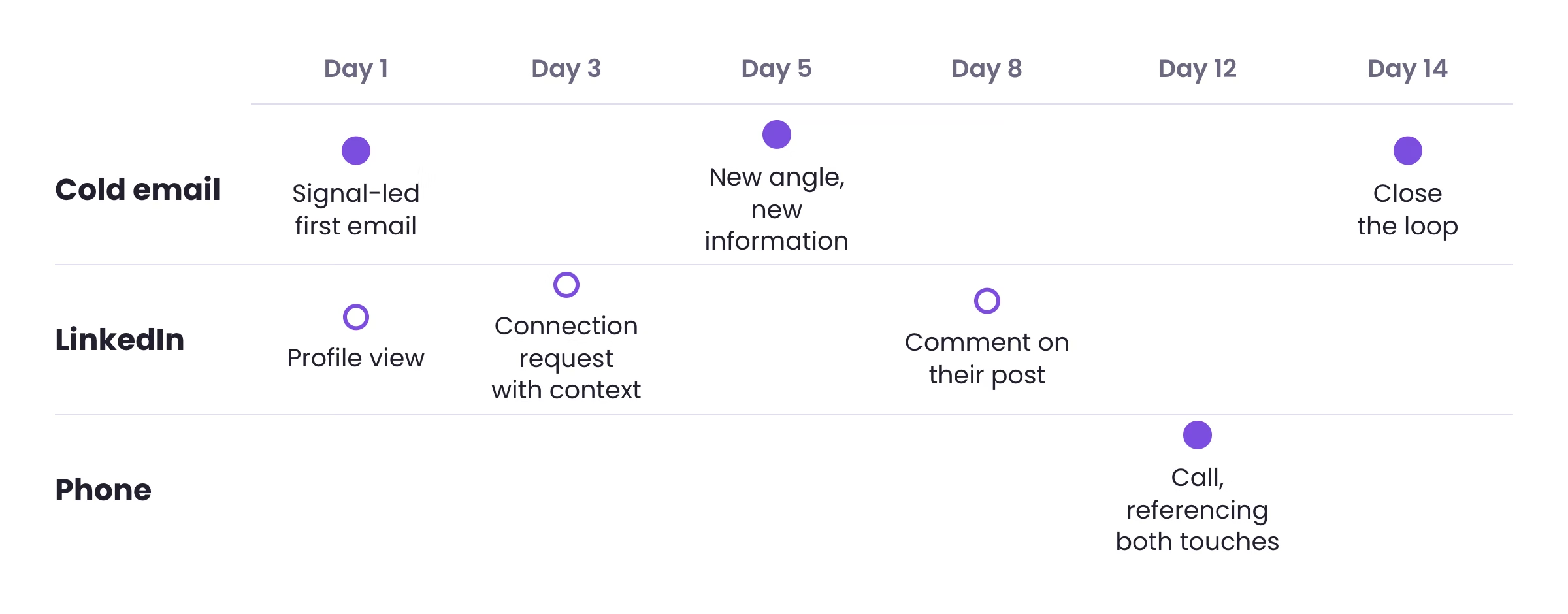
| Day | Channel | Action | Why it is there |
|---|---|---|---|
| 1 | Signal-led first email, under 100 words, one ask | The opening line has to prove the timing is real | |
| 1 | View the profile | Puts your name in their notifications without a request | |
| 3 | Connection request with one line of context | No pitch here. The request is the whole ask | |
| 5 | Second angle, new information, not a reminder | Every follow-up needs its own reason to exist | |
| 8 | Comment on something they posted | Builds recognition faster than two more emails | |
| 12 | Phone | Call referencing the email and the LinkedIn touch | By now this is a warm call, not a cold one |
| 14 | Short close-the-loop message | Often replied to by people who were simply busy |
Email sequencing runs through Smartlead for inbox rotation and reply routing. LinkedIn touches run through HeyReach against the same account list, so the two channels never contradict each other. The full build is in our outbound lead generation guide, and the LinkedIn half is in our LinkedIn lead generation strategies playbook.
How do you write outreach that earns a reply?
The first email has one job, and booking the meeting is not it. The job is a reply. That means a specific opening, one problem the reader recognizes, one sentence of proof, and an ask small enough to answer from a phone.
| Element | What it does | Example |
|---|---|---|
| Subject line | Earns the open by being specific | question about [Company]'s sales expansion |
| Opening line | Proves the timing, names the signal | Saw you brought on a new VP of Sales last month |
| Problem | Connects the signal to a likely priority | That usually makes predictable pipeline the first 90-day problem |
| Proof | One outcome, from a company that looks like them | 85 qualified sales calls in six months, no new SDR |
| Ask | A question, not a calendar demand | Is outbound pipeline on the list this quarter? |
The version that gets deleted
A generic pitch names your company, lists your services, and asks for 30 minutes. It carries no evidence that the sender knows anything about the recipient, so the recipient has no reason to treat it differently from the other nine that arrived that morning.
The version that gets answered
Same offer, rebuilt on the signal. Under 100 words, one ask, no attachment.
Subject: question about [Company]'s new VP of Sales

Hi [First name],

Saw you brought on a new VP of Sales last month. At your stage that
usually means predictable pipeline becomes the first 90-day problem.

We build the outbound motion for Series B SaaS teams in APAC and hand
over booked meetings, not lists.

Is outbound pipeline on the list for this quarter?

[Your name]
Subject: re: question about [Company]'s new VP of Sales

Hi [First name],

One number in case it is useful: a marketing services client of ours
booked 85 qualified sales calls in six months without hiring an SDR,
at an 8% positive reply rate.

Happy to send the campaign structure rather than a deck.

Worth a look?

[Your name]
Both are starting points, not scripts to send as they are. The cold email playbook covers subject lines, length, and the follow-up rules in detail.
What technical setup protects deliverability before you send?
Volume without infrastructure costs you the company domain. Every campaign Reachly runs sends from dedicated domains that sit beside the client's brand domain, so a reputation problem never reaches their invoices and their support replies. Work through this before the first campaign, not after the first bounce spike.
Warm-up is the step teams cut first and regret. Our email warm-up guide covers the ramp schedule and how long a new domain needs before it can carry real volume.
How should you handle replies and qualify leads?
Campaigns create replies, and replies create the work. Sort every one of them the day it lands. Speed on a positive reply is the single cheapest conversion gain available, because interest decays within hours.
| Reply type | What it means | What to do |
|---|---|---|
| Positive | Clear interest, ready to talk | Book the meeting while the thread is warm, same day |
| Questioning | Asking price, scope or proof | Answer the question directly, then return to the ask |
| Not now | Timing is wrong, not the fit | Set a re-entry date and let the signal layer wake it |
| Not interested | Wrong fit or a firm no | Acknowledge, remove from every sequence, suppress the domain |
A not-now reply is a lead with a date on it. Parking those properly is what makes strategy 15 work later in the year.
How do you measure B2B lead generation results?
Open rates stopped being a usable signal after mail privacy protection started pre-loading images. These are the five numbers that tell you whether the motion is working, and what to change when each one is weak.
| Metric | What it tells you | Working range | If it is low, check |
|---|---|---|---|
| Reply rate | Message relevance and list fit | 5 to 15% | Segmentation and the offer, before the copy |
| Positive reply rate | Whether you named a real problem | 2 to 8% | ICP quality and the angle, not the subject line |
| Meeting booked rate | Friction in the ask and the handoff | 1 to 4% | Reply speed and how big the ask is |
| Meeting to opportunity | Whether the meetings are qualified | Baseline dependent | Qualification before the booking, not after |
| Cost per meeting | Channel efficiency | Varies by ICP | Compare channels before cutting any of them |
The diagnosis order matters. If deliverability is clean and reply rates are still low, the list or the angle is wrong, and rewriting the copy will not move it. Tighten the ICP and re-segment first.
What does this look like on a real campaign?
Two client programs, both published as case studies, both built on the same motion described above.
| Client | Setup | Result |
|---|---|---|
| Primal, marketing services, Thailand | Evergreen campaigns to CMOs and CEOs plus signal campaigns on hiring, funding, traffic decline and ranking drops | 85+ SQLs in 6 months, 6 deals closed, 35% lower CAC, 4.57x ROI, 8% positive reply rate |
| The Great Room, premium co-working, Singapore and Australia | Signal campaigns on headcount growth, hiring, funding and market expansion, with SDR-led nurturing before handoff | $250K+ in closed contract value in about 9 months, meetings up from around 2 a quarter to around 2 a month |
Full write-ups: the Primal case study and The Great Room case study.
Get more meetings with the people who matter
Reachly builds and runs the whole outbound motion across cold email, LinkedIn and cold calling, from TAM mapping and signal enrichment through to reply management and booked meetings. One flat retainer from $3,500 a month, with first qualified meetings in weeks 5 to 7.
See how it works
B2B lead generation FAQs
What is the most effective B2B lead generation strategy in 2026?
Signal-based multichannel outreach. It combines buying signal monitoring, a tightly defined ICP and coordinated touches across cold email, LinkedIn and cold calling. The difference from traditional outbound is timing: you send when a trigger makes the message relevant rather than when the sequence fires.
How do you generate B2B leads without a large budget?
Start with one segment, a verified list of a few hundred contacts, and one sequence you write by hand. Precision costs less than volume. Free signal sources such as LinkedIn activity and job postings will carry the first campaigns before you pay for enrichment platforms.
What is a realistic budget to start outbound lead generation?
A self-run campaign needs sending domains, mailboxes, an email platform, a data source and a verification step, which together sit in the low hundreds of dollars a month before anyone's time. A managed service costs more and removes the build. Reachly runs one flat retainer from $3,500 a month. Our breakdown of lead generation agency pricing compares the two paths line by line.
How long does B2B lead generation take to produce meetings?
Weeks 1 to 4 go on ICP work, domain setup and warm-up. Campaigns launch around week 4, and first qualified meetings usually land in weeks 5 to 7. Volume becomes predictable around month 3. Judging a campaign at two weeks measures warm-up, not performance.
What is reverse intent targeting?
Identifying companies, and sometimes individuals, who visited your website without filling in a form, then reaching out directly. Tools such as RB2B deanonymize a share of that traffic. Conversion is higher than cold outreach because the prospect already knows who you are.
How many lead generation strategies should you run at once?
Two or three, executed properly. Most teams underperform because they run eight things badly rather than three things well. Get cold email and LinkedIn working against one segment, then add reverse intent, case-based campaigns and partnerships once the core motion produces meetings.
What is the difference between a lead generation strategy and a tactic?
A strategy defines who you target, through which channels, with what positioning. A tactic is one action inside it, such as a subject line test or an enrichment column. Most companies have plenty of tactics and no strategy joining them up.
Is cold calling still effective for B2B lead generation?
Yes, as part of a sequence rather than on its own. A call on day 12, after two emails and a LinkedIn touch, reaches someone who recognizes the name. Cold dialing a list with no prior context is where calling gets its reputation.
What is the difference between outbound and inbound lead generation?
Outbound means you start the conversation with people who have not heard of you, through cold email, LinkedIn and calling. Inbound means they find you through search, content or referral. Outbound gives you control over who and when, which is why it is the faster of the two to start.
Should your own team run outbound, or should you outsource it?
Early on, the founder or first sales hire running campaigns gives you unfiltered market feedback and is worth the time. Once the motion needs dedicated infrastructure, daily reply management and constant list work, it becomes a full role, and that is the point where teams hire an SDR or bring in an outbound partner.
How many contacts does a B2B campaign need to work?
Enough to read the result, not enough to hide a bad list. A few hundred well-segmented contacts produce a readable reply rate within two weeks. If a segment cannot reach a few hundred accounts, the ICP is a niche play and should be run as manual outreach rather than a sequence.
What reply rate should a B2B cold email campaign get?
A working range is 5 to 15% total replies and 2 to 8% positive replies. Below that, look at the list and the timing before the copy. Our Primal campaigns ran at an 8% positive reply rate across a six-month program.
How does Reachly approach B2B lead generation in APAC?
Reachly maps the TAM from multiple data sources, enriches accounts with intent signals such as headcount growth and funding, then runs multichannel campaigns across cold email, LinkedIn and phone with timing and tone set by market. Reply management, nurturing and meeting booking are included, and sending runs on dedicated domains.
Recommended service
Outbound Lead Generation Services
Reachly builds and runs the whole outbound motion across email, LinkedIn, and phone, and books qualified meetings on your calendar.