
The gap between a 1% reply rate and a 10%+ reply rate is rarely a copy problem.
We've run 400+ B2B cold email campaigns at Reachly. The teams stuck below 3.43% (the industry average) almost always have the same three problems: infrastructure, list quality, and sequencing. Fix those and reply rates triple in 30 to 60 days.
This playbook covers the 18 rules we use to take a stalled outbound program from average to elite. It's the same system we run for client campaigns across APAC and beyond. Follow them in order. They compound.
TL;DR: Summary
- The distance between a 3.43% average reply rate and a 10% elite reply rate is an infrastructure and targeting problem before it is a copy problem. Dedicated sending domains, SPF, DKIM and DMARC on every one of them, a 2 to 4 week warmup, and bounce rates held under 2% are the floor everything else stands on.
- Keep first-touch emails between 50 and 125 words, and under 80 where you can. Past 200 words, reply rates drop in every industry and against every ICP.
- 58% of replies come from the first email and the other 42% come from follow-ups, so a single-send campaign gives away close to half of what it could earn. Four to five emails is the range that holds, with a different angle on each one.
- Real personalization changes the reason for the email. A city, a job title or a vague compliment on a post only decorates it. A funding round, a hiring surge or a tech stack change is a reason to write this week.
- Send windows still matter, and Tuesday to Thursday between 8am and 11am in the prospect's own time zone remains the default. A trigger beats a calendar: reach out inside 72 hours of a real business event and the timing reads as earned.
- Email on its own is a channel. A coordinated 14-day sequence across email, LinkedIn and phone stacks recognition, so the Day 7 call lands on someone who has already seen your name twice. Reachly runs the whole system as a managed service through its cold email agency.
Why Most Cold Emails Fail Before Anyone Reads Them
Most cold email problems are diagnosed at the wrong layer. Teams rewrite subject lines when the real issue is deliverability. They add more follow-ups when the real issue is list quality. They blame the channel when the real issue is targeting. If you are new to the channel, start with what cold email is and how a campaign runs.
Here is where campaigns actually break:
| Failure point | What it looks like | What actually fixes it |
|---|---|---|
| Bad list | Low reply rates, lots of bounces | Tighter ICP, waterfall enrichment, verification |
| Broken infrastructure | Emails landing in spam, open rates below 20% | Dedicated domains, warmup, SPF/DKIM/DMARC |
| Wrong sequence logic | Replies coming in but no meetings | Angle changes per follow-up, better reply handling |
| Generic copy | Low positive reply rate despite decent opens | Signal-based personalization, problem-led opening |
Fix the foundation before you touch the copy. Everything else compounds on top of that.
Cold Email Best Practices: Technical Setup
1. Use Dedicated Sending Domains
Never send cold email from your primary business domain. If a sending domain earns a poor reputation or gets blacklisted, your main domain stays clean.
Rules for domain setup:
- Buy similar-looking domains specifically for outbound, for example getreachly.co or tryreachly.co.
- Redirect them to your main site in case a prospect looks you up.
- Stick with .com or country-level extensions like .co.uk.
- Avoid .biz or .online domains. They trigger more spam filters before a human ever sees your message.
- Set up no more than 3 mailboxes per domain to avoid looking like a bulk sender.
2. Configure SPF, DKIM, and DMARC on Every Sending Domain
These are not optional hygiene steps. They are what determine whether mailbox providers trust your messages at all.
| Record | What it does | What happens without it |
|---|---|---|
| SPF | Lists which mail servers are authorized to send on behalf of your domain | Receiving servers may reject or flag your mail |
| DKIM | Signs messages with a cryptographic signature confirming authenticity | Emails are more likely to land in spam |
| DMARC | Sets policy for failed SPF/DKIM checks and delivers reporting data | No visibility into authentication failures |
All three are now required for bulk senders under 2024 Gmail and Yahoo standards. Skipping any of them is the fastest way to end up in spam before your campaign even starts.
3. Warm Up Every New Domain and Mailbox
A brand new domain with zero sending history looks suspicious to email providers. You need to build a positive sender reputation before launching any campaign volume.
Standard warmup schedule:
| Week | Daily send volume |
|---|---|
| Week 1 | 5-10 emails per day |
| Week 2 | 10-20 emails per day |
| Week 3 | 20-30 emails per day |
| Week 4+ | Cap at 30 campaign emails per inbox per day |
Keep warmup running between campaigns, not just during setup. Smartlead handles this automatically with built-in warmup across a large deliverability network.
How Reachly manages this for clients: Every client campaign runs through Zapmail for domain and mailbox management. We configure SPF, DKIM, and DMARC on every domain, run a full warmup schedule before any campaign goes live, and monitor bounce rates and spam complaint rates daily. Across all active client campaigns, bounce rates stay consistently below 2%.
4. Monitor Deliverability Continuously
| Metric | Safe threshold | Action if exceeded |
|---|---|---|
| Bounce rate | Below 2% | Stop sending, re-verify list, resume at lower volume |
| Spam complaint rate | Below 0.1% | Pause campaign, audit list quality and targeting |
| Open rate | Above 25% | If it drops suddenly, check inbox placement before touching copy |
For a full breakdown of how to protect and recover sender reputation, our email deliverability guide covers every step.
Cold Email Best Practices: List Building and Targeting
5. Start With Accounts, Not Contacts
The single most common mistake in cold email is building a contact list before defining the account criteria. Start with companies, not people. Define your ICP, filter for firmographic fit, layer in buying signals, then pull the relevant contacts.
The right order:
- Define ICP criteria
- Pull target account list
- Enrich for firmographic and technographic fit
- Layer in buying signals
- Remove bad-fit accounts
- Pull relevant contacts by title cluster
- Verify all emails before launch
6. Define a Tight ICP Across Five Dimensions
| Dimension | What to define | Why it matters |
|---|---|---|
| Firmographics | Industry, company size, geography, funding stage, revenue | Filters out obvious bad-fit accounts before enrichment |
| Technographics | Current tools, CRM, sales engagement stack | Gives you a relevant angle based on their setup |
| Buying triggers | Funding, hiring surges, new offices, tech stack changes | Tells you why to reach out now, not just who to reach |
| Role mapping | Pain owner, budget holder, blocker, champion | Tells you who to contact and with what message |
| Negative signals | Company types or stages that produce bad-fit meetings | Protects calendar quality and AE time |
For a deeper framework on this, our B2B segmentation guide covers how to break a market into workable, high-precision outbound segments.
7. Use Waterfall Enrichment
No single data provider covers your entire market accurately. The waterfall approach chains multiple providers together so that if the first source cannot find a verified email, the next one runs automatically.
Reachly's enrichment waterfall:
| Step | Tool | Purpose |
|---|---|---|
| 1 | Icypeas | Primary work email finding |
| 2 | LeadMagic | Fallback if Icypeas comes up empty |
| 3 | MillionVerifier | Email verification pass one |
| 4 | ZeroBounce | Email verification pass two |
| 5 | BetterContact | Phone number enrichment |
The entire workflow runs automatically inside Clay with no manual steps.
Re-run the waterfall before every launch. Up to 30% of B2B contacts change role or company inside a year, so a list built six months ago is already part fiction, and the stale rows are where bounce rates come from.
Cold Email Best Practices: Copy and Structure
8. Keep It Under 100 Words
The 2026 cold email benchmark data is clear:
| Email length | Reply rate impact |
|---|---|
| 50-80 words | Highest reply rates, elite performer standard |
| 80-125 words | Strong performance, still in the optimal range |
| 125-200 words | Noticeable drop in reply rates |
| 200+ words | Significantly lower reply rates across all industries |
Short wins because it respects the prospect's inbox. Long intros about your company history get ignored before the third sentence.
9. Write Subject Lines That Earn the Open
| What works | What does not work |
|---|---|
| "Re: your APAC expansion" | "Quick question for you" |
| "SDR ramp time at [Company]" | "Thought you might find this interesting" |
| "How [Similar Company] cut CAC by 35%" | "Our new platform for outbound teams" |
| "[Trigger]: is this on your radar?" | "Following up" |
Rules for subject lines:
- Keep them to 6-10 words.
- Reference a specific trigger, problem, or result.
- Personalized subject lines achieve up to 50% higher open rates than generic ones.
- Never write a subject line that could have been written for anyone.
Most teams write the subject line and forget the preview text. The subject line earns the open, and the first sentence of the body earns the read. On a phone that first sentence sits right under the sender name, so it gets read before the email is even opened. Write it knowing that.
Subject lines to leave alone:
- Anything that promises something the body does not deliver.
- A fabricated "Re:" or "Fwd:" on a thread that never existed.
- "Quick question", which every buyer now reads as a template.
- Words in full capitals, and more than one punctuation mark.
- Any subject line that would work for every company on the list.
10. Use the Four-Line Cold Email Framework
Every cold email should do four things in four lines:
| Line | Purpose | Example |
|---|---|---|
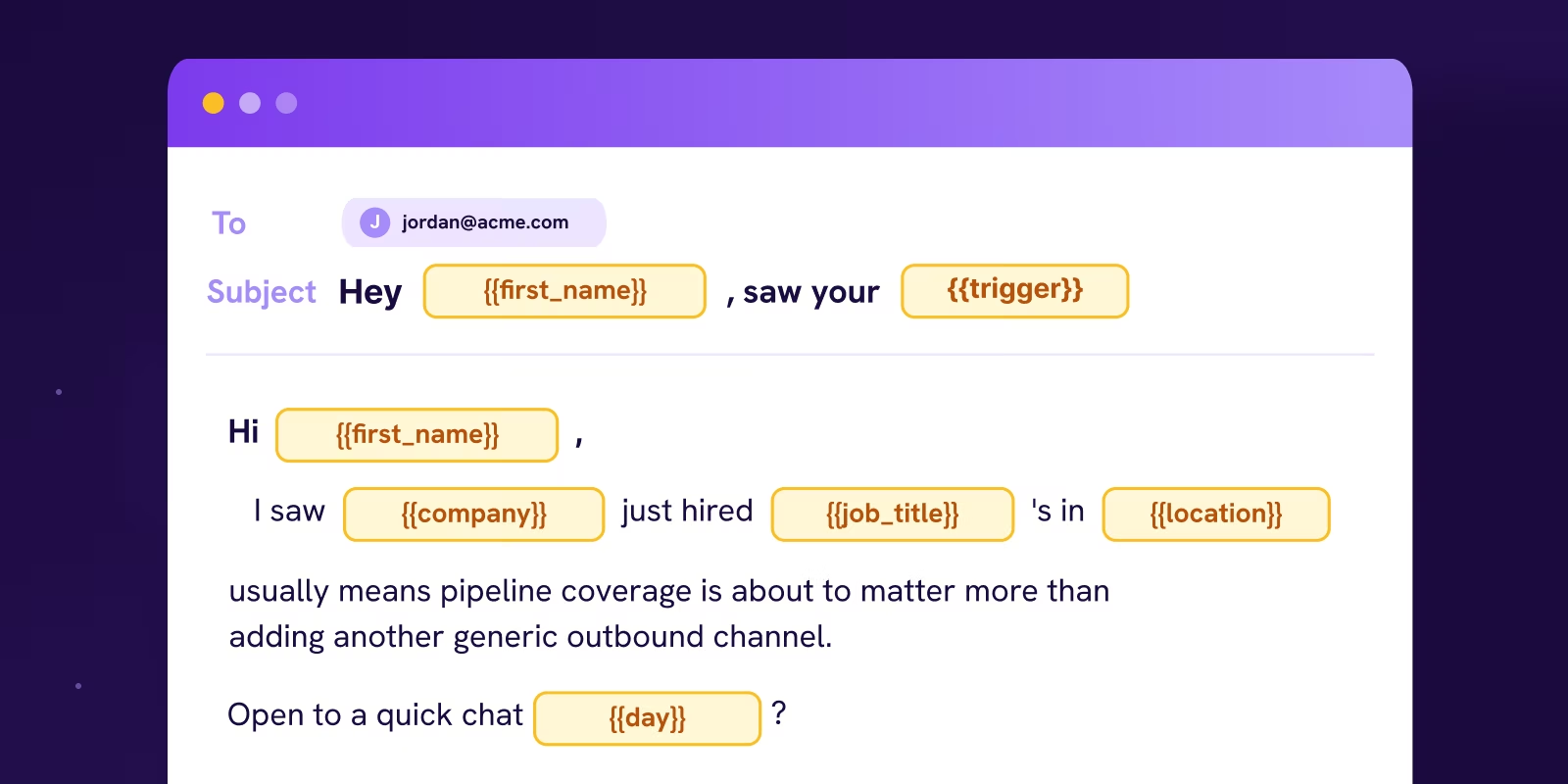
| Line 1 | Why them. Reference a specific trigger or business event. | "Noticed your team is expanding sales coverage into APAC." |
| Line 2 | What problem likely exists as a result. | "Usually that means pipeline targets rise before the outbound process catches up." |
| Line 3 | What outcome you produce for similar companies. | "We help B2B teams build multichannel outbound from day one in new markets." |
| Line 4 | A soft, low-friction CTA. | "Worth a quick look?" |
The four lines have to sound like a person wrote them. AI-drafted cold email converges on the same rhythm and the same vocabulary, and buyers have learned the pattern. Keep the sentences short. Allow a fragment. Cut the corporate filler: circle back, touch base, align, reach out. Read the email out loud before it goes anywhere, because anything that sounds strange spoken reads strange in an inbox.
11. Personalize the Opening Line Around a Business Signal
Strong personalization triggers:
| Signal type | What to reference | Example opening line |
|---|---|---|
| Hiring signal | SDR or AE hiring surge | "Saw you are scaling the AE team across APAC. That usually means pipeline coverage gets uneven by market before new reps ramp." |
| Funding signal | Recent round announcement | "Congrats on the Series B. Usually at this stage, outbound process needs to scale faster than headcount." |
| Tech stack signal | New tool adoption | "Noticed your team recently added a sales engagement tool. Usually that means outbound is getting more formalized." |
| Expansion signal | New market or office | "Saw you are opening coverage in [region]. That usually creates a pipeline gap while the local team ramps." |
Weak personalization to avoid:
- "Loved your recent LinkedIn post."
- "Saw you are based in Singapore."
- "Impressive company growth."
- "I came across your profile and..."
The rule: personalization should change the reason for the email, not just decorate it.
Four questions to run a first line past before it ships:
- Does this speak to a problem this specific person is dealing with right now?
- Would a stranger reading it know it was written for them?
- Does it name something from their world: their role, their market, a recent event?
- Is there anything here that could only apply to this one account?
Two yes answers is the minimum. Below that, the line is a template with a name field in it.
The mistake most teams make is building massive lead lists and then writing copy that appeals to everyone. Appealing to everyone means appealing to no one. Start with one ideal prospect. Write as if they are the only person in your world. Do this 20 times. Find the pattern. Then scale it.
12. Use One CTA Per Email
CTA comparison:
| CTA Type | Example | When to use |
|---|---|---|
| Interest check | "Worth a look?" | First email, maximum low friction |
| Relevance check | "Is this even on your radar?" | First or second email |
| Routing check | "Are you the right person for this?" | When title targeting is broad |
| Calendar link | "Here is my calendar if easier" | Only after they express interest |
Never jump to a calendar link in the first email. Save it for after they reply with interest.
The same ask, rewritten:
| Weak ask | Stronger ask |
|---|---|
| "Want to explore what we could do together?" | "Would it help if I sent over a quick breakdown?" |
| "Can I get 30 minutes of your time?" | "Open to 15 minutes next week?" |
| "Let me know if you would like to learn more." | "Want to see what we did for a company like yours?" |
| "Feel free to grab a slot in my calendar." | "Tuesday or Wednesday for a short meeting?" |
| "I would love to connect and discuss further." | "Relevant?" |
Sometimes one word outperforms a full sentence. "Relevant?" and "Worth a look?" carry no pressure, so the prospect only has to answer yes or no.
Keep links and attachments out of the first touch as well. A case study PDF or a tracked calendar link in email one gives spam filters something to score, and it tells the reader they are on a list. Send plain text first. Once someone replies they are no longer cold, and you can send them whatever helps.
Worked examples of each structure are in cold email examples.
Cold Email Best Practices: Sequence Design
13. Run 4-5 Email Sequences
| Sequence length | Reply rate | Notes |
|---|---|---|
| 1 email only | 4.1% average | Missing 42% of potential replies |
| 3-5 follow-up steps | 8.3% average | Optimal balance of persistence and reputation |
| 6+ follow-ups | Declining | Spam complaint rates rise noticeably |
58% of all replies come from step one. The remaining 42% come from follow-ups. Stopping after one email means leaving nearly half your potential replies on the table.
14. Change the Angle on Every Follow-Up
| Follow-up | Timing | What to do |
|---|---|---|
| Follow-up 1 | Day 3-4 | Reframe the problem from a different angle |
| Follow-up 2 | Day 7-8 | Add value: case study, stat, or relevant observation |
| Follow-up 3 | Day 12-14 | Lower friction further. Ask a simple yes or no question. |
| Follow-up 4 | Day 18-21 | Breakup email. Close the loop and give them a way to opt out. |
Never send a follow-up that just says "bumping this to the top of your inbox." It adds zero value and signals you have nothing new to say.
Spacing is one half of timing. The send window is the other half.
| Send window | What to expect |
|---|---|
| Tuesday to Thursday, 8am to 11am | The default window for opens and replies. Local to the prospect, never local to you. |
| Monday morning | Competing with the whole weekend backlog. Weakest of the weekdays. |
| Friday afternoon | Lowest reply rates of the week. Nothing gets actioned before Monday anyway. |
| Inside 72 hours of a trigger | Beats every fixed window, because the reason for the email is still current. |
In APAC the window shifts by market. Prospects in Singapore and Hong Kong tend to answer on the morning commute or just after lunch, Australia behaves close to the US, and the rest of the region varies enough that it is worth setting per country rather than per campaign.
Trigger-based sending beats any fixed schedule. Someone promoted two weeks ago, a company that just announced a round, a decision maker who posted yesterday about the problem you solve: those are worth reaching inside 72 hours, while the reason still holds. Reachly watches those triggers in Clay and Trigify and drops the account into a sequence the moment one fires, instead of waiting for the next campaign batch.
Cold Email Best Practices: Multichannel Integration
15. Coordinate Email With LinkedIn and Phone
A proven 14-day multichannel sequence:
| Day | Channel | Action |
|---|---|---|
| Day 1 | First personalized email | |
| Day 3 | Connection request via HeyReach, no pitch | |
| Day 4 | Second email referencing the connection | |
| Day 6 | Profile view or light engagement with content | |
| Day 7 | Phone | Cold call. Prospect has now seen your name twice. |
| Day 10 | Brief message if connected | |
| Day 14 | Final breakup email |
Each channel reinforces the others. By the time you call on Day 7, the prospect has seen your name in two places. That familiarity changes the conversation.
Each channel reinforces the others. By the time you call on Day 7, the prospect has seen your name in two places. That familiarity changes the conversation.
16. Layer in Buying Signals Before Outreach
Signal-based outreach is what separates campaigns that hit 8%+ positive reply rates from campaigns that hit 1-2%.
| Tool | Signal type | How it feeds outreach |
|---|---|---|
| Clay | Funding, hiring, headcount growth, tech stack | Powers personalized first lines across the whole list |
| Trigify | LinkedIn engagement activity | Identifies warm accounts showing category interest |
| RB2B | Website visitor identification | Flags accounts already researching your solution |
Cold Email Best Practices: Metrics and Measurement
17. Track the Four Numbers That Matter
| Metric | Target | What it diagnoses if weak |
|---|---|---|
| Open rate | 25-45% | Deliverability or subject line relevance |
| Reply rate | 5% minimum, 10%+ elite | Targeting, personalization, or CTA |
| Bounce rate | Below 2% | List quality and verification |
| Positive reply rate | 5-8% | ICP fit and message relevance |
The average cold email reply rate across the industry is 3.43%. Top performers exceed 10% by keeping emails under 80 words, using problem-first positioning, and maintaining clean sender infrastructure. If your campaigns are consistently below the 3.43% average, the problem is almost always infrastructure or targeting, not copy. For a full breakdown of current benchmarks by industry, our cold email response rates guide covers what good numbers look like and how to close the gap.
18. Run a Weekly Review
Each week, answer these five questions:
- Which segments produced real, qualified conversations this week?
- Which replies looked positive but disqualified on closer inspection?
- Which booked calls moved forward to opportunities?
- Which signals keep appearing in accounts that became deals?
- What one thing should change in the sequence or targeting before next week?
That review loop is how cold email becomes a learning system instead of a guessing game.
Which Cold Email Mistakes Should You Fix Before Launch?
Run this list before a campaign goes live. Each row pairs the mistake with the tell that gives it away, so the diagnosis comes off your own dashboard rather than a guess. More than three of these open at once and the work is infrastructure, not copy.
| Mistake | How it shows up | Best practice | Priority |
|---|---|---|---|
| Generic templates | Reply rate under 2% on a list that fits the ICP | Personalize to the role, the problem and the signal, not the first name | High |
| First-name-only personalization | No context in the email beyond a merge field | Live signals: hiring, funding, tech stack, a recent post | High |
| Weak or long subject lines | Open rate below 25% with clean deliverability | Six to ten words, one specific trigger, nothing that fits everyone | High |
| Sending from the primary domain | Deliverability decays month over month | Dedicated sending domains, managed in Zapmail | High |
| No domain warmup | New domain, immediate spam placement | Two to four weeks of warmup before any campaign volume | High |
| Missing SPF, DKIM or DMARC | Authentication failures in the DMARC report | All three records on every sending domain, checked before launch | High |
| Links in the first email | Spam placement on an otherwise healthy domain | Plain text first touch, links only after a reply | Medium |
| More than one CTA | Opens and reads with no replies | One ask per email, low friction, easy to answer yes or no | Medium |
| Reminder-only follow-ups | "Just following up" language in the sequence | A new angle, stat or observation on every step | Medium |
| Wrong send window | Low opens despite good inbox placement | 8am to 11am recipient local time, or trigger-based sending | Medium |
| Emails too long | Drop-off before the CTA, replies asking what you want | 50 to 125 words, four lines, one idea | Medium |
| Static contact lists | Bounce rate above 2%, contacts who moved on | Waterfall enrichment re-run before launch, verification on every row | Foundation |
| Single-channel outreach | Email only, no LinkedIn or phone layer | A 14-day sequence across email, LinkedIn and phone | Foundation |
| No weekly review | Nothing changes between campaign weeks | Five questions every week on segments, replies, meetings and signals | Foundation |
The Foundation rows are the ones worth fixing first even though they look least urgent, because every High row above them fails again as soon as the list or the channel mix goes back to what it was. Reachly rebuilds all three layers together on every engagement, which is what the cold email agency service actually consists of.
The Reachly Cold Email Stack
For reference, here is the exact stack we use to run multichannel cold email campaigns for clients across APAC and beyond:
| Tool | Role in the stack |
|---|---|
| Clay | TAM mapping, waterfall enrichment, signal layering, personalization across large lists |
| Icypeas | Primary email finding in the waterfall |
| LeadMagic | Fallback email finding when Icypeas comes up empty |
| MillionVerifier + ZeroBounce | Final email verification before any contact enters Smartlead |
| Smartlead | Email sequencing, inbox rotation, warmup, and reply management |
| Zapmail | Dedicated domain and mailbox management |
| HeyReach | LinkedIn automation and multichannel coordination |
| Trigify | LinkedIn engagement signal tracking |
| RB2B | Website visitor identification for warm signal outreach |
| BetterContact | Phone number enrichment for calling workflows |
Every tool has a specific job. None of them work in isolation. The system is what produces results, not any single tool.
This stack is maintained by Thibault Garcia and updated as sending rules change.
Get more meetings with the people who matter, 100% done for you.
We don't spray and pray. We use real buying signals to reach the right people at the right time, then run coordinated outreach across email, LinkedIn, and phone with messaging that earns replies.
Get Started
FAQs
What is a good cold email reply rate in 2026?
The industry average reply rate is 3.43% according to the Instantly Cold Email Benchmark Report 2026, and top performers exceed 10%. A well-run program with tight ICP targeting and clean infrastructure should aim for 5% to 8% positive reply rates.
Consistently below 3% points at list quality, deliverability or ICP definition long before it points at copy.
Is cold email still effective in 2026?
Yes, with a narrower margin for error than five years ago. The industry average reply rate is 3.43% and top performers clear 10%, so the channel still works for teams that hold bounce rates under 2%, authenticate every sending domain, and build the list from signals rather than filters.
What changed is the technical floor. Google and Yahoo now enforce authentication and complaint-rate thresholds on bulk senders, so cold email sent at volume from an unwarmed domain does not reach an inbox at all.
How long should a cold email be?
Between 50 and 125 words for maximum reply rates, and elite performers average under 80 words on a first touch. Past 200 words, reply rates fall in every industry.
Short emails respect the prospect's time, reach the point faster, and survive being read on a phone, which is where most business email is now opened.
What is the 30/30/50 rule for cold emails?
Two different rules travel under that name. The original, published by Close in 2018, is a set of benchmarks: at least a 30% open rate, at least a 30% response rate, and at least a 50% conversion rate from a response to the next step. The version in wider use now is an effort split, 30% of the work on copy, 30% on list quality and 50% on follow-up.
Both point the same way. Follow-ups carry 42% of replies and list quality decides whether the copy gets read at all, so a campaign that spends everything on the first email is spending it in the wrong place.
How many follow-ups should I send?
Four to five emails in total, including the first one. The first follow-up alone can raise the chance of a reply by 49%. Beyond five, spam complaint rates rise noticeably and deliverability starts to suffer.
Every follow-up needs a distinct reason to exist: a new angle, a piece of value, or a lower-friction ask. Repeating the same message with different punctuation is what makes a sequence look automated.
What is the best time to send cold emails?
Tuesday through Thursday between 8am and 11am in the prospect's own time zone produces the highest open and reply rates. Monday mornings compete with the weekend backlog and Friday afternoons get actioned on Monday, if at all.
A trigger beats a time slot. An email sent inside 72 hours of a funding round, a promotion or a relevant post outperforms a perfectly timed send with no reason behind it.
How is cold email outreach different in APAC?
Inbox competition across APAC is lower than in the US, so a well-executed campaign can clear US benchmarks, but the cultural range is wider. Relationship-first framing lands better in Japan and Vietnam, while direct value-led outreach works well in Singapore, Hong Kong and Australia.
Send windows move with it. Reachly localizes copy and timing per market rather than running one sequence across the whole region.
How do I avoid the spam folder?
The most common reasons cold email lands in spam are technical rather than editorial.
- Configure SPF, DKIM and DMARC on every sending domain.
- Warm up new domains and mailboxes for at least 2 to 4 weeks before campaign volume.
- Keep bounce rates below 2% and spam complaint rates below 0.1%.
- Never send from your primary business domain.
- Cap sends at 30 emails per inbox per day.
- Verify the list before every campaign launch.
- Use spintax so messages do not fingerprint as one template.
Do I need DMARC for cold email?
Yes. Google and Yahoo both require DMARC on domains sending bulk mail, and cold email at any real volume falls inside that. Start at p=none to collect reports, confirm SPF and DKIM alignment, then move to p=quarantine.
Sending without DMARC means landing in spam at the two largest inbox providers.
What are Google's sender guidelines for cold email?
Google requires SPF, DKIM and DMARC on every sending domain, a spam complaint rate below 0.3%, one-click unsubscribe on bulk messages, and valid forward and reverse DNS on the sending IP.
The complaint rate is the one that catches cold email programs, because it is measured per domain and takes weeks to recover once breached.
Is cold email legal under GDPR?
Yes, under the legitimate interest basis of GDPR Article 6(1)(f), provided there is a genuine business reason for contacting the recipient, only the minimum data is processed, and every email carries a clear opt-out. Non-compliance carries fines of up to 20 million euros or 4% of global annual revenue.
Contact people who have a plausible professional reason to benefit from the message, and always give them an easy way out.
Should I use AI to write cold emails?
AI earns its place in research, signal identification and first-line personalization across a large list. It is weaker at the email itself, where the best results come from a human voice that reads like a knowledgeable peer.
Write 20 emails by hand first, find what actually gets replies, then use AI to carry that shape across the list.
Which AI outbound tools hurt deliverability?
Sending patterns create the risk rather than any single tool. Anything sending from shared infrastructure, or generating near-identical copy across thousands of messages, will damage inbox placement.
Use AI for research and personalization inputs, keep sending on your own warmed domains and mailboxes, and vary structure across the sequence.
What cold email tools does Reachly use?
Smartlead for sequencing and inbox rotation, Clay for enrichment and signal layering, Zapmail for domain and mailbox infrastructure, HeyReach for the LinkedIn layer, Icypeas and LeadMagic for email finding, MillionVerifier and ZeroBounce for verification, Trigify and RB2B for buying signals, and BetterContact for phone enrichment.
Each one has a single job in the waterfall. The system is what produces the result, not any tool in it.
Recommended service
Cold Email Agency
Reachly runs cold email end to end: dedicated infrastructure, signal-led copy, and replies handled until a meeting is booked.