

 Key Findings
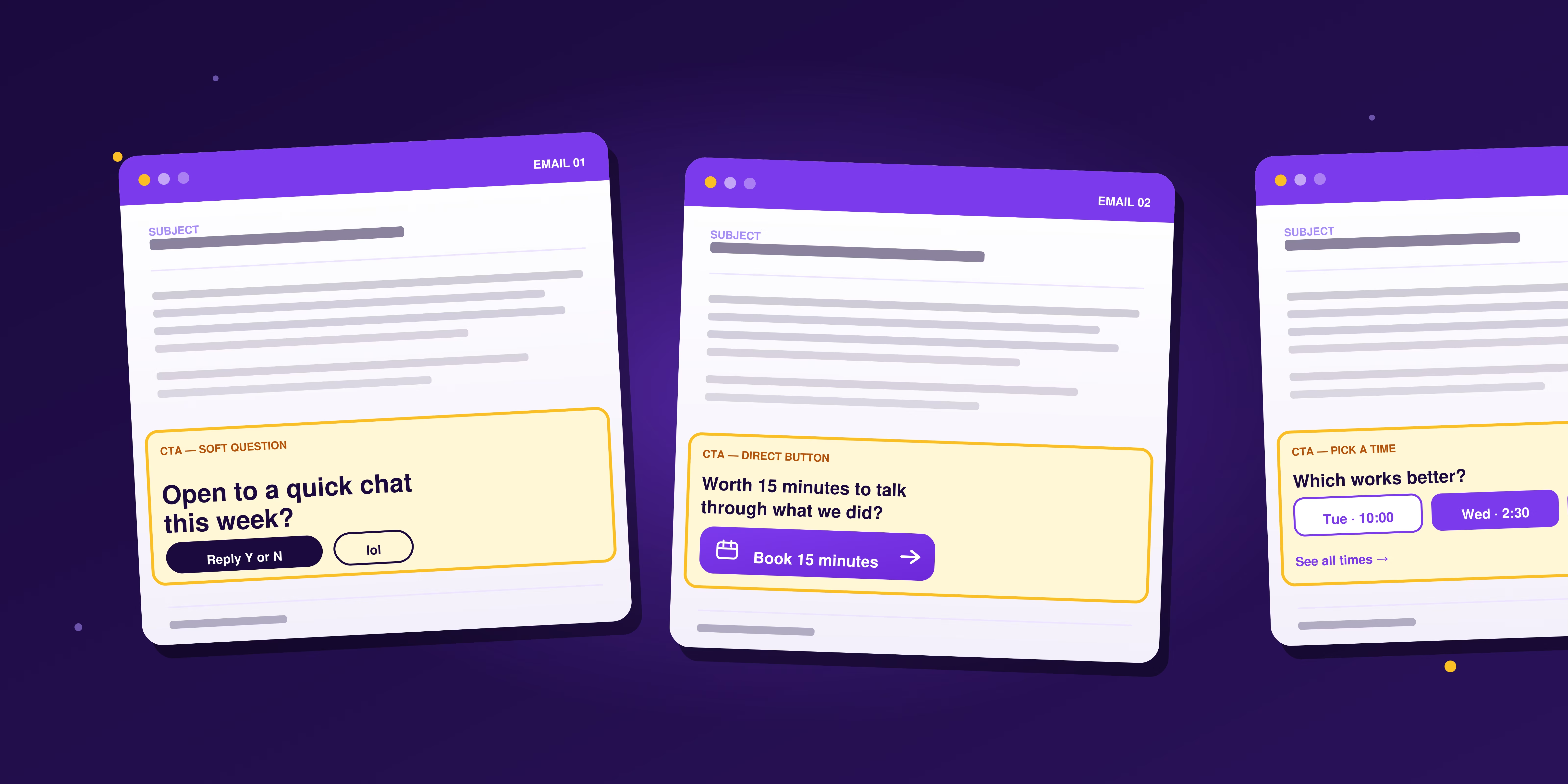
Three CTA types do three different jobs: low-friction questions open the thread, value-first assets earn permission, direct asks book the meeting. Using the wrong type at the wrong stage tanks reply rate.
Stacked CTAs ("chat, info, or grab time") kill momentum. Pick one main action. If you want booking available, leave the calendar link in your signature.
A 30-minute calendar request is the heaviest ask in outbound. Use a question or a useful asset on Day 1. Earn the meeting by Day 5 to 8.
"Let me know your thoughts" reads polite, asks nothing. "Worth sending the short breakdown?" reads direct, gets a yes/no. Specific defined CTAs lift reply rate by up to 50%.
200 to 300 sends per variant. Hold body and subject constant. Reachly uses 8% positive reply rate as the floor when judging which CTA wins.
Most cold emails die at the last line.
The opener can be sharp, the targeting can be right, the offer can be relevant, and then the CTA asks a stranger for 30 minutes on a calendar before the prospect has decided you matter. The reply never comes. The problem is not the offer. The problem is that the ask is too heavy for where the conversation actually is.
After 400+ outbound campaigns we have learned the same thing every quarter. The best cold email CTAs are not the polite ones or the clever ones. They are the ones that match the prospect's willingness to act right now. Some CTAs are built to open a thread. Some are built to earn permission to send something useful. Some are built to book the meeting once interest is real. Treating those as the same job is why most outbound CTAs underperform.
This guide is the CTA system we use for clients at Reachly. The three types, the patterns inside each one, the mistakes that get you ignored, and the way we test CTAs against reply rate inside live sequences.
Why your CTA is the reason replies dry up
A bad CTA forces the reader to think.
In a crowded inbox, prospects do not weigh options like a procurement committee. They scan, decide if the message feels relevant, and then either reply, ignore, or archive. A CTA that asks too much, gives too many options, or stays vague creates cognitive load right at the moment you need the easiest path to a reply.
A default meeting ask usually fails for three practical reasons:
- It asks for commitment before interest is clear. Busy buyers protect calendar time harder than almost anything else in outbound.
- It makes the next step fuzzy. "Quick chat" sounds harmless, but it does not explain what the buyer gets from replying.
- It signals sales-process risk. A call can feel like the start of demos, follow-ups, and internal pressure the prospect did not sign up for.
A practitioner roundup of cold email CTA tests is worth reading on this. Prospeo's analysis of 15 cold email CTAs cites a test across 8,000 agency cold emails where "Can I show you a demo video?" produced 50% of positive replies, well above heavier asks like sending sample data or pushing the prospect to a website. The same roundup references a Mailshake example where moving the close from "What does your calendar look like for a short call?" to "Are you open to talking numbers?" lifted reply rate from 9.8% to 18%.
The pattern matters more than the exact wording. Lighter asks win earlier in the conversation because they require less time, less trust, and less context switching from the reader.
A well-written CTA is consequential. MarketingProfs on using CTAs in B2B cold emailing reports that a strong CTA can lift click-through rate by 30 to 35%, and HumanLinker's guide to cold email calls to action says clear, specific CTAs can improve response rates by up to 50%. That tracks with what we see across client campaigns. Clarity gets action.
If you want the broader system behind the rest of the email, our cold email best practices for higher reply rates in 2026 post is the companion read.
The three CTA types you actually need
One CTA for every email is a lazy habit. CTAs change because the prospect's relationship to you changes.
The right CTA depends on two inputs. The sales goal and the friction the prospect can absorb right now. Get those two right and the rest of the CTA work is wording.
Low-friction CTAs to open a conversation
When the prospect does not know you yet, your first job is not booking the meeting. It is getting any response that opens the thread.
Question-based CTAs work well here because they sound like the start of a conversation rather than the end of a pitch. HumanLinker recommends question-based prompts like "Is this something your team is currently exploring?" and reports that clear, specific CTAs can lift response rates by up to 50%.
Five low-friction CTAs that work on first touch:
- "Is this something your team is exploring this quarter?" Good for broad problem awareness. Easy to answer without commitment.
- "Worth sending the short outline?" Use when your offer needs a little context. You are asking permission, not pushing a meeting.
- "Open to seeing how other teams handle this?" Works when the prospect knows the problem but has not prioritised fixing it yet.
- "Is this a priority for the team in Q3?" Better for managers and leaders who think in planning cycles. Yields a yes, no, or not now.
- "Would it make sense to share a short example?" Strong when your value is easier to understand through proof than through prose.
Where teams get this wrong is confusing "low-friction" with "weak." A CTA can be light without being lazy. "Thoughts?" is low friction but gives the reader no direction. "Let me know" is easy to type but gives no reason and no next step. Good low-friction CTAs are still specific. They just ask for a small action.
If your CTA can be answered while someone is walking between meetings, you are in good shape. If they have to open their calendar to respond, the CTA is too heavy for first touch.
The trade-off is real. You will get more replies, and not every reply will be sales-ready. That is fine. Early outreach should create signal first and qualify later. If you force qualification into the CTA, you lose conversations you could have developed.
For the pairing between subject line, body, and CTA, our cold email subject lines guide covers how the three pieces work as one unit.
Value-first CTAs that earn the next step
A meeting request is expensive when the prospect does not know you. A useful asset is cheaper. It gives them a reason to reply without forcing them to protect calendar time for something they still do not understand.
Four shapes of value-first CTA, in the order we usually try them.
The trade-off is simple. You lower reply friction, and you need an asset that actually offers something useful when the prospect opens it. Thin collateral gets ignored faster than a meeting ask. A generic brochure does not work. A homepage link does not work. "More information" does not work. A value-first CTA earns the next step when the promised asset delivers insight, proof, or clarity.
If your value-first move is wrapped around a real account signal (funding round, hiring spike, leadership change, traffic decline), the CTA gets even sharper. Our signal-based outbound playbook covers how the signal layer feeds the offer and the CTA at the same time.
Direct CTAs for when interest is already on the table
You do need to ask for the meeting eventually. Just not on the first email.
Once the prospect has replied, clicked, or engaged with a useful asset, the CTA can move from soft to direct. The job changes from earning attention to reducing the friction of saying yes.
The best direct CTAs do that by removing the work from the buyer's side. Offer specific times instead of forcing them to open a calendar, compare schedules, and propose options. Three patterns that work:
- "Would Tuesday at 2 or Thursday at 10 work for a quick intro?"
- "Happy to walk you through it. Wednesday morning or Friday afternoon easier?"
- "If this is relevant, does a short call this week make sense?"
These narrow the decision. The prospect is not building the next step from scratch, they are choosing between two defined options. A calendar link has its place, but in cold outreach a calendar link as the main CTA usually shifts the effort onto the prospect too soon. Mixmax's analysis of cold email CTAs recommends keeping the booking link in the signature as a low-friction path, not as the primary ask.
Use a direct CTA when one of these is true:
- They replied with interest. You have permission to move forward.
- They asked a buying question (pricing, timing, implementation, fit). The conversation is already happening.
- They engaged across touches. Maybe they ignored email one, then replied to a follow-up or engaged on LinkedIn.
A direct CTA should still feel easy. Keep the meeting short. Give a reason for the conversation. Avoid bloated phrasing like "jump on a quick call to learn more about our platform." Nobody wants that meeting. For the broader follow-up framework, our automated email follow-ups post covers the pacing that earns the right to ask directly.
5 CTA mistakes that get you ignored
Most bad CTAs fail in familiar ways. They are vague, self-serving, overloaded, or too heavy for the stage of the conversation. The worst part is they sound normal, which is why teams keep sending them.
The pattern across all five: each rewrite is shorter, makes the next step concrete, and asks for less from the buyer at this stage of the relationship. The fastest CTA audit is to ask three questions of the line you have written. Is it easy to answer in under 10 seconds? Is it useful to the buyer, not just to you? Is it appropriate for how cold the relationship still is?
If the answer to any of those is no, the CTA is the wrong shape for the email.
The signature also affects how the CTA reads. A heavy footer with three links and a calendar widget makes a soft CTA feel pushy by association. Our cold email signature examples guide covers how to keep the signature aligned with the ask.
How Reachly tests CTAs across client campaigns
We do not treat the CTA as a closing line. We treat it as a reply-rate variable that gets tested inside live sequences the same way subject lines and offers get tested.
The variables we test most often:
- CTA type by sequence stage. Low-friction on Day 1, value-first on Day 3 or 5, direct on Day 8 or later.
- Question shape. Yes/no questions versus open-ended prompts. Yes/no almost always wins on first touch.
- Asset specificity. "Send the case study" versus "Send the APAC SaaS case study with the 8% reply rate result." The specific version wins.
- Calendar phrasing. Two-time options versus an open ask versus a signature link. Late-sequence prospects respond to options. Early-sequence prospects do not.
A concrete example from a recent client. Primal's campaign, the one that hit 4.57x ROI and signed 6 deals in 6 months, used three different CTA shapes across the sequence. Day 1 ran a question-based CTA ("Is this a priority this quarter?"). Day 3 switched to a value-first CTA ("Want the workflow we built for a similar APAC SaaS team?"). Day 8 was a direct ask with two time options. Eight percent positive reply rate in month 1. The Great Room campaign, which closed a $250K contract, used the same three-stage pattern with the value-first move pointed at a specific case study.
The pattern is not the magic. The discipline of matching the CTA to the stage is the magic. Same offer, same body, the wrong CTA at the wrong stage will tank the campaign.
FAQ
Recommended service
Cold Email Agency
Reachly runs cold email end to end: dedicated infrastructure, signal-led copy, and replies handled until a meeting is booked.