
Most cold email vs cold call articles are useless because they pretend you're choosing a winner.
You're not. You're choosing which channel should lead, which one should support, and when each earns its place. That's a very different decision.
Email is easier to send to a big market. Calls create live conversations faster when the account is worth the effort. Everyone already knows that. The problem is that advice doesn't tell a founder with a narrow enterprise list, or an SDR manager with a broad mid-market TAM, what to do on Monday morning.
The core question is simpler. For this prospect, in this market, at this stage, should outreach start with email, start with a call, or run both in sequence?
Stop Asking Which Channel Is Better
"Cold email vs cold call" is the wrong debate.
A founder does not need a winner. A founder needs a decision rule. Which channel should lead for this ICP, this deal size, and this buying stage. Which channel should support it. Broad prospecting is mostly a sorting exercise, and the right sequence changes the economics of that sorting.
That is why scorecards keep leading teams into bad outbound.
Why the scorecard approach fails
A pros-and-cons list sounds useful until you put reps and pipeline targets behind it.
Take two common motions. A company selling a low five-figure product into a broad mid-market list usually needs coverage first. Email leads because it can test message, segment, and pain point across a large market at low cost. A company selling six-figure deals into 40 named accounts has a different problem. It needs contact, context, and fast qualification. In that case, a call often deserves the first shot, with email there to reinforce and document the outreach.
Same channels. Different job.
| Situation | Lead with | Support with | Why |
|---|---|---|---|
| Large market, broad targeting | Cold email | LinkedIn and selective calls | You need reach first |
| Small named account list | Cold call | Follow-up email | You need live feedback |
| High-value executives | Cold call or same-day call plus email | Direct contact can cut through | |
| Early awareness in a cold market | Cold email | Retargeted call attempts later | Buyers need context first |
| Trigger-based outreach | Cold call | Fast recap email | Timing matters more than volume |
The mistake is treating email and calls like competing tactics. They are sequencing tools. One gets you efficient coverage. The other gets you direct signal. The order should depend on what is expensive to waste in your motion. Rep time, market coverage, or timing.
The better way to think about it
Use three filters.
- ICP size: Big lists usually push you toward email-first because very few teams can call every account without wasting hours. If you need benchmarks to sanity-check that approach, these cold email reply rate benchmarks help set realistic expectations.
- Deal size: Higher-value deals justify more manual effort because one good conversation can pay for a lot of dials.
- Buying stage: If the buyer is already showing intent, direct conversation usually beats waiting for an inbox reply.
Practical rule: Ask which channel is most likely to produce the first useful signal from this account.
That one shift clears up a lot.
It stops teams from burying enterprise prospects in generic email sequences when a sharp call and a tight follow-up note would have done more. It also stops SDR teams from spending prime calling hours on low-probability accounts that should have been filtered through email first.
The channel is not the strategy. The sequence is.
The Performance Scorecard by the Numbers
Scorecards get abused in this debate.
A founder sees one stat saying email gets more replies, another saying calls book more meetings, and the takeaway becomes "pick the winner." That misses the decision. Baseline channel performance matters, but only if you use it to judge cost, speed, and signal quality.
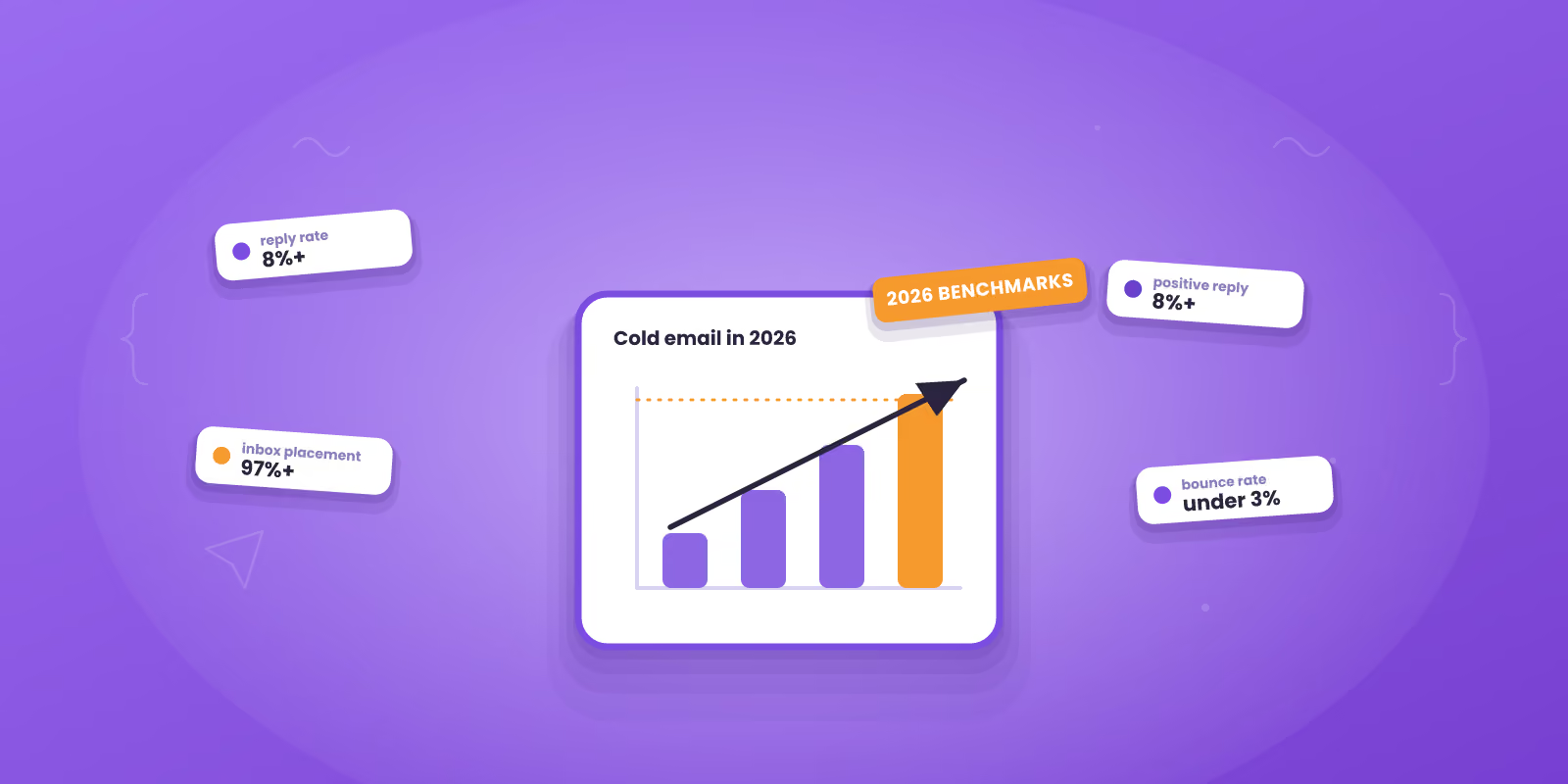
Cold email still wins on scalable coverage. In Oneflow's benchmark comparison, reported cold email open rates are 8% to 9%, response rates are 15% to 25%, and conversion rates are 1% to 5%. The same comparison also cites stricter benchmarks, including Martal's view that about 95% of cold emails fail to generate replies and Sopro's 5.1% average response rate. The spread matters. Email results swing hard based on list quality, offer clarity, domain health, and whether the message matches buyer pain.
Performance Scorecard: Cold Email vs. Cold Call
Side-by-side baseline
| Metric | Cold email | Cold call |
|---|---|---|
| Reach | High volume, low marginal cost | Rep-limited |
| Typical success picture | Wide benchmark range. Strong for finding pockets of interest fast | Lower volume. Strong for getting immediate qualification signal |
| Main strength | Fast market coverage and message testing | Real-time objection handling |
| Main weakness | Easy to ignore | Expensive in rep time |
That table is the useful part.
Email gives you cheap at-bats. Calls give you sharper feedback. If an SDR can send 150 well-targeted emails in the time it takes to make a focused block of dials, the question is not which channel "works better" in the abstract. The question is which one gets you a useful next step at an acceptable cost.
For teams building email-first motions, this cold email guide covers the mechanics well, and these cold email reply rate benchmarks are useful for setting expectations before you call a campaign good or bad.
The practical read on the numbers is simple. Email is usually better for testing and coverage. Calls are usually better for pressure-testing interest once an account is worth human time.
Benchmarks are guardrails. They help you price the effort. They do not choose the sequence for you.
When to Lead with Cold Email
Lead with email when the math says calling first would be wasteful.
That usually means a broad ICP, a big target account pool, or an offer where you need to test positioning before sending reps into live conversations. Email handles that job better because the channel is built for reach, iteration, and low-cost learning.
Use email first when coverage matters
In the cold email vs cold call decision, email should lead when your market is too large for manual first touches.
Saleshive frames the split clearly in its cold email and cold calling comparison. Cold email reply rates typically land around 3.43% to 8.5% overall, while email usually wins on top-of-funnel volume and the phone works better later when a prospect is engaged. If you want the calls handled for you, compare these B2B cold calling services.
That matters because broad prospecting is mostly a sorting exercise. You're trying to find who cares, who doesn't, and which message earns attention. Email is the cleaner tool for that.
The practical checklist
Lead with email if most of these are true:
- Your TAM is large. You need to contact a lot of accounts before you know where the interest is.
- Your deal size doesn't support heavy dialing. Rep time is expensive. Save it for accounts that show signal.
- Your market doesn't know you yet. Email gives buyers context before anyone calls them.
- You need message testing. Subject lines, offers, and positioning are easier to test in email than on live calls.
- The ask is small. If you're trying to start a conversation, not force a meeting, email is often the less abrasive first move.
Email-first also works well when you're using a modern stack to enrich and personalize at the list-building stage. Clay for research, Smartlead for mailbox rotation and sending, and a clean CRM handoff can keep the motion disciplined. If you're looking for a grounded refresher on writing emails that don't sound like templates, this cold email guide is useful.
Buyers don't owe you a call back. Email gives them room to evaluate without pressure.
What doesn't work is using email-first as an excuse for lazy outreach. Huge lists, vague copy, and no account filtering will get ignored. Email earns its keep when you use it to identify signal, not when you dump everyone into the same sequence.
When to Lead with a Cold Call
Cold calling should not be treated as the tougher version of email. It is the faster decision tool when the account is valuable, the timing is real, and the buyer can act.
That is the filter. Not "phone versus email." Which channel should lead, based on account value and buying stage?
Call first when you have a short list of accounts and a credible reason to interrupt them now. If you're working 40 named accounts with six-figure potential, waiting a week for inbox engagement is usually the expensive choice. A live conversation can confirm fit, surface the actual stakeholder, and tell you within minutes whether the timing is real.
Call-first fits a different kind of outbound motion
This approach works best in targeted outbound, where rep time is justified by account value.
Lead with a cold call when these conditions are true:
- The account list is small and important. A rep can afford to research 20 accounts well. They cannot afford to treat those 20 like a bulk send.
- You have a trigger. New funding, leadership changes, expansion, active hiring, or a visible initiative gives the call a reason to happen today.
- The deal needs discovery. If the offer only makes sense after two or three questions, a call gets there faster than a long email thread.
- The buyer is senior. Executive buyers often respond to relevance and brevity. If the reason is strong, direct outreach can work better than a nurture sequence.
- There is a narrow window. If the problem is tied to quarter-end pressure, a launch, or a system change, speed matters more than coverage.
The mistake is assuming "call-first" means "call blindly." It means the opposite. The bar is higher.
A good cold call opens with context, not a pitch. "Saw you're hiring three AEs in EMEA" is a reason. "Wanted to introduce our company" is not. Reps who make that distinction get more honest answers, even when the answer is no.
Research matters here because relevance is doing the heavy lifting. Tools like Clay can help reps pull job posts, headcount changes, and recent company activity before they dial. That prep is what turns a cold interruption into a business conversation.
If you're deciding whether the account is cold or already warm enough to justify a different approach, this breakdown of cold calling vs warm calling is a useful gut check.
If you can explain why this prospect should talk now, a cold call earns its place.
What usually fails is not the phone. It is poor call selection. Teams dial low-value accounts with no trigger, no context, and no point of view, then conclude cold calling does not work. For high-value accounts in an active buying window, call-first is often the right move. Email still supports it. It just should not lead.
The Multichannel Playbook That Actually Works
The wrong question is "email or call?"
The useful question is which channel should lead for this account, at this deal size, at this buying stage, and which channel should support it. That is the difference between a sequence that creates conversations and one that just creates activity.
Multichannel Playbook
Initial Email Outreach
Send a personalized introduction email.
Follow-up Call (No Reply)
Attempt a call if no email response after 2 days.
Value-add Email (Post-Call/VM)
Send a helpful resource or recap after a call or voicemail.
Second Call Attempt
Make a second call attempt a few days later.
Break-up Email / Final Offer
Send a final, value-driven email before archiving.
A good multichannel playbook does two jobs. It matches the first touch to how the buyer is likely to engage, then uses the second channel to either confirm interest or recover attention. Email-first and call-first can both work. The mistake is running the same cadence across every segment.
Reachly's outbound sales strategy guide lays out a sample 14-day version across email, LinkedIn and a phone call.
Sequence one for broad prospecting
Use this for larger TAMs, lighter personalization, and accounts that still fit your ICP but do not justify heavy research up front.
- Send a short intro email. One problem, one reason for reaching out, one CTA.
- Call the non-responders. The goal is not to force a meeting. It is to test whether the problem is live and whether you have the right person.
- Send a follow-up email after the call attempt. Reference the call, add one useful detail, and make the reply easy.
- Call again at a different time. Timing changes connect rates more than reps like to admit.
- Close with a final email. Keep it clean and easy to answer.
This works because email filters for basic fit, and the phone adds pressure in a good way. A prospect can ignore two emails. Ignoring an email, a voicemail, and a follow-up tied to the same issue is harder.
Sequence two for high-value named accounts
Use this when the account value is high enough to justify research and you have a real reason to believe timing matters now.
- Start with a call. Lead with the trigger, not your company.
- Send an email right after. Recap the reason for reaching out and give the buyer something concrete to react to.
- Use LinkedIn to support recognition. Views, profile touches, and relevant comments help the next call feel less random.
- Call again after the email lands. By then, the buyer has context and can place your name.
This sequence gets stronger when reps choose accounts well. If there is no trigger, no urgency, and no clear business case, call-first usually just means interrupting people with weak timing.
Sequence three for top-tier accounts
For a small list of high-value targets, run outreach like an account team, not a sequence tool.
One owner should control the account plan. Messaging should stay consistent across phone, email, and LinkedIn. Each touch needs a job. The email introduces the business case. The call tests urgency and access. LinkedIn supports familiarity and credibility. If those channels feel disconnected, the buyer experiences them as noise.
Operations matter here because coordination breaks before copy does. Research, list building, mailbox rotation, LinkedIn steps, and call tasks need to reflect the same account status. Teams using lead scoring models usually handle this better because they know which accounts deserve heavier sequencing and which ones should stay in a lighter flow. Clay can support account research, Smartlead can manage mailboxes, HeyReach can handle LinkedIn workflows, and a dialer can track phone activity. Reachly runs this kind of coordinated outbound system across email, LinkedIn, and phone for teams that do not want to manage the tooling in-house.
A simple rule helps. Let the first channel earn the second. If email gets no signal, use the call to test fit. If the call creates interest, use email to document value and keep momentum. The channel choice matters less than the handoff.
How to Measure Your Outbound Performance
Most outbound reporting is too shallow.
Teams stare at opens, total replies, and dial counts because those numbers are easy to pull. None of that tells you much about whether your outbound is creating revenue. You need metrics that reflect fit, intent, and movement.
What to track for email
Open rate has become a noisy signal. Use it carefully.
What matters more is whether the replies are useful. Separate positive replies from neutral replies, objections, and removals. If an email gets attention but no real interest, the copy may be curiosity-driven instead of problem-driven.
Track these first:
- Positive reply rate. Replies that show actual interest.
- Meeting booked rate from replies. This shows whether the CTA and handoff work.
- Qualified account rate. Are the replies coming from the right companies and people?
What to track for calls
Dials are an activity metric, not an outcome.
The numbers that matter are whether reps connect, whether they create real conversations, and whether those conversations turn into meetings. If connects are weak, fix data quality and call timing. If conversations happen but meetings don't, the opener or offer probably needs work.
Use a simple progression:
- Connect rate
- Conversation rate
- Meetings booked from conversations
- Qualified opportunities from meetings
Track the step where momentum dies. That's usually where the real problem is.
Build one dashboard, not five
Put email, call, and pipeline data in one place so you can compare channel contribution by segment. Break performance out by ICP, offer, region, and sequence type. That's how you learn whether a call-first motion works better for enterprise APAC accounts while email-first works better for broad mid-market campaigns.
If you're trying to tighten how your team judges lead quality after those first touches, this piece on lead scoring models is a useful companion.
The mistake is treating all replies and all meetings as equal. They aren't. Track what turns into qualified pipeline.
Templates and Scripts You Can Use Today
Templates should give you structure, not excuses.
If a template sounds polished but says nothing specific, it will get ignored. Keep the message short, tie it to a real problem, and make the next step easy.
Cold email template
Use this for an email-first motion:
Subject: quick question about [company]
Hi [first name],
Reaching out because [relevant observation about team, market, or workflow].
We help [ICP] deal with [specific problem].
Worth a quick conversation to see if this is relevant at [company]?
[your name]
Why it works: it gets to the point fast, avoids the fake familiarity most cold emails use, and doesn't stuff the first message with product detail. If you want more starting points, this library of cold email templates is useful for testing different angles.
Cold call opener
Don't start with “Did I catch you at a bad time?”
That hands control away before you've earned attention.
Try this instead:
Hi [first name], it's [your name]. I'm calling because I noticed [specific trigger or relevant context].
We work with [type of company] on [specific problem].
Not sure if it's relevant, but I wanted to ask how you're handling that today.
That opener works because it sounds like a reasoned call, not a script read to everyone on a list.
A few rules before you use either
- Cut the pitch early. The first job is to start a conversation, not explain your whole company.
- Use one idea per touch. Multiple offers in one message create friction.
- Write like a person. If the email sounds like marketing wrote it for sales, rewrite it.
- Keep improving. Resources on improving sales outreach can help sharpen messaging once you've got the basics down.
The best script is still the one tied to a real reason for contact.
Recommended service
Cold Email Agency
Reachly runs cold email end to end: dedicated infrastructure, signal-led copy, and replies handled until a meeting is booked.