

 Key Findings
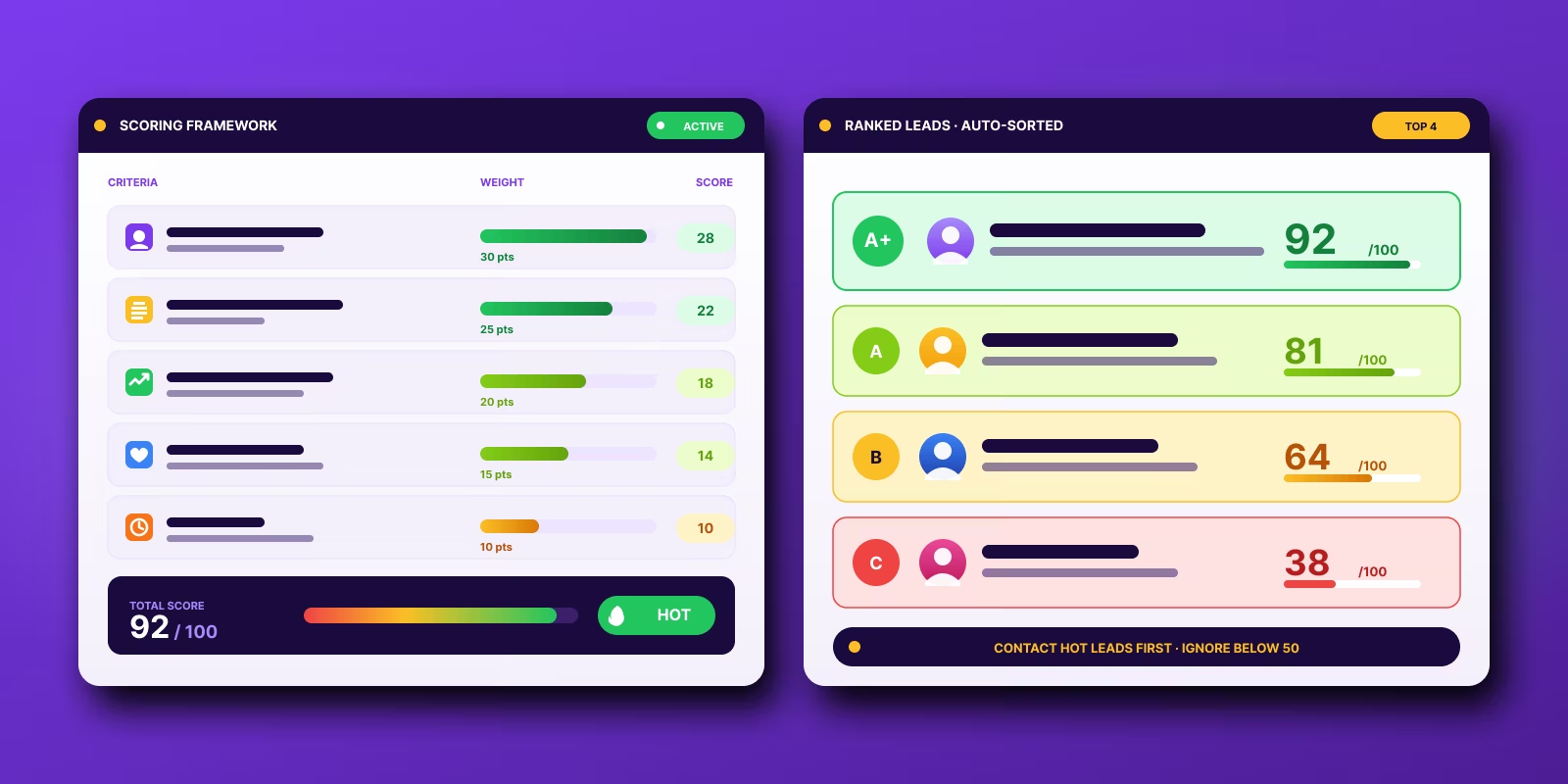
A lead scoring framework is a revenue tool, not a marketing report. If it cannot tell an SDR who to call first this morning, it is a spreadsheet hobby. Score buying likelihood, not visible activity.
Use a 2x2 grid. Fit decides whether an account belongs in your queue at all. Intent decides whether it belongs there today. One summed score hides why a lead ranked high and over-ranks the busy but irrelevant.
Firmographics, buyer profile, technographics, and account priority. Pick the few attributes that show up in closed-won deals, weight them clearly, and stress-test against accounts your team already knows.
Funding rounds, leadership hires, new teams, tech adoption, and repeat pricing-page visits beat generic opens and follows. Use negative signals like hiring freezes, contraction, and leadership churn to cut rank fast.
Build weights from historical conversions, not a workshop guess. Add score decay so old curiosity stops looking hot. If reps keep ignoring high scores, trust their behavior and fix the model.
Most advice on lead scoring framework B2B gets the job wrong.
It treats scoring like a marketing reporting project. Add points for a webinar. Add more for an ebook. Add a few for email clicks. Then hand sales a neat list of “hot” leads who were active but never had the budget, the timing, or the profile to buy.
That model looks organized. It also wastes rep time.
A scoring framework should answer one brutal question: who deserves sales attention right now. If it can't help an SDR manager decide who gets called first this morning, it isn't a revenue tool. It's a spreadsheet hobby.
For outbound teams, this matters even more. You aren't waiting for hand-raisers. You're working a market, ranking accounts inside your TAM, watching for signals, and deciding where to spend finite outreach volume across email, LinkedIn, and calls. That requires a different mindset. Less “who consumed content” and more “who fits, who shows timing, and who should be ignored.”
Why Your Lead Scoring Is Probably Broken
Bad lead scoring usually fails for one reason. It rewards visible activity instead of buying likelihood.
That sounds harmless until reps spend half a day working people who opened emails, clicked links, and were never plausible buyers in the first place. Meanwhile, strong accounts sit untouched because they were quiet in your systems but obvious in the market. They raised a round, hired a VP, launched a new team, changed tech, or showed another trigger you can act on.
Busy isn't the same as qualified
A lot of B2B teams still run scoring like a marketing admin task. They dump every signal into one total, call anything above the threshold "hot," and hope sales can sort it out later.
That creates fake precision.
A bad-fit contact can pile up points from site visits and email activity, then outrank an ideal account that has the right size, the right problem, and a live reason to buy. In outbound, that mistake gets expensive fast. Rep capacity is fixed. Sequence volume is finite. Every low-quality contact worked today pushes a better account to tomorrow.
A score should direct effort toward likely pipeline, not reward random digital body language.
Another common failure is how the model gets built. Revenue teams pick criteria in a workshop, assign numbers that feel reasonable, then never check whether those weights match closed-won deals. The result looks organized inside the CRM and falls apart in the pipeline review.
The primary job of scoring
The primary job of scoring is simple. Help the team decide who deserves attention now, who belongs in monitoring, and who should stay out of active outbound.
For inbound-heavy programs, a blended score can be good enough for routing. For outbound, it usually is not. Outbound teams need a scoring model that ranks the TAM, not just form fills. That means combining firmographic fit with timing signals from outside the CRM, including hiring changes, funding events, tech adoption, expansion moves, job posts, and other trigger data surfaced through tools like Clay. A signal-based outbound playbook for prioritizing accounts is far closer to how strong outbound teams work than the usual "add 10 points for a download" setup. Our guide to B2B prospecting methods shows where that ranking feeds into list building and outreach.
If your current model cannot answer three operating questions quickly, it is broken. Who should reps contact first. What changed that makes the account worth attention now. What message should the rep use based on that context.
Those are revenue questions. Your scoring framework should answer them clearly.
The Two-Axis Framework That Actually Works
The only sane structure is fit on one axis and intent on the other.
Not one blended score. Two separate judgments.
Fit score
Is this the right company?
Ideal customer profile alignment. Firmographic, technographic, and demographic fit factors.
Engagement score
Is this the right time?
Behavioral interest and intent. Website visits, content interactions, email engagement, and other signals.
Why one score hides the truth
A technically sound B2B framework should separate fit from intent. Marketo-style setups use parallel tracks for demographic fit and behavioral engagement, then combine them into a two-dimensional grade because a single summed score can over-rank “busy but irrelevant” leads, as explained in this guide on two-track lead scoring.
That's the core problem with most models. They hide why a lead scored well.
Imagine a dating app. One question is “is this person a match for me?” The other is “are they interested right now?” You need both. A perfect match with no interest goes nowhere. High interest from the wrong person also goes nowhere.
The simple matrix
Use a 2x2 grid.
| Fit | Intent | What to do |
|---|---|---|
| High | High | Prioritize now |
| High | Low | Keep warm and watch for triggers |
| Low | High | Sanity check, then usually deprioritize |
| Low | Low | Ignore |
A lead scoring framework B2B proves useful for outbound. You can rank the whole TAM without pretending every signal means the same thing.
A few practical examples:
- High fit, high intent. Your SDR should work this first. Personalized email, LinkedIn touch, and a call task.
- High fit, low intent. Don't force the meeting. Watch for fresh signals, leadership moves, hiring shifts, or repeat engagement.
- Low fit, high intent. Teams often get fooled in this scenario. Activity looks exciting, but the account often won't close.
- Low fit, low intent. Remove it from active focus.
If you're building outbound around trigger-led account selection, Reachly's signal-based outbound playbook is the kind of workflow thinking that matters here. The point isn't scoring for its own sake. The point is deciding who enters active sequence coverage and who stays out.
Practical rule: Fit decides whether an account belongs in your queue. Intent decides whether it belongs there today.
Defining Your Fit Score to Find Ideal Customers
Fit answers the part many teams avoid.
If this account replied today, should sales spend time on it at all?
If the answer is shaky, stop scoring around the problem. A lead scoring framework B2B teams can trust starts by excluding bad-fit accounts before activity inflates their score.
Start with the variables that change win rate
B2B revenue teams often overbuild fit scoring. They dump every available field into the model, assign tiny weights, and call it complex. What they get is a score that looks precise and predicts very little.
Keep it tighter.
The attributes that usually matter are the ones that show up repeatedly in closed won accounts and healthy expansions. Company size. Industry. Geography, if your delivery model depends on it. Role and seniority. Existing stack. Named-account status if you already know which parts of the TAM deserve coverage.
A practical fit model usually pulls from four buckets:
- Firmographics. Industry, employee count, revenue band, region.
- Buyer profile. Title, function, seniority, likely buying influence.
- Technographics. Current tools, adjacent platforms, obvious disqualifiers.
- Account priority. Named accounts, strategic segments, expansion targets.
For outbound, this matters more than it does in a pure inbound workflow. You are not waiting for forms to tell you who raised a hand. You are sorting a broad market into accounts worth sequencing, accounts worth monitoring, and accounts that should never hit an SDR queue in the first place.
Make the trade-offs explicit
Every fit variable has edge cases. Mid-market headcount might be a strong positive if your product needs a mature team to adopt it. The same variable can hurt you if smaller companies close faster and churn less. Senior manager titles can be perfect in one sales motion and useless in another if budget always sits with a VP.
That is why I prefer a short model with hard choices over a long model with polite compromises.
Pick three to five attributes that separate good customers from expensive distractions. Weight them clearly. Then stress-test the model against real accounts your team knows well. If top customers score in the middle and noisy accounts score near the top, the model is wrong. Fix the assumptions before you add more fields.
Clay helps here because it lets teams enrich accounts and contacts at scale, instead of asking reps to research every company by hand. You can append headcount, industry, hiring patterns, role context, and tech stack data across your TAM, then sort accounts before outreach starts. If you want a clearer picture of how outbound teams use external signals alongside fit, this guide to B2B intent data for outbound prospecting complements the scoring work well.
The same principle applies to account research more broadly. This piece on understanding B2B buyers with data gets the core idea right. Fit scoring should reflect buyer reality, not internal guesswork.
Use thresholds as workflow rules, not truth
CRM automation still needs a cutoff. That is fine. Set one.
Just do not confuse an operational threshold with an accurate model. A score threshold should tell your team when an account enters active coverage, gets routed to a rep, or stays in monitored territory. It should not hide the fact that some variables matter far more than others.
As noted earlier, many teams use a score cutoff to trigger handoff. The exact number matters less than the logic underneath it. If weak-fit accounts can cross the line because they accumulated surface-level activity, the model will create meetings that never become pipeline.
Tracking Intent Signals That Predict Revenue
Intent is about timing.
Not interest in general. Not content consumption. Timing.
Most models fall apart precisely because they give nearly every activity a reward. The result is predictable. SDRs waste hours on people who were curious, researching, or killing time between meetings.
Strong signals versus weak ones
Some actions deserve attention. Others barely deserve storage.
Strong signals tend to look like this:
- Pricing-page visits with repeat behavior
- Demo requests
- Direct replies to outreach
- Deep content consumption tied to evaluation, not top-of-funnel browsing
- Return site visits after prior engagement
- Webinar attendance when the topic is product or use-case specific
Weak signals tend to be noisier:
- Single blog visits
- Generic email opens
- Social follows
- One-off content downloads with no follow-up behavior
Modern guidance on lead scoring reflects this shift away from old demographic-only models and toward a mix of fit plus buying signals like pricing-page visits, repeat website activity, replies, webinar attendance, and trigger events such as funding rounds, leadership changes, new hires, office expansions, and technology purchases, as outlined in ZoomInfo's overview of modern lead scoring.
Intent in outbound needs external triggers
Inbound platforms mostly watch owned-channel behavior. Outbound teams need a wider lens.
That means looking outside your website and CRM. Did the company hire a new VP? Did they start a new team? Did they adopt a tool that creates a wedge for your offer? Did headcount move in a direction that suggests active investment? Those are timing signals. Clay is strong here because you can pull trigger data into account lists and score the TAM before the buyer ever fills a form.
This is also why generic “engagement scores” often miss real pipeline. They only capture interaction with you. They don't capture what's happening inside the account.
If you want a better handle on signal quality, Reachly's perspective on B2B intent data is useful because it forces the right question: which signals indicate buying motion, not just content activity?
Negative signals matter more than teams admit
A lead can look hot and still be wrong.
A company showing behavioral activity may also be dealing with internal problems that make a sale unlikely right now. Traditional models often ignore that. One cited analysis states that 53% of “high-intent” leads in traditional scoring models were unviable because of hidden financial distress or organizational instability.
That should change how you score.
Use negative external signals to cut rank fast. Examples include hiring freezes, visible contraction, leadership churn that stalls projects, or signs the account is unstable enough that reps should stop treating clicks as a buying signal.
If an account is showing activity and distress at the same time, don't let the activity win by default.
How to Build and Calibrate Your Scoring Model
Most scoring models are built backward.
People start by asking how many points a webinar should get. Wrong first question. Start with outcomes. Which accounts became pipeline? Which ones closed? Which ones stalled after “good” engagement? Build from there.
Reachly's pipeline generation guide uses the same outcome-first logic: it starts from the revenue target and works back to meetings, emails and leads.
Build from won and lost data
The most effective B2B scoring models are calibrated from historical conversion data. Best-practice guidance recommends analyzing won and lost opportunities to find the attributes and behaviors that preceded conversion, then assigning heavier weights to a small set of critical criteria instead of spreading points across lots of weak signals, according to this guide on calibrating lead scoring with historical data.
That means you should review:
- Closed-won accounts and the traits they shared
- Closed-lost accounts that looked promising but never progressed
- Abandoned opportunities that showed activity without buying readiness
Pull those patterns into separate fit and intent lists. Then weight the few signals that show up repeatedly.
A workable build process
Here's the version that keeps teams out of the weeds:
- Define the outcome first. Usually that means accepted meeting, qualified opportunity, or closed-won. Pick one primary target.
- Choose a small signal set. A handful of fit variables. A handful of intent variables.
- Weight late-stage behaviors more heavily. Demo requests and pricing interest should outrank casual browsing.
- Create routing logic. High fit plus high intent gets a fast path to a rep or sequence.
- Review rejected leads. If sales keeps ignoring “high scores,” the model is lying.
If your CRM data is messy, fix that before pretending the model is smart. Enrichment quality matters. Missing titles, bad company names, duplicate accounts, and stale firmographics will poison the score before the SDR ever sees it. This is why clean B2B data enrichment matters operationally, not just administratively.
Score decay is not optional
A stale hot lead is one of the most damaging records in a CRM.
Multiple best-practice sources recommend score decay for inactivity so a lead reflects current readiness, not old curiosity. That's practical, not theoretical. If someone hit your pricing page weeks ago and then disappeared, sales should not keep treating them like an active buyer.
A simple rule works. Give more weight to recent signals and let older activity lose value over time. That keeps queue priority fresh and stops old engagement from clogging outreach.
Field test: If reps complain that your “hot” leads never reply, decay is probably missing or too weak.
Common Mistakes That Make Lead Scoring Useless
You don't need a bad model to ruin lead scoring.
A few bad operating habits will do it faster.
The mistakes that kill trust
| Mistake | Why it breaks the model | Fix |
|---|---|---|
| Static thresholds | The market changes while your cutoff stays frozen | Review thresholds against current pipeline behavior |
| Too many attributes | Weak signals drown strong ones | Cut back to a small core set |
| No score decay | Old interest keeps looking fresh | De-rank inactivity automatically |
| No sales alignment | Reps ignore scores they did not help define | Build and review with sales input |
Static thresholds are a huge problem. Data from a 2024 Gartner study says 68% of revenue leaders report their static scoring models become obsolete within three months due to market shifts, while fewer than 15% of published frameworks explain how to adjust thresholds over time.
That's why “set it and forget it” fails. Your market moves. Your score should move with it.
Another common failure nobody talks about
Teams often score bad inbound spam as if it were buyer interest.
A junk form fill can trigger alerts, clutter reports, and even push a fake contact into the same workflow as a real prospect. If your inbound motion has that problem, this guide on why contact forms attract spam and how to fix it is useful because garbage inputs poison scoring before the model even starts working.
Keep the model legible
If only RevOps understands the scoring rules, adoption dies.
Sales managers need to know why an account ranked high. SDRs need to know what action follows each score band. Leadership needs to see whether the model is producing accepted meetings, not pretty dashboards. If the framework becomes too complicated to explain in a few minutes, simplify it.
One more truth. If your reps override the score constantly, trust their behavior before you trust the spreadsheet.
From Score to Conversation Your Action Plan
A score doesn't create pipeline.
A rep using the score to start the right conversation does.
Turn the score into a workflow
The handoff should be automatic. Once an account crosses your chosen fit and intent threshold, it should trigger a real action inside your outbound system.
For example:
- High fit, high intent goes into a personalized multichannel sequence in Smartlead, HeyReach, and your call task queue.
- High fit, medium intent gets lighter outbound with tighter monitoring for new triggers.
- High fit, low intent stays in watchlists, not aggressive sequencing.
- Low fit stays out unless a human makes a clear exception.
A lead scoring framework B2B becomes useful for outbound prospecting. You aren't just labeling leads. You're deciding sequence entry, personalization depth, and rep attention.
Match the outreach to the score
Not every lead should get the same playbook.
A top-ranked account deserves custom messaging based on the trigger that pushed it up the list. If the signal was a leadership hire, write to the change. If the signal was repeated pricing interest, speak to evaluation risk and decision speed. If the signal was just mild activity from a good-fit account, don't overinvest yet.
That same logic helps if you're weighing in-house versus external execution. If your team doesn't have the bandwidth to operationalize high-priority accounts consistently, it can help to study how outsourced inside sales solutions are structured so you can compare process quality, ownership, and speed.
The simplest action plan
Use this:
- Score the TAM weekly. Refresh fit data and trigger signals.
- Create action bands. Decide what outreach motion each band gets.
- Route automatically. Don't make reps hunt through CRM views.
- Check sales acceptance. If reps reject the leads, inspect the model.
- Update the rules. Keep what correlates with meetings and remove what doesn't.
That's the whole point. Scoring should reduce decision friction so your team spends more time in real conversations with accounts that can buy.
Recommended service
Outbound Lead Generation Services
Reachly builds and runs the whole outbound motion across email, LinkedIn, and phone, and books qualified meetings on your calendar.