
 Key Findings
A valid number changes how you route the lead. Mobile lines fit SMS-plus-call. Landlines need a different talk track. VoIP changes the confidence you place in the field.
Reps waste around 27% of their time chasing inaccurate information, including invalid phone numbers. Validation isn't optional at scale.
Format, country-aware, carrier and line type, real-time activity, compliance. Most B2B teams need Levels 2 and 3. Few should run Level 4 on every record.
Real-time checks improve confidence but add latency and cost. Use deeper validation on tightly selected accounts. Use lighter validation on broad outbound.
The cleanest setup runs validation at form capture, on list import, and again before high-priority call blocks. Use the validation result to route the lead, not just to flag it.
"Global coverage" is a marketing claim. Test two providers on a sample of your real outbound data before committing.
Half your cold calls don't fail because your reps are weak. They fail because your data is.
Phone number validation is the process of checking whether a number is correctly formatted, tied to a real telecom network, and reachable on the channel you want to run. For B2B sales teams that's not a database chore. It decides whether the next two hours of call blocks turn into pipeline or into wasted payroll.
Americans check their phones 262 times per day, roughly once every 5.5 minutes, which makes phone outreach high-leverage when you have the right number and useless when you don't (EDQ on phone validation and customer data accuracy). If your SDR team is pulling numbers from Apollo.io, enriching in Clay, sequencing in Smartlead, and handing call tasks into a dialer, one bad field upstream creates wasted steps everywhere downstream. The fix starts with cleaner inputs, tighter routing, and better B2B data enrichment workflows.
This guide covers what phone number validation actually is, what it costs you when you skip it, the five levels of depth, how to pick the right level for your motion, how to roll it out, and how to choose a validation vendor without overpaying.
What is phone number validation?
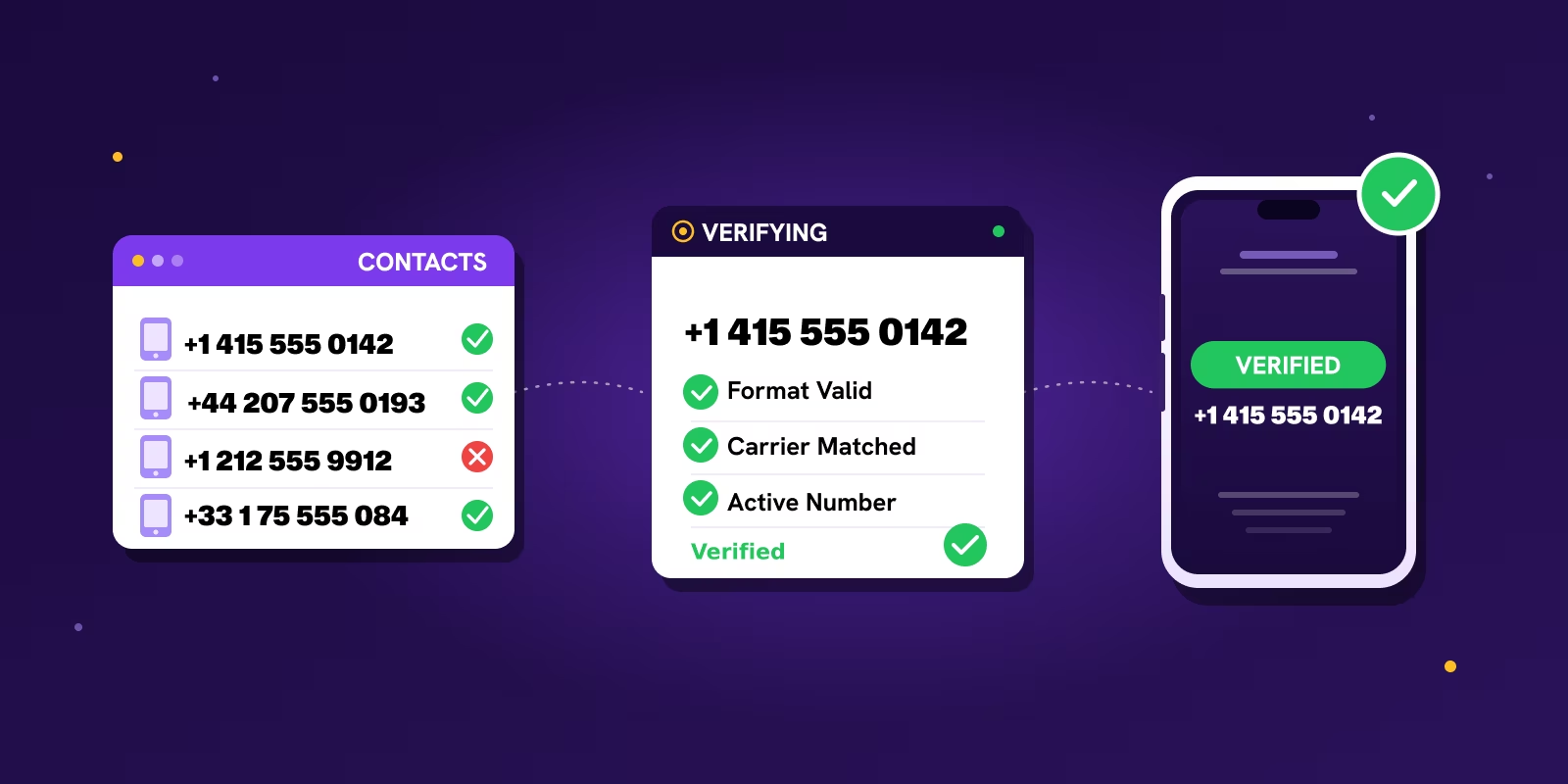
Phone number validation is the technical and operational process of confirming that a phone number is structurally correct, tied to an active telecom carrier, and usable for the channel you plan to use it on. A complete validation answers four questions: is the number formatted to a recognized standard, does it match the national numbering rules of the country it belongs to, what type of line is it (mobile, landline, VoIP), and is it currently reachable.
For sales teams the working definition is sharper. A valid number is one a rep can call or text and get to the right person. Anything short of that is noise in your CRM.
People often use phone number validation and phone number verification interchangeably. They overlap, but they're not identical. Validation tells you whether a number could work. Verification tells you a real human is at the other end of it, usually via an OTP confirmation. B2B sales uses validation. Account-creation flows and fraud-prevention systems use verification.
Why phone number validation matters for B2B sales
Bad phone data wastes payroll first. Then it wrecks momentum.
B2B contact data decays at roughly 70% annually, and sales reps waste around 27% of their time chasing leads with inaccurate information, including invalid phone numbers (SalesHive on phone number validation). If your team treats phone validation as optional, you're paying people to dial records that should have been filtered out before the campaign launched.
The hidden cost shows up in places most teams miss
The hidden costs of bad phone numbers in outbound sales
Bad phone numbers silently drain your budget, waste valuable time, and hurt your team's productivity and morale.
Failed calls don't just hurt call metrics. They eat into list confidence. Reps stop trusting the CRM. Managers stop trusting activity numbers. Forecasting gets noisy because task completion no longer means quality coverage.
There's also an execution problem. A list with weak phone data creates fake volume. It looks like your team has enough accounts to work, but a chunk of those tasks were dead from the start, which means your actual coverage is thinner than you think.
Here's where the damage usually concentrates:
- Rep output drops. Bad numbers turn call blocks into admin work. Reps disposition junk instead of having conversations.
- Connect rates get masked. The team blames the script when the list is the actual problem.
- Follow-up timing breaks. If the call step fails on bad data, your multichannel sequence loses rhythm.
- Appointment setting suffers. Call tasks stop being a reliable path to meetings, which puts pressure on email alone and weakens your broader B2B appointment setting process.
-
The trust problem hurts more than the dial problem
Once reps believe the phone field is unreliable, they start skipping it. That's how good channels die inside a sales org. Not because the channel stopped working, but because the data made the team stop using it properly.
Teams don't lose time one bad number at a time. They lose it one broken workflow at a time. For a simple example of why identity signals tied to phone numbers matter even outside sales, this online dating safety guide is a useful reminder that a phone number often acts as a trust checkpoint
The five levels of phone number validation
Not all phone number validation does the same job. Some checks are fast and cheap. Others are deeper, slower, and only worth running on leads valuable enough to justify the extra cost.
Level 1: format check
This is the minimum. You check whether the number is shaped like a phone number and can be normalized into a standard structure.
That structure should be E.164: a leading plus sign, a country code, and up to 15 digits total. Inconsistent formatting causes 20–30% of phone-data deliverability failures, which is why numbers like (415) 555-0123 and +14155550123 should never be treated as equivalent raw inputs in a sales system (Derrick on E.164 and validation).
If your lists come from multiple sources, Level 1 catches obvious junk early. It does not tell you whether the number is real.
Level 2: country-aware validation
Libraries like Google's open-source libphonenumber (and the popular libphonenumber-js port for browsers) do more than check shape. They parse the number against national numbering rules and tell you whether it is structurally valid for that specific market.
That matters when you're working across APAC, Europe, and North America in the same CRM. A number can look clean and still be invalid for the country it claims.
Common Level 2 use cases:
- Web form capture. Stop typo-heavy submissions before they enter the CRM.
- Apollo.io list imports. Standardize numbers before any rep sees them.
- Clay enrichment tables. Normalize inputs before waterfall enrichment and routing logic.
Level 3: carrier and line type lookup
This is the first level that changes channel decisions, not just list cleanliness. Carrier lookup tells you what kind of number you have — mobile, landline, or VoIP — and which carrier owns it.
Mobile lines fit SMS-plus-call sequencing. Switchboards and landlines need a different talk track. VoIP can mean a real direct dial or a forwarded line, which changes the confidence you place in the field. Vendors that do this well include Twilio Lookup, IPQualityScore, Veriphone, Numverify, ClearoutPhone, and Experian EDQ. We benchmark each of them by accuracy, latency, and cost in our phone validation API comparison.
If you don't know line type, you're guessing at channel fit.
Level 4: real-time activity or reachability checks
This layer asks a harder question: is the number currently active and reachable. It's more useful than Levels 1–3, and it's also where most teams overpay.
For high-value account lists, Level 4 saves reps from wasting time on lines that look fine but go nowhere. For bulk outbound, it adds latency, costs more per record, and can reject numbers that are still worth working because carrier data is stale.
Use real-time checks when the prospect is expensive to miss. Skip them when speed matters more than perfect certainty.
Level 5: compliance screening
A number can be real and still be risky to contact. Compliance checks look at jurisdiction, consent expectations, and whether the number appears on relevant do-not-call lists or similar suppression datasets. If you run outbound into multiple regions, this layer matters because legal exposure changes by market, not just by number quality.
What each level actually changes
| Validation level | What it tells you | Outbound impact |
|---|---|---|
| Level 1 — format | The number is correctly formatted | Fewer broken imports, cleaner CRM fields |
| Level 2 — country-aware | The number fits national numbering rules | Higher list acceptance, fewer obvious bad records |
| Level 3 — line type + carrier | Mobile, landline, or VoIP plus carrier | Better channel choice across SMS, call, and fallback |
| Level 4 — real-time activity | The number appears active and reachable | Better rep time allocation on high-value leads |
| Level 5 — compliance | The number may carry legal contact risk | Fewer avoidable compliance and process issues |
Most B2B teams need at least Level 2. Few should run Level 4 on every record.
How much phone number validation do you actually need
More validation sounds smart. It isn't always smart.
One of the biggest mistakes in outbound is paying for the deepest possible phone number validation on every record, then wondering why the campaign took too long to launch or why high-value prospects disappeared from the list. The real question isn't "what's the most accurate check." It's "what level of validation changes meetings booked enough to matter."
Excessive validation can also remove high-intent prospects whose numbers appear inactive because carrier updates lag behind reality, which is exactly why teams should watch for diminishing returns (Trestle IQ on the trade-off in validation depth).
Match validation depth to lead value
Real-time carrier pinging improves confidence, but it adds cost and latency. Your validation stack should change by campaign type.
If you're running broad outbound into a large TAM, use enough validation to keep garbage out of the dialer. If you're working a named-account list where each contact matters, deeper checks pay back fast because one missed conversation costs more than the extra spend.
Don't buy certainty where speed matters more. Don't buy speed where missing a single target hurts more than the delay.
A practical decision framework
Use lighter validation when:
- Launch speed matters. Batch list building is moving daily and delays kill momentum.
- Volume is high. You need clean-enough routing, not forensic certainty on every record.
- Phone is one channel among several. Email and LinkedIn still carry the sequence.
Use deeper validation when:
- Accounts are tightly selected. Enterprise or ABM campaigns justify the extra checking.
- Call tasks are central to the motion. Phone isn't optional. It's the main path.
- Rep time is expensive. Senior AEs or specialist SDRs shouldn't burn cycles on uncertain lines.
Phone number validation methods compared
| Validation level | Typical cost per 1,000 | Best for | Watch-out |
|---|---|---|---|
| Format and syntax | Cents | Imports, web forms, first-pass cleanup | Looks valid doesn't mean usable |
| Country-aware parsing | Low to moderate | Multi-country databases | Still no proof the line is live |
| Carrier and line type | Moderate | Channel routing and call planning | Carrier data can lag a few weeks |
| Real-time activity | Higher than batch checks | High-value named accounts | Slows launches and can create false negatives |
| Compliance screening | Varies by market and provider | Cross-border outbound | "Valid" doesn't mean legally safe to contact |
Exact vendor prices vary. Compare spend against connect rate, rep talk time, and meetings booked. If a deeper check doesn't move those numbers enough, stop paying for it.
How to implement phone number validation
Most teams know they need this. They still bolt it on too late.
The cleanest setup is to validate numbers before they enter the CRM, before they reach your sequencer, and again before high-priority call blocks. If you wait until reps complain, you're fixing the symptom after the list already spread across Apollo.io exports, Clay tables, Smartlead sequences, and dialer tasks.
Start where bad data enters
If you collect inbound demo requests or partner leads, validate numbers at the form layer. Catch typos before they become records. That one step stops junk from polluting your CRM and reduces cleanup later.
For outbound list building, put validation right after data collection and before enrichment branching. A clean operating flow looks like this:
- Pull contacts from Apollo.io, ZoomInfo, referrals, event lists, or scraped inputs.
- Normalize to E.164 so every downstream tool sees one clean version.
- Run syntax and country checks to remove malformed entries.
- Append line type data so routing logic can decide how to use the number.
- Push only approved records into the CRM, sequencer, and dialer.
In Clay, this is straightforward. Build the table, standardize the phone field, run your validation provider, write line type and status into separate columns, then filter to decide which records become active outreach tasks.
Treat validation as routing logic, not hygiene
Teams usually get sloppy here. They validate a number and then don't change workflow behaviour based on the result. A validation field that never changes rep behaviour is just decoration.
Use validation outcomes to control the next step:
- Mobile and usable. Add to call task queue and SMS-capable branch if your process supports it.
- Landline or switchboard. Keep the call task, but change the rep prompt and sequence path.
- Unclear or risky. Hold out of the dialer until manual review or fallback channel use.
- Bad number. Keep the contact if email or LinkedIn data is solid, remove phone actions.
That's the difference between validation as data hygiene and validation as workflow control.
Bulk phone number validation for established lists
If you already have 50,000 contacts in the CRM with phone fields of mixed quality, run a bulk phone number validation pass against the entire database. Most major providers (Veriphone, ClearoutPhone, IPQualityScore, Experian EDQ, RealPhoneValidation, Numverify) accept CSV uploads or batch API calls and return enriched data within hours. Budget the spend once, then move to incremental validation at the point of new-record entry. For the operator playbook on bulk passes (cost modelling, CSV column structure, what to do with the "unknown" segment), see our full guide on bulk phone number validation.
Re-check the records that matter most
Data ages fast. Numbers usable last quarter may already be stale, especially in markets with high job-change rates.
Quarterly re-validation is the practical baseline for key account segments and active pipeline. A simple review cadence:
- Before launch. Validate every new outbound list.
- Before call sprints. Re-check named accounts and current opportunities.
- Quarterly. Scrub high-value segments and saved ICP lists.
- After poor connect-rate weeks. Audit source quality before rewriting scripts.
Keep the fix close to the workflow, which is where it belongs.
How to choose a phone number validation vendor
Most vendor demos are built to impress operations people. Your job is simpler. You need a phone number validation service that fits a live outbound workflow without slowing it down or hiding behind vague accuracy claims.
Ask about speed, not just features
A vendor can have beautiful docs and still be a bottleneck. If your team builds lists in bulk, you need clean batch processing. If you validate at form capture or in live workflows, you need quick API response times and stable outputs.
Also check how easy the integration is. If the provider doesn't fit your CRM, enrichment layer, or outbound stack, the result is manual work, and validation gets skipped when the team gets busy.
Demo questions worth asking:
- How do bulk jobs work? CSV, API, webhook, native integration?
- What fields come back? Format status, line type, carrier, activity, risk flags?
- How much setup is required? Can RevOps handle it, or do you need engineering time?
- How are failures handled? Retry logic matters when records move between systems.
Regional accuracy matters more than homepage claims
A vendor may claim worldwide support, but global validation claims can be misleading because a number that's technically "valid" in one region may carry different legal or operational risk in another due to consent rules and do-not-call registries (IPQualityScore on phone validation blind spots).
If you sell across APAC, ask market-specific questions. Singapore, Australia, India, and the EU are not interchangeable from a compliance and data-quality standpoint. Don't accept "global coverage" as an answer. Ask where the vendor's data is strongest, where it's weaker, and what compliance signals they actually return by region. For a region-by-region breakdown of validation accuracy and consent rules, see our guide to international phone number validation.
Pick for fit, then test with live lists
Don't choose on marketing copy. Run a sample from your real outbound data through two vendors and compare outputs against actual rep results. The right provider helps your team route cleaner call tasks and fits the rest of your stack, especially if you're already working through a mix of tools like the ones in this list of best B2B lead generation tools. Think about it the way operators evaluate workflow software in any industry. If you were trying to automate real estate disposition workflows, you wouldn't buy the platform with the most tabs. You'd buy the one that fits the process and holds up under daily use. Same rule here.
Stop wasting dials, start booking meetings
Phone number validation is not an ops side quest. It decides whether rep time becomes conversations or disappears into disconnected lines.
Treat the phone field like a revenue input. Validate early, route based on line type, and go deeper only when the account value justifies it. That's how you protect call blocks, keep multichannel sequences tight, and get more from the same team.
If you want a team that already does the list building, contact verification, sequencing, and appointment setting for you, talk to Reachly. We run coordinated outbound across email, LinkedIn, and phone, so your team spends less time chasing bad records and more time closing real opportunities. If you're building territory lists in new markets, even resources on how to find importers in Spain show the same operational truth: better targeting only matters if the contact path is usable.
FAQ
Phone number validation is the process of checking whether a phone number is correctly formatted, follows the numbering rules of its country, is tied to a real telecom carrier, and is reachable on the channel you want to use. For B2B sales teams it's the difference between a call task that leads to a conversation and one that wastes a rep's time.
Phone number validation tells you whether a number could work, by checking format, country rules, carrier, and line type. Phone number verification tells you a real human controls the number, usually by sending an OTP code and confirming receipt. Sales teams use validation. Account-creation and fraud-prevention flows use verification.
Normalize the number to E.164 format (plus, country code, up to 15 digits), parse it against the country's numbering rules using a library like libphonenumber, then optionally enrich it with carrier and line type data via a service like Twilio Lookup, Veriphone, IPQualityScore, or Experian EDQ. For high-value records you can also run a real-time reachability check.
Format and country-aware validation is essentially 100% accurate because it's a deterministic check against a specification. Carrier and line type lookups are typically 95–99% accurate. Real-time reachability checks are noisier because carrier and porting data lags reality by days to weeks, which is why over-validating high-value records can produce false negatives.
Yes. All major phone number validation services (Veriphone, ClearoutPhone, IPQualityScore, Experian EDQ, RealPhoneValidation, Numverify, Twilio Lookup) support bulk validation via CSV upload or batch API calls. Bulk validation is the right move when cleaning a large existing CRM. Incremental validation is the right move for new records as they enter the system.
Costs vary by depth and provider. Format and country-aware validation is typically free or pennies per 1,000 records (libphonenumber is open source). Carrier and line type lookups run roughly $4–15 per 1,000. Real-time reachability checks are usually $10–25 per 1,000. For sales teams the right benchmark isn't cost per record. It's cost per additional meeting booked.
E.164 is the international standard for phone numbers, defined by the ITU. It uses a leading plus sign, a country code, and up to 15 total digits, with no spaces or formatting characters. Example: +14155550123. E.164 is the format every CRM, dialer, and validation tool expects, which is why standardizing on it is the first move in any validation rollout.
There's no single best tool. The right choice depends on whether you need batch or real-time, whether you sell into one country or many, what your CRM and enrichment stack looks like, and what you're willing to pay per record. Twilio Lookup, Veriphone, IPQualityScore, Numverify, and Experian EDQ all rank well for B2B use. Run a sample through two vendors against your real outbound list before committing.
Recommended service
Outbound Lead Generation Services
Reachly builds and runs the whole outbound motion across email, LinkedIn, and phone, and books qualified meetings on your calendar.