Your outbound probably looks familiar.
A rep pulled a list, wrote a sequence that sounded decent on paper, and sent it through a tool with almost no guardrails. A few opens came in. Replies were thin. Meetings were worse. Then someone said cold email does not work anymore.
That is usually the wrong conclusion.
Cold email still matters because buyers still accept it when it is relevant. Decision-makers receive an average of 15 cold emails per week, yet 61% still prefer cold email over other outreach methods, and 71% of ignored emails lack relevance. The channel is not dead. Bad execution is.
A real cold email agency fixes the operating system behind outbound. Not just the copy. Not just the sends. The whole machine.
What Is a Cold Email Agency (And What It Is Not)
A cold email agency is an external team that builds and runs outbound for you. That sounds simple. It is not.
The amateur version buys data, stuffs first names into a template, and sends volume until the domain degrades. That model gets ignored fast because it treats outbound like a mail merge problem instead of a relevance problem.
What It Is Not
- A freelancer with a Smartlead account and no process behind it.
- A lead list vendor pretending to be strategy.
- A copywriter who writes clever lines but has no answer when bounce rates climb, mailboxes get flagged, or replies turn out to be junk.
Those shops obsess over sends. Good operators obsess over fit, timing, deliverability, and reply quality. Generic outreach fails for a boring reason. It asks a stranger to care before you have shown them why this matters now.
What a Real Agency Actually Does
A serious agency owns the chain from target market selection to booked meeting. That usually means:
StageWhat happensMarket mappingDefine the account set, segments, and buyer roles worth contactingData workFind contacts, verify them, and enrich them with context that shapes the messageMessage strategyMatch one clear offer to one clear pain point for one specific segmentSending setupUse dedicated infrastructure so your main brand domain does not take the hitSequence managementRun touches in a controlled cadence instead of blasting a listReply handlingSeparate interest, objections, referrals, and disqualifications fastCalendar conversionTurn positive replies into actual meetings, not "we got a response" vanity
You are not buying emails. You are buying a working outbound system.
The Test That Matters
If an agency cannot explain why a prospect should reply, how they choose who to contact, and what happens after a response lands, they are not running outbound. They are renting software and marking it up.
The strongest agencies treat cold email as one part of a broader prospecting engine. They know inboxes are crowded, but they also know relevance still wins. That is why the work starts long before the first send.
The Modern Agency Playbook: The Core Process
Good outbound is operational. The agencies that keep getting meetings do not rely on a magic prompt or a clever opener. They run a repeatable process.
Stage 1: TAM Mapping
Start with the market. Not the message.
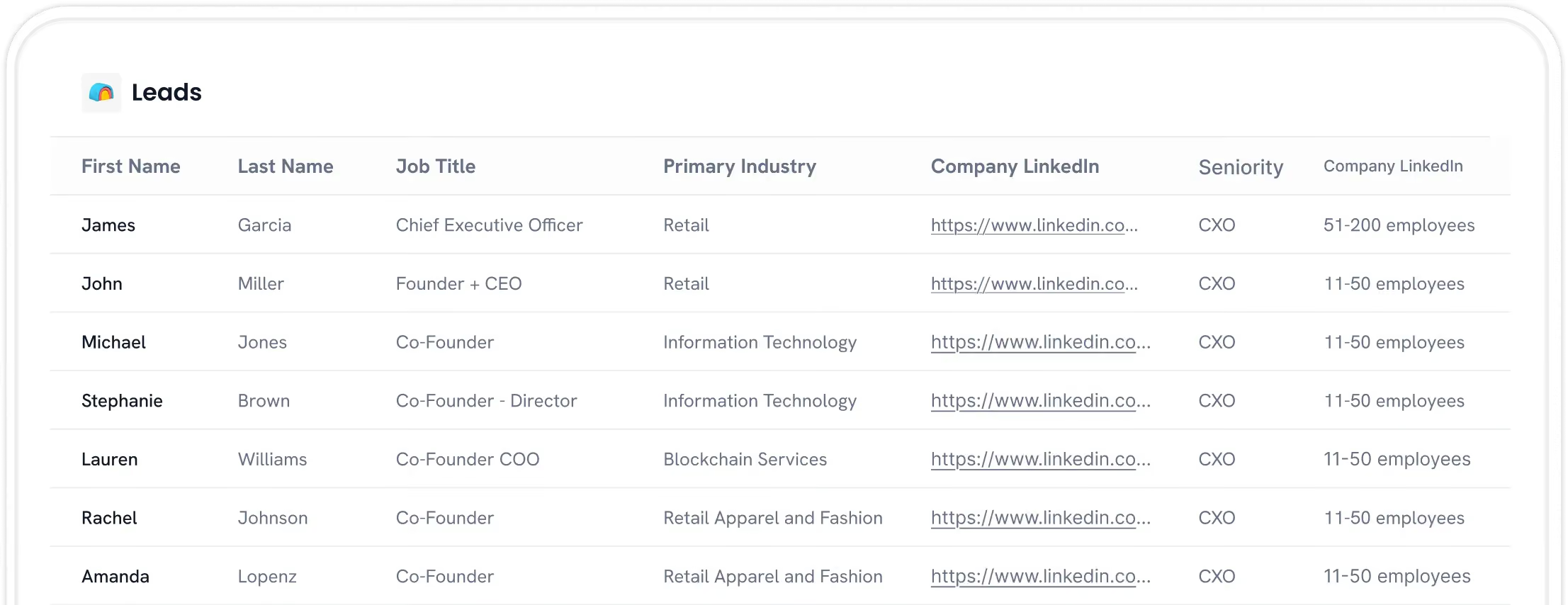
The first job is to define who should be in the campaign and who should stay out. That means building a real TAM by country, industry, company size, buyer role, and trigger fit. In practice, teams use Clay to pull and combine data from multiple providers, then filter for accounts that resemble customers you can close.
Most bad campaigns go wrong by targeting "B2B SaaS founders" or "Heads of Sales" as if that is enough. A real build narrows harder. A segment might be software firms expanding into APAC, hiring account executives, and showing recent headcount movement. That gives the message a reason to exist.
Stage 2: Enrichment and Personalization
Once the account set is right, contacts get enriched with context that shapes the outreach. Hiring, funding, team structure, tech stack, and role-level responsibility all matter because they tell you what angle is plausible.
That is not busywork. According to Apollo Technical's cold email data, advanced personalization can move reply rates from 9% with no personalization to 18% with advanced techniques. The jump happens when the message ties to a real trigger, not when it just repeats someone's company name.
The practical rule: if the personalization only proves you found their LinkedIn page, it will not carry the email.
For a tighter breakdown of the mechanics behind stronger campaigns, our guide on cold email best practices for higher reply rates is a useful reference.
Stage 3: Sequence Build and Sending
The message comes after the data. Not before.
A modern sequence keeps the ask narrow, the copy plain, and the number of touches controlled. Dedicated sending domains matter here because outbound should never risk your main domain reputation. Agencies that know what they are doing separate infrastructure, warm mailboxes carefully, and keep sequencing disciplined via Smartlead.
The goal is not to sound polished. It is to sound relevant.
Stage 4: Reply Management and Qualification
Replies are where campaigns either create pipeline or create noise.
Someone has to sort genuine interest from soft interest, referrals, unsubscribes, objections, and out-of-office replies. Then they need to qualify the positives, route them correctly, and book the meeting while the thread is warm.
That is why a cold email agency is not just a sender. It is part researcher, part operator, part SDR bench. At Reachly, we run this entire workflow across Clay, Smartlead, and HeyReach, with reply handling and calendar booking included.
Why Email-Only Fails: A Multichannel Approach
A VP sees your email at 7:12 AM, ignores it, checks your LinkedIn profile after lunch, then recognizes your name when a rep calls two days later. That is how a real buying sequence often works. Single-channel outreach misses those stacked touches, so the account stays cold even when the offer is relevant.
The problem is not email itself. The problem is treating email like a complete outbound system.
Gartner's research on the B2B buying journey found that B2B buyers spend only 17% of the purchase journey meeting with potential suppliers, and that time is usually split across multiple vendors. If attention is that limited, relying on one channel is a self-imposed constraint.
How Reachly Runs Multichannel Outreach
A coordinated sequence does not blast all channels at once. It controls spacing, suppresses contacts who already engaged, and adjusts by account value.
The KPI to watch is not total activity. It is progression. Are more target accounts moving from unaware to aware, from aware to engaged, and from engaged to booked?
Realistic Timelines, Pricing, and ROI
A founder signs an agency on Monday and asks for meetings by Friday. That is how bad outbound starts.
A serious cold email program needs a few weeks before the first controlled sends go out. The time goes into domain setup, mailbox warming, ICP definition, list QA, copy, tracking, and reply routing. Skip those steps and the campaign may launch fast, but the result is higher bounce risk, weak targeting, and a sender reputation problem that takes longer to fix than the original setup.
Timelines: What Actually Happens
WeekWhat the agency is doingWeek 1Define ICP, pull account lists, enrich contacts, verify data, buy domains, set up inboxesWeek 2Warm mailboxes, write copy by segment, build sequences, connect tracking and routingWeek 3Start controlled sending, review early reply quality, cut weak segments, adjust targeting and copyWeek 4+Increase volume only if bounce, spam, and positive reply quality stay healthy
If the agency has to fix your positioning, build segmentation from scratch, or support a multichannel motion, the ramp takes longer. If they promise instant scale, ask what they are skipping.
ROI Depends on Throughput Quality, Not Vanity Metrics
Track ROI in this order:
- Qualified positive reply rate
- Meetings booked
- Meetings held
- Opportunities created
- Revenue against total program cost
Agencies that know what they are doing will also show operational metrics behind those outcomes: bounce rate, inbox placement, lead-to-reply quality, and time to first meeting. If they only report sends, opens, and raw reply count, they are hiding the ball.
For companies comparing agency fees with hiring, this breakdown of outsourced lead generation services that work is a useful frame. The actual comparison is not monthly retainer versus salary. It is speed to pipeline, tooling costs, management overhead, and how many failed tests you can afford before the system stabilizes.
How to Evaluate a Cold Email Agency: A Checklist
Most agencies sound competent on the sales call. The gap shows up when you ask operational questions.
Ask About Deliverability First
If they dodge this, stop there.
According to SalesCaptain's cold email benchmarks, bounce rate should stay under 2%, while rates over 5% can trigger provider blocks, and top teams use verification and cleaning to reach 95%+ deliverability. That is not a technical footnote. It decides whether your campaign gets seen at all.
Ask them these directly:
- What bounce rate do you target? If they do not say under 2%, that is a problem.
- How do you verify contacts? "We trust our data provider" is not a method.
- Do you use dedicated sending domains? If they send from your main domain, walk away.
- How often do you clean lists? Good data decays. Everyone serious knows that.
- What do you monitor weekly? They should mention bounce, spam risk, and reply quality.
Inspect How They Build Lists
A bad agency sells volume because it cannot sell relevance.
Ask where the data comes from, how accounts are segmented, and what triggers they use to decide who enters a campaign. If the answer is mostly about job titles and company size, you are looking at commodity outbound. You want to hear things like multi-source data, contact verification, buyer signals, and segment-specific messaging.
Red flag: "We can target anyone." Good outbound gets stronger when the market gets narrower.
If they cannot explain the machine, they probably do not have one.
The Decision Framework: Hire an Agency or Build In-House
This decision comes down to control, speed, and competence. Not ideology.
Build In-House If You Want the Capability Long Term
An internal team gives you tighter control over message, brand nuance, and feedback loops with sales. That matters if outbound is becoming a core function and you are willing to invest in the stack, the management time, and the mistakes that happen during ramp.
But there is a catch. Sequenzy's agency roundup notes that 60-70% of standalone cold email campaigns underperform due to poor inbound synergy, while aligned campaigns can improve reply rates by up to 40%. The problem is not just sending. It is making sure the outbound story matches the website, proof, positioning, and buying journey.
Hire an Agency If You Need Speed and a Working System
An agency makes more sense when you need pipeline sooner than you can hire, train, and manage for it. You are buying pattern recognition and operating discipline: data sourcing, enrichment, sequencing, deliverability, reply handling, and cross-channel coordination.
If you cannot yet define your ICP cleanly, write segmented messaging, and manage deliverability without guessing, building in-house will be slower than you think. In-house gives control. Agency gives speed and execution depth. Pick the constraint that hurts more right now.
Your Next Step Toward Predictable Pipeline
If you have read this far, you probably do not need another definition of outbound. You need to decide whether you are building a prospecting system yourself or plugging into one that already exists.
That is the value of a cold email agency. It is not "someone sends emails for us." It is a team that handles market mapping, data quality, message logic, sequencing, reply management, and handoff well enough that your sales team can focus on closing.
For a broader view of how outbound fits into revenue creation, this piece on pipeline generation is a useful read. It helps frame pipeline as a managed process, not a collection of disconnected tactics.
The practical question is simple. Do you want your team spending the next stretch of time testing tools, rebuilding data, and fixing delivery issues, or do you want meetings landing while they work deals already in motion?
For a lot of B2B teams, the answer is obvious once they see the actual work involved.


20(17).jpeg)

.webp)