
 Key Findings
If the personalization does not change the offer, angle, or timing, it is decoration. Good outbound finds the right signal first, then writes a short message around it.
TAM, ICP, persona, intent signals. Skip this and every tactic downstream gets weaker. One offer tied to one likely pain per segment is the working unit.
Signal opener, role pain angle, offer match, segment tag. Four dependable fields beat 100 shallow ones. If your data system cannot produce a useful first sentence, your data is not good enough yet.
Do not stack signals. Keep the opener narrow, the second sentence connects signal to pain, the CTA stays light. Short copy is the output of good research, not the input.
Token-based for SMB, hybrid for mid-market, hyper-personalization for enterprise. Track positive reply rate and meetings booked, not opens. Primal hit 4.57x ROI on signal-anchored sequences with an 8% positive reply rate.
Most advice on cold email personalization is bad because it treats the email as the work.
It is not. The work is finding a real reason to contact someone right now, then turning that signal into a short message that feels obvious to the reader.
That is the shift that matters. Good outbound teams do not win because they write cuter intros. They win because they build a relevance engine, feed it clean data, and send messages that match timing, role, and pain. This playbook walks through the five layers that make that engine work: mapping audience and intent, building the data system, writing the message, scaling without losing quality, and measuring the right outputs.
If you want the broader picture this slots into, signal-based outbound: the 2026 guide is the pillar piece. The data side connects to B2B intent data. And once the message is written, cold email best practices for higher reply rates in 2026 is the companion read.
Why personalization is the wrong goal
"Personalize your cold emails" sounds right. It is also incomplete.
Adding a first name, company name, or fake compliment is not personalization in any meaningful sense. It is decoration. Buyers see it instantly, and when the rest of the email is generic, that opener makes the message feel even more automated.
Flattery gets ignored. Relevance gets replies.
If your opener says "loved your recent post" and the body pivots into a generic pitch, you have wasted the only part of the email that had a chance. Many teams keep doing this anyway. They confuse familiarity with relevance.
The better question is simple: why does this message make sense for this person right now?
The data is blunt. EmailTooltester's cold email statistics report shows personalized subject lines are 26% more likely to be opened, while basic personalized cold emails usually see 1% to 5% response rates, and deeper personalization tied to a prospect's context typically sees 40% to 60% open rates. That gap is the cost of getting this wrong.
Practical rule: if the personalization does not change the offer, angle, or timing of the message, it is fake personalization.
Stop writing clever emails, start finding buying context
The strongest cold email personalization usually starts before the email exists.
You look for a trigger. Hiring. Funding. New market expansion. Product launch. Team growth. A founder talking publicly about a problem. Those are reasons to reach out.
A smart opening line is useful. A system for identifying intent signals is far more useful. That is the shift from "personalized copywriting" to signal-based outbound.
What most teams get wrong
The blunt version:
- They personalize the wrong layer. They change the opener, then send the same pitch to everyone.
- They overvalue novelty. Mentioning a podcast, college, or marathon finish does not matter unless it connects to business pain.
- They underinvest in targeting. Bad list in, bad campaign out.
- They confuse effort with quality. A heavily researched email can still be irrelevant.
Cold email personalization is not a creative writing exercise. It is a filtering problem.
Find the right accounts. Find the right moment. Send the shortest possible message that proves you noticed something that matters. That is what gets replies.
The foundation: map your audience and their intent
Before you write a line, build the map. Skip this and every personalization tactic after it gets weaker.
Most outbound problems are not messaging problems. They are audience definition problems. Teams start inside the email editor when they should start with market shape, account fit, role relevance, and timing.
Ideal Customer Profile (ICP)
Broad characteristics of your best-fit customers.
Core pain points
Specific challenges or problems they regularly face.
Goals and aspirations
What they are actively trying to achieve or improve.
Intent signals
Behaviors indicating they are ready for a solution.
Start broad, then narrow fast
Think in four layers.
TAM. Your total addressable market is the broadest pool you could sell to. Keep it broad on purpose. Industry, region, company type, basic firmographics.
ICP. Your ideal customer profile is tighter. These are the companies that ultimately buy, get value, and stay. If your TAM is "B2B SaaS," your ICP might be venture-backed SaaS firms with sales teams, an outbound motion, and active hiring.
Persona. Pick the people inside those accounts. Founder. Head of Sales. RevOps lead. SDR manager. Different roles care about different problems. If your copy reads like one person wrote it for everyone, it will fail.
Intent signals. This is the layer most teams skip. It matters most. Intent signals explain why now.
Intent is the layer that makes cold email work
You cannot fake timing. Either there is a reason to contact them or there is not.
Useful intent signals usually come from visible change:
- Hiring changes. New SDR, AE, RevOps, or regional expansion roles.
- Company momentum. Funding announcements, office expansion, headcount growth.
- Tech changes. New tools on site, a category switch, a stack mismatch.
- Messaging shifts. New landing pages, new verticals, new use cases, pricing changes.
- Public comments. Founder posts, job descriptions, interview quotes, webinar themes.
For a deeper look at what intent data looks like in practice, B2B intent data breaks intent into observable buying signals instead of abstract scoring.
The point of mapping is not to know everything about the prospect. It is to know enough to send a message that feels timely.
A simple audience map that sales teams can actually use
It is easy to make this too academic. Do not.
Use a working sheet with these fields:
| Field | What to capture | Why it matters |
|---|---|---|
| ICP definition | Industry, size, geography, sales motion | Stops the campaign drifting into wrong-fit accounts |
| Primary persona | Job title and core responsibility | Determines the pain you can credibly speak to |
| Pain hypothesis | What usually breaks for this role | Anchors the message to a real problem |
| Trigger list | Events that suggest they might care now | Creates the "why now" the email needs |
| Message angle | One offer tied to one likely pain | Keeps copy short and on-target |
That is enough to build campaigns.
Common mapping mistakes
A few mistakes show up constantly:
- Too many personas in one sequence. A founder and a sales manager should not get the same body copy.
- Pain points with no proof. "You probably struggle with growth" is lazy. Tie pain to something observable.
- Signals with no message. Spotting hiring is useless if you cannot explain why that event connects to your offer.
- Segments that are too wide. If one sequence covers five industries and four company stages, it will sound like mush.
Cold email personalization starts here. Not in the template. In the map.
Build the data engine for personalization
Once your audience map is clear, the next problem is operational. You need data that keeps the system fed.
Personalization efforts often fail not because teams do not value it, but because the inputs are weak. Contact data is incomplete. Account data is stale. The "personalization" field ends up being a scraped headline or a generic line from LinkedIn.
For a cleaner overview of this layer, Reachly's guide to B2B data enrichment covers how enriched account data supports better targeting and personalization.
Modern personalization runs on signals, not merge tags
The old model was simple. Import list, add first name, send sequence.
That model is dead. Tario's analysis of whether cold email still works describes the shift clearly: successful cold email in 2026 has moved beyond name insertion into signal-based outreach using triggers like funding rounds and hiring spikes, with personalized context becoming the standard.
That matches what works in the field. You do not need dozens of variables. You need a few strong ones that can change the angle of the message.
The data stack that makes this possible
Here is the practical setup most operator teams use:
- Clay for enrichment, variable generation, and pulling multiple data points into one workflow.
- Apollo for contacts and firmographic coverage.
- BuiltWith or similar tools for tech stack clues.
- LinkedIn Sales Navigator for role, hiring, and account movement.
- Smartlead for sequencing and mailbox operations.
- HeyReach when LinkedIn touchpoints are part of the motion (code REACHLY).
The point is not the brand names. It is the flow.
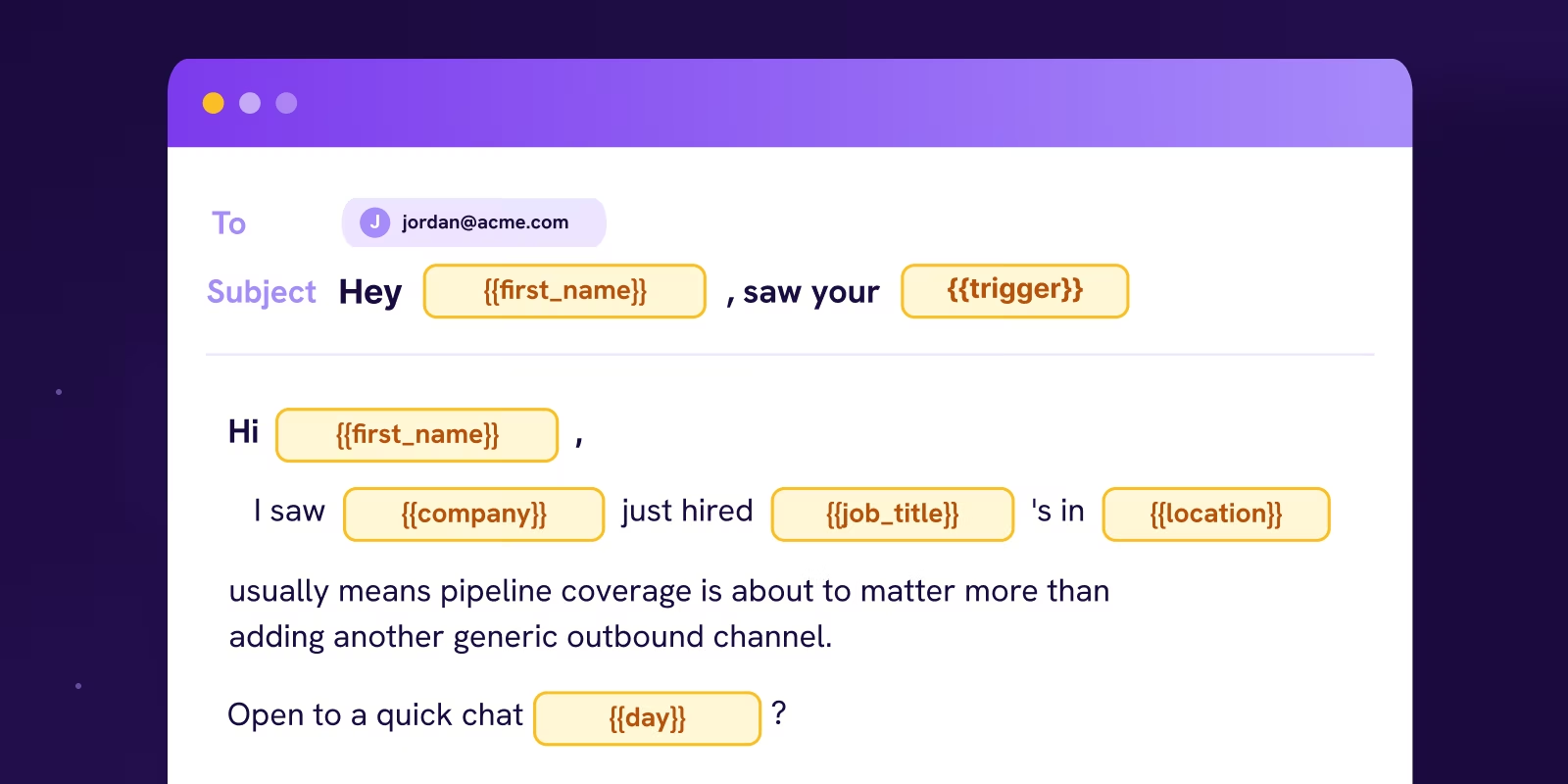
You take a company list. You enrich it. You identify account-level changes. You map those changes to likely pain by persona. Then you create a usable personalization field that a sending tool can insert cleanly.
Build fields that matter to the message
A good personalization engine usually creates fields like:
- Signal opener. One sentence tied to a recent trigger.
- Role pain angle. A short line about what that trigger likely creates for the recipient.
- Offer match. A lightweight asset, audit, teardown, or idea that fits the signal.
- Segment tag. Used to route prospects into the right sequence logic.
That is enough to make your messages feel specific without turning each send into a manual project.
If your enrichment workflow cannot produce a useful first sentence, your data is not good enough yet.
For the AI side of this, SupportGPT's guide to AI personalization is a useful complement because it focuses on how to structure AI-assisted personalization without letting the output go robotic.
Keep the machine simple enough to run
A lot of teams overbuild this. They create giant workflows with too many dependencies, then wonder why sends stall.
You do not need a hundred fields. You need dependable ones.
| Step | What happens | Why it matters |
|---|---|---|
| List input | Add target accounts or contacts | Starts with the market you actually want |
| Enrichment | Pull firmographic, role, and account data | Fills the gaps basic exports miss |
| Signal detection | Find hiring, funding, tech, or messaging shifts | Gives you a reason to contact now |
| Variable creation | Turn signals into usable text snippets | Makes the data usable in copy |
| Sequence sync | Push fields into sending tools | Keeps execution consistent |
For an operator view of how to slice segments inside this data system, a modern guide to segmentation for B2B covers the segmentation logic that pairs with this enrichment flow.
Agencies and in-house teams using Clay plus Smartlead workflows tend to generate signal-specific personalization variables and push them into sequences from the same orchestration sheet. That is one valid model. Plenty of teams build a similar stack in-house. The rule is the same either way: do not ask writers to invent relevance that your data system failed to find.
Write messages that get replies
Once the data is right, writing gets easier. Not easy. Easier.
Most bad cold email personalization fails in the first two lines. The signal is weak, the sentence is bloated, or the writer tries to cram three observations into one opener to prove they did research. That usually lowers reply quality.
Use one sentence and one signal
This is the cleanest writing rule for outbound. One sentence. One signal.
The Scale Lab's breakdown of cold email personalization recommends spending 2 to 15 minutes researching each lead to find one relevant trigger, and cites an analysis showing 17% response rates for emails with advanced personalized snippets versus 7% without them. That is the payoff for doing this properly.
Keep the opener narrow. Use the second sentence to connect that signal to a likely problem or goal.
Do not stack signals. "Saw you raised, hired SDRs, launched a new page, and posted on LinkedIn" sounds like surveillance, not relevance.
Bad, better, best examples
What that looks like in practice.
Trigger: hiring SDRs
- Bad. "Congrats on the recent growth at your company. Loved what you're building."
- Better. "Saw you're hiring SDRs right now. That usually creates follow-up inconsistency for a few weeks."
- Best. "Saw you're hiring SDRs. That is usually when reply handling and follow-up quality start slipping before the team catches up."
Trigger: new funding
- Bad. "Congrats on your funding round. We help companies grow faster."
- Better. "Noticed the recent raise. Teams usually start rebuilding outbound after that."
- Best. "Noticed the recent raise. That usually means pressure to turn headcount and pipeline plans into working outbound fast."
Trigger: new product or market page
- Bad. "I was on your website and thought I'd reach out."
- Better. "Saw the new page for mid-market teams. Looks like you're widening the sales motion."
- Best. "Saw the new mid-market page. Expanding upmarket usually breaks messaging consistency before it breaks volume."
Keep the CTA light
The first email should start a conversation. It should not push for a calendar link unless intent is already strong.
Low-friction CTAs work better because they ask for less. They also match how people read cold email. Fast, skeptical, and in the middle of other work.
Use asks like:
- Share a resource. "Want me to send the sequence structure we'd test here?"
- Offer an example. "Open to a few sample angles based on that hiring push?"
- Prompt a quick reaction. "Worth sending a short teardown?"
If you want more on follow-up structure once the first email lands, automated email follow-ups covers how to keep the sequence working without flattening the opener.
What to cut immediately
A lot of this is subtraction.
Remove these:
- Forced praise. It almost always reads fake.
- Long company intros. Prospects do not care in email one.
- Feature dumps. Save that for later.
- Heavy CTAs. "Can you do 30 minutes Thursday?" is too much for a cold first touch.
- Overwritten AI tone. If it sounds polished but empty, it dies.
The best cold email personalization feels simple because the hard part happened upstream. Good research creates short copy.
Scale personalization without losing quality
You cannot handwrite every email forever. You also cannot send the same generic template to thousands of people and expect pipeline.
The actual job is finding the middle. That is the operating model most teams need, and most content barely touches it.
Saleshandy's article on personalizing cold emails gets to the right question: how much personalization is enough? The answer matches what works in production. You need the minimum viable personalization for the segment. Thin personalization looks generic. Deep research for smaller deals slows throughput and hurts pipeline creation.
Two models that actually exist in the wild
There are really two personalization systems in use.
Token-based personalization. Structured personalization. You build variations using fields like industry, role, tech stack, region, company stage, or a limited set of account signals.
It works well when:
- You have a broad TAM.
- Deal sizes are moderate.
- You need consistency across reps or campaigns.
- The same pain repeats across segments.
This is where Smartlead and similar sending tools help. They let you route segments into different sequences, insert variable fields per segment, and keep follow-ups running without making every first touch fully manual.
Hyper-personalization. Deeper research and a custom first line or custom angle per lead. Sometimes the whole first email changes. Sometimes only the opening and CTA do.
It works well when:
- The account list is tight.
- ACV is high.
- The buying group is small.
- Timing matters more than volume.
It also burns time fast if you apply it to the wrong segment.
Personalization strategy decision matrix
| Factor | Token-based (scale) | Hyper-personalization (depth) |
|---|---|---|
| TAM size | Better for broad lists | Better for small target lists |
| Deal size | Better when each account is worth less | Better when each account is worth more |
| Research effort | Lower per lead | Higher per lead |
| Message consistency | Easier to maintain | Harder to maintain |
| Best signal type | Repeatable segment patterns | Unique account events |
| Team fit | SDR teams, larger outbound motions | Founders, AEs, named-account plays |
| Main risk | Feels generic if segments are sloppy | Throughput collapses if research gets excessive |
Pick depth based on the economics
Do not personalize because it feels good. Personalize because it makes economic sense.
A practical way to decide:
- SMB lists. Use segmented, token-based personalization with one strong variable.
- Mid-market. Mix both. Standard body copy, custom opener when signal quality is high.
- Enterprise or named accounts. Go deeper. Fewer accounts, better timing, tighter custom angles.
The best system is not the most personalized one. It is the one that gets enough relevance into the message without choking volume.
Where teams usually break the system
Three mistakes show up all the time:
- They use hyper-personalization on low-value segments. The math does not work.
- They use tokenization on complex enterprise accounts. The message feels thin.
- They let automation flatten the first touch. Follow-ups can be standardized. The opener usually needs more care.
Cold email personalization should be built like a tiered service model. Different segments deserve different levels of effort. If you treat every prospect the same, you will either waste time or lose replies. Usually both.
Measure what matters and improve the system
A frequent error is staring at the wrong dashboard. Open rates get attention because they move fast and look clean. They also tell you very little about whether the campaign is creating pipeline.
If your subject line gets opens and the body gets ignored, you do not have a good campaign. You have curiosity without relevance.
Track response quality, not just response volume
The two metrics that matter most:
- Positive reply rate. Reachly's Primal campaign held an 8% positive reply rate as the average across 6 months, which sits in the "very good" band for B2B outbound (10 to 20% is normal, 35 to 40% is very good).
- Meetings booked. This is what the whole system exists to produce. Track meetings booked per 1,000 sent, not just reply count.
Those numbers tell you whether the message reached the right person, at the right time, with the right angle. Generic reply rate can get inflated by brush-offs, unsubscribes, and "not me" responses. That does not help sales.
Use symptoms to find the problem
When a campaign underperforms, diagnose it by pattern.
| Symptom | Likely issue | What to fix |
|---|---|---|
| High opens, weak replies | Subject line works, opener does not | Improve the first two lines |
| Replies but low interest | Message is relevant, offer is weak | Change the CTA or value angle |
| Lots of "not me" responses | Persona selection is off | Tighten targeting |
| Objections about fit | ICP is too wide | Narrow the segment |
| Inconsistent performance by segment | Personalization layer is uneven | Rebuild message variants by audience |
One pattern the table leaves out is opens and replies falling together across every segment. That points at inbox placement, so rewriting the copy will not move it. Check where the emails land and keep every sending mailbox warm with a tool like TrulyInbox before you touch a line.
That is how you turn outbound into a system instead of a guessing contest. Good measurement should tell you what broke. If the metric cannot guide a fix, it is mostly noise.
Improve the workflow, not just the copy
The biggest mistake after a weak campaign is rewriting the sequence before checking the inputs. Sometimes the copy is the problem. Often it is not.
Check these in order:
- List quality. Are these accounts within your ICP?
- Signal quality. Did you use a real trigger or a weak proxy?
- Persona match. Does the message fit the role?
- Offer fit. Is the CTA relevant to the signal?
- Sequence logic. Are follow-ups supporting the first message or repeating it?
That loop matters. Cold email personalization only compounds when the team keeps improving the data, segmentation, and message together.
A Reachly case in point: Primal (a marketing agency client) hit 4.57x ROI in 6 months on a signal-anchored sequence, with 85+ SQLs, 6 deals signed, and a 35% reduction in customer acquisition cost. The Great Room closed a $250K contract on the same pattern. Neither result came from clever copy. Both came from finding the signal first, then writing a short message that matched it.
For more examples of practical email structure, I, Icypeas's post on mastering B2B cold outreach pairs messaging choices with real outreach scenarios.
Personalization that books the meeting. Across 400+ campaigns.
Reachly is a triple-certified cold email agency (Clay, Smartlead, HeyReach) running done-for-you cold email, LinkedIn, and cold calling for B2B teams across APAC, USA, Canada, UK, and ANZ. Signal-based targeting, enriched account data, and personalized messaging tied to real buying triggers. Primal hit 4.57x ROI in 6 months. The Great Room closed a $250K contract on the same playbook.
See how Reachly works
FAQ
Cold email personalization is matching a message to a real buying signal from the prospect, not adding a first name or compliment to a template. Effective personalization changes the offer, angle, or timing of the email. If the personalization does not change any of those, it is decoration.
Depth depends on deal size. SMB segments work with token-based personalization (industry, role, one signal). Mid-market needs a custom opener when the signal is strong. Enterprise and named accounts deserve hyper-personalization on the first email. Match the effort to the economics, not your gut.
Hiring changes, funding announcements, headcount growth, tech stack changes, new landing pages, and recent public posts from the buyer. These are visible, time-bound, and connect to real business pain. Generic signals like "growing company" or "active on LinkedIn" do not change the message and should be cut.
70 to 80 words for 2026. Cold emails are competing for attention span, not against other cold emails. A short message built around one real trigger outperforms a long, heavily researched email almost every time. Keep the opener to one sentence, the body to two, the CTA to one.
Track positive reply rate, not generic reply rate. 10 to 20% positive reply is normal. 35 to 40% is very good. Reachly's Primal campaign held an 8% positive reply rate as the 6-month average, with 85+ SQLs booked. Generic reply count gets inflated by brush-offs and unsubscribes, which do not produce pipeline.
Yes, for variable creation and segment routing, not for writing the email. AI is good at turning raw signals into clean snippets and matching prospects to segments. It is bad at producing copy that does not sound polished but empty. Use Clay or similar tools to structure inputs, then have a human write the final sentence.
Token-based personalization inserts segment-level variables (industry, role, one signal) across many prospects. Hyper-personalization writes a custom opener or full first email per lead. Token works for SMB and broad lists. Hyper works for enterprise and named accounts. Picking the wrong one wastes time or loses replies.
Recommended service
Cold Email Agency
Reachly runs cold email end to end: dedicated infrastructure, signal-led copy, and replies handled until a meeting is booked.