 Key Findings
Ten sharp fields beat forty vague ones. If a field does not change who you contact, when you contact them, or what you say, cut it from the template.
Written exclusions protect reply rates and deliverability, and trigger events turn a static fit profile into timing. Reachly refuses accounts under $30K monthly revenue in writing.
Pull 12 months of won deals, interview your five best customers, and keep the attributes that appear in roughly 70 percent of wins. Patterns beat opinions.
The ICP picks the accounts, buyer personas shape the copy for the 3 to 4 roles inside each one. Run the same offer across personas with different pain points and language.
Weight fit and signals, set a threshold accounts must clear, and refresh data every 30 days. This scored approach produced 85+ qualified leads and a 4.57x return for Primal in six months.
CEOs and CROs of funded startups get 60 to 70 cold emails a week. Almost every one of those emails exists because somebody's ideal customer profile said "SaaS, 11 to 50 employees, United States" and a list tool did the rest. That is not an ICP. That is a filter preset, and it is why most outbound campaigns lose before the first email is written.
This guide gives you a working ICP template: every field worth documenting, where to pull the data for each one, a six-step build process, real B2B examples you can copy, and the scoring layer that turns the document into pipeline. Whether you keep the template in Notion, Excel, a Word doc, or your CRM matters far less than what goes in it and whether anyone updates it.
We build and rebuild ICPs constantly at Reachly. Across 400+ outbound campaigns run on cold email, LinkedIn, and cold calling, the profile below is the one we actually use with clients, not a theory sheet.
What an ICP template actually is
In marketing and sales, ICP stands for ideal customer profile: a detailed description of the company, not the individual person, that gets the most value from your product fastest, pays for it without drama, and stays. Salesforce frames it as the buyer who is a perfect fit among everyone in the market for what you sell. An ICP template is simply the structured document that captures that description in fields your whole team can read, challenge, and act on.
The template earns its keep downstream. Your list building, your segmentation, your copy angles, and your channel mix all inherit whatever the ICP says. Get it wrong and every campaign built on top of it is precision-executing the wrong plan.
One rule before the fields: an ICP template is a sending decision, not a strategy essay. If a field does not change who you contact, when you contact them, or what you say, cut it. Ten sharp fields beat forty vague ones.
The ICP template: every field that matters
Here is the full ideal customer profile template we run for B2B clients. Copy the fields into whatever tool your team lives in. The example column shows what a completed entry looks like for a sales-tech SaaS company.
| Field | What to capture | Example entry | Where to get it |
|---|---|---|---|
| Industry and vertical | Specific niches, not broad category codes | B2B SaaS in sales tech and martech, not agencies | Closed-won CRM data |
| Company size | The employee range that buys fastest | 20 to 200 employees | LinkedIn Sales Navigator, won deals |
| Revenue band | The annual revenue range where budget exists | $1M to $50M | Enrichment via Clay or AI Ark |
| Geography | Regions you can serve, sell to, and support | US, UK, ANZ, APAC | CRM plus delivery constraints |
| Funding stage | The stage where your pain peaks | Seed to Series B, raised in the last 12 months | Funding data piped into Clay |
| Tech stack | Tools that signal fit or replaceability | Runs Salesforce plus a sequencer, no data team | Technographic enrichment |
| Pain points and triggers | The problem, plus the events that surface it | Pipeline stalled after a raise; new VP Sales hired | Win interviews, signal tools |
| Buying committee | Who signs, who champions, who blocks | CEO signs, Head of Sales champions, RevOps vets | Won-deal reviews |
| Deal economics | ACV, sales cycle length, retention | $18K ACV, 45-day cycle, 90%+ retention | CRM reporting |
| Disqualifiers | Accounts you refuse to contact, in writing | Under $30K monthly revenue, pre-product, agencies | Lost-deal and churn data |
Two of these fields separate a real ICP framework from a form-filling exercise, and they are the two most templates skip. The first is disqualifiers. Reachly will not run campaigns for companies under $30K in monthly revenue, because the outbound math stops working below that line, and we put that in writing. Your exclusions protect your reply rate, your deliverability, and your reps' calendars. Lost deals and churned accounts are where you find them.
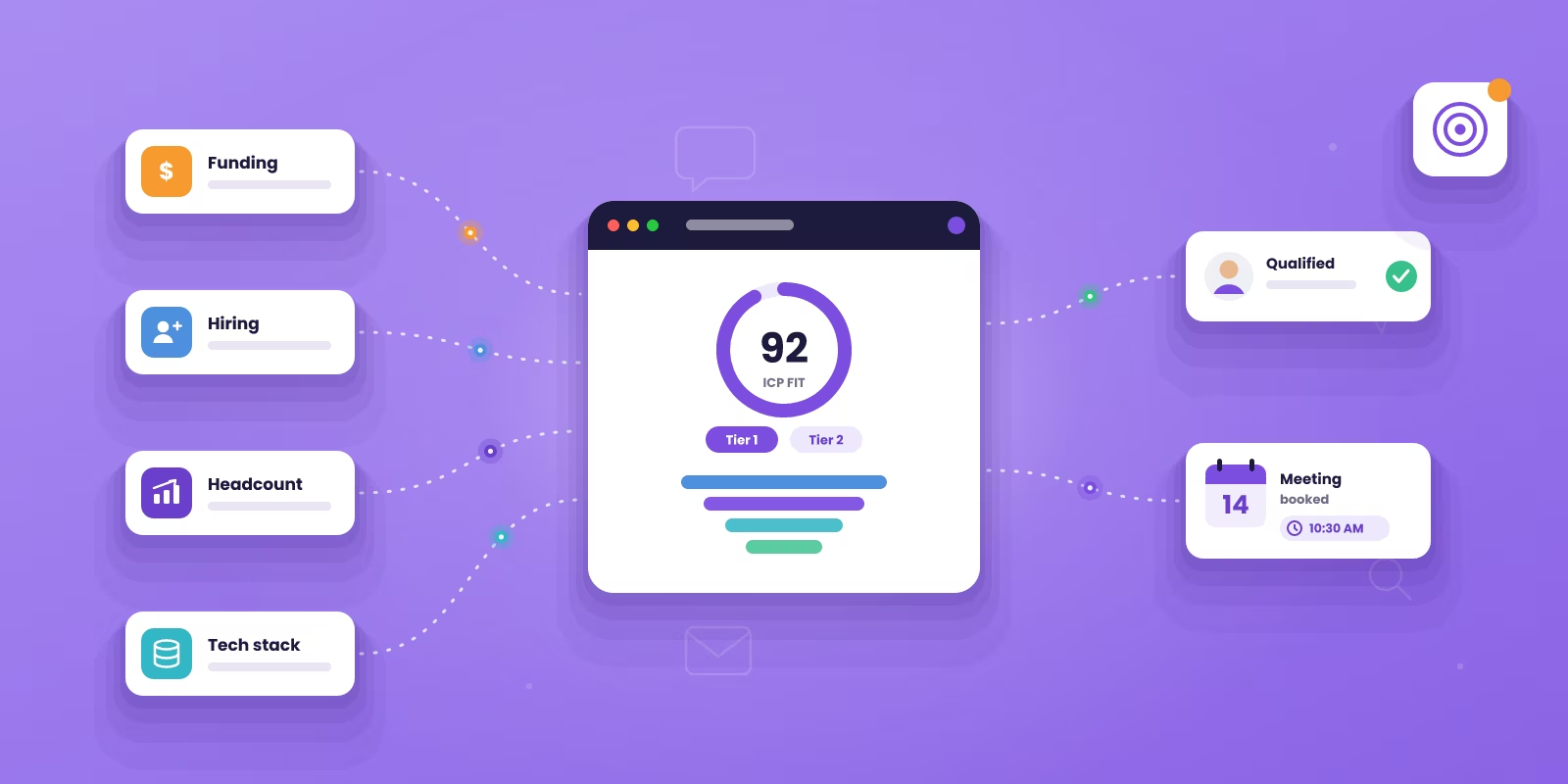
The second is triggers. A static profile tells you which accounts fit. Trigger events, a funding round, a hiring spike, a new sales leader, a stack change, tell you which fitting accounts are in motion right now. That timing layer is the difference between fit and opportunity, and it is where B2B intent data plugs directly into the template.
How to create an ideal customer profile in six steps
You do not need a quarter and a consultant. A first working version of your ICP takes about a week if you run the steps in order.
Step four is where most teams flinch, because writing "we do not sell to X" feels like leaving money on the table. It is the opposite. Every disqualified account you skip is budget and sending capacity redirected at accounts that convert, which is the entire economic argument behind focused outbound lead generation.
ICP vs buyer persona: what each one does
The two documents get conflated constantly, and mixing them up produces lists built on job titles and copy written for companies. Here is the clean split.
| Dimension | Ideal customer profile | Buyer persona |
|---|---|---|
| What it describes | The company or account: firmographics, technographics, economics | The individual person: role, goals, KPIs, objections |
| Question it answers | Which accounts should we target at all? | How do we speak to each person inside those accounts? |
| Built from | Closed-won data, deal economics, churn analysis | Customer interviews, call recordings, role research |
| Used for | List building, account scoring, segmentation, channel choice | Copy angles, messaging per contact, objection handling |
| Order of operations | First. Personas without an ICP aim well at the wrong crowd | Second. One persona set per ICP, usually 3 to 4 roles |
The practical link between the two: run the same offer across every persona in the account, but change the pain points and the language. A CMO reads a different email than a marketing manager, even when both emails sell the same thing. That is also why the buying committee field sits inside the ICP template, it tells you which personas you need before you write a word of copy.
ICP examples you can copy
Abstract fields only get you so far, so here are two completed icp examples. The first is our own. Reachly's ideal customer profile, written as template entries:
- Industry: B2B companies selling a considered product or service, SaaS, professional services, fintech
- Buying committee: founders and CEOs, Heads of Sales or Revenue, CMOs
- Revenue band: $1M to $50M annual revenue, with a hard floor of $30K in monthly revenue
- Geography: global, weighted to the US, Canada, UK, ANZ, and APAC
- Trigger events: recent funding, sales hiring, a stalled inbound engine, a founder still doing all the selling
- Disqualifiers: pre-product startups, sub-$30K monthly revenue, companies that want an agency to run their sales calls
The second is a niche one. For a SaaS client in fintech, the winning profile was not "financial services companies." It was compliance leads at mid-market payment processors in two specific corridors, running a named legacy tool, within 90 days of a regulatory deadline. Narrow reads as risky. It is the opposite: the tighter the profile, the less competition inside the inbox.
The campaigns that perform best are usually the niche ones. We have run campaigns into garment manufacturing facilities in North America and India, churches, brokers. Less cold email lands in those inboxes. And if your ICP insists on speaking only to the CEO, remember that CEOs and CROs of funded startups get 60 to 70 cold emails a week. They are not reading their inbox. Put the buying committee in the template and work it.

Turn the template into a scored, living profile
A finished ICP template is the halfway point, not the finish line. Most versions die quietly, and they die the same four ways.

The fix is mechanical. Give the template an owner and a quarterly review. Pipe your fit attributes and trigger events into one table in Clay, weight them, for example funding at 30 percent, headcount growth at 25 percent, tech stack change at 20 percent, and set the score an account must clear before a rep touches it. That scoring bar is the same discipline we describe in our guide on how to qualify leads in sales, applied one step earlier in the funnel.
Freshness matters as much as the weights. A list older than 30 days starts accumulating bounces and out-of-date titles, which is why we source from AI Ark, it rebuilds lookalike lists from your closed-won accounts and refreshes the data every 30 days. From there, the scored profile feeds directly into signal-based outbound: fit decides who gets contacted, signals decide when, and the template stops being a document and starts being a pipeline filter.
Put your ICP template to work
The template above gives you the fields, the six steps give you the process, and the scoring layer keeps it honest. What remains is the part most teams stall on: wiring the profile into daily campaigns across cold email, LinkedIn, and cold calling, and keeping the data fresh while doing it.
That is the machine Reachly runs as a done-for-you service. We turned this exact approach into 85+ qualified leads in six months and a 4.57x return for Primal, with an 8 percent average positive reply rate and break-even at month three. If you would rather your ICP produced meetings instead of comments in a doc, start at the Reachly homepage, run your numbers through the ROI calculator, or see how the pieces connect in our modern outbound sales strategy guide.
ICP template FAQ
An ICP template is a structured document that captures your ideal customer profile: the industry, company size, revenue band, geography, tech stack, trigger events, buying committee, deal economics, and disqualifiers of the accounts most likely to buy, succeed, and stay. It turns targeting from opinion into a written, testable standard the whole team works from.
Pull your last 12 months of closed-won deals, interview your five best customers, and extract the attributes that appear in roughly 70 percent of wins. Write explicit disqualifiers from lost and churned accounts, layer live signals like funding and hiring on top, then score and tier accounts so only true fits enter campaigns. A first version takes about a week.
Ten fields cover it: industry and vertical, company size, revenue band, geography, funding stage, tech stack, pain points and trigger events, buying committee, deal economics, and disqualifiers. The last two are the most skipped and the most valuable. If a field does not change who you contact or what you say, leave it out.
An ICP describes the company: firmographics, technographics, and deal economics that define which accounts to target. A buyer persona describes the individual people inside those accounts: their role, goals, and objections, which shapes the copy. Build the ICP first, then write 3 to 4 personas for the buying committee inside it.
Reachly's own ICP: B2B companies at $1M to $50M annual revenue with at least $30K in monthly revenue, led by founders, Heads of Sales, or CMOs, global with a US, UK, ANZ, and APAC weighting, showing triggers like recent funding or sales hiring. Pre-product startups and sub-threshold companies are written disqualifiers.
Recommended service
Outbound Lead Generation Services
Reachly builds and runs the whole outbound motion across email, LinkedIn, and phone, and books qualified meetings on your calendar.