
A phone validation API comparison comes down to three things: which fields come back, what each lookup costs, and how fast the response returns. To validate 5,000 numbers a month, list prices across the eight vendors below run from $12.99 to $99, and every one of them returns country, carrier and line type. The difference is in the extras: live line status, porting-aware carrier data, fraud scoring and compliance flags.
This guide compares each provider on verified September 2026 pricing, costs them at three volumes, and gives you the 200-record test we use to pick one. For validation as a process, start with the phone number validation guide.
Key Findings
- To validate 5,000 numbers a month, list prices run from $12.99 (Veriphone) to $99 (IPQualityScore), a 7.6x spread for calls that all return a line type.
- At 50,000 a month the gap widens: Veriphone is $39, Numverify $59.99 and Twilio's line type lookup $400.
- Format checks are free everywhere that matters. libphonenumber and Twilio's basic formatting call both cost nothing, so paid lookups should only run on numbers that pass them.
- The cheapest tiers return the carrier a number was first assigned to. The current carrier after porting costs extra: Veriphone charges 10 credits for it instead of 1.
- Pick on a 200-record test against your own dial outcomes, scored on true positive rate, dead-line detection and p95 latency, before price.
- For sales teams, the API is step 3 of a six-step pipeline. Reachly runs it as the dial-quality gate inside B2B appointment setting.
What is a phone validation API?
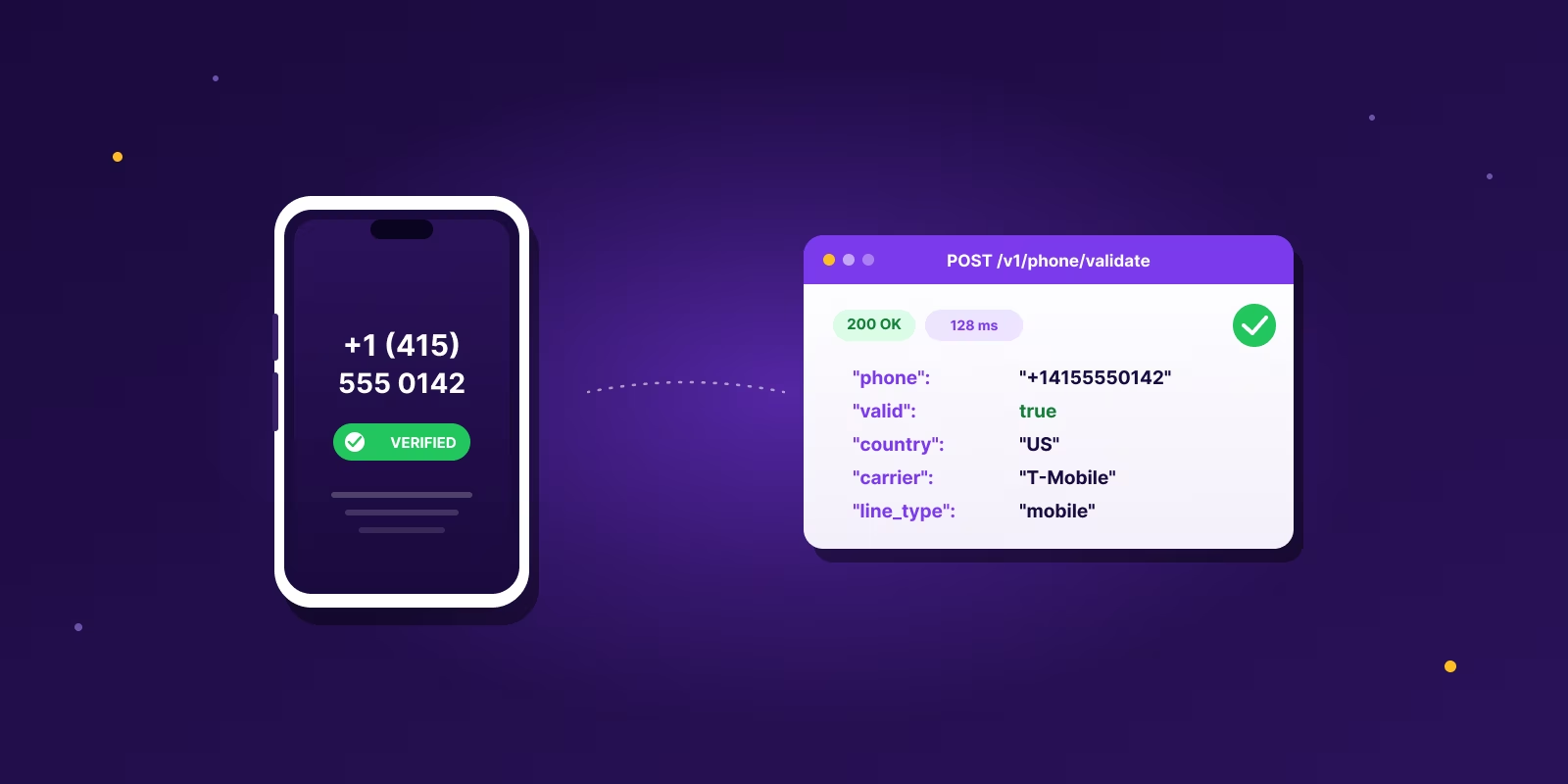
A phone validation API exposes phone number checks as an HTTP endpoint. You send a number and get back JSON with fields such as "is_valid", "country", "line_type", "carrier" and, on some vendors, a risk or activity score. The point of the API over a CSV upload tool is that the same check can run inside a Clay table, a CRM workflow, an inbound form handler or your own enrichment script.
Most validation APIs sit on three data layers:
- Numbering rules and standards, the free layer, mostly handled by libphonenumber.
- Carrier and line type databases, bought from telecom industry sources.
- Real-time reachability checks, live queries to carrier networks, the expensive layer.
Vendors differ on layers two and three, plus response speed and which risk signals they add. For sales teams, it sits between enrichment (Apollo.io, Clay, ZoomInfo) and the dialer or sequencer (Smartlead, Salesloft, Outreach, Aircall, Orum).
Original carrier versus current carrier
This is the detail most comparisons skip. A cheap lookup usually reports the carrier the number range was originally assigned to. If the owner has ported the number to another network, that answer is stale, and so can be the line type. Porting-aware lookups cost more because they query live routing data. Veriphone prices its Current Carrier Lookup at 10 credits against 1 for a standard validation, and Twilio sells Line Status separately from Line Type Intelligence. If you route leads by mobile versus landline, price the porting-aware call, not the headline one.
Which phone validation APIs are worth comparing in 2026?
Eight vendors plus one open-source library cover almost every B2B use case. Prices below were read from each vendor's own pricing page on September 28, 2026.
Twilio Lookup
The default when engineering already runs on Twilio. Lookup v2 is one endpoint with paid add-on packages. Formatting and validation is free. Line Type Intelligence, which returns carrier plus mobile, landline, fixed VoIP, non-fixed VoIP and toll-free, is $0.008 per request. Line Status, which checks whether the number is active, starts at $0.007 per query under 100,000 and falls to $0.00385 at 10 million and up. SIM swap and call forwarding checks are priced by sales.
Best when: you already use Twilio for SMS or voice and want one vendor and one API surface.
Watch-out: per-request pricing adds up fast. At 250,000 line type lookups a month the list price is $2,000, against $99 on Veriphone, so deduplicate before you send.
IPQualityScore (IPQS)
The strongest fraud and risk signals in the category. IPQS returns the standard fields plus a fraud score, abuse velocity and active-line confidence, and is used heavily in signup flows and lead-quality scoring. The free plan allows 1,000 lookups a month, capped at 35 a day. Startup is $99 a month for 5,000, and SMB Basic is $499 for 10,000. Lookups on those plans are shared across IPQS products, so phone checks compete with email and IP checks for the same quota.
Best when: you want validation and fraud scoring on the same call.
Watch-out: the most expensive per lookup at low volume, and carrier data is strongest in North America.
Veriphone
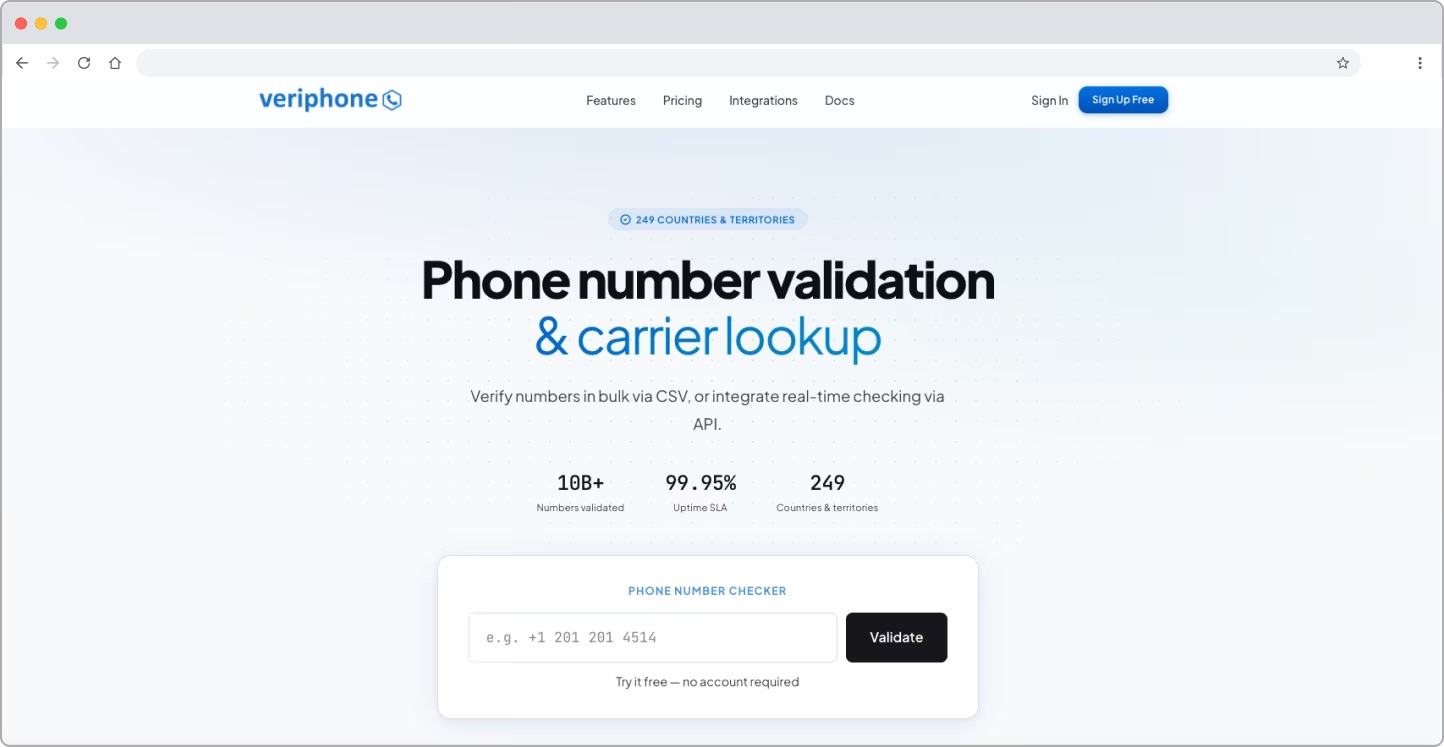
A lean REST API focused on format, country, carrier and line type across 243 countries. The free tier is 1,000 validations a month with no card. Paid plans are Starter at $12.99 for 10,000 credits, Professional at $39 for 50,000, Business at $99 for 250,000 and Enterprise at $249 for 1,000,000. Pay-as-you-go packs that never expire are also sold. Current Carrier Lookup costs 10 credits per number.
Best when: you want the lowest published cost per lookup at any volume.
Watch-out: no fraud score and no live status on the standard call.
Numverify
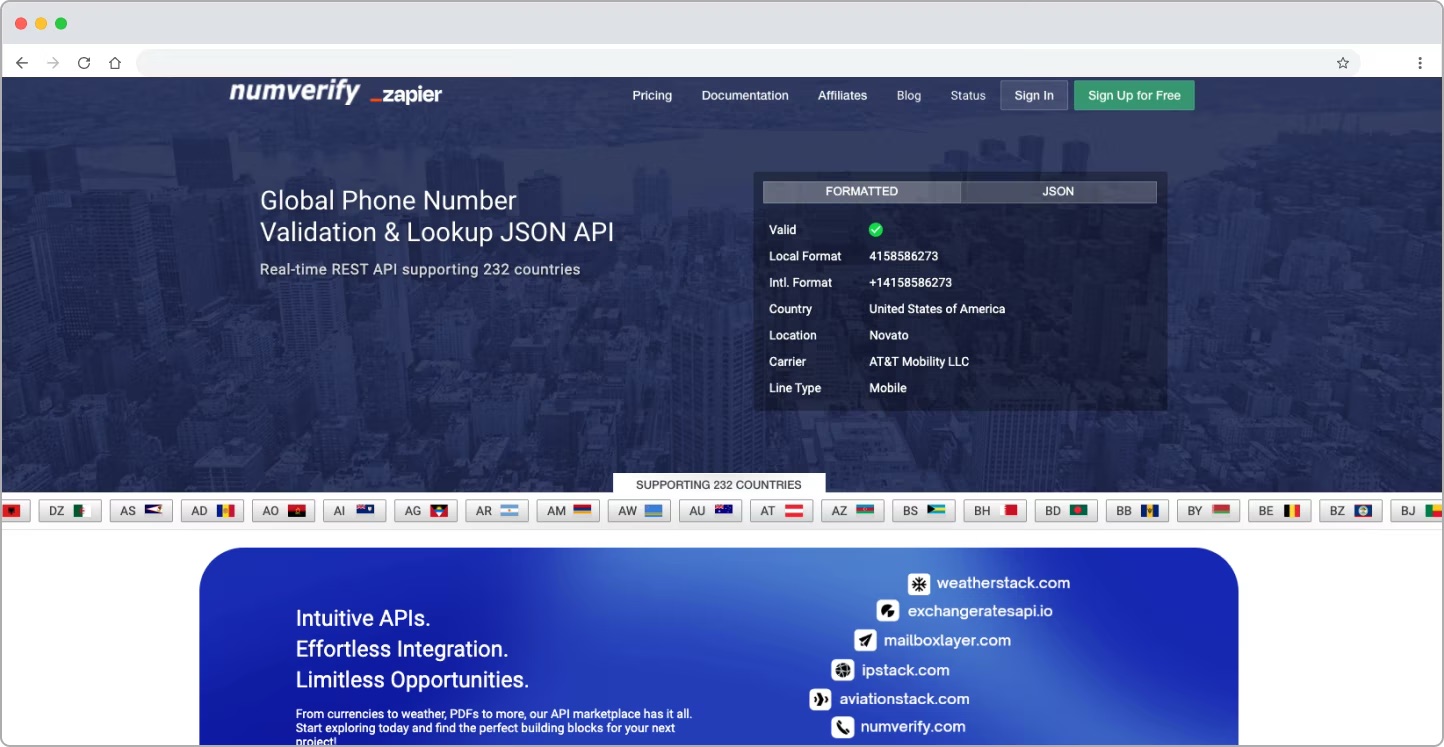
Owned by APILayer. JSON-first and simple, returning format, country, location, carrier and line type. The free plan is 100 requests a month. Basic is $14.99 for 5,000, Professional $59.99 for 50,000 and Enterprise $129.99 for 250,000, with up to 15% off on annual billing.
Best when: you want a cheap, well-documented API for a small team or an MVP.
Watch-out: the carrier returned is the originally assigned one, and there is no live activity check.
Abstract
A developer-focused API from AbstractAPI that ranks near the top of the search results for the head term. The free plan is 100 requests. Starter is $19 a month for 5,000 requests on monthly billing, or $17 a month billed annually for 60,000 a year. Higher tiers add messaging, registration and risk fields to the carrier and location data.
Best when: you want one vendor for phone, email and IP validation with the same auth and docs.
Watch-out: the risk and registration fields sit on higher plans than the entry price suggests.
Trestle
Built around one question sales teams care about: is this number still connected. The Phone Validation API returns an activity score, seven line types (including fixed and non-fixed VoIP, premium and voicemail), the carrier including MVNOs, and a prepaid flag. Self-serve pricing is $0.015 per query at 10 queries a second, with custom pricing above 18,000 queries a month. The trial gives 25 free validations over 14 days.
Best when: dead lines are your main cost and you want an activity score on every record.
Watch-out: at $15 per 1,000 it is the priciest self-serve rate here, so gate it behind cheaper checks.
Experian EDQ
Enterprise data-quality stack with phone validation alongside address and email, plus compliance and consent signals in some regions. Pricing is quote-only and sits above the API-first vendors.
Best when: you operate in financial services, healthcare or another regulated market.
Watch-out: heavier integration and procurement than the self-serve APIs.
ClearoutPhone
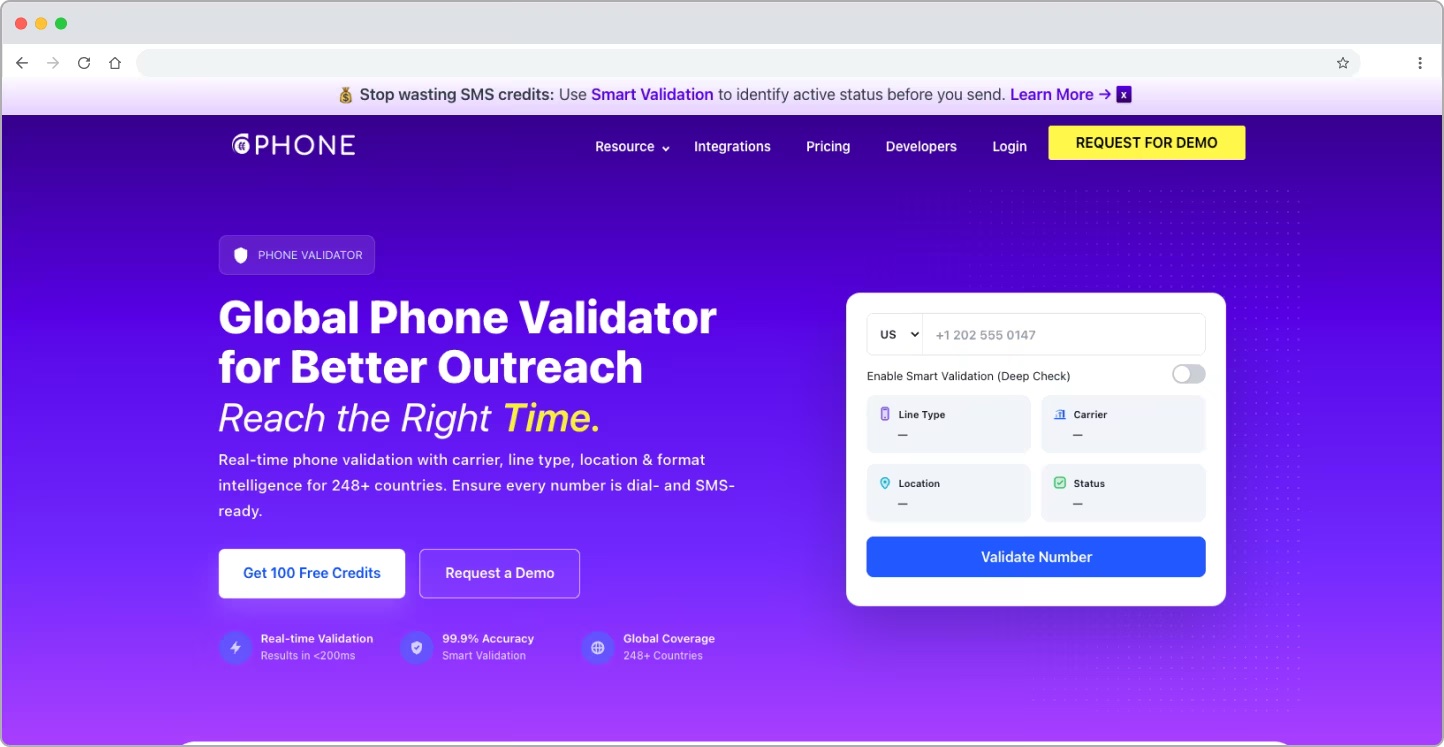
Sits between Veriphone and IPQS in scope, with a bulk upload dashboard and an API on the same credits across 200+ countries. New accounts get 100 free credits, and the annual plan is $278 for 60,000 credits, about $23 a month. Standard validation is 1 credit. Smart validation uses up to 5 credits when a deeper live check is needed for ported or VoIP numbers.
Best when: you want bulk CSV cleanup and ongoing API validation without buying two products.
Watch-out: less known in the US, which can slow procurement.
libphonenumber (open source)
Google's library is not a vendor API, but every team should run it as layer 0. It handles format validation and country-aware parsing for free, and the libphonenumber-js port runs in browsers and Node.js. Clean and normalize to E.164 with it before you spend money on carrier and line type.
Best when: always, as the first layer of every validation pipeline.
Watch-out: it returns no carrier and no line type. That is what the paid APIs are for.
| Provider | Strongest signal | Free allowance | Entry paid plan | Best for |
|---|---|---|---|---|
| libphonenumber | Format and country rules | Free, open source | None | Layer 0, always |
| Twilio Lookup | Line type, line status, SIM swap | Formatting free | $0.008 per line type request | Teams already on Twilio |
| IPQualityScore | Fraud and risk score | 1,000 a month, 35 a day | $99 a month, 5,000 | Signup fraud, lead quality |
| Veriphone | Line type and carrier | 1,000 a month | $12.99 a month, 10,000 | High volume on a budget |
| Numverify | Format and carrier | 100 a month | $14.99 a month, 5,000 | Small teams, MVPs |
| Abstract | Carrier, messaging, risk | 100 requests | $19 a month, 5,000 | Developer-first stacks |
| Trestle | Activity score, prepaid flag | 25 in a 14-day trial | $0.015 per query | Dead-line detection |
| Experian EDQ | Compliance and consent data | None published | Quote only | Regulated industries |
| ClearoutPhone | Bulk upload plus API | 100 credits | $278 a year, 60,000 | Bulk cleanup and API in one |
How much does a phone validation API cost?
From $0.00025 per lookup (Veriphone's 1,000,000-credit plan) to about $0.05 (IPQualityScore's SMB Basic plan) at list price, depending on vendor and volume. The chart below prices the same job, 5,000 validations in a month, on the cheapest published plan from each vendor.
Two things stand out. The cheapest four all land under $25 a month, so price only becomes a real decision above that volume. And the three most expensive vendors are selling something extra: Twilio's per-request line type data, Trestle's activity score, and IPQS's fraud scoring. If you do not use those fields to route a lead, you are paying for them anyway.
Cost at 50,000 and 250,000 a month
Volume changes the ranking. Subscription vendors get cheaper per lookup as the plan grows, while per-request pricing stays linear.
| Provider | 5,000 a month | 50,000 a month | 250,000 a month | Source |
|---|---|---|---|---|
| Veriphone | $12.99 | $39 | $99 | veriphone.io/pricing |
| Numverify | $14.99 | $59.99 | $129.99 | numverify.com/pricing |
| Twilio Lookup (line type) | $40 | $400 | $2,000 | twilio.com pricing |
| Trestle | $75 | Custom above 18,000 | Custom | trestleiq.com |
| IPQualityScore | $99 | Not published | Not published | ipqualityscore.com/plans |
Method: cheapest published plan that covers the volume, monthly billing, no overage, no tax, read on September 28, 2026. Abstract, ClearoutPhone and Experian are left out of this table because they do not publish a price at all three volumes. Recheck before you commit, as these pages change.
How do you test phone validation APIs against your own data?
Every vendor page claims high accuracy and global coverage. The only number that matters is how the API scores on your own records, so run a test before you sign anything. It takes about half a day.
Step 1: Build a 200-record test set
Pull 200 numbers from your CRM with known dial outcomes: 50 that reached the right person, 50 that reached a wrong person or switchboard, 50 that went to voicemail or failed, and 50 confirmed dead lines. Anonymize if you need to, but keep the outcome labels.
Step 2: Run the same 200 through two APIs
Use the free tiers above. Veriphone's 1,000 a month covers all 200 in one run, IPQS's 35-a-day cap spreads them over six days, and Trestle's trial covers 25. Send identical inputs and store the full response payload from each vendor.
Step 3: Score against ground truth
Paste your results into the sheet below and score each vendor on the same five lines.
phone,known_outcome,vendor,is_valid,line_type,carrier,active_flag,latency_ms
+14155550100,connected_right_person,vendor_a,true,mobile,T-Mobile,active,212
+14155550101,dead_line,vendor_a,true,landline,AT&T,unknown,190

# score per vendor
true_positive_rate  = valid_and_active on connected_* rows / all connected_* rows
true_negative_rate  = invalid_or_inactive on dead_line rows / all dead_line rows
line_type_accuracy  = line_type matches what the rep heard / rows with a known line type
latency_p95         = 95th percentile of latency_ms
cost_per_good_dial  = monthly_price / (monthly_volume x true_positive_rate)
p95 latency matters more than the average when validation sits inside a live form or a dialer queue, because the slow tail is what the user or rep actually waits on.
Step 4: Cost-adjust the comparison
Divide the monthly price by the good dials each vendor lets through. A vendor that is 96% accurate at about $4.60 per 1,000 (ClearoutPhone's annual rate) usually beats one that is 99% accurate at $15 per 1,000 (Trestle's self-serve rate) for bulk B2B lists. Multiply the difference by your annual volume to see what the extra three points actually cost.
When should you skip a paid phone validation API?
If the only job is catching typos on inbound web forms, libphonenumber-js running client-side is enough.
If you validate fewer than 1,000 numbers a month, the free tiers cover it. Veriphone's 1,000 free validations a month, run only on the records that pass libphonenumber, is the cheapest working setup in this list.
Paid APIs earn their cost when you validate tens of thousands of records a month, need line type to route leads, or need fraud and compliance signals on the same call.
Should you use waterfall enrichment instead of a validation API?
Some teams skip the standalone API and use a waterfall enrichment tool that finds and validates the number in one call. BetterContact queries 20+ providers in priority order, returns the highest-confidence mobile number, and drops numbers that fail format and carrier checks before they reach your CRM.
The trade-off is cost per record. Waterfall enrichment is priced per credit and built for the find step. If you have 50,000 records and need to know which are still active, a standalone validation API is cheaper. If you have a list of companies and need fresh mobile numbers on the right contacts, a waterfall gets you a validated number in one call.
For most B2B teams the answer is both: waterfall when a record first enters the CRM, then a cheap validation API to re-check the records that matter before each campaign cycle.
Where does a phone validation API sit in an outbound stack?
A validation API is one node in a larger workflow. The full pipeline for most B2B teams:
- Capture. The number arrives from a form, an import, an enrichment vendor or a partner push.
- Normalize. libphonenumber-js formats it to E.164.
- Validate. The paid API adds carrier, line type and status.
- Route. Workflow logic picks the sequence branch based on the result.
- Dial or sequence. The lead enters the right outbound motion.
- Re-validate. High-value records are re-checked quarterly or before major campaigns.
The API is step 3. The other five are workflow decisions the API cannot make for you, which is why the useful question is which API fits your stack and routing logic.
How Reachly uses it
We treat phone validation as the cheapest insurance in cold calling, the third channel in our B2B appointment setting stack after cold email and LinkedIn. Our setup is the pipeline above: waterfall on intake, libphonenumber-js as the format gate, and a paid lookup only on the records that are about to be dialed. A dead number mid-session costs more than the month's API bill, because it breaks the rep's rhythm and inflates the connect-rate denominator.
Validation is also one signal among several in signal-based outbound. A valid mobile number plus a fresh funding round is a different lead from a valid mobile number with nothing else attached.
For one-time list cleanup, see bulk phone number validation. For US, EU and APAC rules, see international phone number validation. For the rest of the stack, see the outbound tools directory.
Validated numbers are only the start. Get meetings booked.
Reachly runs cold email, LinkedIn and cold calling as one signal-based outbound system for B2B teams in APAC and globally, and is a Clay certified partner. Primal reached 4.57x ROI and 85+ SQLs in 6 months. The Great Room closed $250K+ in total contract value.
Book the meeting
Frequently asked questions
What is the best free API for phone number validation?
For format checks, Google's libphonenumber is free with no quota, and Twilio Lookup's formatting and validation call costs nothing per request. For carrier and line type, the largest free allowances on the vendors' own pricing pages are Veriphone at 1,000 validations a month and IPQualityScore at 1,000 lookups a month, capped at 35 a day. Numverify and Abstract each give 100 free requests, ClearoutPhone gives 100 free credits, and Trestle gives 25 free validations in a 14-day trial.
Is there a 100% free phone lookup?
Only at the format layer. Any lookup that returns a carrier, a line type or a live status queries a paid telecom data source, so the free versions are metered trial allowances. A free lookup site that shows the owner's name for any number is usually pulling from scraped directories, which is a compliance risk for B2B calling and should stay out of a sales stack.
Can a phone validator detect fake numbers?
It catches most of them. Impossible formats fail the numbering rules, unassigned ranges fail the carrier lookup, and non-fixed VoIP numbers (the type most often used for throwaway signups) are flagged by line type. It cannot prove a real person owns a valid, active number. That takes a verification step, usually a one-time code sent by SMS or voice.
Which verification API provider is best?
That depends on which job you mean. Validation answers whether a number is real and what kind of line it is, which is what a sales team needs before dialing. Verification answers whether the person in front of you controls the number, which is what signup, login and payment flows need. Twilio sells both under one account, which is why engineering teams often start there, while sales teams cleaning lists usually buy validation only.
Can ChatGPT look up phone numbers?
No. A language model has no live connection to carrier or porting databases, so any carrier or line type it states is a guess. It is useful for writing the libphonenumber parsing code or the API integration, and for spotting malformed numbers in a pasted list, but the lookup itself has to come from an API.
Is there a way to validate a phone number without an API?
Yes, three. Parse it with libphonenumber in a script or spreadsheet add-on, which catches format and country errors. Upload a CSV to a bulk tool such as ClearoutPhone's dashboard, which returns the same fields as the API without any code. Or dial it, which is the only check that confirms who picks up, and is why connect outcomes belong in your CRM as ground truth for testing vendors.
Recommended service
Outbound Lead Generation Services
Reachly builds and runs the whole outbound motion across email, LinkedIn, and phone, and books qualified meetings on your calendar.