
 Key Findings
Most outbound fails because the message lands when the buyer has no reason to care. Average copy sent at the right moment starts conversations. Great copy sent at the wrong moment gets ignored.
A real trigger has an owner, a budget implication, and a timing window, and it maps to your offer. "Hiring" is junk. "Adding eight reps in two months" is a reason. If a trigger fails two of those four checks, do not send it.
Pull signals from multiple sources, enrich, score the event, verify the contact, then route only qualified records into Smartlead. The best system routes cleanly and creates no manual cleanup every morning.
Four parts: the trigger mention, the consequence, the offer angle, and a low-friction CTA. One line on the trigger is enough. Mentioning the event without explaining why it matters still reads as generic.
Track positive reply rate and meetings booked per trigger, plus time from detection to first touch. If the sequence starts nine days after the event, you are running historical outreach. Never scale a weak reason to reach out.
Most advice on outbound still boils down to the same bad idea. Send more messages, add more steps, hit more channels, and hope one lands.
That's backwards.
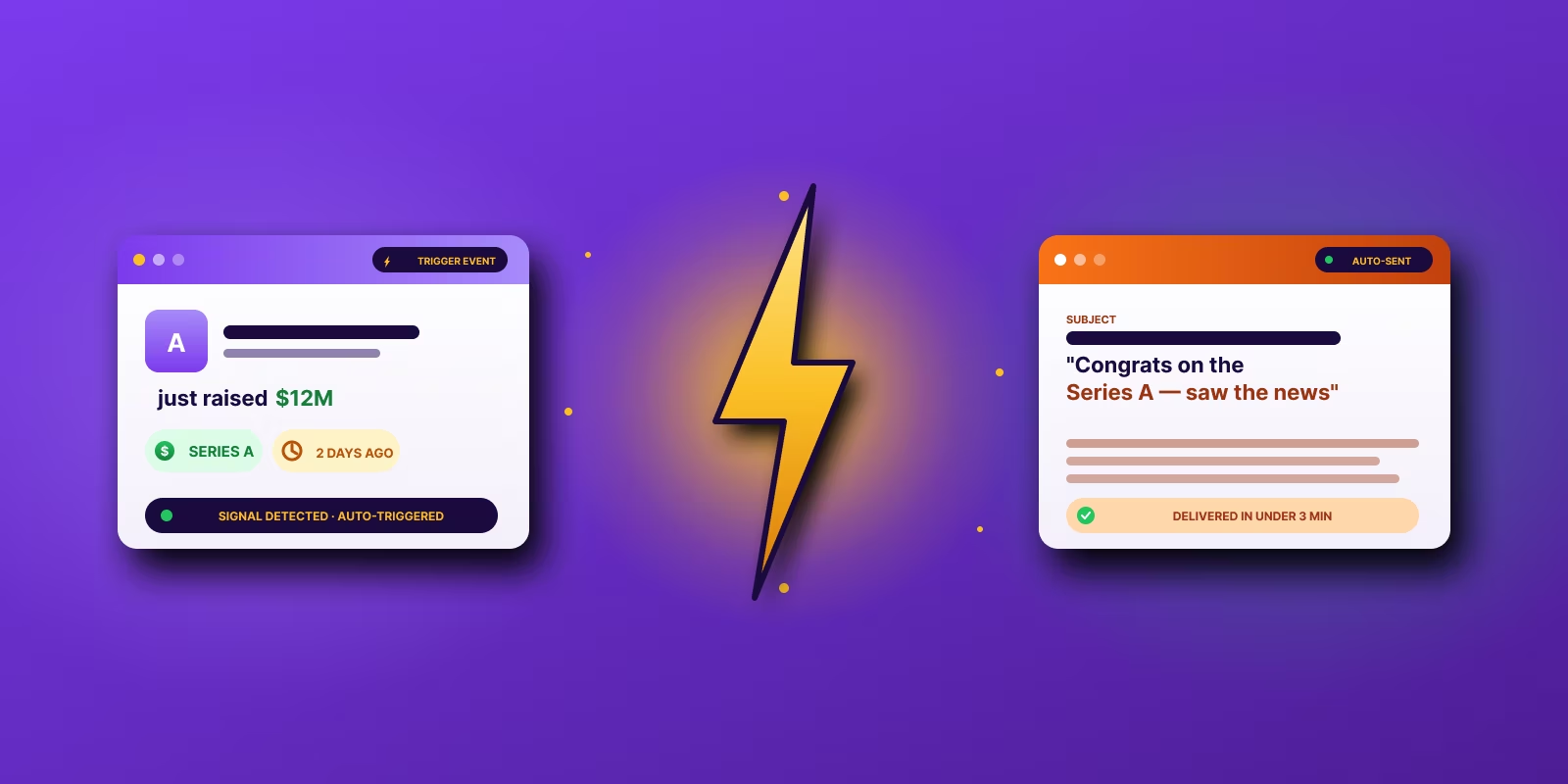
Most outbound doesn't fail because the cadence is too short or the SDR team isn't pushing hard enough. It fails because the message arrives when the buyer has no reason to care. Trigger based outreach fixes that by tying the outreach to a real event, not an arbitrary schedule. That event might be funding, a leadership hire, a product launch, a hiring push, or a tech change. The point is simple. You contact people when something changed, not because your sequence says it's day three.
Teams use trigger based outreach because it's built around concrete business events and real-time detection from news, press releases, social activity, and sales tools, then routes those accounts into customized multichannel campaigns instead of static prospecting as described here.
Your High Volume Outreach Is Probably Just Annoying People
If your current outbound play is “add volume until replies show up,” you're not building pipeline. You're building resentment.
A generic sequence sent to a cold list can still work in pockets, especially if the offer is tight and the market is narrow. But once you push volume without context, your message turns into inbox wallpaper. Prospects don't care that your team spent hours writing a six-step sequence. They care whether the email matches something happening inside their company right now.
Volume hides bad timing
This is the mistake I see most. Teams think poor performance means they need more contacts, more mailboxes, more LinkedIn sends, and more follow-ups. Sometimes they just need a reason to reach out.
When a company raises funding, hires a VP, expands a team, or changes part of its stack, priorities shift fast. Budgets move. New owners want early wins. Internal problems that were tolerable last quarter become urgent. That's when outbound stops feeling cold.
Generic outreach asks for attention. Trigger based outreach earns it by showing up at the right moment.
There's a big difference between “we help SaaS teams book meetings” and “noticed you're hiring outbound reps after a growth push, are you building pipeline internally or using outside capacity for ramp coverage?” Same channel. Same ICP. Totally different relevance.
What actually changes when you use triggers
You stop treating every account the same.
Instead of dumping everyone into one master sequence, you split accounts by event, write messaging around that event, and send the prospect into a path that matches what changed. That one shift cleans up half the nonsense in most outbound programs.
Triggers handle the timing. The outbound sales strategy guide covers the other parts a campaign needs: the ICP, the data, the offer and the sequence.
A lot of operators obsess over copy first. I wouldn't. Copy matters, but timing matters more. If you message someone at the wrong moment, even great copy gets ignored.
And if you message them at the right moment, average copy can still start a conversation.
Stop Guessing What a Good Trigger Is
Bad trigger selection breaks these campaigns before the first email goes out.
I see the same failure pattern in Clay builds all the time. Someone pipes in every funding alert, every job post, every press mention, every tech install, and calls it a trigger engine. Then Smartlead starts pushing sequences off weak signals, reply rates collapse, and the team blames copy. The problem started earlier. They never defined what deserves outreach.
Trigger quality hierarchy
High-intent triggers
Immediate need and strong potential to convert.
e.g. VP of Sales hire, funding roundMedium-intent triggers
Needs further qualification or has a longer sales cycle.
e.g. new Director hire, tech stack changeLow-value noise
Generic signals with little to no immediate relevance.
e.g. junior developer job post
High-intent triggers are tied to change
The triggers that perform best are attached to an operational shift with an owner, a budget implication, and a reason decisions need to happen now. Leadfeeder's guide to trigger events highlights funding rounds, executive hires, and growth signals as common categories. That lines up with what we see in live campaigns. A new VP, a hiring sprint in one department, or an expansion into a new market usually means somebody is being asked to fix or build something fast.
Here's the framework I use before I let any trigger into production:
| Trigger type | What it usually signals | Priority |
|---|---|---|
| Executive hire | New owner, new plan, vendor review | High |
| Funding event | Budget movement, expansion, urgency | High |
| Function-specific hiring surge | Team buildout, process gaps, tooling need | High |
| Tech stack change | Active evaluation or workflow shift | Medium to high |
| Product launch | New go-to-market pressure | Medium |
| Generic hiring post | Weak context without role relevance | Low |
The key is specificity. "Hiring SDRs" can be useful if they are adding eight reps in two months. "Hiring" by itself is junk. Same with tech signals. If they installed Gong, Salesforce, or HubSpot six months ago, that is trivia. If they just replaced a tool your service touches, that is a reason to message.
Low-value noise looks active, but it does not create demand
A lot of outbound teams confuse movement with intent.
A single junior engineering role is rarely a reason to contact the revenue leader. A random LinkedIn post about company culture is not a trigger. A generic press mention about growth with no change in headcount, leadership, budget, or systems usually goes nowhere. These events make dashboards look full. They do not create pipeline.
The test is simple. Ask four questions before you route anything into sequence:
- Who owns the change? Senior hires and team leaders matter more than general company activity.
- Did the event create a real project? One open req is weak. A concentrated hiring pattern often means a buildout.
- Is there a timing window? Leadership changes, funding, and stack swaps usually compress decision cycles.
- Does the trigger map directly to your offer? If the event does not connect to the problem you solve, skip it.
If a trigger fails two of those four checks, I do not send it.
Where to find triggers without wasting the SDR team's time
The source matters less than the logic. Clay works best when it acts as the filter, not just the bucket. We pull signals from multiple places, enrich the account and contact, score the event, then only pass qualified records into Smartlead once the trigger is clear enough to write around.
The core sources are straightforward:
- LinkedIn Sales Navigator for leadership changes and headcount movement
- Crunchbase and similar datasets for funding events
- Job boards and company career pages for hiring patterns
- BuiltWith and similar tools for stack changes
- News and press release monitoring for launches, expansions, and executive moves
Trade-off matters here. Broad sources give coverage, but they also create cleanup work. Narrow sources miss accounts, but the signal quality is better. In practice, I would rather miss some volume than flood reps with junk alerts they stop trusting after a week.
If you want a broader view of how signal-based prospecting fits into effective sales growth strategies, that resource is a useful comparison point. For a more detailed breakdown of signal types, scoring logic, and outreach use cases, Reachly published this guide on buying signals in B2B with signal stack examples and playbooks.
The Modern Stack for Trigger Based Outreach
A trigger-based system is just plumbing. Good plumbing matters.
Teams often don't fail because they lack ideas. They fail because the signal sits in one tool, the enrichment sits in another, the sequencing tool has no routing logic, and the CRM gets updated three days late by someone working from a spreadsheet.
The trigger-based outreach stack
Signal detection
Catch the trigger events that mean a buyer has the problem now.
Data enrichment
Verify the contact and score the account against the signal weights.
Outreach automation
Run the multichannel sequence across cold email, LinkedIn, and calling.
Performance tracking
Monitor reply rates, cut losers fast, and rotate winners before fatigue.
The stack I'd actually build
Keep it simple enough to maintain.
Start with an account source like Apollo or another similar platform if you need broad TAM coverage. Pull target accounts and core firmographic filters there, then move them into Clay. Clay becomes the working layer where you enrich, validate, classify the trigger, and create the fields your outbound tools need.
My default stack looks like this:
- Apollo or a contact discovery platform for account and contact discovery.
- Clay for enrichment, trigger detection, scoring, and routing logic.
- Smartlead for email infrastructure and sequence execution.
- HeyReach for LinkedIn sequence coordination across sender accounts.
- CRM for lead ownership, pipeline status, and reporting.
What each tool should do
Don't make one tool do five jobs badly.
Clay should answer questions like: Did this account raise funding recently? Did they add leadership in sales or marketing? Are they hiring SDRs in multiple regions? Did their stack change? Once those fields are populated, you can create conditional paths.
For example:
- If
new_vp_sales = yes, send to Sequence A - If
funding_event = yesandheadcount_growth = yes, send to Sequence B - If
tech_change = yes, send to Sequence C - If trigger confidence is low, hold for review
The best trigger system isn't the one with the most signals. It's the one that routes cleanly and doesn't create manual cleanup every morning.
Smartlead is where email happens. Use it for mailbox rotation, inbox management, sequence branching, and reply handling. HeyReach handles the LinkedIn side if you want connection requests and follow-ups tied to the same trigger window.
If you need scraper-style automations for pages that don't expose data cleanly through normal providers, some teams also Browse AI agent tools to pull updates from public web pages into their workflow.
For a broader tool shortlist beyond this exact stack, this Reachly post on the best B2B lead generation tools is a useful reference.
One practical note on operations
Many teams, at this point, give up without fanfare.
If your system depends on one ops person manually exporting CSVs every week, it isn't a system. It's a recurring failure point. The trigger should enter Clay automatically, enrich automatically, and push to the right channel automatically unless the confidence score is too weak. Human review should be the exception, not the default.
Reachly runs this kind of setup as a service for teams that don't want to own the build, but the underlying model is the same whether you do it in-house or outsource execution.
From Signal to Sequence The Complete Workflow
A trigger is only useful if it turns into a sequence without breaking deliverability or creating cleanup work for the team.
That is where a lot of outbound programs fail. The signal is real, but the handoff is sloppy. Clay finds the event, someone exports a list, another person guesses at the contact, and Smartlead gets a sequence with weak context fields. The result is predictable. Bad timing, wrong recipients, generic copy, and reply rates that never justify the effort.
The actual workflow
This is the production workflow we use when building trigger systems in Clay and Smartlead.
- Capture the signal in Clay. Pull the account into a trigger table from your source, then timestamp the event so timing stays visible.
- Filter for ICP fit. Remove companies that match the trigger but do not match deal size, geography, industry, or sales motion.
- Map the buying owner. Tie the trigger to the person most likely to care. A hiring trigger often goes to the team leader. A funding trigger often goes to the operator responsible for growth.
- Verify contact data. Check work email, job title, and recency before anything enters a live sequence.
- Write structured context fields. Add short variables for the event, the likely business consequence, and the offer angle.
- Route into the right Smartlead campaign. Different triggers need different timing, sending identities, and follow-up logic.
- Watch performance by trigger type. Review reply quality, positive replies, and bounce rates at the trigger level, not just at the campaign level.
That flow sounds simple. It only stays simple if the routing rules are strict.
What it looks like in the tools
Say Clay catches a company that hired a new VP of Sales this week.
The wrong move is sending the same generic sequence to the CEO, CRO, and a few reps because they all look relevant in a spreadsheet. The right move is narrowing the list to the new VP of Sales and one nearby operator if the org chart supports it. Then add two useful fields in Clay. One for the observed event. One for the likely consequence, such as pipeline coverage pressure or ramp speed. Push that record into a Smartlead sequence built for leadership transitions, not a general outbound campaign.
Bad message:
Saw your company is growing. We help B2B teams generate more leads through multichannel outbound. Open to a quick chat?
Message that has a reason to exist:
Congrats on the VP of Sales hire. New sales leadership usually means coverage targets show up before the team is fully ramped. Are you planning to build outbound entirely in-house, or add support while the new team settles in?
That difference is the whole model. If you need more examples of how we build those custom fields into live campaigns, this guide to cold email personalization workflows that use real account context covers the mechanics.
Protect deliverability before you add volume
Trigger based outreach breaks fast when teams treat every signal like permission to scale.
Keep outbound email on separate sending domains. Segment mailbox groups by client, offer, or market so one bad campaign does not contaminate the rest. Spread sends across multiple inboxes instead of forcing volume through a small set of mailboxes. Use the same rule for LinkedIn activity. If one profile is doing all the work, you are creating account risk and making reply patterns harder to diagnose.
Poor reply quality is usually a targeting or messaging problem. It is rarely fixed by increasing daily volume.
A practical companion resource here is EmailScout's guide on how to automate email campaigns for sales outreach. It is useful for teams still handling trigger timing, list movement, and sequence enrollment manually.
Operating checklist before a lead enters sequence
- Signal quality: Did something happen that creates a real reason to reach out now?
- Account fit: Is this company still inside the ICP after enrichment?
- Contact ownership: Does this person own the problem created by the trigger?
- Context fields: Do the variables explain the event and why it matters in plain English?
- Sequence match: Is the lead entering the campaign built for this trigger, not a catch-all sequence?
- Sending capacity: Do you have enough healthy inboxes and profiles to distribute the load safely?
When a trigger campaign misses, the failure is usually in one of those six checks. After running hundreds of these builds, that has been the pattern more often than anything else.
Triggers are one of several approaches compared in sales prospecting techniques.
Writing Messages That Acknowledge the Moment
Good trigger data gets wasted by bad writing every day.
Teams find the signal, build the workflow, and then send a message that could have gone to anyone. That kills the whole advantage. Trigger based outreach works because the message matches the moment. If the copy sounds generic, you're back to normal outbound with extra steps.
Crafting trigger-based messages
Personalized messages
Higher engagement
Messages resonate directly with the recipient's situation.
Improved conversion
Leads to more meaningful conversations and better outcomes.
Builds rapport
Shows understanding and establishes trust.
Generic messages
Low response rates
Often ignored or marked as spam.
Damages credibility
Appears untargeted and unprofessional.
Wastes resources
Inefficient use of time and tools.
The structure that works
Most strong trigger-led messages have four parts:
| Part | What it does | Example |
|---|---|---|
| Trigger mention | Proves relevance | Saw you've started hiring SDRs in Singapore |
| Consequence | Shows you understand the pressure | That usually means pipeline coverage matters before the team fully ramps |
| Offer angle | Connects your service or product to that pressure | We help teams add outbound coverage across email, LinkedIn, and phone |
| Low-friction CTA | Keeps the ask easy | Worth comparing notes? |
That's it. You don't need a founder story, three credentials, and a paragraph about your platform.
Examples by trigger type
A funding message should sound different from a leadership-change message. If it doesn't, your personalization is fake.
New funding
- Subject line: Congrats on the raise
- Email opener: Saw the funding news. Teams usually hit a weird stretch right after this where growth targets jump before systems catch up.
- CTA: Are you adding pipeline capacity internally, through partners, or both?
New VP of Sales
- LinkedIn note: Congrats on the new role. New sales leaders usually inherit target pressure before they inherit a fully built machine.
- Follow-up email: If outbound coverage is one of the gaps you're fixing first, I can share how other teams structure multichannel testing during ramp.
Tech stack change
- Cold call opener: Calling because your team appears to have changed part of the stack recently, and that usually creates short-term process gaps. Curious if this is tied to a broader GTM rebuild or just one workflow change.
If your message only mentions the trigger but doesn't explain why it matters, it still feels generic.
What usually ruins the copy
The biggest mistakes are predictable.
- They overexplain the trigger. One line is enough. Don't sound like a surveillance report.
- They center themselves too fast. “We are a leading provider…” gets ignored.
- They ask for too much. Don't lead with a long demo ask.
- They confuse personalization with flattery. Congratulating someone isn't enough if there's no insight after it.
- They track the wrong metric. Opens can be noisy. Positive replies tell you whether the message landed.
There's also a channel mistake. Teams copy the same wording into email, LinkedIn, and call scripts. Bad move. The idea should stay consistent, but the format needs to fit the channel. LinkedIn should be lighter. Email can hold more context. Calls need a sharp reason for the interruption.
If you want a more detailed breakdown of how to personalize without sounding forced, Reachly's guide to cold email personalization is worth reading.
A before-and-after example
Bad:
Hi Sarah, I wanted to reach out because we help companies like yours improve outbound performance with personalized multichannel campaigns. Would you be open to a quick intro call?
Better:
Hi Sarah, noticed you've started hiring account executives after expanding the sales team leadership. That usually creates pressure to fill pipeline before new reps are fully productive. If outbound coverage is part of that plan, I can share a simple way teams handle it without waiting for full internal ramp.
The second one sounds like a person who understands the situation. That's the whole job.
Measuring Success and Avoiding Campaign-Killing Mistakes
Trigger campaigns fail in boring ways.
The trigger is weak. The contact is wrong. Verification runs too late. Every signal gets pushed into the same sequence. Then the team blames channel performance when the core problem is setup.
The scorecard needs to reflect that reality. I do not care about opens unless I am debugging deliverability. I care about whether a specific trigger, sent to a specific persona, creates a sales conversation.
The dashboard that actually helps you make decisions
Keep the reporting close to the workflow in Clay and close to sending performance in Smartlead. If the data lives in a slide deck, nobody fixes anything fast enough.
Watch these first:
- Positive reply rate by trigger type: The best read on trigger quality and message fit.
- Meetings booked by trigger type: Which signals produce pipeline, not just curiosity.
- Bounce rate by domain and mailbox: This catches verification problems and sending issues before they spread.
- Reply sentiment: Neutral and negative replies matter. They tell you whether the trigger felt off, invasive, or mistimed.
- Stage progression after booking: A trigger can book calls and still be low quality if nothing moves past discovery.
One more metric matters in practice. Time from trigger detection to first touch. If a company posts a VP Sales hire on Monday and your sequence starts nine days later, you are running historical outreach, not trigger based outreach.
Common mistakes that kill performance
1. Mixing unlike triggers into one sequence
Funding, hiring, tech changes, leadership moves, and expansion events do not belong in the same path. They signal different problems and different priorities.
In Clay, each trigger type should get its own qualification logic, owner logic, and sequence path. If we see sales hiring, we route toward revenue leadership. If we see a new territory launch, we often route by region owner or GTM lead. That sounds obvious, but it frequently leads to campaign failure.
2. Verifying too late
Verification should run before the contact ever reaches Smartlead.
Our standard setup is simple. Clay enriches the record, assigns the likely owner, runs verification, stamps the verification date, and only then pushes passing records into the right campaign. Failed records stay in a review table or get recycled for another contact at the same account. If you wait to spot bad emails after send, you are already paying for the mistake with bounces and sender damage.
3. Treating the company signal as enough
A real event at the account level does not automatically mean every senior person is relevant. A company can announce aggressive hiring while the CFO has nothing to do with outbound coverage, sales capacity, or pipeline generation.
Owner mapping matters as much as the trigger itself. Good campaigns pair event, problem, and operator. Miss one of those and reply quality drops fast.
4. Scaling before the message is proven
Teams get a few weak results and respond by adding volume or opening more mailboxes. Bad move.
If positive replies are low, check three things in order. Trigger quality. Contact mapping. Message angle. Mailbox scale comes after that. Smartlead can help you distribute volume, but it cannot rescue a weak reason to reach out.
5. Breaking the handoff after the reply
A trigger-aware first email followed by a generic booking page, generic case study, or generic discovery call loses momentum. The follow-through should match the event that started the conversation.
Our lead generation for marketing agencies playbook shows one full signal campaign end to end, from the trigger list to the booked meeting.
If the outreach is tied to hiring, the call should focus on ramp pressure, rep productivity, and pipeline coverage. If it is tied to expansion, the follow-up should stay on territory buildout, new market demand, or partner gaps. Relevance has to survive past the first reply.
A simple diagnosis table
Use this before changing anything.
| Symptom | Likely issue | First fix |
|---|---|---|
| Good opens, weak positive replies | Trigger is real, but the message angle is weak | Rewrite the first two lines around the business consequence of the event |
| High LinkedIn acceptance, low response | Persona fit is decent, ask is too generic | Tighten the CTA and make the value specific to the trigger |
| Bounce rate spikes in one campaign | Verification step failed or stale records got pushed | Audit the Clay handoff, reverify, pause the affected mailboxes |
| Negative replies mention irrelevance | Contact-owner mapping is wrong | Change persona rules for that trigger type |
| Meetings book but do not progress | Trigger gets attention but does not map to buying intent | Drop or narrow the trigger, then review notes from the calls |
A healthy campaign usually looks plain. The same trigger types keep producing acceptable reply quality. The same mailboxes stay stable. The same routing rules keep passing clean records into the right sequences. That is what you want.
If you want someone else to run that system, Reachly handles trigger-led outbound across email, LinkedIn, and phone, using Clay, Smartlead, and signal-based targeting in the operating workflow.
Recommended service
Outbound Lead Generation Services
Reachly builds and runs the whole outbound motion across email, LinkedIn, and phone, and books qualified meetings on your calendar.