

 Key Findings
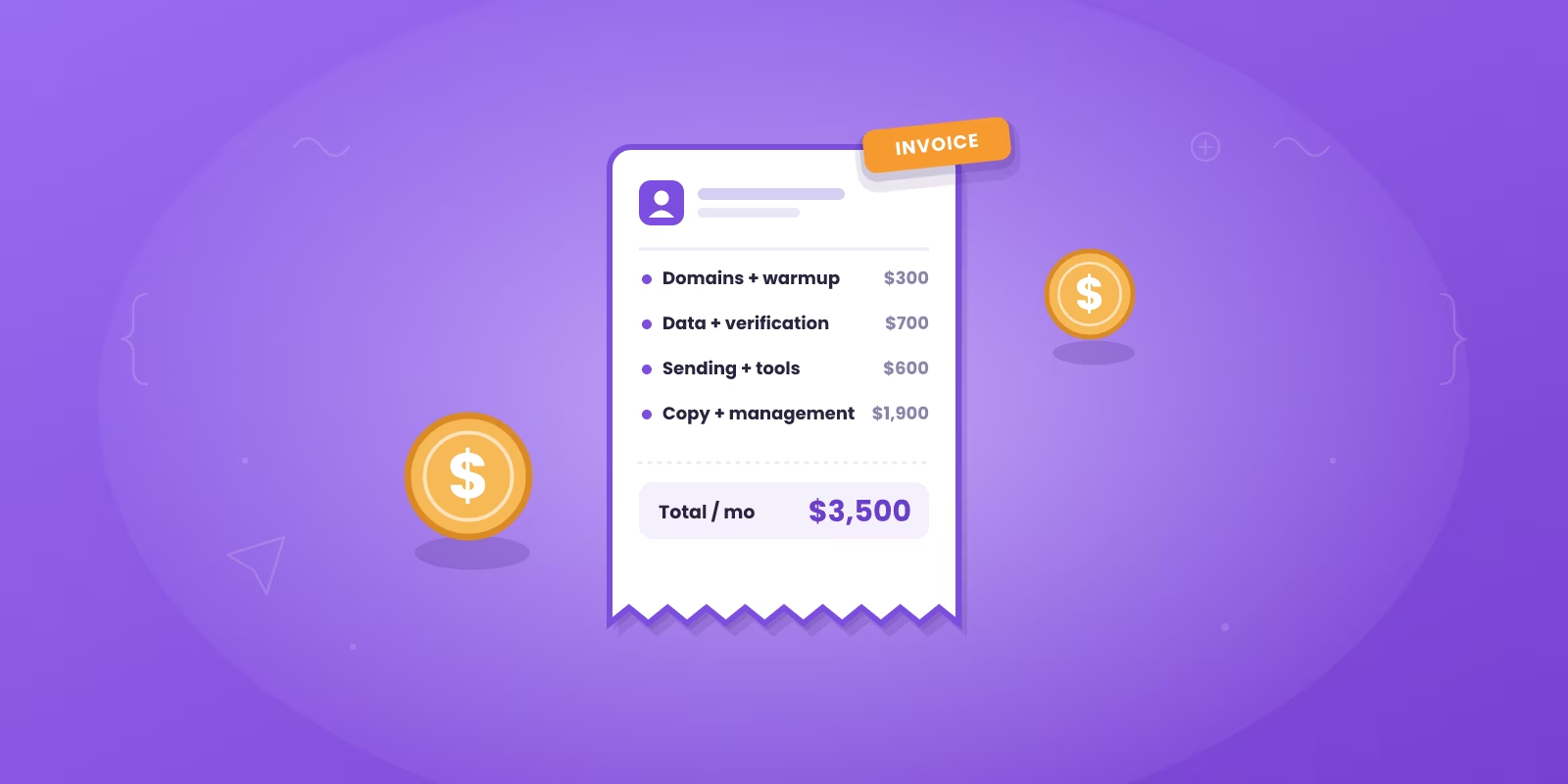
Full-service lead generation agencies charge a monthly retainer between $3,500 and $12,000, with omnichannel programs reaching $20,000 or more. Pay-per-lead deals land anywhere from $25 to over $400 per lead.
A retainer buys a full system and keeps quality high. Pay per lead looks safest but rewards volume over fit. Pay per appointment only bills for booked meetings, provided the qualification bar is written down and tight.
Cost per lead runs from about $30 on outbound to $900 for events. A low-cost lead from an unverified list bounces, damages deliverability, and books nobody, which makes it pricier than a targeted lead that actually replies.
ICP difficulty, number of channels, volume, whether infrastructure is included, and depth of signal-based personalization move the price. A low quote that excludes domains, warmup, and data is not cheaper, it just moves the bill to you.
Across 400+ campaigns, a weak offer sits near a 0.5 percent reply rate at any budget. One Reachly client returned 4.57x with break-even by month three, which makes the offer, not the invoice, the number that decides whether an agency is worth the cost.
A lead generation agency costs $3,500 to $12,000 a month on a retainer for most B2B programs, $25 to over $400 per lead on pay-per-lead deals, or a set fee for each booked meeting on pay-per-appointment. Reachly, a B2B outbound agency, charges one flat retainer from $3,500 a month that covers the data, the sending domains, the copy, reply handling and meeting booking, and delivers 10 to 40 interested leads a month depending on volume.
TL;DR: Summary
- Most B2B lead generation agencies charge a flat monthly retainer of $3,500 to $12,000, with full omnichannel programs running to $20,000 or more.
- Unit pricing is the other half of the market: $25 to $400+ per delivered lead, or $150 to $1,000+ per booked qualified meeting.
- Five things move a quote: how hard your ICP is to reach, how many channels you run, the volume you need, whether sending infrastructure is included, and how deep the personalization goes.
- The stack behind 30,000 emails a month costs roughly $3,600 to $6,100 a month to run before any margin, which is why quotes far under that exclude something you will end up paying for.
- Cost per lead is the most misleading number in the exercise. A $30 lead from an unverified list can cost more than a $300 lead that actually replies, once you count domain damage and wasted rep time.
- Reachly runs cold email, LinkedIn and cold calling as one signal-based system on a flat retainer from $3,500 a month. See what is included on the outbound lead generation page.
How much does a lead generation agency cost in 2026?
Most B2B lead generation agencies charge a monthly retainer between $3,500 and $12,000, with full omnichannel programs running to $20,000 or more and pay-per-lead deals landing anywhere from $25 to over $400 per lead. The spread is wide because "lead generation" covers everything from a freelancer scraping a list to a done-for-you team running cold email, LinkedIn, and cold calling as one system with the sending infrastructure included.
Here is the fast version by pricing model, then the detail on each one below.
| Pricing model | How you pay | Typical 2026 range | Best for |
|---|---|---|---|
| Monthly retainer | Flat fee for a defined scope of work | $3,500 to $12,000 a month, omnichannel up to $20,000+ | Teams that want a full system and predictable spend |
| Pay per lead | Fixed price for each delivered lead | $25 to $400+ per lead | Low commitment testing, with real quality risk |
| Pay per appointment | Price per booked, qualified meeting | $150 to $1,000+ per meeting | Teams that only want to pay for meetings on the calendar |
| Hourly or project | Time billed, or one scoped deliverable | $50 to $200 an hour, or $1,000 to $10,000 per project | One-off list builds, audits, or campaign setup |
| Commission or revenue share | Percentage of closed deal value | 10 to 20 percent of the deal | Rare in B2B, aligns incentives but hard to attribute |
Notice what the table does not say: it never claims one model is cheaper than the others. A $50 lead can cost you more than a $10,000 retainer once you count the ones that never pick up the phone. Price and cost are not the same thing, which is the whole game with outbound lead generation pricing.
Which lead generation pricing model should you pay for?
Every quote you get is really a bet on who carries the risk. Understand who is on the hook when a campaign underperforms and the price tags start to make sense.
A monthly retainer is the standard for full-service B2B outbound. You pay a flat fee, the agency builds and runs the machine, and you own the pipeline it produces. This is where most serious lead gen lives because outbound needs domains, warmup, data, copy, and daily management that only make sense as a system. The risk sits with you month to month, which is why the good agencies earn the retainer by showing pipeline fast rather than hiding behind a twelve-month lock-in.
A pay-per-lead model looks safest and often is the most expensive per real opportunity. You pay a set price for each lead delivered, so the agency is incentivized to deliver volume, not fit. That is fine for a broad, high-velocity motion, and a trap for a niche B2B offer where ten wrong leads are worth less than one right one. Read the definition of a "lead" in the contract before anything else.
A pay-per-appointment deal moves the goalpost to a booked meeting, which is closer to what you actually want. You pay $150 to $1,000 or more per qualified meeting, so the agency only wins when a real prospect shows up. The catch is the qualification bar. A meeting with someone who has no budget and no authority is still billable, so the definition of "qualified" has to be tight and written down.
Hourly and project pricing suits one-off work: a list build, a deliverability audit, a campaign setup you will run yourself. It is the wrong model for ongoing pipeline because outbound is a testing loop, not a single deliverable, and hourly billing punishes the iteration that makes it work.
| Dimension | Monthly retainer | Pay per lead or appointment |
|---|---|---|
| What you pay for | A full system and a team running it | A unit: one lead or one booked meeting |
| Cost predictability | Fixed and known each month | Variable, scales with volume delivered |
| Lead quality control | High, targeting and copy are shared and tuned | Lower, the incentive rewards volume over fit |
| Who owns the infrastructure | The agency, included in the fee | The agency, but you rarely see or keep it |
| Where the risk sits | With you, month to month | Split, but quality risk lands on you |
| Best for | A real B2B motion you want to own | Broad, high-volume, less niche offers |
If you already have a proven, repeatable motion and want to keep the knowledge in house, a retainer that hands you the whole system is the better long-term buy. If you are still testing whether the offer lands, a small pay-per-appointment pilot can be a cheaper way to see signal before you commit.
What do you actually pay per lead, and why are cheap leads a trap?
Cost per lead is the number founders fixate on, and it is the most misleading one in the whole exercise. The channel decides most of it, and the same "lead" means wildly different things across channels. Published 2026 pricing guides put the per-lead cost anywhere from around $30 on a well-run outbound program to more than $800 for an event or trade-show lead.
| Channel | Typical cost per lead | What you are really paying for |
|---|---|---|
| Cold email and outbound | $30 to $200 | Data, domains, sending stack, copy, and management |
| LinkedIn outreach | $50 to $300 | Account warmup, connection cadence, and manual replies |
| Content and SEO | $30 to $200 | Slow to start, then compounds and lowers over time |
| Paid search and social | $50 to $400 | Ad spend on top of management, stops when you stop paying |
| Public relations | Around $300 | Brand reach, hard to attribute to a specific deal |
| Events and trade shows | $600 to $900 | Booth, travel, and staff time per captured lead |
The trap is treating a $30 lead and a $300 lead as the same purchase. A cheap lead from a scraped, unverified list bounces, damages your domain reputation, and books nobody. A more expensive lead from a signal-based, verified, well-targeted campaign actually replies. This is why a low cost per lead can be the most expensive line in your budget once you count deliverability damage and wasted rep time. The way to protect against it is upstream, in how you qualify leads before a single one gets counted.
What drives a lead generation agency's price up or down?
Two agencies can quote the same logo and land $8,000 apart. The gap is almost always explained by these five factors, and knowing them lets you read a quote instead of just reacting to it.
Run any quote through those five factors and the number stops looking arbitrary. A $3,500 single-channel program and a $12,000 signal-based omnichannel program are not the same product at different prices. They are different products. The right question is which one fits the motion you are trying to build, which is the same discipline behind a modern outbound sales strategy.
What does it cost an agency to run the program you are buying?
Almost nobody publishes this, which is why a $1,200 quote and a $6,000 quote look like the same product with different greed attached. Here is the real line-item cost of running one client at 30,000 emails a month, taken from our own build, before anyone is paid a margin.
| Line item | What it covers | Cost |
|---|---|---|
| Domains | 72 secondary domains bought so the main domain never carries send risk | About $900 one-off |
| Mailboxes | 180 mailboxes, warmed and rotated | $640 a month |
| Contact data | 45,000 leads over three months, sourced and normalized at about $0.01 each | About $450 |
| Email verification | 45,000 verification credits so bounce rate stays low | About $500 |
| Sequencing platform | Sending, rotation and reply sync | $50 to $150 a month |
| The person running it | One GTM engineer, or an operator plus a strategist, who writes the angles and builds the campaigns | $2,500 to $5,000 a month |
Spread the one-off and quarterly items across a month and the floor lands around $3,600 to $6,100 a month before margin, office, tooling or account management. That is the arithmetic behind the ranges in the first table. A $1,500 retainer at this volume is not a cheaper version of the same program. Something in that list is missing, and in practice it is usually the verification, the domain spread, or the person who writes the copy.
The last line is the one that resists volume. Data and mailboxes get cheaper per unit as sending rises, while the human who decides what to say to whom does not, which is the real reason a researched, personalized program costs more than a mass send.
What should you expect for your monthly budget?
The useful way to read a quote is to ask what that number can physically buy once the stack above is paid for. These are realistic expectations by band for a B2B motion with a defined ICP.
| Monthly budget | What it buys | What to expect |
|---|---|---|
| Under $2,000 | One channel, low volume, usually LinkedIn or email sent on shared infrastructure | A test of whether the offer lands. Treat any pipeline as a bonus |
| $2,000 to $3,500 | One channel run properly, or two channels run thin, with basic verification | Early reply signal, enough to judge the offer and the list |
| $3,500 to $6,000 | A full done-for-you system: dedicated domains, verified data, written and tested copy, reply handling and meeting booking | Reachly clients in this band see first meetings 2 to 6 weeks after launch and predictable volume by month 3 |
| $6,000 to $12,000 | Higher volume, deeper per-account research, cold calling added to email and LinkedIn | Coverage of a larger TAM and more meetings per month from the same ICP |
| $12,000 and above | Multiple pods, several regions or languages, dedicated account direction | Enterprise motions with long cycles and named-account plans |
Our own service sits in the third band. Reachly is a flat retainer from $3,500 a month covering the data, the sending infrastructure, the copy, reply management and meeting booking, and clients see 10 to 40 highly interested leads a month depending on volume. Anything that promises enterprise output on a budget-band fee is quoting on a list, not a system.
What should a real agency price include?
A serious retainer is not just people sending emails. It is a working outbound system, and the fee should cover every piece of it. When you compare quotes, compare what is inside the number, not just the number. A complete program includes domains bought and warmed for at least 30 days, a configured sending platform, contact data sourced and verified, signal-based targeting, copy written and tested, multichannel management across cold email, LinkedIn, and cold calling, and reporting you can actually read.
The reason infrastructure matters so much to the price is deliverability. If the domains are not warmed and the authentication is not set up, the emails never land, and you pay for sends that hit spam. A serious agency verifies every contact before a single send and reviews placement, bounce and reply rates every week, and that discipline is baked into the retainer. Cutting it is how a "cheap" program quietly stops working, which is why the fundamentals in our guide to cold email best practices are non-negotiable at any price.
Our take: The most expensive lead generation is the kind that looks cheap on the invoice and produces nothing. A low retainer that skips warmup, data verification, and signal targeting is not a discount. It is a slower way to burn the same budget with worse results.
Is a lead generation agency worth the cost?
The cost only means something next to the return, and the return depends almost entirely on one thing most pricing pages ignore: the offer. Across the campaigns we run the pattern is consistent. Teams with clean infrastructure and a weak offer sit near a 0.5 percent reply rate no matter what they pay. The same setup with a direct, question-based offer moves to well over 1 percent. The agency sets your ceiling. The offer decides whether you reach it.
Cold email is a marketing experiment. You test offer, angle, CTA, copy, and audience until something converts. Founders who will not budget for that test loop should not be running outbound yet. The cheapest agency behind a weak offer is expensive. A pricier agency behind an offer too good to say no to is the best money in the budget.

Put real numbers on it. For Primal, our program produced 85+ qualified leads in six months, a 4.57x return, and break-even by month three, with an 8 percent average positive reply rate, a 35 percent reduction in cost to acquire a customer, and zero added headcount on their side. Against a retainer of a few thousand a month, that is not a cost. It is the highest-return line in the budget. The way to sanity-check any quote against your own numbers is to run it through an ROI calculator before you sign.
The other half of "worth it" is speed. A single in-house rep is a six-figure fixed bet that takes months to ramp. An agency turns that into a variable cost that produces pipeline in weeks, and it does it with signal-based outbound that no single new hire could run alone. If the offer is right, the agency almost always pays for itself faster than the alternative.
How does Reachly price lead generation?
Reachly is a done-for-you B2B outbound agency running cold email, LinkedIn, and cold calling as one signal-based system. Pricing starts at $3,500 a month, and the exact number depends on the five factors above: how hard your ICP is, how many channels you run, the volume you need, and the depth of personalization. We are live for a client in two to three weeks because the infrastructure and playbooks already exist, and the fee includes domains, warmup, data, verification, copy, and daily management, not a stripped-down base with add-ons.
For Primal that system returned 85+ qualified leads in six months, 4.57x on spend and break-even by month three. If you want to see how the same fee compares against named agencies and their published starting prices, we keep a reviewed list of the top B2B lead generation agencies. For the exact number for your motion, the fastest path is a short call so we can scope it against your ICP and goals. Start on the Reachly homepage, or if appointments are the only unit you care about, see how B2B appointment setting works.
Find out what your pipeline actually costs
Tell us your ICP, your volume and your target, and we will scope the exact retainer against it. Flat fee from $3,500 a month, infrastructure included, first meetings 2 to 6 weeks after launch.
See how it works
Lead generation agency cost FAQ
Most B2B lead generation agencies charge a monthly retainer between $3,500 and $12,000, with full omnichannel programs running to $20,000 or more. The number depends on how hard your ICP is to reach, how many channels you run, the volume you need, and whether infrastructure like domains and data is included in the fee. A low quote often excludes those costs rather than removing them.
Reachly sits at the low end of that band. Our outbound lead generation service is a flat retainer from $3,500 a month, covering the data, the sending infrastructure, the copy, reply handling and meeting booking, with first meetings 2 to 6 weeks after launch.
It ranges from about $30 to $200 for a well-run outbound or content program, $50 to $400 for paid channels, and $600 to $900 for events and trade shows. A reasonable cost per lead is less about the dollar figure and more about quality. A cheap lead from an unverified list that bounces is more expensive than a pricier lead that actually replies and books the meeting.
Pay-per-appointment deals land between $150 and $1,000 or more per qualified meeting, and the spread is almost entirely about seniority and how narrow the ICP is. A meeting with a VP at a 500-person company in a niche vertical costs several times a meeting with an SMB owner. Before agreeing to a per-meeting price, get the definition of "qualified" written into the contract, because a meeting with someone who has no budget and no authority is still billable.
It looks cheaper because you only pay for delivered leads, but it is often more expensive per real opportunity. Pay-per-lead rewards the agency for volume rather than fit, so a niche B2B offer can end up paying for leads that never convert. A retainer or a pay-per-appointment model usually protects quality better because targeting and copy are tuned rather than mass-produced.
Around $1,200 to $2,500 a month once you count everything: roughly 25 domains, 60 mailboxes at about $3.50 each, contact data at about a cent per lead, verification credits, and a sending platform. That is the raw stack with nobody running it. Add the person who writes the angles and manages replies and the real floor is closer to $3,500, which is why that number shows up as the entry retainer across the category.
A workable rule is that your monthly outbound spend should be under a third of the revenue from one closed deal. If your average deal is $30,000 at a 20 percent close rate, a $5,000 a month program only needs to close one deal a quarter to pay for itself. Below about $2,000 a month you are buying a test rather than a pipeline, and the test is still worth running before you commit to a year.
Enterprise programs run $12,000 to $30,000 a month or more, usually priced per pod covering one region or language. Multi-region coverage means multiple pods, so an international program can pass $50,000 a month. What you are paying for at that level is named-account research, multiple dedicated SDRs, a dedicated account director and coverage across time zones, not simply more sending volume.
Domains bought and warmed for at least 30 days, a configured sending platform, contact data sourced and verified, signal-based targeting, copy written and tested, multichannel management across cold email, LinkedIn and cold calling, reply handling, meeting booking, and reporting you can read. If a quote excludes domains, data or verification, those costs have moved to you rather than disappeared.
Because they are selling different things under the same label. A $500 program is usually one channel, a bought list and an automated sequence with light review. A $12,000 program is a research-led, multichannel system with dedicated infrastructure and a team tuning it weekly. Both can be honest prices. Only one of them can work for a niche ICP with a long sales cycle.
On paper an SDR salary looks comparable to a mid-band retainer, but the loaded cost is higher once you add tooling, data, management time and three to six months of ramp during which you pay full cost for very little pipeline. An agency turns that fixed bet into a variable cost that produces pipeline in weeks. In-house wins later, when the motion is proven and you want the knowledge to stay in the building.
It is worth it when the offer is strong and the agency includes real infrastructure. For one Reachly client the program returned 4.57x with break-even by month three and a 35 percent reduction in cost to acquire a customer. The agency sets the ceiling, but the offer decides whether you reach it, so pressure-test the offer before you argue about the price.
A good agency is usually sending inside two to three weeks because the domains, warmup, tools and playbooks already exist. First meetings typically come 2 to 6 weeks after launch, and volume becomes predictable around month 3. Anyone promising meetings in week one is sending to a bought list from a domain they did not warm.
Most ask for a 3 to 6 month minimum, and there is a real reason for it: domain warmup alone takes the first month, so a 30-day contract cannot show you the result you are buying. Month-to-month after an initial term is a fair structure. A 12-month lock-in with no performance review built in is worth pushing back on.
Domain damage, mostly. Sending volume from unwarmed domains to unverified contacts gets your sending reputation flagged, and rebuilding it takes months during which nothing you send lands, including from your main domain if it was in the rotation. The second cost is rep time spent on leads that were never in the ICP. Both show up after the invoice, which is why they are easy to miss when comparing quotes.
Recommended service
Outbound Lead Generation Services
Reachly builds and runs the whole outbound motion across email, LinkedIn, and phone, and books qualified meetings on your calendar.