
GTM engineering is the practice of building the automated systems that turn buying signals into outbound pipeline: the account data, the enrichment, the sending infrastructure, and the reply handling. A GTM engineer builds and owns that system instead of working lists by hand. Demand for the role is real: an analysis of 1,000 job postings found 205% year-over-year growth in listings and a median advertised base salary of $127,500.
Key Findings
- A GTM engineer builds and owns the systems that turn buying signals into outbound campaigns: data, enrichment, sending infrastructure, and reply handling.
- Job postings for the role grew 205% year over year, and employers ask for 4.11 years of experience on average.
- Median advertised base pay is $127,500. The US in-house median is $135,000, and senior roles at the top payers reach $252,000.
- Coding ability is the biggest pay variable, worth $40,000 to $45,000 between low-code operators and high-code engineers.
- A full-time hire costs around $300,000 in year one. Reachly runs the same function as a managed outbound service from $3,500 a month, with first meetings within 10 days on pre-warmed domains, or 5 to 6 weeks from kickoff on branded domains.
- Signal-based campaigns built this way produced 85+ SQLs in six months for Primal, at 4.57x ROI and a 35% drop in CAC.
Reachly is a Clay Solutions Partner and runs GTM engineering as a service, so the cadence, scorecard, and plays below come from systems we build and run for clients every week.
What Is GTM Engineering?
GTM stands for go-to-market, and GTM engineering is the work of designing, building, and maintaining the systems behind outbound pipeline. Those systems find the right accounts, enrich them with buying signals, trigger outreach when a signal fires, and route replies to a seller. People stay on the conversations that need a person.
The short version: an SDR works the list, and a GTM engineer builds the machine that produces the list, writes the context into each row, and decides when to send. One builder with a Clay and AI stack now covers prospecting work that used to need several reps, which is why companies started hiring the title before they could define it.
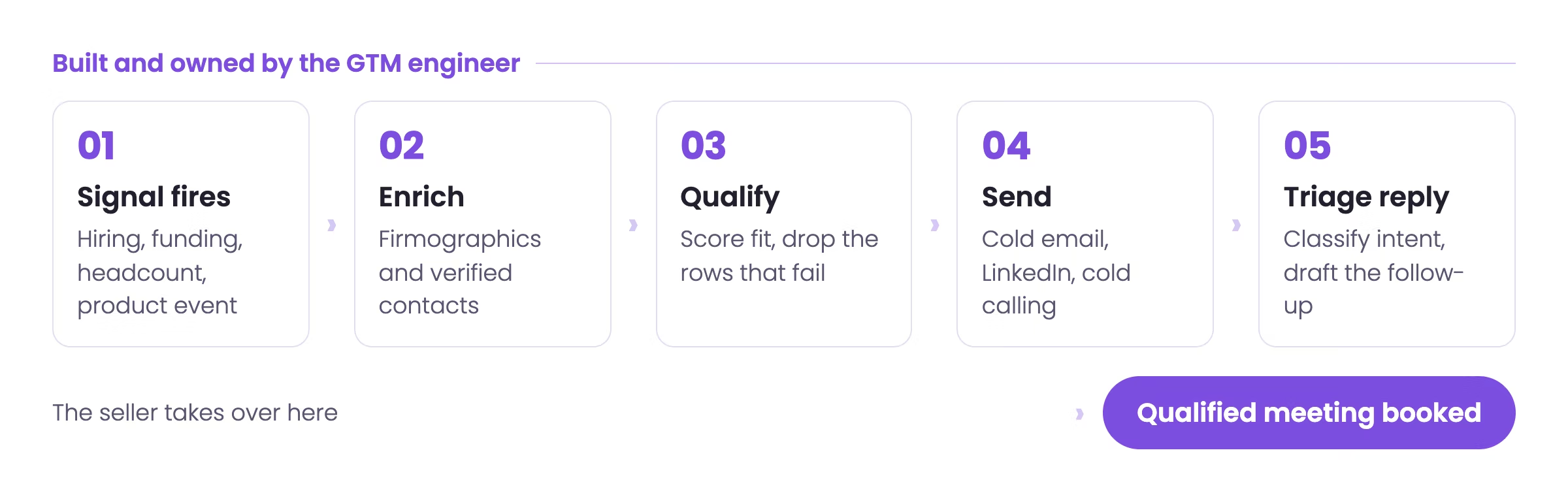
Clay popularized the term in 2023 and describes the job as building revenue engines with AI and automation. In practice it is systems work across five layers.

What a GTM Engineering System Does
GTM engineering and Google Tag Manager
The two share initials and nothing else. Google Tag Manager is a free Google product for deploying analytics and marketing tags on a website. If a job description mentions containers, triggers, and dataLayer variables, it means Tag Manager. If it mentions enrichment waterfalls, buying signals, and sending infrastructure, it means go-to-market engineering.
How Does a GTM Engineer Compare to RevOps, SDRs, and Other Revenue Roles?
The quickest way to place the role is next to the jobs it gets confused with.
| Role | Primary Focus | Typical Output |
|---|---|---|
| GTM Engineer | Building automated revenue systems across data, outbound, and AI | Pipeline workflows, signal automations, enriched databases |
| RevOps Manager | Process, reporting, and CRM hygiene for existing sales motion | Dashboards, forecast models, CRM cleanup |
| SDR / BDR | Manual outbound prospecting and meeting booking | Calls made, emails sent, meetings booked |
| Marketing Ops | Campaign execution and martech stack | MQLs, nurture sequences, attribution |
| Sales Engineer | Technical pre-sales support for complex products | Demos, POCs, technical objection handling |
| Growth Engineer | Product-led growth loops and in-product conversion | In-product experiments, onboarding flows, activation |
SDRs are operators. They work the list a system hands them, and their output grows in a straight line with headcount.
RevOps runs the existing motion: CRM hygiene, reporting, and forecasting. Its job is to make the current machine accurate and visible.
GTM engineers build the system that creates pipeline that did not exist before. Their output grows with every play they ship and tune, which puts the role closer to engineering and product thinking than to sales.
The lines blur in practice. A published analysis of 1,000 postings found that 9 of the 10 responsibilities in GTM engineer roles also appear in RevOps engineer postings, so part of the boom is title inflation. The test that holds up is output: if the person ships plays that book meetings, the title fits.
Why Did GTM Engineering Become Its Own Role?
Three changes landed between 2023 and 2026 and made the role hard to avoid.
Tools collapsed three jobs into one. Clay let one person do work that used to need a data engineer, a sales ops manager, and an SDR team: pulling accounts, enriching them from many providers, and pushing them into a sequence.
AI moved into the core of revenue work. Models now research accounts, write the line of context that makes an email worth reading, and classify replies. Someone has to wire that into the CRM and the sending tools, and decide where a model belongs and where a rule does.
The SDR model got more expensive per meeting. Deliverability tightened and reply rates fell across the industry, so adding reps to a generic list stopped adding meetings at the same rate. Signal-triggered outreach on clean infrastructure kept working, and it needs a builder.
The hiring order changed with it. A Series A company used to make three SDRs its first revenue hires. Now the first hire is often a GTM engineer, with SDRs added once the system is booking meetings for them to work.
The shift from SDR to GTM engineer is the same shift that happened in marketing 15 years ago when growth engineers replaced email blasters. It takes one good builder to replace five decent operators. The companies that figure this out first get a 12 to 18 month lead on their market because building the system takes time, but once it runs, it compounds. The ones that keep hiring SDRs to throw at the problem are running a playbook that already broke.

How Big Is the GTM Engineering Job Market in 2026?
Two independent datasets now exist: a published analysis of 1,000 GTM engineering job postings, and the 2026 State of GTM Engineering report covering 228 practitioners in more than 30 countries.
| Metric | 2026 figure | Source |
|---|---|---|
| Year-over-year growth in job postings | 205% | 1,000-posting analysis |
| Average years of experience requested | 4.11 | 1,000-posting analysis |
| Median advertised base salary | $127,500 | 1,000-posting analysis |
| Median US in-house base salary | $135,000 | State of GTM Engineering 2026 |
| Median base outside the US | $75,000 | State of GTM Engineering 2026 |
| Practitioners reporting direct revenue impact | 72% | State of GTM Engineering 2026 |
| Companies that clearly understand the role | 45% | State of GTM Engineering 2026 |
| Practitioners using Clay | 84% overall, 96% at agencies | State of GTM Engineering 2026 |
| Practitioners using AI coding tools (Cursor, Claude Code) | ~70% | State of GTM Engineering 2026 |
| Median age of practitioners | 25 | State of GTM Engineering 2026 |
Two things stand out. The role is priced above the functions it draws from. And recognition lags demand: 72% of practitioners report direct revenue impact, but only 45% say their own company clearly understands what the role does. Companies are hiring the title faster than they are setting it up to succeed.
Demand is heaviest at AI-native and infrastructure companies, which also pay the most. With 4.11 years of average requested experience, this is a mid-career move, and the salary bands further down reflect that.
What Does a GTM Engineer Do Day to Day?
The role covers six areas of responsibility, and the week is mostly upkeep on systems that already run. Here is the scope first, then the calendar.
The six responsibilities
Every serious GTM engineer covers all six. What separates a $90,000 operator from a $135,000 engineer is how deeply they can build in each one and how well the pieces connect.
The weekly cadence
This is the cadence a GTM engineer runs inside a live outbound system, taken from the engagements Reachly operates.
| Cadence | The work | What it protects |
|---|---|---|
| Daily | Deliverability check across every sending mailbox and domain | Reply rates, and the domains themselves |
| Daily | Signal queue review: job changes, hiring posts, funding, tech installs | Speed from trigger to first touch |
| Daily | Reply routing and objection tagging | Nothing warm sits unanswered for a day |
| Weekly | Clay table QA: waterfall coverage, bounce rate, duplicate detection (how we build these) | The data accuracy every play depends on |
| Weekly | Copy iteration on the two lowest-performing sequences | Compounding reply-rate gains |
| Weekly | Volume pacing per mailbox against the warm-up curve | Inbox placement as the account scales |
| Every 2 weeks | One new play shipped: a signal, a segment, or a channel | Pipeline diversity |
| Monthly | Attribution review against the client CRM | Budget moving to the plays that convert |
| Quarterly | Stack review and cost audit | Tool sprawl and duplicate spend |
Most of the week goes to maintenance and QA, and a smaller slice goes to new build. An engineer who ships a new play every week and never checks data quality ends up with impressive workflows and thin pipeline.
Where Does a GTM Engineer Sit on the Org Chart?
Most teams place the role under revenue operations or directly under sales leadership, and a smaller number put it under growth or marketing. The reporting line matters less than two practical conditions: the engineer needs CRM access as an owner rather than a requester, and a budget line for data and sending tools.
Three patterns show up in practice.
- Under RevOps. Works when RevOps already owns the CRM and the data contracts. The failure mode is that the engineer inherits a reporting queue and never ships campaigns.
- Under sales leadership. Works when a VP of Sales wants pipeline coverage and will protect the role from support requests. The failure mode is a horizon that stops at this quarter's meetings.
- Under growth or marketing. Works when the company runs product-led motions and the useful signals live in product data. The failure mode is distance from the people who take the meetings.
A team of one should report high, because the role needs air cover to say no. At three or more the function usually earns its own line, and starts to resemble an internal platform team. Teams that would rather buy the output than staff it can run the same function through Reachly's outbound lead generation service.
What Is in the GTM Engineering Tech Stack?
The stack has settled into layers, and job descriptions now name tools by layer instead of asking for one platform. A GTM engineer is expected to hold an opinion on every row below.
The stack by layer
| Layer | What it does | Tools in common use |
|---|---|---|
| Data and contacts | Builds the account and contact list from several providers | Apollo, Clay, Findymail, Apify for custom scraping of job boards, websites and directories |
| Enrichment | Fills firmographics and verifies email across fallbacks | Clay |
| Email finding | Chains several finders so each contact gets a verified address | Icypeas, LeadMagic, BetterContact |
| Visitor identification | Names the companies and people visiting your site | RB2B |
| Signals | Watches hiring, funding, headcount, and product events | Clay, Apify, provider signal feeds |
| Email sending | Rotates inboxes and runs the sequence | Smartlead, Instantly |
| LinkedIn sending | Runs connection and message steps | HeyReach |
| AI and agents | Writes research lines and triages replies | Claude, GPT, MCP servers |
| Automation glue | Moves records between systems on a trigger | n8n, Zapier, Make |
| CRM | Holds the record of truth and the handoff to sellers | HubSpot, Salesforce, Attio |
The layer that decides whether the rest works is sending infrastructure, because a perfect list sent from a cold domain still lands in spam. It is the part most in-house builds under-resource, and the reason a managed outbound system tends to reach volume faster.
What job postings ask for
Vendor lists are easy to write. This one is weighted by how often each tool is named in real GTM engineering job postings.
| Layer | Tools most often named | Share of postings |
|---|---|---|
| CRM | HubSpot / Salesforce | 52% / 45% |
| Sequencing | Outreach | 49% |
| Workflow automation | Zapier / n8n | 39% / 28% |
| Data and enrichment | Clay, Apollo | Clay most-named tool overall; Apollo 29% |
| Conversation intelligence | Gong | 23% |
| BI and reporting | Looker | 17% |
| Query and scripting | SQL / Python | 38% each |
| Visitor identification | RB2B and similar | 43% of companies hiring the role |
| Intent and signal platforms | Various | 35% of companies hiring the role |
Clay is both the most-named tool in postings and the most-used tool in the practitioner survey, at 84% overall and 96% at agencies. The figure that moved most between 2025 and 2026 is AI coding tools: Cursor and Claude Code now sit near 70% adoption. For the data layer in more depth, see the best data enrichment tools, and for the sending layer, inbox rotation for cold email.
What Does a GTM Engineer Job Description Look Like?
Most GTM engineer job descriptions in circulation are RevOps postings with the title swapped, which is why the 9-in-10 responsibility overlap keeps showing up in the data. The version below is written from the responsibilities that actually separate the role: owning the data layer, the signal design, and the sending infrastructure, and being measured on meetings rather than tickets closed. Copy it, cut what you do not need, and keep the measurement block.
GTM ENGINEER
Reports to: Head of Revenue / VP Sales
Level: 3 to 5 years, commercial or technical background

WHAT YOU WILL OWN
- The outbound data layer: TAM definition, enrichment waterfalls, and
  the coverage rates behind them
- Signal design: which triggers open a play, how recent they must be,
  and what happens when one fires
- Sending infrastructure: domains, DNS records, warm-up, inbox rotation,
  and daily volume per mailbox
- Campaign build and iteration across cold email, LinkedIn, and cold calling
- Reporting: reply rate, meetings booked, and cost per meeting by play

WHAT YOU WILL BUILD IN THE FIRST 90 DAYS
- One enrichment waterfall with documented coverage per source
- Two signal-to-sequence plays running end to end
- A deliverability setup you can defend in a review
- A weekly report the sales team actually reads

TOOLS WE EXPECT YOU TO KNOW
Required : Clay, a CRM (HubSpot or Salesforce), a sequencer
Strong    : SQL, Zapier or n8n, a visitor identification tool
Nice      : Python, Looker, conversation intelligence

HOW WE MEASURE THE ROLE
- Qualified meetings booked per month
- Cost per meeting, all tooling included
- Enrichment coverage rate per play
- Percentage of pipeline sourced from signal-triggered plays

WHAT THIS ROLE IS NOT
- A list-pulling function. You design the system, you do not staff it.
- A reporting seat. You build, ship, and iterate the plays yourself.
What Skills Does a GTM Engineer Need?
Ranked by how much each one changes the output of the role.
- Data modelling. Knowing what a clean account and contact record looks like, and how to get there with waterfall enrichment. Everything downstream inherits this.
- SQL and Python. Named in 38% of postings each. The coding premium in the 2026 survey runs $40,000 to $45,000: low-code operators sit near $90,000, high-code engineers near $135,000.
- Signal design. Choosing which triggers predict buying and which are noise, then scoring accounts before anything sends. Our guide to B2B account scoring covers the model.
- Sending infrastructure. Domains, DNS, warm-up, rotation, and placement testing. This is the most common reason a well-built system produces no meetings.
- Copywriting. A GTM engineer who cannot write a first line that earns a reply stays dependent on someone who can.
- API and integration work. Webhooks, rate limits, retries, idempotency. This is where the role touches software engineering directly.
- AI orchestration. Prompting, evaluation, and judging which steps deserve a model and which deserve a rule.
- Commercial judgment. Reading a pipeline report and deciding what to kill. The scarcest of the eight, and the one that separates a $90,000 operator from a $135,000 engineer.
How Do You Become a GTM Engineer?
The median practitioner is 25 and employers ask for 4.11 years of experience on average, so people move into this role early. Three entry paths dominate, and a portfolio built over one quarter does more than any certificate.
Three entry paths
From SDR or AE. You already know the market, the objections, and what a good reply looks like. The gap is technical: Clay, SQL, and enough API literacy to build rather than file requests. This tends to be the fastest path, because the commercial judgement is the harder half to teach.
From RevOps or marketing ops. You already own the CRM, the data model, and the reporting. The gap is outbound: deliverability, sequencing, signal design, and copy. Given the 9-in-10 responsibility overlap between the two job families, this is often a title change more than a career change.
From software engineering. You can build anything, and the gap is knowing what to build. Engineers moving into GTM tend to over-build the pipeline and under-invest in the offer. Spend the first quarter reading replies before writing a line of code.
Certifications and the portfolio
There is no accredited GTM engineering qualification in 2026. Clay's certification is the closest thing to a recognized credential, which is why agencies advertise it. A portfolio still outperforms a certificate, and four artifacts get interviews:
- A Clay table with a working enrichment waterfall and documented coverage rates. Our Clay tutorial walks through the build.
- One signal-to-sequence play running end to end, with the trigger, the enrichment logic, and the copy.
- A deliverability setup you can defend: domains, DNS records, warm-up schedule, and daily volume per mailbox.
- A one-page report showing reply rate and meetings booked from a real campaign, however small.
A 90-day roadmap
This is the sequence we would give a rep or an ops hire moving into the role, ordered so each block produces an artifact the next one needs.
| Weeks | What you learn | What you build |
|---|---|---|
| 1 to 2 | ICP definition and the firmographic patterns behind closed-won accounts | A segmented TAM in a spreadsheet, with the scoring rule written down |
| 3 to 4 | Clay: tables, HTTP enrichment, conditional formulas, waterfalls | One enrichment waterfall with documented coverage per source |
| 5 to 6 | Deliverability: SPF, DKIM, DMARC, warm-up, inbox rotation, volume per mailbox | A sending setup you can defend line by line in a review |
| 7 to 8 | Signal design: which triggers are worth acting on and how fast they decay | One signal-to-sequence play, trigger to copy, running end to end |
| 9 to 10 | Copy that earns replies, and how to read a reply set for intent | A second play on a different trigger, plus a rewritten first play |
| 11 to 12 | Measurement: reply rate, meetings booked, cost per meeting by play | A one-page report from a real campaign, however small the volume |
What Does a GTM Engineer Earn in 2026?
Median advertised base salary for a GTM engineer in 2026 is $127,500, across 1,000 analyzed job postings. The 2026 State of GTM Engineering report, the first real industry survey of the role, puts the US in-house median base at $135,000 and the median outside the US at $75,000, roughly an 80% premium for US-based talent.
Bands by level and company stage
| Segment | Base salary | Source |
|---|---|---|
| Median advertised, all levels | $127,500 | 1,000-posting analysis |
| US in-house median | $135,000 | State of GTM Engineering 2026 |
| Outside the US, median | $75,000 | State of GTM Engineering 2026 |
| Junior (roughly 0 to 2 years) | $60,000 to $90,000 | State of GTM Engineering 2026 |
| Low-code operator | ~$90,000 | State of GTM Engineering 2026 |
| Mid-level technical | ~$105,000 | State of GTM Engineering 2026 |
| High-code engineer | ~$135,000 | State of GTM Engineering 2026 |
| Series B to Series D company | ~$145,000 | State of GTM Engineering 2026 |
| Pre-seed and seed | ~$85,000 | State of GTM Engineering 2026 |
| Senior, top-paying companies | $184,000 to $252,000 | 1,000-posting analysis |
Company stage beats company size. Series B and Series D companies show the highest medians at around $145,000, while pre-seed and seed averages sit near $85,000. Companies of 201 to 1,000 employees pay the most on average, because that is the stage where the systems are complex enough to need a builder and the company is funded enough to pay one.
Monthly and hourly equivalents
Neither dataset publishes monthly or hourly pay, so the figures below are arithmetic on the annual numbers. They help when comparing an offer with a contractor or agency rate.
| Annual base | Per month | Per hour |
|---|---|---|
| $127,500 median advertised | $10,625 | about $61 |
| $135,000 US in-house median | $11,250 | about $65 |
| $75,000 median outside the US | $6,250 | about $36 |
| $252,000 top published senior | $21,000 | about $121 |
Who pays the most
The top of the market is AI-native and infrastructure companies, where the go-to-market motion is itself technical and the systems are complex enough to justify the band.
| Company | Senior base | Source |
|---|---|---|
| Vercel | $252,000 | 1,000-posting analysis |
| OpenAI | $250,000 | 1,000-posting analysis |
| LILT AI | $221,500 | 1,000-posting analysis |
| Air | $208,500 | 1,000-posting analysis |
| Ramp | $184,000 | 1,000-posting analysis |
| Squint | $182,500 | 1,000-posting analysis |
| Tandem | $175,000 | 1,000-posting analysis |
| Clay | $175,000 | 1,000-posting analysis |
| Mux | $173,500 | 1,000-posting analysis |
What moves the number
Coding ability is the single largest pay variable. The survey found a $40,000 to $45,000 gap between low-code operators and high-code engineers. Someone who writes SQL, ships a custom API integration, and works daily in Claude Code lands near $135,000. Someone operating Clay at surface level sits nearer $90,000. Same title, same tools, different ceiling.
Equity is thin. Nearly 68% of practitioners report holding little or no meaningful equity, so base salary is carrying almost the whole package. Worth knowing before you offer a below-market base against a generous option grant.
Geography matters less in this role than in traditional sales roles. The work is remote-friendly and judged on output, so a GTM engineer in Lisbon or Bangkok building at a high level can approach US bands. That is also why the non-US median has the most room to move over the next two years.
Telling a $90,000 hire from a $135,000 one
Since coding depth carries the biggest spread, the interview has to separate operating a tool from building a system. These four probes do most of the work, and the difference shows in how specific the answer gets.
| Probe | What to ask | What the higher-band answer contains |
|---|---|---|
| Data layer | How would you build a list of accounts hiring for a role we sell into? | Named sources, a dedup rule, and what they do when two providers disagree |
| Integration work | Walk me through an integration you shipped that broke. | Rate limits, retries, and idempotency, described from memory |
| Judgment on AI | Which steps in your last build used a model, and which used a rule? | A reason per step, usually cost or determinism |
| Deliverability | Who owned domain reputation on your last build? | They did, with specifics on warm-up, separate domains, and bounce thresholds |
An answer that stays at tool names without mechanics is the $90,000 band, which is a good hire for a team that needs campaigns operated. Paying the higher band for it is where budgets get wasted.
Should You Hire a GTM Engineer or Use an Agency?
Most teams weighing the role are choosing between three options: hire a full-time GTM engineer, work with an agency that operates as GTM engineers, or keep their SDR model.
Hire full-time when
- You have around $300,000 a year for a senior hire, fully loaded with equity and tools
- Your outbound volume is high enough to justify a dedicated builder (typically $50M+ ARR or aggressive growth targets)
- You have a clear ICP and proven offer (GTM engineers amplify what works; they don't fix bad positioning)
- You want to own the system long-term as an internal asset
- You can wait 3 to 6 months for ramp time while they learn your market and build the first iteration
Use a Claygency when
A Claygency is an agency that delivers through GTM engineering, with Clay as the orchestration layer, in place of a bench of SDRs.
- You want GTM engineering capability without the hiring risk and ramp time
- Your budget starts around $3,500 a month
- You want first meetings within 10 days on pre-warmed domains, or 5 to 6 weeks from kickoff on branded domains, ahead of a 3 to 6 month hiring ramp
- You want the agency to transfer ownership of infrastructure (domains, workflows, Clay workspace) when the engagement ends
- You're testing signal-based outbound before committing to hiring the role internally
Stay with SDRs when
- You have an existing team that's performing above average (rare in 2026)
- Your product needs human conversation-first selling (complex enterprise, high-touch)
- You have multi-region phone-heavy requirements that a systems-first approach can't replace
- Your budget only supports junior headcount
Most mid-market B2B companies ($1M to $50M ARR) find that working with a Claygency is the right first move. You get the capability, prove the model works for your ICP, and then make an informed decision about whether to hire the function internally once you've seen the results.
The outbound sales strategy guide sets out the same choice for the whole outbound function: building it in-house or hiring an agency.
What each option costs
The 2026 survey collected agency pricing for the first time. Minimum retainers across GTM engineering agencies range from $1,000 to $33,000 a month, with a median minimum of $5,000 and a median maximum of $8,000. A full-time hire costs far more: a $135,000 base lands near $300,000 in year one once payroll tax, equity, and a $1,500 to $4,000 monthly tool stack are counted, before three to six months of ramp.
| Line | Full-time hire | Managed service | Source |
|---|---|---|---|
| Entry cost | $135,000 base | from $3,500 a month | State of GTM Engineering 2026; Reachly pricing |
| Year one, fully loaded | around $300,000 | retainer only | derived; Reachly pricing |
| Tool stack | $1,500 to $4,000 a month | included | State of GTM Engineering 2026 |
| Time to first meetings | 3 to 6 months of ramp | within 10 days on pre-warmed domains, or 5 to 6 weeks from kickoff on branded domains | State of GTM Engineering 2026; Reachly pricing |
| Market retainer range | not applicable | $1,000 to $33,000 a month | State of GTM Engineering 2026 |
For the full hire-versus-agency math, including a one-hour candidate test, see Do you need a GTM engineer, or an agency? If you are shortlisting partners, our review of the 12 best GTM lead generation companies in 2026 covers who does what.
What Does Reachly Do as a GTM Engineering Team?
Reachly is a Clay Solutions Partner and operates as a Claygency. Our entire delivery model is GTM engineering applied at the agency level. When we engage a client, the workflow looks like this:
This is the sequence a typical Reachly GTM engineering engagement runs from week one through month three. The signals change by client, but the structure is consistent.
| Week | Phase | Action | Outcome |
|---|---|---|---|
| 1 | Foundation | ICP definition, TAM mapping in Clay, signal stack selection (hiring, funding, tech stack, intent) | Target accounts ranked by signal priority |
| 1 to 4 | Infrastructure | Secondary domains and mailboxes set up, then 4 weeks of warm-up on every mailbox. LinkedIn profiles prepared in HeyReach | Sending infrastructure on dedicated domains that never touch the client's main domain |
| 2 to 4 | System build | Clay tables wired for waterfall enrichment, AI personalization templates, signal detection automations | Fully automated workflow from signal fire to sequence launch |
| 5 | Launch | First campaigns go live once warm-up ends. Signal-triggered sequences start across email and LinkedIn | First meetings within 10 days on pre-warmed domains, or 5 to 6 weeks from kickoff on branded domains |
| 6 to 10 | Iteration | Weekly review cycles. Cut weak segments, scale winning copy, layer in new signals | Budget and volume moving to the plays that book meetings |
| Month 3 on | Compounding | Several signal-triggered campaigns running in parallel. AI agents handling reply classification | Predictable meeting volume by month 3 |
A real example: Primal, a Thai digital marketing agency, hit 85 SQLs, 8% overall reply rate, 6 new deals signed, and 4.57x ROI in six months with this exact workflow. The signal stack for them was hiring for marketing roles, raised funding, decreasing organic traffic, and not ranking on page 1 of Google.
Reachly's GTM engineer, Pao Pornsiripanich, owns the Clay tables and enrichment waterfalls behind client campaigns.
How Do You Measure GTM Engineering Success?
Activity metrics are the fastest way to make a broken system look busy. Sends, sequences shipped, and workflows built all go up while pipeline stays flat. These are the numbers Reachly reports on instead, with the targets we plan an engagement against from week one.
| Layer | Metric | Target we plan against |
|---|---|---|
| Pipeline | Qualified meetings per 1,000 contacts touched | 5 to 10 |
| Pipeline | Reply-to-meeting conversion | Above 20% |
| Pipeline | Share of pipeline from the best-performing single play | 30% or more |
| Data | Bounce rate across all sends | Under 2% |
| Data | Enrichment coverage on ICP accounts | Above 90% |
| Data | Duplicate rate in the CRM | Under 1% |
| Infrastructure | Sends per mailbox per day at steady state (the volume math) | 12 to 15 |
| Infrastructure | Domain blacklist incidents | Zero per quarter |
| Speed | Time from a signal firing to the first touch | Under 24 hours |
| Ownership | Infrastructure transferred to the client at handover | 100% |
Two of these carry most of the weight. Bounce rate under 2% is what keeps domains alive long enough for the rest of the system to compound. Time from signal to first touch under 24 hours is what makes signal-based outbound outperform list-based outbound at all: a funding trigger acted on a week late is a cold email with extra steps.
Which GTM Engineering Plays Should You Build First?
Every play has the same shape: a signal fires, enrichment adds context, a rule decides whether the account qualifies, and a channel carries the message. Three rules come before the first one.
Before the first play
- Define the ICP before buying the tool. A vague ICP makes every tool look broken, and a sharp one makes a basic stack produce meetings.
- Build the sending infrastructure before the campaigns. Secondary domains, SPF, DKIM, and DMARC, 4 weeks of warm-up, and bounce monitoring. Skipping this is how teams spend a quarter sending from a flagged domain.
- Own the infrastructure. In-house or outsourced, the domains, mailboxes, Clay workspace, and workflows should belong to the company. If they leave with an agency, the investment resets when the contract ends.
Six plays, in build order
- Job change. A former champion turns up at a new company. Enrich the new employer, confirm your product is absent, and reach out in week two of their new role while budget is still being set. It is the play we build first for most clients.
- Hiring intent. A target account posts a role that implies your problem. A company hiring three SDRs needs outbound infrastructure. Pull the posting, quote the specific line that triggered the signal, and lead with it.
- Tech install. A prospect adds or drops a tool near your category. Competitor installs create displacement plays; complementary installs create integration plays. Both convert better than firmographic lists.
- Website visitor. Deanonymize traffic with a visitor identification tool, score the account, touch it the same day. 43% of companies hiring GTM engineers already run visitor identification, which tells you how standard this has become.
- Funding. Fresh capital means new budget and new headcount. This play lives entirely on speed, so wire the alert straight into a sequence rather than into a spreadsheet someone reviews on Friday.
- Account scoring gate. A filter applied before any of the five plays above is allowed to send. Score every account on fit first. This is the play that stops the other five from burning your domains, and the one most teams skip. Our B2B account scoring guide covers the model we use.
Run the triggered plays on top of an evergreen campaign aimed at ICP-fit accounts. That is the structure behind both the Primal and The Great Room campaigns: evergreen outreach plus signal-based plays on hiring, funding, and growth.
How Are AI Agents and MCP Servers Changing GTM Engineering?
Adoption of Cursor and Claude Code among GTM engineers reached roughly 70% in 2026, up from a niche minority two years earlier. Four concrete shifts came with it.
- Custom tools replaced feature requests. A GTM engineer who can prompt a working script stops waiting on a vendor roadmap or an internal engineering ticket. This is most of the $40,000 pay gap between operators and engineers.
- Research became a workflow step. Agents read filings, job boards, review sites, and podcasts, then write the one line of context that makes an email land. Personalization at volume used to be the hard ceiling in outbound.
- Qualification moved upstream. Models score fit and intent before a human ever sees the account, which is what makes a 5-to-10-meetings-per-1,000-contacts target realistic on a small team.
- The bottleneck moved to judgment. When building gets cheap, the constraint becomes deciding what deserves to exist. That is why commercial judgment tops the skills list above.
Where MCP servers fit
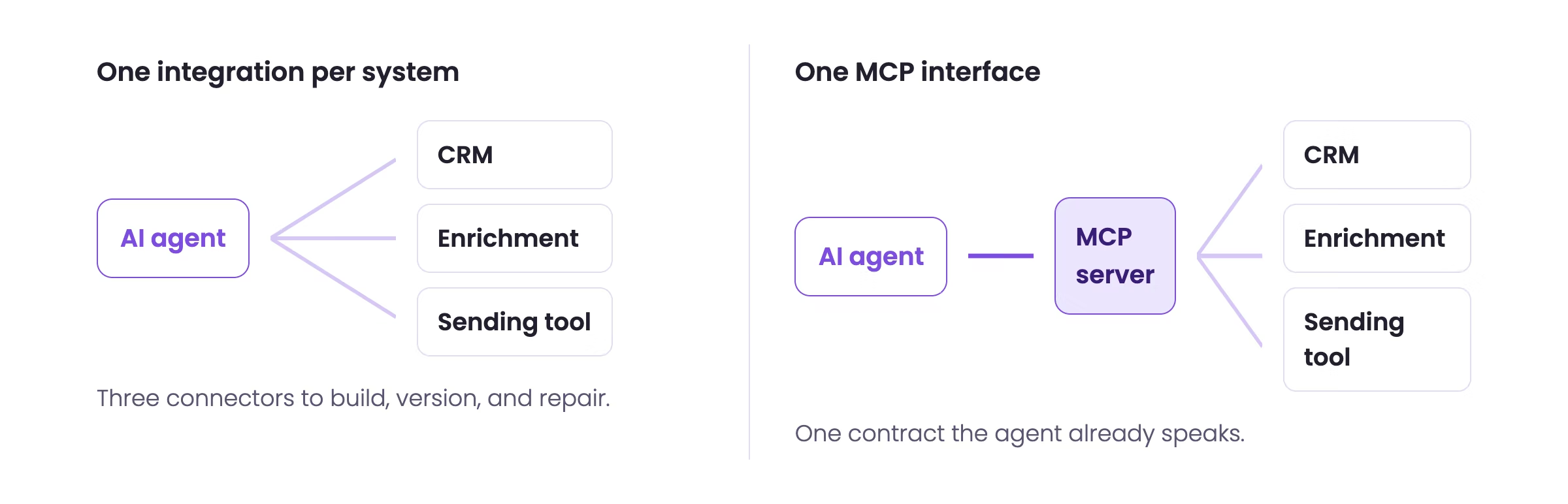
The Model Context Protocol, published by Anthropic in November 2024, is an open standard that lets an AI model reach tools and data sources through one interface instead of a custom integration per system. Through 2026 it became the layer GTM engineers use to point an agent at the CRM, the enrichment provider, and the sending tool at the same time.
The practical change is timing. Research that used to run as an overnight batch now runs per account at the moment a signal fires. Four uses carry most of the value:
- Account research. An agent reads the company site, recent funding, and open job postings, then writes the personalization line into the row. Apify has its own MCP server, so the agent can call any Apify scraper directly to read a job board, a review site or a company site.
- Data checks. An agent flags rows where the enriched job title and the company size disagree, before anything sends.
- Reply triage. An agent classifies replies by intent and drafts the follow-up for a human to approve.
- Internal queries. An agent answers CRM questions in plain language, which ends the queue of one-off report requests.
Two limits are worth designing around from the start. An agent with write access to the CRM needs a review step, because a wrong bulk update takes seconds to make and hours to unpick. And an agent that writes copy needs a fixed voice reference, or the output drifts toward the same phrasing every other agent produces.
Our breakdown of AI SDR tools and software covers where the tooling stands today, and which parts still need a person.
Where Is GTM Engineering Heading in 2027?
Three shifts already visible in the most advanced teams look set to spread.
Agents that supervise the funnel. AI agents watch the TAM continuously, qualify accounts, draft outreach, and hand off only meeting-ready conversations. The GTM engineer becomes the person who builds and supervises those agents.
The role becomes standard in B2B SaaS. Expect most Series A and later B2B SaaS companies to have a GTM engineer, in-house or through an agency, before they build a large SDR team.
Fewer tools in the stack. Platforms like Clay keep absorbing adjacent jobs, so the stack gets simpler and the advantage moves to engineers who understand the whole system.
Reachly is a Clay Solutions Partner. We build the signals, the enriched data, and the sending infrastructure, run coordinated outreach across cold email, LinkedIn, and cold calling, then hand you the workspace and the domains. First meetings come within 10 days on pre-warmed domains, or 5 to 6 weeks from kickoff on branded domains, from $3,500 a month.
Book a call with Reachly →
Frequently Asked Questions About GTM Engineering
What does GTM mean in tech?
In tech, GTM almost always means go-to-market: the plan and the teams that carry a product to buyers. People say GTM strategy for the plan, GTM teams for sales, marketing, and customer success, and GTM engineering for the systems layer underneath them. The one common exception is web analytics, where the same letters refer to a tag deployment tool.
What jobs fall under GTM?
Any role that wins or keeps revenue: SDRs and BDRs, account executives, sales engineers, demand generation and product marketing, RevOps, customer success, and partnerships. GTM engineering is the newest and most technical job in that family, and it is often the first one a company struggles to place on the org chart.
Is GTM engineer a good career?
For people who like building systems, the numbers are strong. Junior roles start around $60,000, senior roles at the top payers clear $180,000, and coding skill raises pay faster than tenure does. Common next steps are head of GTM engineering, RevOps leadership, head of growth, or a founding GTM role at an early startup. The main risk is joining a company that hired the title without deciding what it owns, so ask what the first 90 days are meant to produce.
What is the best GTM engineering course?
Start with Clay University, which is free and leads to Clay's own certification. Paid cohort courses run roughly $1,500 to $2,000 and are worth it mostly for structure and the peer group. Judge any course by whether you finish with a working enrichment table and one live signal play, because that is what hiring managers ask to see.
What are the biggest GTM engineering mistakes?
Five come up again and again. Shipping AI first drafts without editing them. Judging campaigns on opens and clicks when only meetings and pipeline count. Running signal plays with no evergreen campaign underneath, which leaves gaps between triggers. Reviewing results monthly when weak segments should be cut weekly. And letting reply data sit unused when it should feed back into targeting.
Do I need a GTM engineer to use Clay?
No. Founders, ops people, and SDRs use Clay every day for list building and enrichment. A dedicated GTM engineer starts to pay off once Clay tables feed live sends: signals triggering sequences, enrichment writing to the CRM, and replies routing back. At that point a broken formula costs domains and meetings, so teams either hire the role or bring in a Clay partner to build it.
Sources and Further Reading
Market, salary, and tool-adoption figures in this guide come from two public 2026 datasets:
- The 2026 State of GTM Engineering, GTM Strategist. Survey of 228 GTM engineering practitioners across more than 30 countries, covering compensation, tooling, and org design.
- An analysis of 1,000 GTM engineering job postings, Bloomberry. Posting volume, growth rate, experience requirements, advertised salaries, and named tools. Updated January 2026.
More from Reachly on building the system:
Recommended service
Outbound Lead Generation Services
Reachly builds and runs the whole outbound motion across email, LinkedIn, and phone, and books qualified meetings on your calendar.