



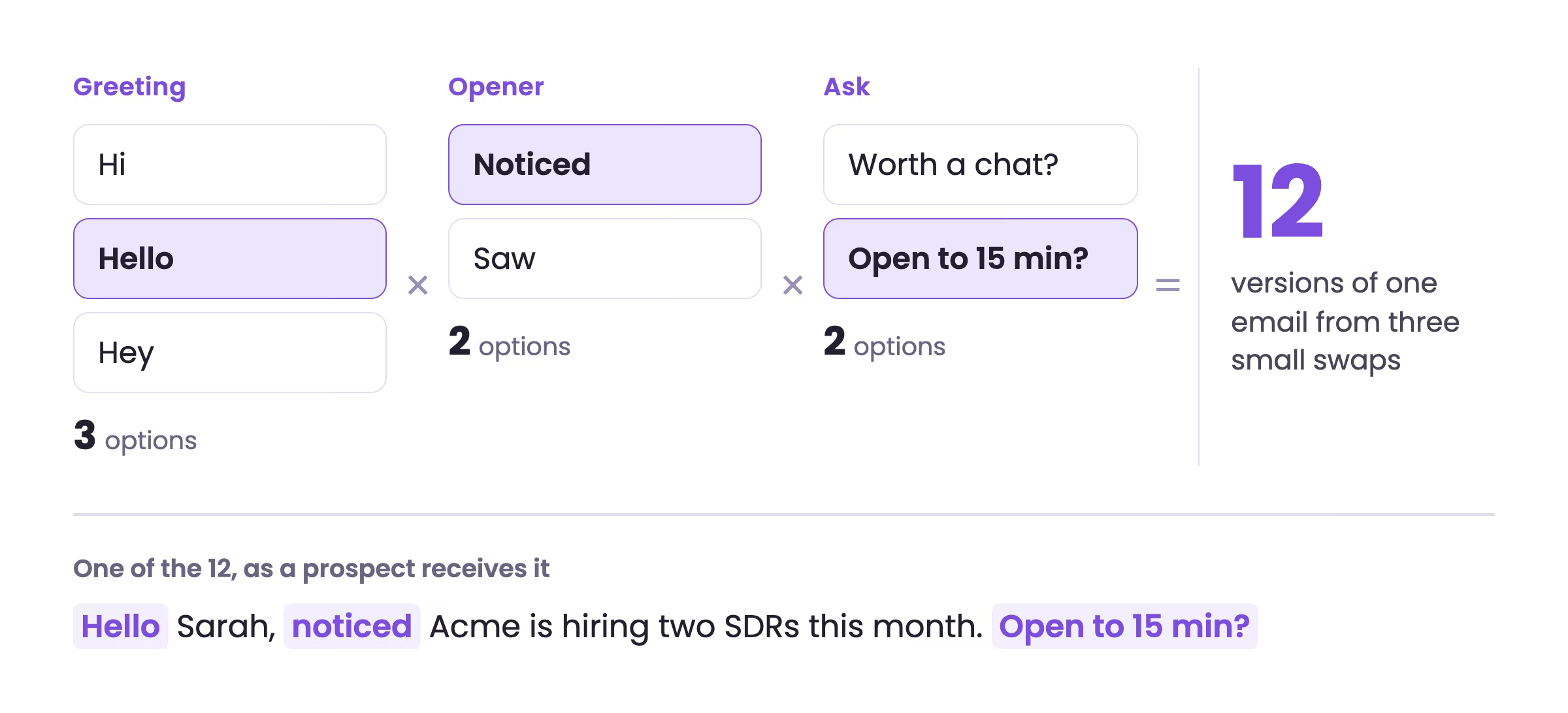
Spintax, short for spin syntax, is a text-variation format that puts interchangeable words inside braces, like {Hi|Hello|Hey}, so your sending tool picks one option for each recipient. Three spun slots with 3, 2 and 2 options turn one cold email into 12 different versions.
Key Findings
- Spintax multiplies: the number of versions is the product of the options in each slot, so {3} x {2} x {2} gives 12.
- The syntax changes by tool. Smartlead reads {Hi|Hello}, Instantly reads {{RANDOM | Hi | Hello}}, Saleshandy reads {spin} Hi | Hello {endspin}, and lemlist uses Liquid spin and variation tags.
- Spintax pasted from one tool into another prints raw braces to the prospect, a common failure when a sequence moves between tools.
- Spin the greeting, the opener verb and the ask. Leave the claim, the signal and the offer fixed.
- Deliverability comes from authentication, warm-up, list quality and volume. Spintax is a small layer on top of those.
- If the work is more than you want to run in-house, our cold email agency runs the full sending stack.
What is spintax and how does it work?
Spintax is a set of options written inside a syntax block. At send time the tool picks one option at random for each recipient, so mailbox providers see varied copy across a batch instead of one repeated block of text. The most common format uses curly braces with a pipe between each option: {option A|option B|option C}.
Write {Hi|Hello|Hey} {{first_name}} and one prospect gets "Hi Sarah", the next gets "Hello Marcus", and a third gets "Hey Priya". Same intent, slightly different output, all from one template.
How many versions does spintax make?
Multiply the options in every slot. Three greetings, two opener verbs and two calls to action give 3 x 2 x 2 = 12 versions. Add a fourth slot with three options and you have 36. The count grows fast, which is why a few light swaps already cover a large list.
What is nested spintax?
Nested spintax puts one block inside another, like {Hi|{Hello|Hey} there}. The outer block has two options, and the second option contains its own two, so the block produces three versions: "Hi", "Hello there" and "Hey there". Nesting is useful for a phrase that only sometimes carries a second word. It is also the fastest way to produce a sentence you would never write, so keep it to one level and read every branch.
Does spintax syntax differ between cold email tools?
Yes, and this is where most spintax breaks. Each sending platform reads its own format. We checked each vendor's own documentation in September 2026, and only list what the vendor itself documents.
| Tool | Syntax | Example | Source |
|---|---|---|---|
| Smartlead | {option|option} | {Hi|Hello|Hey} Pierre | Smartlead help center |
| Instantly | {{RANDOM | option | option}} | {{RANDOM | Hi | Hello | Hey}} {{firstName}}, | Instantly help center |
| Saleshandy | {spin} option | option {endspin} | {spin} Hi | Hello | Hey {endspin} | Saleshandy's spintax syntax guide |
| lemlist | {% spin %} {% variation %} ... {% endspin %} | {% spin %} {% variation %} Hi {% variation %} Hello {% endspin %} | lemlist help center |
The practical consequence: a template written for Smartlead and pasted into Saleshandy or lemlist does not rotate. The braces go out as literal text in front of the prospect. Saleshandy's guide also notes that an unclosed {spin} tag breaks formatting and shows the raw syntax. Before moving a sequence between tools, rewrite the blocks in the new format.
Smartlead
{Hi|Hello|Hey} {{first_name}}, {noticed|saw} {{company}} is hiring SDRs.

Instantly
{{RANDOM | Hi | Hello | Hey}} {{firstName}}, {{RANDOM | noticed | saw}} {{companyName}} is hiring SDRs.

Saleshandy
{spin} Hi | Hello | Hey {endspin} {{First Name}}, {spin} noticed | saw {endspin} {{Company}} is hiring SDRs.

lemlist
{% spin %} {% variation %} Hi {% variation %} Hello {% variation %} Hey {% endspin %} {{firstName}}, {% spin %} {% variation %} noticed {% variation %} saw {% endspin %} {{companyName}} is hiring SDRs.
Merge-tag names differ by tool too (first_name, firstName, First Name). Check your own workspace's variable picker before you paste.
How do you check spintax before it goes live?
Paste the copy below. The checker counts how many unique versions the standard {a|b} format produces, shows one at random, and flags a brace that was never closed or a pipe sitting outside a block. Double-brace merge tags like {{first_name}} are left alone. Click the button to see a different version each time.
Most sending tools also have a preview that renders one version per contact. Use it on three or four contacts before the campaign starts, because the preview shows the merge tags filled in as well.
Does spintax help cold email deliverability?
A little, and only on top of the basics. Spintax started in SEO, where it was used to generate many near-duplicate articles, and it moved into cold email later, as covered in Instantly's history of spintax in cold email. That history is why people still expect it to trick a filter.
Mailbox providers weigh sender reputation, domain history, authentication, warm-up behavior and engagement. Operators in this cold email spintax thread on Reddit put it bluntly: most deliverability problems trace back to DNS and account setup, and spintax does little when warm-up and DKIM or DMARC records are missing.
What spintax does well is narrower. It stops a large batch from going out as thousands of identical messages, which is a pattern filters can group. The order of fixes when placement is weak:
- Publish SPF, DKIM and DMARC on every sending domain.
- Warm new mailboxes before they carry campaign volume.
- Verify the list, because bounces damage reputation quickly.
- Ramp volume gradually and keep daily sends per mailbox modest.
- Then add light spintax so the batch varies.
The deeper work is in our email deliverability guide.
How do you write spintax that sounds human?
Keep the variation light. A reasonable ceiling is one spun phrase per paragraph, so a five-paragraph email carries about five blocks, the approach explained in this cold email spintax guidance on YouTube. Smartlead's own help center recommends the same focus: the greeting and the call to action.
Where to spin
Greetings ({Hey|Hi|Hello}), opener verbs ({Noticed|Saw|Came across}), soft transitions ({Thought I would reach out|Wanted to send a quick note}) and the ask ({Worth a chat?|Open to 15 min?}). These swaps are small and every option means the same thing.
Where to leave the copy alone
The signal, the claim and the offer. If one branch says "saw you raised a Series A" and another says "saw you are hiring", you are sending two different emails and the follow-up may reference the wrong one. Keep every branch interchangeable in meaning and in tone.
Signs of bad spintax
- Word-level swaps that break the rhythm of the sentence.
- Tone drift, where one option is casual and another is stiff.
- A branch that does not fit the sentence after it.
- Generic copy in more versions, which still reads as generic.
Write the email first and add spintax only once it reads well as plain text. For option ideas, resources on using AI to brainstorm phrasing options can help, as long as you read every variant yourself before it goes into a live sequence. For real reply gains, time spent on cold email personalization pays back more than time spent on synonyms.
Where does spintax sit in the outbound stack?
Near the end. The foundation is technical, the middle is targeting and offer, the top is message relevance, and spintax is a light polish once the rest works.
| Layer | What it does | Why it comes first |
|---|---|---|
| Technical setup | Authenticates and stabilizes sending | Inbox placement depends on it from day one |
| List quality | Removes bad and risky contacts | Bounces and low engagement hurt reputation |
| Offer fit | Gives the prospect a reason to care | A relevant offer earns the reply |
| Personalization | Ties the message to a real signal | This is where replies come from |
| Spintax | Adds micro-variation across a batch | Useful once the layers above are solid |
Replies usually come from a relevant trigger like hiring, funding or a tech-stack change, one clear problem and outcome, and tight targeting on the right role. That is why teams using Clay for account research get more from better personalization inputs than from ten ways to say the same opener. If a message would not earn a reply as plain text, the syntax will not change that. The same logic runs through our guide to signal-based outbound, our modern outbound sales strategy and this cold email playbook. It holds outside cold outbound too: a strong post-webinar email sequence wins on relevance and timing.
When should you use spintax, and when should you skip it?
| Situation | Call | Why |
|---|---|---|
| Sending a large batch from warmed, authenticated mailboxes | Use | Varies the batch once the basics hold |
| Small A/B-style swaps in greeting, opener or ask | Use | Low risk, every branch means the same |
| Still fixing bounces, authentication or warm-up | Skip | Setup problems need setup fixes |
| Ten high-value accounts with custom research | Skip | Each email is already unique |
| Hoping it will make generic copy relevant | Skip | Relevance comes from the research |
In plain terms, spintax is a formatting method for controlled copy variation: helpful, practical and small.
Who can run the outbound that moves replies?
The reply lift comes from clean infrastructure, a verified list, a relevant offer and personalization tied to a real signal, with spintax as a small final layer. That is a lot to run while building a company. Reachly runs signal-based multichannel outbound for B2B teams across cold email, LinkedIn and cold calling, from domain setup and list verification to sequencing and booked meetings. For Primal, that produced 85+ SQLs in six months and a 4.57x ROI. See how it works on the Reachly homepage, or hand the sending to our cold email agency.
Want the whole sending stack run for you?
Reachly builds the domains, the warm-up, the verified list and the signal-based copy, then books the meeting. For Primal that meant 85+ SQLs in six months and a 4.57x ROI.
See the cold email agency
Spintax FAQ
What does spintax stand for?
Spintax is short for "spin syntax", the notation that tells software which parts of a text to spin, meaning rotate between alternatives. The same idea sits behind "article spinning", the older SEO practice of rewriting one article into many near-copies, which search engines now treat as spam. In cold email the notation survived because rotating a greeting or an ask is still useful when it stays light.
Can you use spintax in subject lines?
Yes, in the tools that document it. Saleshandy states its spin tags work in both the subject line and the body with the same syntax, and lemlist lists subject lines as a use case for its spin tags. Keep subject line spins very short, such as two phrasings of the same three words, because a subject line has little room before the meaning drifts.
Is spintax the same as a merge tag?
No. A merge tag like {{first_name}} pulls a value from the contact record, so the output is decided by your data. Spintax picks at random between options you wrote, so the output is decided by chance. Most emails use both together, and in the standard format the double braces of a merge tag and the single braces of spintax sit side by side.
Do you need a spintax generator?
A generator only writes candidate options, which you can do in a minute by hand. The part that needs care is review: every combination has to read naturally and mean the same thing. Use a generator for ideas if it helps, then paste the result into a counter such as the one above and read a handful of versions aloud before the campaign starts.
Recommended service
Cold Email Agency
Reachly runs cold email end to end: dedicated infrastructure, signal-led copy, and replies handled until a meeting is booked.