


- An AI SDR automates everything upstream of the reply: list building, enrichment, signal scoring, first-touch copy, sending and follow-up.
- It does not automate the offer, the objection, the multi-threading, or the judgment on whether an account deserves a meeting.
- Gartner expects AI agents to outnumber human sellers 10 to 1 by 2028, with fewer than 40% of sellers reporting a productivity gain.
- Gartner finds 69% of B2B buyers go to a sales rep to validate AI-generated insight.
- Median SDR held-meeting quota is 10 a month and falling, per The Bridge Group, so the volume bar for software is low.
- Skip an agent with no proven offer, a TAM under a few hundred accounts, or an ACV under $5,000. Our B2B appointment setting service handles small-TAM precision work with a human on every reply.
An AI SDR is a software agent that runs the top of an outbound sales development workflow on its own: it sources accounts, enriches them against an ICP, writes and sends the first touch, and works the follow-ups without a person starting each thread. It replaces the volume work inside the SDR role rather than the role itself. Gartner expects AI agents to outnumber human sellers 10 to 1 by 2028, and in the same forecast expects fewer than 40% of sellers to say those agents improved their productivity. Both halves of that prediction matter when you are deciding whether to buy one.
We build and run outbound systems for B2B companies, so we evaluate this category as operators rather than as a vendor selling an agent. What follows is where an AI SDR clearly outperforms a person, where it reliably falls over, and the split we run in production.
TL;DR: Summary
- An AI SDR automates list building, enrichment, signal scoring, first-touch copy, sending and follow-up. It does not automate offer design, objection handling, multi-threading, or the judgment call on whether an account deserves a meeting.
- Three different products are sold under the label: inbound agents, outbound agents, and AI features inside a sequencer. Only the outbound agent competes with an SDR headcount.
- Gartner expects AI agents to outnumber human sellers 10 to 1 by 2028, with fewer than 40% of sellers reporting a productivity gain from them.
- Buyers keep pulling humans back in: Gartner finds 69% of B2B buyers go to a sales rep to validate AI-generated insight, and expects 75% to prefer human-first sales experiences by 2030.
- The configuration that works is an agent on the first four stages, a human on the reply onward. Gartner finds sales organizations giving sellers AI-generated next best actions are 2.6x more likely to hit their commercial growth targets.
- Skip the agent entirely if you have no proven offer, a TAM of a few hundred accounts, or an ACV under $5,000. For small-TAM precision work our B2B appointment setting service books the meetings with a human owning every reply.
What is an AI SDR?
An AI SDR performs the sales development representative's top-of-funnel work without a person driving each step. Give it an ICP definition, a data source and a mailbox, and it will build a target list, write a message per contact, send it, and follow up on a cadence. The stronger products read the reply and either answer a simple question or route the thread to a human.
The term covers three different products, which is where most evaluations go wrong. A team buys one shape expecting another, then concludes the category does not work.
| Shape | What it does | What feeds it | Competes with |
|---|---|---|---|
| Inbound agent | Sits on your site, answers questions, qualifies the visitor and books the meeting | Traffic you already have | An inbound BDR seat |
| Outbound agent | Sources cold accounts, writes and sends cold sequences, chases follow-ups | Data providers and signal feeds | An outbound SDR seat |
| AI inside a sequencer | Drafts copy and researches accounts on top of a sending tool a human still runs | Your existing lists | Nothing, it is a feature |
Only the outbound agent is a real alternative to an SDR headcount. An inbound agent works a different funnel, and an AI drafting feature inside a sequencer changes how fast your team writes without changing who is accountable for the send. When someone tells you their AI SDR produced a 40% reply rate, the first question is which of the three they are describing, because inbound and outbound numbers are not comparable.
What does an AI SDR actually do?
Break the SDR role into its component jobs and the picture gets concrete. Some of these are solved, some are partly solved, and some are not close.
| Job | What an AI SDR does | Where it still needs a person |
|---|---|---|
| Build the target list | Queries multiple data sources against an ICP and dedupes at volume no person matches | Deciding which filters actually correlate with a closed deal |
| Verify contact data | Cascades across verification providers and drops risky addresses automatically | Setting the bounce tolerance, which is a domain risk decision |
| Read a buying signal | Detects headcount growth, hiring, funding and technology installs on a schedule | Ranking which signals mean intent for your specific offer |
| Write the first touch | Produces a personalized opener per contact from research it gathered itself | The offer inside the message, which is the part that determines reply rate |
| Send and follow up | Executes the cadence without forgetting the fifth or seventh touch | Per-mailbox caps and which domain sends what |
| Handle the reply | Answers a simple factual question and books a clean yes | Objections, referrals, pricing pushback, anything with nuance in it |
| Qualify the account | Checks stated criteria against enrichment data | Budget, timing and political reality, which only surface in conversation |
| Multi-thread the account | Adds contacts at the same company to a sequence | Coordinating a buying committee, which needs a person holding the relationships |
The pattern is consistent. Everything upstream of the reply is mechanical and automates well. Everything from the reply onward is a conversation, and conversations are where agents lose.

That break point is the single most useful thing to know about the category. It tells you what to buy, what to staff, and where to put your review gate.
Where does an AI SDR outperform a human SDR?
Four areas, and they are real advantages rather than marketing.
Coverage of a large TAM. A person researching properly manages a few dozen accounts a day. An agent works thousands, and if your TAM runs to tens of thousands of accounts, human coverage is arithmetically impossible. Gartner expects 95% of sellers' research workflows to begin with AI by 2027, up from under 20% in 2024, which is the same observation from the research side.
Follow-up discipline. Most replies arrive after the first touch, and most human sequences quietly stop early because the rep got busy or the thread felt cold. An agent does not get bored on touch six.
Response latency. An inbound agent answers a form fill in seconds at 2am. No staffing model competes with that, and speed to first response is one of the few inbound variables with a clean relationship to conversion.
Cost per touch. The marginal cost of one more researched, personalized first message is close to zero once the agent is running. That changes which segments are worth touching at all.
There is also a less comfortable argument for agents, which is that the human baseline has been sliding. The Bridge Group's tenth-edition SDR study of 351 B2B companies puts the median monthly held-meeting quota at 10, down 40% since 2018, with 60% of SDRs hitting quota, the lowest share in the study's history, and median annual attrition at 40%. A seat that ramps for 3 months, lasts 1.9 years and books 10 meetings a month in its good months is not a high bar for software to clear on volume.
Where do human SDRs still win?
The buyer keeps voting for a person, and the data on that is not ambiguous.
| Finding | Figure | Source |
|---|---|---|
| AI agents to human sellers by 2028 | 10 to 1 | Gartner, press release, July 2026 |
| Sellers who will say AI agents improved productivity by 2028 | Under 40% | Gartner, press release, July 2026 |
| B2B buyers who go to a sales rep to validate AI-generated insight | 69% | Gartner, buyer survey, May 2026 |
| B2B buyers who will prefer human-first sales experiences by 2030 | 75% | Gartner, press release, August 2025 |
| Sales organizations with AI next best actions that hit growth targets | 2.6x more likely | Gartner, sales survey, May 2026 |
| Sellers whose research workflow will start with AI by 2027 | 95%, from under 20% in 2024 | Gartner |
| Enterprise applications with task-specific AI agents by 2026 | 40%, from under 5% in 2025 | Gartner, press release, August 2025 |
| Median SDR ramp time | 3.0 months | The Bridge Group, 10th edition SDR study, 351 companies, Feb 2025 |
| Median SDR tenure | 1.9 years | The Bridge Group, 10th edition SDR study |
| Median annual SDR attrition | 40% | The Bridge Group, 10th edition SDR study |
| Share of SDRs hitting quota | 60%, lowest in study history | The Bridge Group, 10th edition SDR study |
| Median monthly held-meeting quota per SDR | 10, down 40% since 2018 | The Bridge Group, 10th edition SDR study |
Read the first two rows together, because they are from the same forecast. Near-universal deployment of agents, and a minority of sellers who can point to a productivity gain from them. That gap is not a software problem waiting on a better model. It is what happens when the automatable part of a workflow gets automated and the bottleneck moves to the part that was never the bottleneck before.
Four things stay human on our accounts.
The offer. Reply rate is mostly a function of what you are offering, not how well the opener is worded. The question we put to every client before anyone writes copy is the founder's: "If you were to speak to one of your dream clients and only had 30 seconds to convince them to work with you, what would you offer them?" An offer worth testing is either close to too good to be true, or carries a guarantee that removes the risk. No agent answers that question for you, and an agent pointed at a weak offer just spends your TAM faster.
The reply. A cold reply is rarely a clean yes. It is a referral to a colleague, an objection about timing, a question about pricing, or three words that could mean either. Handling that well is the job.
Signal judgment. An agent detects funding rounds easily. Knowing that funding is overdone as a trigger, that it belongs at most in a postscript congratulating the raise rather than in the opening line, and that hiring activity converts better because it shows growth, is judgment built from running campaigns.
Domain risk. An agent tuned for volume will send from whatever is available. Deciding what sends from which domain, at what daily cap, with what bounce tolerance, protects an asset the agent does not value. We run dedicated secondary domains on every cold email account so a bad week never touches the client's primary domain.
Does an AI SDR replace human SDRs?
No. It replaces about the first half of the SDR workflow and makes the second half more valuable. The honest version of the answer is that the role is being cut in two, and the two halves are going to different places.
| Stage | Owner | Why |
|---|---|---|
| Source and dedupe accounts | Agent | Pure volume work with a clear success test |
| Enrich and verify contacts | Agent | Provider cascades beat manual checking on both cost and coverage |
| Detect and score signals | Agent, human sets the weights | Detection is mechanical, ranking is strategy |
| Write the first touch | Agent drafts, human owns the offer | Personalization automates, positioning does not |
| Send and sequence | Agent, human sets the guardrails | Execution automates, domain risk is a human call |
| Handle the reply | Human | Objections, referrals and pricing need a real answer |
| Qualify on budget and timing | Human | Surfaces only in conversation, not in enrichment data |
| Multi-thread the committee | Human | Relationships across a buying group cannot be delegated |
| Book and hold the meeting | Human | Show rate depends on the quality of the conversation before it |
Anyone selling you a fully autonomous outbound SDR is selling you the bottom four rows of that table, and those are the rows that determine whether a meeting happens and holds.
What does an AI SDR cost compared with a human SDR?
We are not going to quote you a seat price, because vendor pricing in this category moves quarterly and the seat is the smallest line on the bill. The costs that decide the answer are the ones around it: data credits, sending infrastructure and domain warm-up, and the human hours spent reviewing agent output and repairing bad sends.
The human side has costs that are just as easy to miss. The Bridge Group's numbers put median ramp at 3.0 months and median tenure at 1.9 years with 40% annual attrition, so a single SDR seat carries a recurring rehire and re-ramp bill that never appears in the salary line.
Compare the two on cost per held meeting instead. That is the only number where an agent, a headcount and an agency are measured on the same basis.
AGENT PATH
  agent seats / licences .............. $______ per month
  data + enrichment credits ........... $______
  domains + mailboxes + warm-up ....... $______
  human review hours x loaded rate .... $______
  reply handling hours x loaded rate .. $______
  A. total monthly cost ............... $______
  B. meetings HELD per month .......... ______     (not booked, held)
  cost per held meeting = A / B ....... $______

HUMAN HEADCOUNT PATH
  base + commission at target ......... $______ per month
  benefits, tax, tooling, management .. $______
  data + infrastructure ............... $______
  ramp cost amortised ................. $______     (3.0 mo median ramp)
  attrition cost amortised ............ $______     (40% median annual attrition)
  C. total monthly cost ............... $______
  D. meetings HELD per month .......... ______     (median quota is 10)
  cost per held meeting = C / D ....... $______

MANAGED PATH
  retainer ............................ $______ per month
  internal hours to manage it ......... $______
  E. total monthly cost ............... $______
  F. meetings HELD per month .......... ______
  cost per held meeting = E / F ....... $______

DECISION RULE
  Run all three for one quarter before comparing.
  An agent path missing line 4 and line 5 is an estimate, never a cost.
Our own managed retainer starts at $3,500 per month and covers the whole stack: TAM mapping, ICP definition, signal enrichment, contact sourcing and verification, dedicated sending infrastructure and warm-up, copywriting, sequence building, reply management, meeting booking and weekly reporting. First qualified meetings land in week 5 to 7, and volume becomes predictable by month 3. If you want to model the return before talking to anyone, our outbound ROI calculator takes your ACV and close rate and gives you a payback month.
How do you run the hybrid model without losing control of quality?
The configuration that works puts the agent on everything upstream of the reply, a review gate before anything sends, and a person on the reply onward. Gartner's finding that sales organizations giving sellers AI-generated next best actions are 2.6x more likely to hit commercial growth targets describes that shape: the agent proposes, the seller decides.
The failure mode is worth drawing, because it is always the same failure.
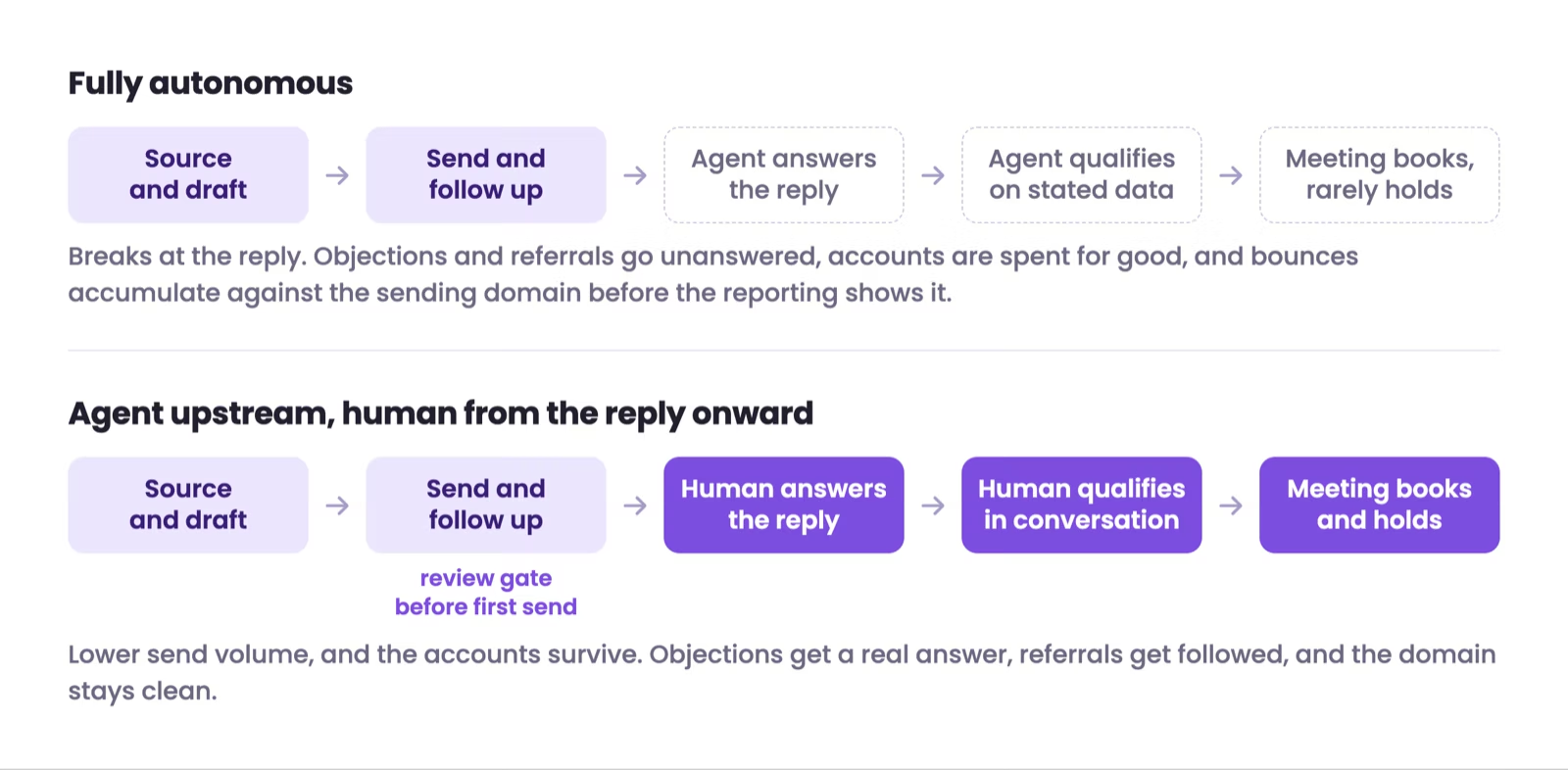
A fully autonomous configuration breaks at the reply, and the damage runs backward. Bad replies burn accounts you cannot re-approach, bounces accumulate against your domain, and by the time the reporting shows it, a quarter of your TAM has been spent. A configuration with a human on the reply loses volume and keeps the accounts.
These are the rules we hold on live accounts. They are worth copying whether you run an agent in-house or hire someone to run one.
1. HUMAN OWNS THE OFFER
   The agent never writes the value proposition. It personalises around
   an offer a person wrote and a person is accountable for.

2. REVIEW GATE BEFORE FIRST SEND
   Sample 20 agent-written first touches per segment before launch.
   If more than 2 would embarrass you, the segment is not ready.

3. EVERY COLD REPLY ROUTES TO A PERSON
   No exceptions for "simple" replies. A referral looks simple and is
   the highest value reply you will get all week.

4. AGENT NEVER CHOOSES THE SENDING DOMAIN
   Dedicated secondary domains only, warmed before launch, with a fixed
   per-mailbox daily cap the agent cannot raise.

5. HARD BOUNCE CEILING, ENFORCED IN THE TOOL
   Pause the segment at 2% bounce. Do not wait for a weekly review.
   Verify every address before it enters a sequence.

6. ONE ACCOUNT, ONE CONVERSATION
   The agent must not open a second thread at a company where a person
   is already in a live conversation.

7. MEASURE HELD MEETINGS, NOT ACTIVITY
   Agents make activity look excellent by construction. Review positive
   reply rate, held-to-booked rate, and cost per held meeting.

8. RE-READ THE SEGMENT MONTHLY
   Falling positive reply rate with rising sends means the agent is
   spending TAM. Cut volume, fix the offer, relaunch.
We use AI heavily inside this model, and the internal goal our founder set for the year is to double the size of the business while keeping the team the same size, on the back of new AI-first systems. The distinction that makes that work is where the AI sits: on research, enrichment, drafting, reporting and internal tooling, with people on the offer and the conversation. That is the same split we run across cold email and LinkedIn outreach campaigns.
It is also what the results depend on. For Primal we ran evergreen campaigns into CMOs and CEOs alongside signal campaigns on hiring, funding, declining traffic and ranking drops, and the account produced 85 or more SQLs in 6 months, 6 closed deals, a 35% reduction in customer acquisition cost and 4.57x ROI, breaking even in month 3, at an 8% positive reply rate. For The Great Room in premium co-working, meetings went from roughly 2 per quarter to roughly 2 per month and the account closed more than $250,000 in total contract value about 9 months in, with drop-off around 30% against roughly 50% from their digital channels. Every one of those replies was handled by a person.
When should you not buy an AI SDR?
Four situations where the answer is no, and one where it is not yet.
| Situation | Why an agent makes it worse | Do this instead |
|---|---|---|
| No repeatable sales process | An agent multiplies whatever process you have, including the absence of one | Sell by hand until a motion repeats |
| No proof of product market fit | You cannot tell whether a flat reply rate is the offer or the targeting | Founder-led outreach, where the learning is the point |
| TAM of a few hundred accounts | Volume cannot cover for imprecision, and a generic touch spends an account for good | Manual, researched outreach per account |
| ACV under $5,000 | Cost per held meeting will not clear the deal size on any path | Self-serve, inbound, or outreach you run yourself |
| No sending infrastructure | The agent will send from your primary domain and you will not get the reputation back | Build dedicated domains and warm them first |
High volume is a genuine skill rather than a default setting. Infrastructure is hard to manage at that level and any mistake wastes real money. As our founder puts it, it "only works with a very big TAM, and only once message-market fit is found and the email offer is already working." An AI SDR bought before that point buys you a faster way to reach the wrong conclusion.
If your market is narrow and every account matters, precision beats volume, and a person should own every touch that goes into it. That is the work we take on: signal-based targeting into a small, defined TAM, with a human on every reply.
Get qualified meetings booked without betting your pipeline on an autonomous agent
We map your TAM across more than 10 data sources, enrich it with real buying signals, run multichannel campaigns across cold email, LinkedIn and phone, and put a person on every reply through to the booked meeting. From $3,500 per month, first qualified meetings in week 5 to 7.
Book a call
AI SDR FAQ
What is an AI SDR?
An AI SDR is a software agent that runs the top-of-funnel work of a sales development representative without a person starting each thread. It builds a target list against an ICP, enriches and scores the accounts, writes a first message per contact, sends it, and follows up on a fixed cadence. The stronger products also read the reply and either answer a simple question or route the thread to a human.
What does an AI SDR do?
In practice an AI SDR covers list building, contact enrichment, signal scoring, first-touch copy, sending, and follow-up sequencing. What it does not reliably cover is offer design, objection handling on a live thread, multi-threading into a buying committee, and the judgment call on whether an account is worth a meeting at all. Those four remain human work in every deployment we have seen.
Does an AI SDR actually work?
It works for the volume half of the workflow and underdelivers on the conversation half. Gartner expects AI agents to outnumber human sellers 10 to 1 by 2028 while fewer than 40% of sellers report those agents improved their productivity. Read those two together: deployment is close to universal, measured productivity gain is not. An AI SDR works when a person still owns the reply and the offer.
How much does an AI SDR cost?
Vendor pricing varies too widely for a single honest figure, and seat pricing is only part of the bill. The real cost is the seat plus data credits, plus sending infrastructure and domain warm-up, plus the human hours spent reviewing output and cleaning up bad sends. Price it as cost per held meeting rather than cost per seat, using the worksheet in this article. Our own managed retainer starts at $3,500 per month and covers the full stack including the human layer.
Will an AI SDR replace human SDRs?
No, on current evidence it replaces roughly the first half of the SDR workflow and raises the bar on the second half. Gartner expects 75% of B2B buyers to prefer sales experiences that prioritize human interaction over AI by 2030, and already finds 69% of B2B buyers going to a sales rep to validate AI-generated insight. The volume work is automatable. The trust work is the job that remains.
What is the difference between an AI SDR and a sales engagement tool?
A sales engagement tool executes a sequence a human designed and loaded. An AI SDR decides what to send, to whom, and when, then executes it. The distinction matters when you evaluate one, because a sequencer with an AI drafting feature is sold using the same words and carries none of the same autonomy or the same risk to your domain reputation.
Can an AI SDR book meetings on its own?
Inbound agents that sit on your website book meetings on their own reliably, because the prospect arrived with intent and the qualification questions are short. Outbound agents book meetings on their own far less reliably, because a cold reply usually contains an objection, a referral to someone else, or a question about pricing that needs a real answer. Route cold replies to a person.
Is an AI SDR safe for domain reputation?
Only with infrastructure that the agent itself does not control. An agent tuned for volume will happily send from your primary domain until the reputation is gone, and no reply rate recovers a burned domain. Send from dedicated secondary domains, warm them before launch, hold per-mailbox daily caps, and verify every address before it enters a sequence. We run dedicated sending domains on every client account for exactly this reason.
What are the best AI SDR tools?
We keep a current comparison rather than repeating it here: see our roundup of AI SDR tools compared and our review of AI SDR software. The short version is that the category splits into inbound agents, outbound agents, and AI features bolted onto sequencers, and the right pick depends on which of those three problems you actually have.
Do AI SDRs work for enterprise and niche markets?
They work least well there. An AI SDR earns its cost on a large TAM where volume covers for imprecision. In a niche market with a few hundred qualified accounts and a long buying cycle, every touch has to be right, and a generic first message spends an account you cannot get back. Precision targeting into a small TAM is where our B2B appointment setting service does better than an agent.
How long does an AI SDR take to produce meetings?
Assume the same infrastructure clock a human team faces, because the constraint is domain warm-up rather than software setup. On our engagements campaigns launch from week 4 after warm-up, LinkedIn replies start in week 2 to 3, first qualified meetings land in week 5 to 7, and volume becomes predictable by month 3. An AI SDR that promises meetings in week 1 is sending from cold infrastructure.
Should a startup hire a human SDR or buy an AI SDR first?
Neither, until the offer is proven. A company with no repeatable sales motion, no proof of product market fit, or an average contract value under $5,000 should be doing founder-led outreach by hand, because the learning is the point. Once a message is converting and the TAM is large enough to work, an AI SDR is a reasonable way to add coverage without adding headcount.
Is SDR still a good job if AI SDRs keep improving?
The volume-only version of the job is being automated and the median numbers already show strain: The Bridge Group puts the monthly held-meeting quota at 10 and falling, with 60% of SDRs hitting quota, the lowest in the study's history. The version of the job that survives is closer to a researcher and a closer of first conversations: someone who owns the reply, the objection, and the multi-threading.
What should you measure to know whether your AI SDR is working?
Measure held meetings and pipeline created, not activity. Agents make activity metrics look excellent by definition, so sends, opens, and even raw reply counts tell you almost nothing. Track positive reply rate, held meeting rate against booked, cost per held meeting, and bounce rate per domain. If positive reply rate falls while sends climb, the agent is spending your TAM.