

 Key Findings
A Series A Reachly client lifted reply rate from 0.5 to 1% up to 1.6% using the same templates, just by rewriting the offer. The signal, the offer, the length, and the ask are what move reply rates.
Past 100 words, mobile previews truncate and pattern recognition flags the message as long sales copy before the prospect reads it. Reply rates drop two to four points on every Reachly campaign we have benchmarked.
Twelve ICPs need 12 templates with 12 different signal openers and consequence frames. CFOs care about CAC. CMOs carry the pipeline number. RevOps cares about the data layer. The same email cannot speak to all three.
Day 1 opens. Day 3 reframes. Day 5 asks. Day 8 routes. Day 12 closes. Reusing the same template shape across the sequence is the most common cold outbound mistake. Each day has a different job.
Use AI for the one-line signal reference only. Buyers are tone deaf to full AI-generated emails. Always QC any AI snippet output before sending. The other 65 to 70 words of the template are written by hand.
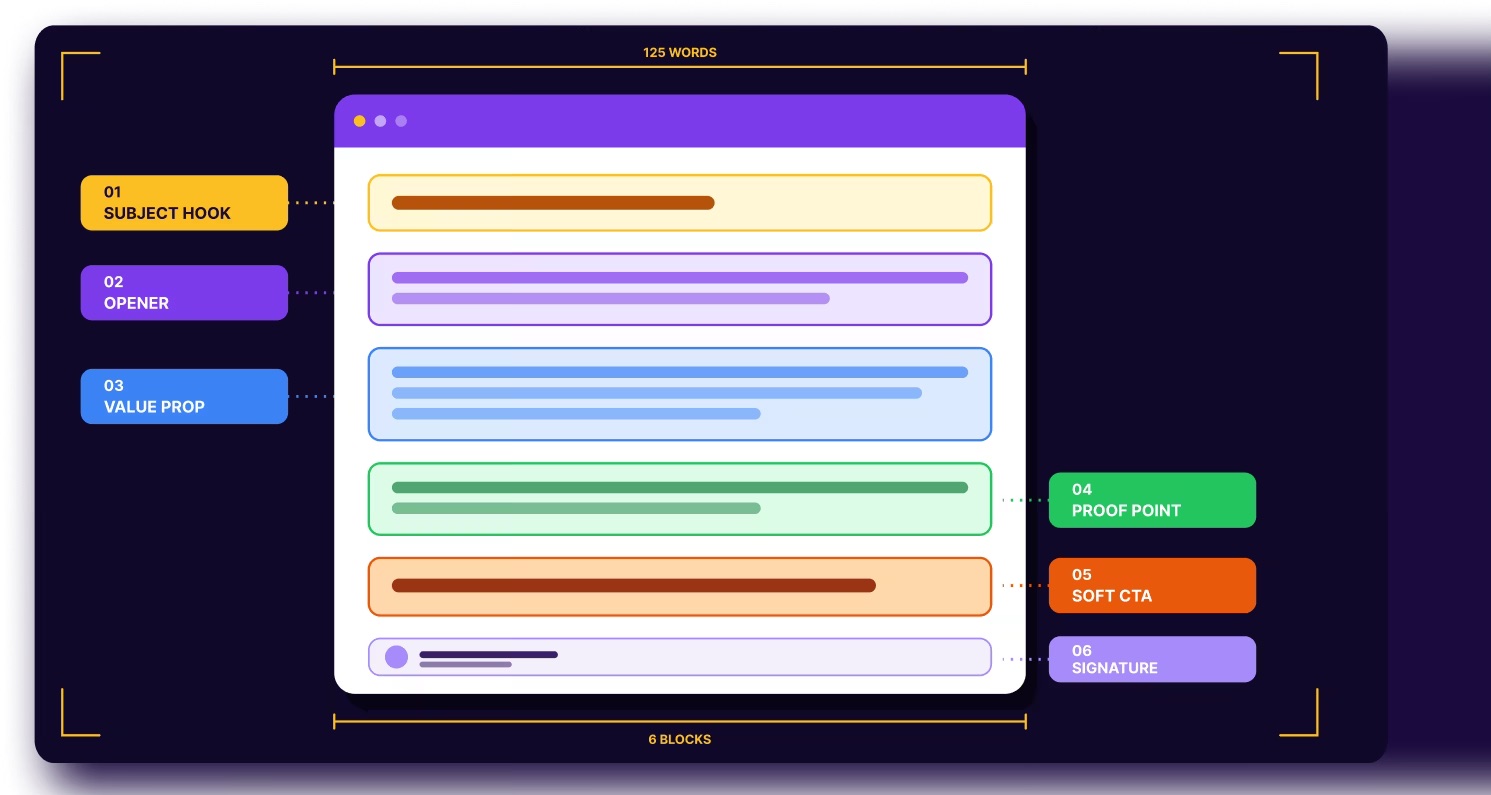
A cold email template is a reusable 70 to 80 word structure built from four parts: a signal opener, a consequence the buyer has felt, one specific offer, and a single defined ask. This library holds 30 cold email templates, grouped by ICP and by the job each one does inside a sequence, plus three that flopped and the fix for each.
The reason most cold email templates stop working is rarely the template. It is what you are pasting into it.
We have shipped cold email templates across 400+ campaigns at Reachly. Every time a new client comes to us with a 0.5% reply rate on copy they swore was tight, the diagnosis is the same. The template is doing its job. The inputs are bad. Wrong ICP, weak signal, weaker offer, too long, asking for too much in the first touch. Swap the inputs, the template suddenly works.
This guide is the system we use to write cold email templates for clients. Templates 1 to 12 are organized by ICP. Templates 13 to 30 are organized by the job they do in a sequence: first touch, follow-up, break-up, offer-led, referral, re-engagement, and niche segment. Every one is shown as sent, with the reply rate it earned where the campaign produced one.
TL;DR: Summary
- Keep the email between 70 and 80 words. Past 100 words the mobile preview truncates and reply rates fall.
- Thirty templates: 12 organized by who you are writing to, 18 by the job they do in a sequence, and eight frameworks organized by how the message is built.
- Three templates that flopped are included with the specific input that broke each one.
- Numbers appear only where a campaign earned them. Templates without a measured reply rate carry no number.
- Pick the framework from the situation, not from the example you like best.
- Match the template to the sequence stage. An opener and a step-four bump are not interchangeable.
- Personalization has to be something only this prospect could receive, or it reads as a merge field.
- The same frameworks are shown applied across five verticals and inside a multichannel sequence.
- Reachly writes and runs these sequences as a managed service. See our cold email agency service page, and the guide to choosing a cold email agency.
Why do most cold email templates stop working in 2026?
The CEOs and CROs of funded startups get 60 to 70 cold emails a week. They are not reading their inbox. They scan the from-name, the subject, and the first two lines. Then they decide whether the email earned the next three sentences. Personalized emails open at 20.79% versus 14.96% for generic, and the average cold email open rate sits at 27.7% in 2026, per Snov.io's cold email statistics."
A template fails one of four ways. The signal is missing or generic, so the email looks like every other one. The body is too long, so the prospect bounces before the ask. The ask is too aggressive, so the prospect closes without replying. The offer is weak, so even if the prospect reads the whole thing, they have no reason to act.
The fix is not a better template. The fix is tighter inputs. A real signal. 70 to 80 words of body. A defined ask. An offer the prospect cannot ignore. The templates below are built around those four constraints. Lift them, paste your inputs in, and watch the reply rate move.
If your reply rate is sitting at zero, the cold email best practices post walks through the full diagnostic. The diagnostic order is infrastructure first, then subject line, then length, then tone, then offer. Templates do not fix infrastructure.
What separates a working cold email template from a dead one?
The shortlist is four things, in this order.
One, a real signal in the opener. Funding, hiring, leadership change, tech stack move, product launch, page-1 ranking gap. Anything specific to the account that gives the prospect a reason to believe you did not blast 5,000 other companies the same morning. Emails referencing verified triggers like funding rounds or hiring surges hit an 18% response rate versus 3.4% for generic outreach, and stacking signals can push replies into the 25% to 40% range, per Autobound's cold email templates guide.
Two, a body between 70 and 80 words. Long enough to explain the relevance. Short enough that the prospect can read it in one breath on a phone.
Three, an offer that is too good to ignore. A specific result, a specific play, a specific lead magnet, a specific time commitment. Not "we help companies grow." That is not an offer. That is filler.
Four, a single defined ask. One yes or no question. Not three. Not "let me know what works for you." That is the prospect's job to answer, not yours.
Every template in this guide hits all four. If you swap one of them out for a generic alternative, the template stops working.
A cold email in 2026 is not competing with other cold emails. It is competing for attention span. Buyers read inboxes on the lift, on the commute, between meetings. Seventy to eighty words is the ceiling. Anything past that, they bounce before the ask. The template is the easy part. The constraint is what makes it work.

How long should a cold email template be?
Every cold email template in this guide sits between 70 and 80 words. That is not arbitrary.
A 70 to 80 word email reads in roughly 25 seconds on a phone. The first sentence proves relevance. The second names the consequence. The third introduces your offer. The fourth asks a defined question. That structure is repeatable, fits inside a phone screen without scrolling, and gives the prospect zero excuse to skim past the ask. Across Reachly client campaigns, messages in that range have consistently outperformed longer ones on reply rate.
Past 100 words, two things happen. The mobile inbox truncates the preview, so the first three lines have to carry more weight. And the prospect's pattern recognition flags the message as "long sales email" before they read any of it. Subject line opens drop a point or two. Reply rates drop more. LinkedIn's 2026 analysis notes 68% of executives check email primarily on phones, and even admitting an email is cold can still earn 20%+ response rates, per LinkedIn's piece on new cold outreach angles.
How should you read the reply rates on this page?
Every number attached to a template below is one the campaign actually earned, and templates that never ran long enough to produce a clean figure carry no number at all. That is deliberate. A template library that puts an invented reply rate on all thirty entries is worth less than one that puts a real rate on six.
Three kinds of number appear here. Named client results come from published Reachly case studies: Primal booked 85+ SQLs, signed 6 deals, cut CAC 35% and returned 4.57x in 6 months at an 8% positive reply rate, and The Great Room closed $250K+ in contract value. Benchmark bands are the ranges our campaigns run inside on clean infrastructure, shown in the table below. External statistics carry the name of their source in the sentence.
Where a template shows no figure, the structure is sound and the campaign it came from has not produced a number we can stand behind. Use those templates on their structure, not on a promise.
What reply rate should these templates run at?
A cold email template is only useful if you know what "good" looks like. Here are the bands these campaigns run inside, so you can judge your own numbers against them rather than against a screenshot.
| Metric | Benchmark | Note |
|---|---|---|
| Reply rate (tight ICP) | 8 to 12% | Where the templates above land on clean infrastructure |
| Positive reply rate | 10 to 20% normal, 35 to 40% very good | Of the replies, the share that is interested |
| Bounce rate | Under 3% | Above this, the list needs re-validation |
| Deliverability score | Above 97% | Below this, fix infrastructure before copy |
| Email length | 70 to 80 words | The binding ceiling on every template here |
Which cold email template matches your ICP? (templates 1 to 12)
These are pulled from live client campaigns we have run in the last 12 months. Twelve ICPs, one template each. Each one runs at 70 to 80 words. Each one has a signal opener, a consequence frame, a specific offer, and a single ask. Lift them. Swap the brackets. Send.
Use the selector below to find the template that matches the prospect you are writing to. Each one is anchored to a different signal because the buying motion is different inside each role.
| ICP role | Primary signal | Template |
|---|---|---|
| Founder or CEO (funded startup) | Funding announcement | Template 1 |
| VP Sales or CRO | AE or SDR hiring posts | Template 2 |
| CMO or head of marketing | Pipeline pressure / paid spend ceiling | Template 3 |
| Head of RevOps | Tooling stack or reporting gap | Template 4 |
| Head of customer success | Expansion revenue mandate | Template 5 |
| Head of talent or people ops | Aggressive hiring plan | Template 6 |
| CFO or finance leader | CAC pressure / efficiency target | Template 7 |
| IT or security leader | Email infrastructure risk | Template 8 |
| E-commerce operator | D2C ceiling / wholesale push | Template 9 |
| Agency owner | Referral pipeline slowing | Template 10 |
| SaaS founder pre-Series A | Fundraise prep window | Template 11 |
| Head of procurement or operations | Vendor consolidation pressure | Template 12 |
1. Founder or CEO at a funded startup
Subject: Series A and {{company}}
Hi {{first_name}}, congrats on the round. Most teams coming out of Series A end up with their outbound 6 to 9 months behind their hiring plan. We run signal-based outbound for funded B2B teams. One of our clients hit 8% positive reply rate and 4.57x ROI in 6 months on this exact stack. Worth 15 minutes this month to see if it fits?
Why it works. Funding is the signal. The consequence (outbound behind hiring) is one a founder has felt. The offer is a specific number from a real campaign. The ask is one yes or no question with a defined time commitment.
2. VP of Sales or CRO
Subject: {{company}} hiring 3 AEs
Hi {{first_name}}, saw the AE postings. Adding three reps usually means an extra 6 to 8 months before the new hires are fully ramped and contributing pipeline. We help VPs of Sales backfill that gap with signal-based outbound across email and LinkedIn so the existing team has warm conversations to work in the meantime. Open to a 15-minute look this month?
Why it works. The signal is hiring. The consequence (ramp gap) is the specific pain a VP of Sales is feeling the week they post the role. The offer names the channels. The ask is short.
3. CMO or head of marketing
Subject: Idea for {{company}}
Hi {{first_name}}, marketing teams usually carry the pipeline number even when sales misses. We run multichannel outbound for B2B marketing leaders who want a second source of qualified meetings that does not depend on paid spend or SEO timelines. Primal added 85+ SQLs and 6 signed deals in 6 months on this approach, on top of their paid funnel. Worth a 15-minute look?
Why it works. The frame names the political reality (marketing owns the number). The offer references a real Primal case study. The ask is the same defined-time question.
4. Head of RevOps
Subject: {{company}} stack question
Hi {{first_name}}, RevOps usually owns the data layer behind outbound, but the team running the campaigns is often two departments away. We run signal-based outbound that plugs into your existing CRM and reporting setup, no rip-and-replace. Clients on this model see 8 to 12% positive reply rates without adding tooling overhead. Worth 15 minutes to see how the data flow works?
Why it works. The opener names the structural problem RevOps deals with every quarter. The offer is non-disruptive (no rip and replace), which is exactly what RevOps cares about. The ask references the data flow, not a generic demo.
5. Head of customer success
Subject: {{company}} expansion plays
Hi {{first_name}}, Customer Success usually owns expansion revenue but rarely owns the outbound layer that surfaces ICP-fit expansion targets inside accounts. We run signal-based outbound into adjacent buying centers at existing customer accounts so your CS team gets warm conversations they did not have to manufacture. Worth a 15-minute look at how that fits with your account expansion motion?
Why it works. Most cold email templates ignore CS. The opener names the gap between expansion targets and the CS team's manufactured outreach. The ask references the existing motion, which signals respect for what they already do.
6. Head of talent or people ops
Subject: Hiring 6 reps?
Hi {{first_name}}, the job postings look like {{company}} is doubling the revenue team this quarter. Most teams scaling this fast end up choosing between recruiter spend and outbound infrastructure when both should be running. We help People leaders bring in outbound as a service so the SDR seats you need to fill in 6 months are not a blocker today. Worth a 15-minute conversation?
Why it works. The signal is the hiring page. The frame names the budget trade-off People leaders actually deal with. The offer reframes outbound as a service, which is exactly the structure a Head of Talent can advocate for internally.
7. CFO or finance leader
Subject: {{company}} CAC question
Hi {{first_name}}, CFOs usually find out about outbound when CAC goes the wrong way. We run signal-based outbound for B2B teams that brings CAC down because every touch is anchored to a real account signal, not a list. Primal cut CAC by 35% in 6 months on this model. Another client, a premium co-working operator, added $250K in new contract value on the same motion. Worth 15 minutes to compare numbers?
Why it works. CFOs hate generic outreach. The opener leads with the metric they actually care about. The offer cites two real numbers from two named engagements (35% CAC reduction, $250K contract). The ask is numbers-based, which is what finance leaders respond to.
8. IT or security leader
Subject: {{company}} email infra check
Hi {{first_name}}, most B2B teams running outbound get IT involved only after deliverability tanks. We set up the SPF, DKIM, DMARC, and warmup layer so your domain reputation stays clean while sales does the campaigns. Bounce rate stays under 3%, deliverability score above 97%. Worth a 15-minute look at how it works alongside your existing stack?
Why it works. IT leaders care about reputation risk and predictable infrastructure. The opener names the late-stage involvement pattern they hate. The offer is the technical authentication layer, which signals you actually know what they care about. The numbers are operational, not commercial.
9. E-commerce operator
Subject: {{company}} wholesale leads?
Hi {{first_name}}, most e-commerce brands hit a ceiling on D2C and have to figure out wholesale or B2B partnerships to keep scaling. We run signal-based outbound into retailers, distributors, and corporate gifting buyers for D2C brands moving into B2B. Reply rates 8 to 12% on these niche segments. Worth a 15-minute look at how it would fit your wholesale push?
Why it works. The opener names the D2C ceiling problem directly. The offer is specific to e-commerce (retailers, distributors, gifting buyers), not generic outbound. The ask is framed in their language.
10. Agency owner
Subject: {{company}} pipeline gap
Hi {{first_name}}, agency owners usually generate pipeline from referrals and inbound until both slow down at the same time. We run multichannel outbound for B2B agencies that need a predictable lead source independent of brand and SEO. One agency client hit 4.57x ROI on this stack in 6 months. Worth 15 minutes to compare notes on what works in 2026?
Why it works. Agencies trust other agencies that have run their own outbound. The opener names the dual-failure pattern (referrals and inbound slow together). The Primal number is named without naming Primal directly. The ask reads peer to peer.
11. SaaS founder pre-Series A
Subject: {{company}} fundraise prep
Hi {{first_name}}, pre-Series A founders usually need to show 12 to 18 months of repeatable outbound performance before raising the next round. We help SaaS founders build that outbound track record in 3 to 4 months, not 9. Clients have used it to compress fundraise cycles and walk into investor meetings with real pipeline numbers. Worth a 15-minute look ahead of the round?
Why it works. Pre-Series A founders are calendar-aware. The opener names the fundraise timeline they are running against. The offer compresses the timeline they care about most. The ask references the round, not the product.
12. Head of procurement or operations
Subject: {{company}} vendor consolidation
Hi {{first_name}}, procurement teams in B2B are often asked to consolidate the outbound stack (data, sending, LinkedIn, calling, enrichment) into fewer line items. We run all of it as one service for B2B teams, so the contract count goes from 6 or 7 down to 1. Helps the budget, helps the security review. Worth a 15-minute look at the contract structure?
Why it works. Procurement cares about vendor count and security reviews. The opener names the consolidation pressure directly. The offer reframes outbound as procurement-friendly. The ask references the contract, not the product.
Templates 13 to 30 below are the same structures as sent, grouped by the job each one does in a sequence.
Which first-touch templates work when you have no context?
The first touch is the hardest email to get right, because it is the one with zero context. The fix is the signal. Each of these opens on something real about the account. The detection layer that pulls these signals across hundreds of prospects runs through Clay, and the signal-based outbound playbook covers how the stack is built.
13. New VP hire (to a department head)
Subject: new VP, old stack?
Hi {{first_name}}, a new VP of Sales usually means a fresh look at the outbound stack in the first 90 days. We run multichannel outbound for B2B teams reviewing how they generate pipeline, so the new leader walks into real numbers instead of a rebuild. Worth 15 minutes before the quarter locks?
Why it worked. A leadership change is a buying trigger with a deadline (the first 90 days). The email respects the window rather than pitching a product.
14. Page-1 ranking gap (to a growth lead)
Subject: {{competitor}} outranking you
Hi {{first_name}}, you are sitting just off page one for a few terms a competitor owns, which usually means inbound is not filling the pipeline fast enough on its own. We run outbound for B2B teams that need meetings now while content compounds in the background. Reply rates land in the 8 to 12% range on tight segments. Worth 15 minutes to compare what is working in 2026?
Why it worked. The ranking gap is a public, checkable signal. The frame (outbound now, inbound later) matches Reachly's outbound-before-inbound stance for B2B teams.
What should each follow-up template say?
The follow-up is where most campaigns quietly die. Reps restate the first email in a new wrapper, and by the third touch the prospect has read the same thing three times. The fix is a new angle each time, then a one-line bump. The spacing rules behind these sit in the automated email follow-ups post.
Reachly's own sequences stop at one follow up, and the cold email follow up guide shows that two email sequence with the exact copy.
15. New-angle follow-up (Day 3)
Subject: re: Series A and {{company}}
Hi {{first_name}}, following up with a different angle. The teams that get outbound right post-raise are usually the ones who treat it as a test loop, not a launch. We run the test (offer, audience, copy) and report back inside 3 to 4 weeks so you know fast whether it fits. Worth 15 minutes?
Why it worked. It does not repeat the first email. It reframes around the test-loop idea, which is a fresh hook. Threaded under the original subject so it reads as continuity.
16. Soft-bump follow-up (Day 5)
Subject: quick one, {{first_name}}
Hi {{first_name}}, I know the inbox is brutal at your level. One question and I will get out of the way: is generating more qualified meetings a priority this quarter, or is the focus elsewhere right now? Either answer is useful. No pitch attached.
Why it worked. It asks permission instead of pushing. The "either answer is useful" line lowers the cost of replying, which is the whole game at this stage.
17. Value-add follow-up (Day 5)
Subject: the teardown I mentioned
Hi {{first_name}}, put together a short teardown of three signals your ICP is throwing off right now that most teams miss. Two pages, no opt-in. Happy to send it over whether or not we ever work together. Want me to drop it in your inbox?
Why it worked. It leads with something useful and free. The ask is to receive a document, which is a far easier yes than a meeting.
18. One-line bump (Day 8)
Subject: re: {{company}}
Hi {{first_name}}, wrong person? Happy to point this to whoever owns pipeline if it is not you.
Why it worked. One sentence. It gets forwarded internally more often than any other email in the sequence, which is how it reaches the real buyer. Easy out keeps the relationship intact.
Which break-up templates reopen a dead thread?
The break-up is the most under-used email in cold outbound. Counter-intuitively, the email that says "I will stop reaching out" often gets the reply the previous four did not.
19. The honest close
Subject: closing the loop
Hi {{first_name}}, I have reached out a couple of times without a reply, so I will assume the timing is off and stop here. If pipeline becomes a priority later in the year, the door is open. Out of curiosity, was it the timing or just not a fit? One word is plenty.
Why it worked. It removes the pressure, which is exactly when people reply. The one-word question often surfaces a real objection you can answer.
20. The reverse break-up
Subject: should I close your file?
Hi {{first_name}}, I am cleaning up my list this week. Should I close your file, or is there a version of this worth a 15-minute look next month? No hard feelings either way, just do not want to keep landing in your inbox if it is not useful.
Why it worked. "Should I close your file" reads as a status question, not a pitch. It gives the prospect a low-stakes reason to re-engage or politely opt out.
Which offer-led templates lead with a lead magnet?
When the audience and infrastructure are clean and replies still will not come, the offer is the lever. These three lead with a specific asset, not the meeting. This is the exact change that moved a Series A client from a 0.5 to 1% reply rate up to 1.6%.
21. Benchmark report offer
Subject: {{industry}} reply-rate benchmarks
Hi {{first_name}}, we pulled reply-rate benchmarks across 400+ B2B campaigns and broke them out by industry and company size. Yours is in there. It is a short read, no opt-in. Want me to send the section that matches {{company}}? If the numbers are off versus your campaigns, that usually points to one of four fixable things.
Why it worked. The offer is a specific, relevant document. The closing line plants a diagnostic hook without pitching the service.
22. Audit offer
Subject: 3 things in your {{company}} outbound
Hi {{first_name}}, looked at your public outbound footprint and spotted three things that are likely capping reply rate: the opener, the length, and the offer. Happy to write up exactly what I would change in a one-pager, free, no call required. Want it?
Why it worked. It is specific (three named things) and the ask is to receive a free one-pager. The meeting is never mentioned, which makes the yes easy.
23. Template pack offer
Subject: the templates behind 4.57x ROI
Hi {{first_name}}, we packaged the cold email structures behind one of our campaigns that hit 4.57x ROI in 6 months. Thirty templates by ICP and sequence stage, each at 70 to 80 words. Yours to keep. Want the pack? If you would rather we just run them for you, that is the other option.
Why it worked. The lead magnet is the proof and the product in one. It cross-promotes the deeper cold email best practices library Reachly publishes.
How do you ask for a referral or a warm intro?
Sometimes the person you reach is not the buyer. Instead of giving up, ask for the redirect. These two are short by design.
24. The redirect ask
Subject: right person at {{company}}?
Hi {{first_name}}, you may not own this, so quick ask: who runs pipeline and outbound at {{company}} these days? Happy to take it to them directly. We run signal-based outbound for B2B teams and think there is a fit, but I would rather start with the right person than guess.
Why it worked. It assumes nothing and asks for one piece of information. People who would never book a meeting will happily forward a name.
25. The mutual-connection open
Subject: {{mutual}} suggested I reach out
Hi {{first_name}}, {{mutual}} mentioned you are rethinking how {{company}} generates pipeline. We run multichannel outbound for B2B teams in a similar spot, and the overlap looked worth a short note. Worth 15 minutes, or should I send a one-pager first so you can decide?
Why it worked. A real mutual connection is the strongest signal there is. The two-option close lets the prospect pick the lower-commitment path if the meeting feels like too much.
How do you re-engage a list you already burned?
Long sequences burn deliverability. The Reachly standard is two emails, then stop, then re-engage the same list 1.5 to 2.5 months later with a new angle. These two are built for that second window.
26. The new-angle re-open
Subject: different idea for {{company}}
Hi {{first_name}}, reached out a couple of months back about pipeline. Different angle this time: a few teams in your space have started running outbound as a quarterly test instead of an always-on cost, which keeps spend tied to results. We run that model. Worth 15 minutes to see the structure?
Why it worked. It acknowledges the earlier touch up front, then leads with a real new frame. Same prospect, fresh reason to reply.
27. The new-proof re-open
Subject: an update worth 60 seconds
Hi {{first_name}}, last time we spoke the timing was not right. Since then a client closed a $250K contract on the outbound motion I described, with no added headcount on their side. Thought it was worth a 60-second update in case the timing has shifted for {{company}}. Open to a quick look?
Why it worked. New, real proof (The Great Room's $250K contract) gives a legitimate reason to reopen a dead thread. The named client is one of the two Reachly names publicly.
What do niche-segment templates look like?
The campaigns that perform best are usually the niche ones. Less cold email lands in those inboxes, so a relevant message stands out. These three templates are anonymized from real segments we have run.
28. Manufacturing operator
Subject: filling {{company}} order books
Hi {{first_name}}, most manufacturers we talk to rely on a handful of repeat accounts and word of mouth, which leaves the order book exposed when one slows down. We run outbound into procurement and sourcing buyers for facilities like yours. We have done this for garment plants in North America and India. Worth 15 minutes to see the buyer list we would target?
Why it worked. The niche reference (garment plants in two regions) proves real experience in a segment that rarely gets relevant outreach. Replies in this segment run above the cross-industry average.
29. Faith or membership organization
Subject: reaching more of {{org}}'s community
Hi {{first_name}}, organizations like yours usually grow through community and referral, which is steady but slow to expand into new groups. We run respectful, signal-based outreach for membership-driven organizations, including churches, to start conversations with aligned partners and sponsors. Worth a short look at how we would approach it?
Why it worked. The tone is matched to the audience (respectful, not aggressive). Naming the segment shows it is not a generic blast.
30. Brokerage
Subject: {{company}} deal flow
Hi {{first_name}}, brokers live and die on deal flow, and most of it still comes from a personal network that does not expand on its own. We run outbound that surfaces new counterparties and referral partners for brokerages, anchored to real activity signals rather than a bought list. Worth 15 minutes to see the targeting?
Why it worked. It speaks the prospect's language (deal flow, counterparties) and names the ceiling of a network-only model. The modern outbound sales strategy post shows how segments like this get sequenced across channels.
Which cold email templates flopped, and what fixed them?
No top-10 result shows you the failures. These three came from real audits of new client campaigns. The fix in each case was one of the four inputs, not the whole email.
Flop 1: the wall of text
Hi {{first_name}}, I hope this email finds you well. I wanted to reach out because I came across {{company}} and was really impressed by the work you are doing in the space. At Reachly we offer a comprehensive suite of outbound services including cold email, LinkedIn outreach, cold calling, data enrichment, deliverability management, and more, all designed to help companies like yours generate more pipeline and book more meetings...
The fix. It was 140 words and said nothing specific. Cut to 75 words, one signal, one offer, one ask. Reply rate moved from near zero into the benchmark band.
Flop 2: the fake personalization
Hi {{first_name}}, I saw on LinkedIn that you went to {{university}} and love hiking, that is awesome. Anyway, I wanted to see if you would be open to a quick call about our solution...
The fix. The personalization referenced the person's life, not their business. It read as scraped. We swapped it for a funding or hiring signal tied to a consequence, and the email stopped feeling creepy. The test: if you can swap the detail to another prospect and the email still reads the same, the detail was filler.
Flop 3: the triple ask
Hi {{first_name}}, worth a 15-minute call this week? Or would you prefer I send a one-pager first? Or should I just share our case study and you can decide from there?
The fix. Three questions is three jobs for the prospect. We cut it to one yes-or-no ask. Replies went up immediately. The infrastructure side of why some of these flops never even reach the inbox is covered in the email deliverability guide.
How do you match a template to the sequence stage?
The biggest mistake we see in cold outbound is teams shipping one template on Day 1, then reusing the same shape on Day 3 and Day 5. By Day 8 the prospect has read the same email three times in different wrappers. They stop opening.
The Reachly standard sequence runs across cold email, LinkedIn, and cold calling. Woodpecker found the best-performing cold email sequences usually land between 4 and 7 touchpoints, per its cold email statistics roundup. Each day does a different job. The template changes by stage because the reader's context changes by stage. If you want the full framework for how email, LinkedIn, and calling fit together, the modern outbound sales strategy post walks through it.
| Day | Step | Template shape | Why this works |
|---|---|---|---|
| Day 1 | LinkedIn visit + connect + Email #1 (signal opener) | One of the 30 templates above | Signal-anchored first touch. Reader sees your name on LinkedIn before the email lands |
| Day 3 | Email #2 (new angle) | 3-sentence reframe, different consequence than Day 1 | Restating the Day 1 email is what kills follow-ups. New angle keeps the thread alive |
| Day 5 | LinkedIn message or Email #3 | One question, references the trigger again | Channel match increases response. Lowercase, short, peer voice |
| Day 8 | Email #4 (bump, easy out) | One sentence. "Wrong person?" or "Reply or close the loop?" | Often forwarded internally to the actual buyer. Easy out keeps the relationship |
| Day 12 | Cold call + final email | Sentence-long sign-off | Call lands warm because the prospect has seen your name three times already |
How Reachly coordinates this at the campaign level: one ops lead owns infrastructure, one strategist owns sequence design, one inbox manager owns reply handling. Every template passes a 70 to 80 word check and a deliverability filter before it ships. Sequence pauses automatically on reply.
Two emails 6 to 7 days apart, then a Day 8 bump, then a Day 12 call plus final email. After Day 12, stop. Long sequences burn deliverability and train prospects to mark you as spam. Re-engage the same list 1.5 to 2.5 months later with a fresh sequence and a new angle. That spacing pattern is detailed in our automated email follow-ups post.
How do you personalize a template without sounding like a stalker?
The line between signal-based and creepy is thinner than people think.
Useful personalization references the prospect's business reality. Funding rounds. Hiring posts. Product launches. Pricing page activity. New roles their team is hiring for. Public LinkedIn posts they wrote. Tech stack changes detected through public job descriptions or technographic data.
Unhelpful personalization references their personal life. Their high school. Their gym. A photo from their LinkedIn banner. A quote from their About section that has nothing to do with the buying motion. Anything that proves you scraped the internet without connecting it to a reason they should reply.
The test is simple. If you can swap the personalization detail for a different prospect and the email still reads the same, the detail was filler. If the detail changes the offer or the consequence, it was real. The signal stack that powers this is the signal-based outbound playbook. The detection layer that handles the volume runs through Clay and sends through Smartlead.
Two practical rules. One, use AI for the one-line signal opener only. Never use it for the full email. Buyers are tone deaf to AI slop. Write the rest yourself. Two, every personalization detail has to connect to the consequence frame. A funding round means hiring plan pressure. A new VP means evaluation of incumbent tools. A pricing page revisit means active comparison. If the detail does not connect to a consequence, cut it.
What should the call to action in a cold email ask for?
Every example above ends in an ask, and the ask is where most of them are lost. The sections below cover the three CTA types worth using, the lines that work for each, and the mistakes that quietly cost replies on otherwise good copy.
Why is the CTA the reason replies dry up?
A bad CTA forces the reader to think.
In a crowded inbox, prospects do not weigh options like a procurement committee. They scan, decide if the message feels relevant, and then either reply, ignore, or archive. A CTA that asks too much, gives too many options, or stays vague creates cognitive load right at the moment you need the easiest path to a reply.
A default meeting ask usually fails for three practical reasons:
- It asks for commitment before interest is clear. Busy buyers protect calendar time harder than almost anything else in outbound.
- It makes the next step fuzzy. "Quick chat" sounds harmless, but it does not explain what the buyer gets from replying.
- It signals sales-process risk. A call can feel like the start of demos, follow-ups, and internal pressure the prospect did not sign up for.
A practitioner roundup of cold email CTA tests is worth reading on this. Prospeo's analysis of 15 cold email CTAs cites a test across 8,000 agency cold emails where "Can I show you a demo video?" produced 50% of positive replies, well above heavier asks like sending sample data or pushing the prospect to a website. The same roundup references a Mailshake example where moving the close from "What does your calendar look like for a short call?" to "Are you open to talking numbers?" lifted reply rate from 9.8% to 18%.
The pattern matters more than the exact wording. Lighter asks win earlier in the conversation because they require less time, less trust, and less context switching from the reader.
A well-written CTA is consequential. MarketingProfs on using CTAs in B2B cold emailing reports that a strong CTA can lift click-through rate by 30 to 35%, and HumanLinker's guide to cold email calls to action says clear, specific CTAs can improve response rates by up to 50%. That tracks with what we see across client campaigns. Clarity gets action.
If you want the broader system behind the rest of the email, our cold email best practices for higher reply rates in 2026 post is the companion read.
Which three CTA types do you actually need?
One CTA for every email is a lazy habit. CTAs change because the prospect's relationship to you changes.
| CTA type | Best for | What the buyer feels |
|---|---|---|
| Low-friction question | First touch, prospect has no context yet | I can answer this in 5 seconds |
| Value-first asset | Touch 2 to 3, building credibility | I can judge this in 2 minutes |
| Direct meeting ask | Interest already on the table, late sequence | I have a defined next step |
The right CTA depends on two inputs. The sales goal and the friction the prospect can absorb right now. Get those two right and the rest of the CTA work is wording.
Which low-friction CTAs open a conversation?
When the prospect does not know you yet, your first job is not booking the meeting. It is getting any response that opens the thread.
Question-based CTAs work well here because they sound like the start of a conversation rather than the end of a pitch. HumanLinker recommends question-based prompts like "Is this something your team is currently exploring?" and reports that clear, specific CTAs can lift response rates by up to 50%.
Five low-friction CTAs that work on first touch:
- "Is this something your team is exploring this quarter?" Good for broad problem awareness. Easy to answer without commitment.
- "Worth sending the short outline?" Use when your offer needs a little context. You are asking permission, not pushing a meeting.
- "Open to seeing how other teams handle this?" Works when the prospect knows the problem but has not prioritized fixing it yet.
- "Is this a priority for the team in Q3?" Better for managers and leaders who think in planning cycles. Yields a yes, no, or not now.
- "Would it make sense to share a short example?" Strong when your value is easier to understand through proof than through prose.
Where teams get this wrong is confusing "low-friction" with "weak." A CTA can be light without being lazy. "Thoughts?" is low friction but gives the reader no direction. "Let me know" is easy to type but gives no reason and no next step. Good low-friction CTAs are still specific. They just ask for a small action.
| Bad CTA | Better CTA | Why it works |
|---|---|---|
| "Let me know what you think" | "Is this something your team is exploring?" | Defined yes/no question |
| "Happy to connect if useful" | "Worth sending the short breakdown?" | Concrete next step |
| "Would love to chat" | "Open to a 2-minute example?" | Lower commitment, defined output |
| "Are you free this week?" | "Is this a Q3 priority?" | Removes the calendar burden |
If your CTA can be answered while someone is walking between meetings, you are in good shape. If they have to open their calendar to respond, the CTA is too heavy for first touch.
The trade-off is real. You will get more replies, and not every reply will be sales-ready. That is fine. Early outreach should create signal first and qualify later. If you force qualification into the CTA, you lose conversations you could have developed.
For the pairing between subject line, body, and CTA, our cold email subject lines guide covers how the three pieces work as one unit.
Which value-first CTAs earn the next step?
A meeting request is expensive when the prospect does not know you. A useful asset is cheaper. It gives them a reason to reply without forcing them to protect calendar time for something they still do not understand.
Four shapes of value-first CTA, in the order we usually try them.
The trade-off is simple. You lower reply friction, and you need an asset that actually offers something useful when the prospect opens it. Thin collateral gets ignored faster than a meeting ask. A generic brochure does not work. A homepage link does not work. "More information" does not work. A value-first CTA earns the next step when the promised asset delivers insight, proof, or clarity.
If your value-first move is wrapped around a real account signal (funding round, hiring spike, leadership change, traffic decline), the CTA gets even sharper. Our signal-based outbound playbook covers how the signal layer feeds the offer and the CTA at the same time.
Which direct CTAs work once interest is on the table?
You do need to ask for the meeting eventually. Just not on the first email.
Once the prospect has replied, clicked, or engaged with a useful asset, the CTA can move from soft to direct. The job changes from earning attention to reducing the friction of saying yes.
The best direct CTAs do that by removing the work from the buyer's side. Offer specific times instead of forcing them to open a calendar, compare schedules, and propose options. Three patterns that work:
- "Would Tuesday at 2 or Thursday at 10 work for a quick intro?"
- "Happy to walk you through it. Wednesday morning or Friday afternoon easier?"
- "If this is relevant, does a short call this week make sense?"
These narrow the decision. The prospect is not building the next step from scratch, they are choosing between two defined options. A calendar link has its place, but in cold outreach a calendar link as the main CTA usually shifts the effort onto the prospect too soon. Mixmax's analysis of cold email CTAs recommends keeping the booking link in the signature as a low-friction path, not as the primary ask.
Use a direct CTA when one of these is true:
- They replied with interest. You have permission to move forward.
- They asked a buying question (pricing, timing, implementation, fit). The conversation is already happening.
- They engaged across touches. Maybe they ignored email one, then replied to a follow-up or engaged on LinkedIn.
A direct CTA should still feel easy. Keep the meeting short. Give a reason for the conversation. Avoid bloated phrasing like "jump on a quick call to learn more about our platform." Nobody wants that meeting. For the broader follow-up framework, our automated email follow-ups post covers the pacing that earns the right to ask directly.
Which CTA mistakes get you ignored?
Most bad CTAs fail in familiar ways. They are vague, self-serving, overloaded, or too heavy for the stage of the conversation. The worst part is they sound normal, which is why teams keep sending them.
| If your CTA says | Rewrite it to |
|---|---|
| "Are you free for a quick chat?" | "Is this something your team is exploring?" |
| "Let me know your thoughts" | "Worth sending the short breakdown?" |
| "Book a 30-minute demo now" | "Want the 2-minute overview first?" |
| "Can I tell you about our solution?" | "Would it help to see how teams handle this today?" |
| "Happy to chat, or send info, or grab time" | Pick one. The other two go in follow-ups. |
The pattern across all five: each rewrite is shorter, makes the next step concrete, and asks for less from the buyer at this stage of the relationship. The fastest CTA audit is to ask three questions of the line you have written. Is it easy to answer in under 10 seconds? Is it useful to the buyer, not just to you? Is it appropriate for how cold the relationship still is?
If the answer to any of those is no, the CTA is the wrong shape for the email.
The signature also affects how the CTA reads. A heavy footer with three links and a calendar widget makes a soft CTA feel pushy by association. Our cold email signature examples guide covers how to keep the signature aligned with the ask.
Which four mistakes kill a working template?
These are the patterns that show up in every audit we run for new clients.
One, copying the template without changing the inputs. A funding-anchored opener does not work for a prospect who is not raising. The template has to match the signal you are actually looking at, not the one in the example.
Two, expanding the body past 80 words. The discipline drops the moment a rep adds "one more sentence" of context. Three reps later, the template is 140 words and the reply rate has halved.
Three, stacking three asks at the end. "Worth a 15-minute call, or do you want a one-pager first, or should I send our case study?" That is three questions. Pick one. The prospect cannot answer three.
Four, using the same template for cold and warm. A warm reply gets a different shape: longer, more specific, deeper on the value. Reusing a cold template on a warm reply makes the prospect feel like they got auto-replied to. Reply rates collapse.
Fix all four and the templates above will run at the benchmark band. Reply rates 8 to 12% on tight ICPs. Positive reply rate 10 to 20% normal, 35 to 40% on very good campaigns.
If you are sitting under those numbers, the email deliverability guide walks through the infrastructure piece (warmup floor of 30 days, ESP-to-ESP matching, SPF/DKIM/DMARC, custom tracking domain) that has to be right before any template can do its job.
How does Reachly write templates for clients?
We have one anchor case study we point to whenever a team is debating whether the template is the problem.
A Series A B2B client came to us sending 20 to 30k emails a month. Lists were validated. Infrastructure was clean. Subject lines were polished. Reply rate was sitting between 0.5 and 1%. They had concluded the templates were broken and were on their second rewrite.
The templates were fine. The offer was generic.
We rewrote the offer to be direct, question-based, with a real lead magnet attached. Same audience. Same sequence pacing. Same channel mix. Reply rate moved from 0.5 to 1% up to 1.6% inside the first month after the rewrite. That is a 60% to 220% relative lift on the same templates, just by tightening the inputs.
That case study is the canonical proof that the template is rarely the thing. The offer is. The signal is. The body length is. The ask is. The template is just the container.
For Primal, the marketing agency client we ran a campaign for, the templates above (specifically the CMO and agency owner variants) carried the 4.57x ROI campaign that booked 85+ SQLs and signed 6 deals in 6 months. Eight percent positive reply rate in month 1. The templates worked because Primal's offer was tight and the signal stack pointed to real buying triggers, not surface activity.
The work we hand to clients is operational. Pulling the signals. Writing the templates for each ICP. Running the reply rate tests. Cutting losers fast. Rotating winners before they fatigue. That is the part most internal teams do not have the bandwidth to run every week.
Which cold email framework should you use, and when?
The templates above are organized by who you are writing to. These eight are organized by how the message is built. Each framework names the situation it suits and the failure it causes when it is used in the wrong one, so pick the framework from the situation rather than from the example you like.
1. Problem-Agitate-Solve (PAS)
PAS earns replies when the pain is tied to a live trigger and the fix is narrow enough to feel credible.
Use PAS after a change event, not before one. Hiring. Expansion. New leadership. Product launch. Stack migration. You are not inventing pain. You are connecting your message to work the buyer already has on their plate.
Hi Sarah,
Saw you're hiring three AEs in Singapore off the back of the product expansion into APAC.
Usually that means coverage moves faster than enablement, and the first 90 days of the new reps end up burning the best accounts before they are ready to close.
We worked with a B2B SaaS team in a similar position and fixed the sequence structure and account routing before the reps hit the floor, so the new hires were booking qualified meetings inside week three instead of week ten.
Worth me sharing the three changes that mattered most?
Thibault
Under 80 words. Every line connects. The signal is visible, the pain is operational, the proof is specific, the ask is low-friction. We go deeper on cadence logic in our piece on automated email follow-ups.
What usually fails is category-level pain ("SaaS teams struggle with pipeline" says nothing useful), overwritten agitation that inflates the stakes, and weak problem-solution fit where the offer does not solve the issue you named. PAS can drive solid reply rates, but it also attracts polite denials if the trigger is weak. We only use it when the enrichment gives enough context to make a strong claim.
2. Curiosity-Driven Open
Curiosity works when it earns the second read. The mistake is treating curiosity like concealment. The open should create a question the buyer wants answered because it is relevant to their world, not because the email is being coy.
Hi Marcus,
Noticed your team added four SDRs this quarter but still reports into a single AE pod in the US.
That usually creates coverage gaps for APAC and EMEA accounts because handoff windows do not match time zones, and response SLAs slip on the accounts that actually reply.
A regional SaaS team we worked with had the same structure, split the pod into two regional pods with separate handoff rules, and cut time-to-first-meeting by nine days inside the first month.
Want the short breakdown of how they redrew the territory?
Thibault
The rule we stick to: if the hook cannot be explained plainly in the second sentence, we do not send it. Vague intrigue like "Quick question" or "Noticed something interesting" creates attention but not confidence. Specific observations do both.
Clay is useful here because it lets you build curiosity from real account signals instead of rep intuition. Hiring trends, new market entries, title changes, tech stack shifts, and funding events can all become hooks if they point to a believable implication.
3. Social Proof & Authority
This one gets abused more than any other template. Most social proof emails are logo dumps. They name three or four companies, say they have worked with teams like yours, and hope borrowed credibility does the rest. It does not.
Social proof works when the prospect can see themselves in the example. Same market. Similar motion. Similar growth stage. Similar operational mess. A named result from a company the prospect recognizes as a peer does more work than any adjective in the email.
Hi James,
Saw the announcement about the new location in Australia.
That kind of expansion usually means your internal team is full-time on closing tours and cannot run the outbound needed to fill pipeline ahead of opening.
We worked with The Great Room on exactly that problem. They went from two face-to-face meetings per quarter to two per month, closed a $250K contract inside nine months, and did it without adding headcount.
Open to a 15-minute walkthrough of how the sequence worked?
Thibault
That lands because it is concrete, the peer group is obvious, and the metric is specific. The detail is what makes it portable, not the logo. You can read the full Great Room case study for the longer version. We cover the underlying math on cold email response rates in a separate piece.
Rules for making social proof work: match the peer group (similar stage beats famous logo), use one proof point (too many examples make the email feel crowded), and make the lesson relevant (tell them what changed, not just who you worked with). If your proof needs three sentences of setup, it is the wrong proof for a cold email.
4. Personalized Value-First
This is the template founders love and teams misuse. The idea is good: lead with something useful before asking for time. The problem is that most value-first emails are fake gifts. A generic audit. A recycled teardown. A vague suggestion that took five minutes to produce.
Real value-first requires work. That is why it stands out. An analysis of 16.5 million emails, summarised in this breakdown of cold email strategy, found that emails with six to eight sentences and fewer than 200 words outperformed longer versions, with open rates around 42% and reply rates near 7%. The trick is not adding more value. It is compressing useful value into a short, readable format.
Hi Priya,
Pulled your public LinkedIn engagement data and noticed two things worth flagging.
Your team is posting consistently from three reps but only one of them is getting inbound conversations from the posts. The other two are publishing to followers who are not your ICP.
Second, your sequences appear to be running from your main domain based on the reply patterns in our data. That is why deliverability probably dipped last month.
I wrote up both fixes in a one-page note. Want me to send it over?
Thibault
That is actionable. The prospect can read the note, fix one of the issues without ever replying, and still walk away having gotten value. If they do reply, you have already proved you know their situation.
Boundaries matter. Give one sharp insight, not the full strategy. Ask for reaction, not a meeting. Use engagement signals so if they click or reply, you can expand in the follow-up. Our guide to B2B segmentation goes deeper on how to slice accounts so the value angle actually fits.
5. Mutual Connection / Warm Introduction
Do not fake familiarity. If you mention a mutual connection, shared community, past customer relationship, or event overlap, it has to be real. Buyers can smell borrowed trust instantly. And if they check with the person you named and the context is off, you have burned the account.
Hi David,
Tim mentioned you were rethinking the outbound motion after the APAC expansion and suggested I reach out directly.
Based on what Tim described, the issue sounds like the same one we fixed for a Hong Kong operator last year. Their internal team were closers, not prospectors, and outbound fell through the cracks whenever a deal heated up.
We ran the full sequence externally so the internal team stayed on closing. Meetings doubled inside two months.
Worth a quick call to compare notes?
Thibault
The referral opens the door. It does not close the deal. You still need a reason for the email, a pain connection, and a proof point. Mutual connection is the setup, not the message.
6. Bold / Provocative Headline
Safe subject lines often pose the greatest risk. They protect your ego and kill reply rates. This template works when you have a clear point of view about a broken outbound habit and can prove the fix in the first few lines.
Good provocation challenges a method, not an identity. "Your team does not need more leads" is weak unless you can defend it fast. "Your team probably has a sequencing problem, not a lead volume problem" is stronger because it points to a diagnosable issue.
Hi Rachel,
You likely have enough accounts in your TAM to hit pipeline. The issue is usually what happens after list building.
Teams spend months fixing targeting when the actual leak is weak sequencing, generic follow-ups, and no channel coordination. Same list with better sequence logic can double positive reply rates.
A marketing agency we worked with had the same list for 12 months, kept buying more data, saw no change. We left the list alone, rebuilt the sequence, and they booked 85 SQLs in six months.
Want me to show what we changed?
Thibault
The claim is sharp but grounded. The email attacks the method, not the prospect. And it points to a fix. Our list of 10 best email subjects for sales is useful for pressure-testing whether your angle sounds credible or just loud.
Use this format in controlled tests. Start with one segment where you know the failure mode well. If positive replies rise but sentiment gets worse, keep the insight and soften the accusation.
7. Specific Use Case / Success Story
Case studies usually get wasted in cold email. Reps paste in a mini testimonial, add a vanity metric, and hope the prospect connects the dots. Good operators strip the story down to the parts that help the buyer recognize their own situation fast.
Hi Jordan,
Saw you are scaling paid acquisition hard and considering how to layer outbound without blowing up CAC.
Primal, a digital agency we worked with, had the same setup. Paid was carrying pipeline but margins were thin, and an SDR hire felt too expensive to test.
We ran a signal-based outbound layer on top of their paid engine. They booked 85 SQLs in six months, hit 4.57x ROI, and cut CAC by 35% without a single SDR hire.
Want me to walk through the four signal campaigns we used?
Thibault
A good success-story email feels like a pattern match, not a testimonial pasted into an inbox. You need enough detail to create relevance, not enough to recreate the sales deck. The version that goes into a cold email is one line about the setup, one about the fix, one about the result, one question back. Full details on the Primal case study if you want the longer version.
This also works better across channels than people expect. If email two references a use case, the LinkedIn touch should reinforce the same story from a different angle, and the call opener should tie to the same operational change. Consistency is the point.
8. Specific Buying Signal Trigger
Generic copy is not the main problem. Bad timing is.
A buying signal gives you a legitimate reason to show up now, tied to a change the account is already dealing with. The email no longer has to create interest from zero. It only has to connect your offer to a real event. We break down the methodology in our guide to signal-based outbound and our piece on B2B intent data.
Hi Kenji,
Congrats on the Series B close last week.
The first 90 days usually look fine. Cash is in, hiring plans are drafted, and the exec team is optimistic. Month three is where it bites. Outbound needs to scale 3x to keep up with the pipeline target, but the SDR hires have not ramped yet and the old sequences cannot carry the load.
We helped a post-Series B SaaS team hit the new pipeline target by running external outbound as a bridge while internal SDRs ramped. Six weeks in, they were booking 40% of their meetings from our sequences.
Open to a short call to map your situation?
Thibault
The obvious signals still work: funding, hiring, product launch, new executive, tech stack change. The better play is signal stacking. Funding plus SDR hiring points to a different motion than funding alone. A product launch plus expansion roles points to pressure on pipeline creation, onboarding, territory design, or lead routing. One signal gives you a hook. Two signals give you a point of view.
How do the eight frameworks compare at a glance?
Before the deep dives, here is the full framework in one view. Use this to jump to the template that matches your current situation.
| Template | Best for | Where it breaks |
|---|---|---|
| Problem-Agitate-Solve | Post-change accounts with a visible trigger and a narrow operational pain | Category-level pain, overwritten agitation, or an offer that does not match the stated problem |
| Curiosity-Driven Open | Buyers who respond to pattern recognition and sharp operational observations | Vague subject lines, teased reveals, or a sentence two that cannot defend the hook |
| Social Proof and Authority | Email 2 or 3 after a trigger-led opener, especially for risk-averse buyers | Logo dumps, mismatched peer groups, or proof that needs three sentences of setup |
| Personalized Value-First | Named accounts and tight segments where research time per prospect is justifiable | Generic audits, vague suggestions, or giving away so much the prospect does not need to reply |
| Mutual Connection | Founder-led sales, niche verticals, partner networks, APAC regional outreach | Fabricated familiarity, treating the referral as the message, or naming someone without permission |
| Bold / Provocative Headline | Segments with a well-known failure mode you can defend in two lines | Attacking the buyer instead of the method, or making a claim you cannot prove fast |
| Success Story | Email 2 or 3 for accounts whose operating shape matches a real customer pattern | Pasting the full case study, missing the peer-group match, or leading with vanity metrics |
| Buying Signal Trigger | Any segment where you have fresh, high-confidence data on recent account changes | Stale triggers, sloppy inferences, or sending before the signal has been verified |
How do the frameworks look across five verticals?
Same framework, different industries. Notice how only the signal, pain, and proof change. The structure is identical.
B2B SaaS:
Hi Priya,
Saw you added five SDRs last month after the seed round.
Usually when teams scale SDRs that fast, quota attainment drops 40% in month one because the reps are working the same playbook the founders used, but at 10x the volume.
A SaaS team we worked with rebuilt the sequence before the new hires started and hit 70% quota attainment by month two instead of month five.
Worth sharing the pre-ramp playbook?
Thibault
Premium coworking:
Hi Alexander,
Saw the Sydney location is opening in Q2.
Usually pre-launch pipeline for premium coworking relies on brokers, which eats 10-15% of MRR on every deal and pushes drop-off rates past 50%.
The Great Room ran into the exact same problem before their Australia expansion. We built an outbound motion that replaced broker dependency, booked two face-to-face meetings per month, and closed a $250K contract with zero added headcount.
Want the pre-launch sequence we used?
Thibault
Marketing agency:
Hi Rachel,
Noticed you are hiring account managers but not SDRs.
That usually means outbound falls on the founders or lands nowhere, so pipeline gets dependent on referrals and retention, and growth stalls when referrals slow.
Primal was in the same spot. We ran a done-for-you outbound layer on top of their agency motion. They booked 85 SQLs in six months and hit 4.57x ROI without adding a single SDR.
Open to 15 minutes to see if the model fits?
Thibault
AdTech:
Hi Daniel,
Saw the product announcement on the new ad audit tool.
Post-launch usually means your team is all-in on customer onboarding, and the outbound engine that should be filling Q3 pipeline goes quiet for six to eight weeks.
An AdTech client ran the same playbook and lost a full quarter of pipeline before realizing it. We ran the outbound motion externally so their team stayed on onboarding, and Q3 pipeline came in at 120% of plan.
Worth a short call to compare?
Thibault
Compliance / GRC:
Hi Nadia,
Noticed the expansion into the Middle East and EU on your latest announcement.
Compliance buyers in different regions run on different regulatory cycles, which means one sequence cannot cover all regions without losing relevance in two of them.
A GRC client had the same issue across APAC, EU, and the Americas. We built region-specific sequences tied to local regulatory calendars, and reply rates doubled in the regions where the cycle-matched copy ran.
Want me to show how we mapped the cycles to the sequence?
Thibault
The pattern is the same across all five. Signal, pain, proof, soft CTA. The only thing that changes is the vertical-specific detail.
How do you run these templates as a multichannel sequence?
A single cold email almost never books a meeting. A sequence does, if the touches reinforce the same angle across channels.
Here is how we run a typical signal-based sequence across cold email, LinkedIn, and cold calling at Reachly.
| Day | Channel | Action | Why it works |
|---|---|---|---|
| 1 | Profile visit + connection request referencing the signal | Puts your name in their notifications before the first email lands | |
| 1 | Signal-specific opener using the PAS or Buying Signal template | First meaningful touch, tied to the exact change the account is dealing with | |
| 3 | Proof-led follow-up with a specific customer pattern and metric | Rewards anyone who opened email one but did not reply | |
| 5 | Message (if connected) reinforcing the same angle in plain language | Second channel, same message, removes the cold-email-only feel | |
| 8 | One-sentence nudge with an easy out and a specific ask | Short, low-friction, tests whether timing is the only issue | |
| 12 | Call | Call attempt on high-value accounts, referencing the prior touches | Prospect has now seen your name three times, so the call is warm not cold |
| 14 | Final email with a direct question and no pressure close | Clean exit if they are not the right fit right now |
How Reachly coordinates this across a client book: Clay pulls the signal and enriches the account. Smartlead routes the prospect into the version of the sequence that matches. HeyReach mirrors the same angle on LinkedIn so every touch reinforces the same point of view instead of introducing a new one.
All touchpoints logged. Replies exit the sequence automatically. Positive replies route to the inbox team for qualification before anything gets booked onto the client calendar.
Templates Are Tools, Not Magic Wands
Templates help with speed and consistency. They do not fix weak targeting, bad data, poor timing, or sloppy sequencing.
That is the mistake we see in a lot of outbound programs. Teams spend hours debating whether the PAS email should be 87 words or 112, then send it to a flat list with no trigger, no segmentation, and no follow-up logic. The copy gets blamed when the actual failure happened upstream.
A cold email template b2b system works best when the template is the last layer, not the first. Start with who should hear from you now. Then define why now. Then decide which message fits that context. Clay turns raw accounts into usable outreach conditions: recent hiring, new funding, tech stack changes, expansion signals, founder activity, job posts, and dozens of smaller clues that shape message angle. Smartlead handles the operational side: which template fires first, what follow-up goes out if there is no reply, when to pause, and how to spread volume across mailboxes without creating deliverability problems.
Operators who treat templates like standalone assets get inconsistent results. Operators who treat them like modular components inside a multichannel system get compounding gains. We go into how this fits into a complete playbook in our piece on a modern outbound sales strategy that books meetings.
Deliverability sits underneath all of this. If your data is dirty, your domain setup is weak, or your sending behavior is erratic, the template barely matters because fewer good prospects will see it. Our email deliverability guide is the baseline reference, but the practical rule is simpler: list quality, domain health, and sequence control come before copy tweaks.
Three operating rules. Match the template to a real trigger, not a generic persona. Build sequence logic around channel behavior, not just email steps. Judge performance by positive replies, qualified conversations, and meetings created.
Opens are a weak optimization target. Positive replies tell you whether targeting, timing, and message are aligned. Qualified meetings tell you whether the whole system works.
If you want Reachly to build this for you, that is the job. We map your market from 10+ data sources, verify contacts, enrich accounts with real buying signals, write the messaging, run the cold email, LinkedIn, and cold calling sequence, and handle replies through to qualified meetings. Campaigns usually launch in 2 to 3 weeks, and most clients see 10 to 40 highly interested leads per month without hiring more SDRs.
Cold email templates that book meetings. Across 400+ campaigns.
Reachly runs cold email, LinkedIn, and cold calling for B2B teams across APAC, USA, Canada, UK, and ANZ. Triple-certified across Clay, Smartlead, and HeyReach. Primal hit 4.57x ROI in 6 months on signal-anchored templates. The Great Room closed a $250K contract on the same playbook. We write the templates, run the sequence, and book the meetings.
See how Reachly works
FAQ
What is the best cold email template for B2B in 2026?
A 70 to 80 word email with a signal-anchored opener, a consequence frame, a specific offer, and one defined ask. Templates 1 to 12 in this library map to 12 ICPs and all follow that structure. The template itself is not the lever. The signal, the offer, and the length are. Reachly campaigns hit 8 to 12% positive reply rates using this format.
How long should a cold email be?
70 to 80 words is the 2026 ceiling. Reads in 25 seconds on a phone. Past 100 words, mobile previews truncate the message and pattern recognition flags it as a long sales email before the prospect reads any of it. Reply rates drop two to four points on emails longer than 100 words across every Reachly client campaign we have benchmarked.
Do cold email templates still work in 2026?
Yes, when the inputs are tight. Templates fail when the signal is generic, the body is too long, the offer is weak, or the ask is unclear. A Series A Reachly client moved reply rate from 0.5 to 1% up to 1.6% by rewriting the offer alone, using the same templates. The template is the container. The inputs are the lever.
How do you personalize a cold email template across hundreds of prospects?
Pull a real account signal from public data (funding, hiring, leadership change, tech stack, pricing page activity) and reference it in the first sentence. Use AI for the one-line signal opener only, never for the full email. Detection runs through Clay or AI Ark, sending through Smartlead. The signal does the personalization. Filler details (hometown, college, gym) get cut.
What is the best cold email follow-up template?
The Day 8 bump email at one sentence: "Wrong person?" or "Reply or close the loop?" Often forwarded internally to the actual buyer. Short, easy out, keeps the relationship. Send only 2 emails per sequence 6 to 7 days apart, then a Day 8 bump and a Day 12 call plus final email. After that, stop and re-engage the same list 1.5 to 2.5 months later.
How many cold email templates should I have per campaign?
One template per ICP per signal type, with 3 to 5 subject line variants on top. A typical Reachly client campaign runs 5 to 8 active templates depending on segment count. Below that and you cannot test. Above that and you cannot keep the inboxes warm. Rotate winners before they fatigue, usually after 4 to 6 weeks of consistent sending.
Are AI-generated cold email templates worth using?
Only for the one-line signal opener. Full AI-generated emails read as slop and buyers are increasingly tone deaf to them. The 30 templates in this library use AI for the signal reference line only ("saw you just raised your Series A with Sequoia leading") and the rest is written by hand. Always QC any AI snippet output before sending.
What is a good example of a cold email?
A good cold email opens on a real account signal (funding, hiring, a leadership change), names the consequence the prospect already feels, makes one specific offer, and asks a single yes-or-no question. It runs 70 to 80 words. The 30 templates in this library all follow that shape and land in the 8 to 12% reply band on clean infrastructure.
How do you write a cold email that gets a reply?
Aim for a reply, not a meeting. Lead with a signal, keep the body to 70 to 80 words, make one specific offer, and ask one small question. A Series A Reachly client moved reply rate from 0.5 to 1% up to 1.6% by tightening the offer and length alone, without changing the audience or the sequence.
What is the best cold email opening line?
One that references a real, public signal about the account: a funding round, a hiring post, a new VP, a tech stack change. Use AI for that one signal line only, never for the full email. The opener exists to prove you did not blast 5,000 companies the same morning. An opener that could apply to any prospect is filler.
What is the difference between a cold email template and a cold email example?
A template is the reusable structure with merge fields left in. An example is that same structure as it was actually sent, with the signal and the offer filled in. Every entry in this library is shown in the example form, because a template with the brackets still in it hides the decisions that make it work. Swap the bracketed fields and you have the template back.
Where can I find free B2B cold email templates?
All 30 templates on this page are free to copy, including the 12 organized by ICP and the 18 organized by sequence stage. Each carries the subject line, the body at 70 to 80 words, and a note on why it earned a reply. No opt-in and no download.
What is a good reply rate for a cold email template?
On tight ICPs with clean infrastructure, Reachly campaigns run at 8 to 12% reply rate, with 10 to 20% of those replies positive on a normal campaign and 35 to 40% on a very good one. Bounce rate should sit under 3% and deliverability score above 97%. Below those infrastructure numbers the template is not the variable worth testing.
Should you use the same cold email template for every ICP?
No. The buying motion differs by role, so the signal that opens the email has to differ too. A VP of Sales responds to a hiring post, a CFO responds to a CAC number, and a procurement lead responds to vendor consolidation. That is why templates 1 to 12 are split by ICP rather than offered as one universal structure.
Recommended service
Cold Email Agency
Reachly runs cold email end to end: dedicated infrastructure, signal-led copy, and replies handled until a meeting is booked.