


- A LinkedIn ghostwriter costs $1,000 to $9,000 a month in 2026. Most B2B founders land in the $1,500 to $4,000 band.
- Upwork puts the median ghostwriter rate at $32 an hour and LinkedIn specialists at $25, but nearly every real engagement runs as a monthly retainer.
- Four line items move the price: voice interviews, profile rewrite, comment engagement and reporting.
- A ghostwriter who asks for your password is asking you to breach LinkedIn's User Agreement.
- At a $25,000 average contract value and a 25 percent close rate, a $3,500 retainer breaks even at 0.56 booked meetings a month.
- Scope and cadence for a full engagement sit on Reachly's LinkedIn ghostwriting service.
A LinkedIn ghostwriter costs between $1,000 and $9,000 a month in 2026, and most B2B founders land in the $1,500 to $4,000 band for eight to twelve posts with real strategy behind them. Freelancers bill a median of $32 an hour for ghostwriting work on Upwork. The spread is that wide because one word covers a writer who tidies your voice notes and a team that runs strategy, profile, publishing, comments and reporting.
Price is the easy part to compare. The part that decides whether the money comes back is what sits inside the retainer, who actually writes the posts, and how the work is measured after month three. This guide gives you the current market rates with sources, the questions that separate a real operator from a reseller, and the arithmetic that tells you whether a given quote can pay for itself.
We run done-for-you LinkedIn ghostwriting for B2B founders, so the numbers here are the ones we see quoted in live deals, alongside published marketplace rates you can check yourself.
TL;DR: Summary
- Expect $1,000 to $9,000 a month. The working band for a B2B founder who wants eight to twelve posts with strategy and interviews is $1,500 to $4,000.
- Per-hour is the wrong unit. Upwork's median ghostwriter rate is $32 an hour, but almost every serious engagement runs as a monthly retainer, because voice consistency needs continuity.
- What moves the price is scope, not word count: voice interviews, profile rewrite, comment engagement, and reporting are the four line items that separate a $1,500 quote from a $6,000 one.
- A ghostwriter who asks for your password is asking you to breach LinkedIn's User Agreement, which requires you to keep credentials confidential and not share your account.
- Break-even is usually one meeting. At a $25,000 average contract value and a 25 percent close rate, a $3,500 retainer needs roughly 0.6 booked meetings a month to pay for itself.
- Judge the engagement at month three, not month one. Profile changes and the first posts move impressions early, and inbound conversations lag them by six to ten weeks.
How much does a LinkedIn ghostwriter cost in 2026?
Published rates cluster into three groups: hourly rates on the freelance marketplaces, monthly retainers quoted by individual ghostwriters, and flat done-for-you retainers from teams. The table below carries every figure with the source it came from, so you can check any of them before you use it in a negotiation.
| Buying unit | What the market charges | Source |
|---|---|---|
| Freelance ghostwriter, hourly | Median $32 an hour, typically $20 to $45 | Upwork, published ghostwriter hourly rates |
| LinkedIn specialist, hourly | Median $25 an hour, typically $15 to $42 | Upwork, published LinkedIn specialist rates |
| Individual ghostwriter, monthly retainer | $999 at the low end to $9,000 at the high end across writers surveyed | David Sardi, LinkedIn post on ghostwriter pricing, 2024 |
| Done-for-you B2B retainer, flat | From $3,500 a month for the full outbound stack, quoted per engagement for content scope | Reachly service pages, 2026 |
Two things in that table are worth sitting with. Hourly rates look low next to the retainers, because hourly work on a marketplace is usually a single post or a profile rewrite rather than an ongoing presence. And the range inside a single survey ran nine times wide, from $999 to $9,000, which tells you the word "ghostwriter" carries almost no information about scope on its own.
What are you actually paying for at each price?
Below roughly $1,000 a month you are buying drafting. You send notes or a call recording, a writer turns them into posts, you approve them. There is no content strategy, no profile work, and usually no engagement. It works when you already know what you want to say every week and the only bottleneck is typing.
Between $1,500 and $4,000 you are buying a content operation for one person. Weekly or fortnightly interviews, a running bank of themes, a rewritten profile, and someone watching which posts pull inbound conversations. This is the band most B2B founders should be looking at, and it is where the work starts to behave like a channel rather than a chore someone else does.
Above $5,000 you are buying a team and a wider surface: several people writing, comment engagement handled daily, video or newsletter alongside posts, and reporting that ties posts to pipeline. It makes sense when LinkedIn is a named growth channel with a number attached to it, and when more than one executive is publishing.
Why do LinkedIn ghostwriter quotes vary so much?
Post count is the number everyone compares, and it explains the least. Four posts a month built from a recorded interview with a writer who understands your market will beat twelve posts assembled from a brief. When you compare two quotes, compare these four line items instead.
| Line item | What it means in practice | What it adds to the monthly price |
|---|---|---|
| Voice interviews | A recorded call every week or fortnight where the writer pulls opinions out of you, rather than working from a brief you type. | The largest single driver. Interview-led writing usually starts around $1,500 a month. |
| Profile rewrite | Headline, about section, featured links and banner rebuilt so the traffic your posts create lands somewhere that converts. | Often a one-off $500 to $1,500, sometimes folded into month one. |
| Comment engagement | Someone replies to comments on your posts and comments on other accounts under your name, which is where most reach is actually earned. | Roughly $500 to $2,000 a month, and the line item most often quietly dropped. |
| Reporting | Monthly impressions, profile views, inbound conversations and pipeline sourced, tied back to specific posts. | Rarely priced separately, but its absence is why a retainer can run a year without anyone knowing if it worked. |
One more variable sits underneath all four: who writes the posts. A quote from an agency is a quote for a team, and the person who wins the deal is often not the person who writes. Ask for the name of the writer assigned to your account and two samples in a voice close to yours before you sign anything.
Is a LinkedIn ghostwriter cheaper than hiring in-house?
A content marketer in the US who can write credibly for a founder runs roughly $70,000 to $110,000 in salary, plus payroll costs, tools and the management time to brief them. Call it $8,000 to $11,000 a month fully loaded before anyone writes a post.
That makes almost every ghostwriting retainer cheaper on paper. The tradeoff is coverage. An in-house hire writes for the company as well as the founder, sits in the sales conversations that produce the good posts, and does not disappear when a contract ends. A retainer buys one narrow output with no ramp and no severance.
The useful test is whether you need content beyond one person's feed. If the answer is only the founder's LinkedIn, a retainer wins on cost every time. If you also need case studies, a newsletter, sales collateral and a website rewrite, the salary starts to make sense.
What are the red flags when hiring a LinkedIn ghostwriter?
Six patterns show up repeatedly in engagements that end badly.
They ask for your password. LinkedIn's User Agreement requires you to keep your credentials confidential and to not share or transfer your account. A ghostwriter who needs your login is asking you to breach it and putting your account at risk. Posts should be delivered for you to publish, or scheduled through a tool with delegated access.
The samples are all in the same voice. Ask for three client samples. If they read like one person wrote all of them, that person will write yours too, and it will not sound like you.
No recorded interview in the process. Original opinions come out of conversation. A process built only on written briefs produces posts that summarize what is already public.
Engagement is out of scope but reach is promised. Comments are where posts get distributed. A quote that promises reach while excluding comment work is promising an outcome it has no mechanism to produce.
The contract has no exit before month six. Voice takes about a month to land. A lock-in longer than that transfers all the risk to you.
Reporting is impressions only. Impressions are the easiest number to move and the least connected to revenue. Profile views, inbound conversations and meetings booked are the ones that matter.
How do you vet a LinkedIn ghostwriter before you sign?
Send these seven questions to every shortlisted writer or team. The answers separate an operator from a reseller faster than any portfolio.
1. Who writes my posts, by name, and how many other accounts do they write for right now?

2. Show me three samples from three different clients, so I can hear whether the voices differ.

3. What does your interview process look like, how often, and how long is each session?

4. Is comment engagement in scope, who does it, and under whose account?

5. How do you get posts published without holding my login?

6. What is in the monthly report, and does it include inbound conversations, not just impressions?

7. What is the notice period, and what happens to the content bank if we stop?
Profile work usually comes first, covered in LinkedIn personal branding for founders.
How do you tell whether the retainer pays for itself?
Content gets defended with impressions because impressions move first. The number that decides renewal is how many booked meetings the feed produced, and how many of those closed. That reduces to one piece of arithmetic you can run before you sign.
Take your average contract value, multiply by the rate at which inbound conversations close, and divide the monthly retainer by the result. That gives you the meetings per month the retainer has to produce to break even. Inbound closes better than outbound in most B2B businesses, so 25 percent is a fair starting assumption to test against your own CRM.
At a $25,000 average contract value and a 25 percent close rate, each booked meeting is worth $6,250. A $3,500 retainer breaks even at 0.56 meetings a month, which is one meeting every two months. A $8,000 retainer needs 1.28 a month. The figure below runs that across three retainer sizes and three deal sizes.
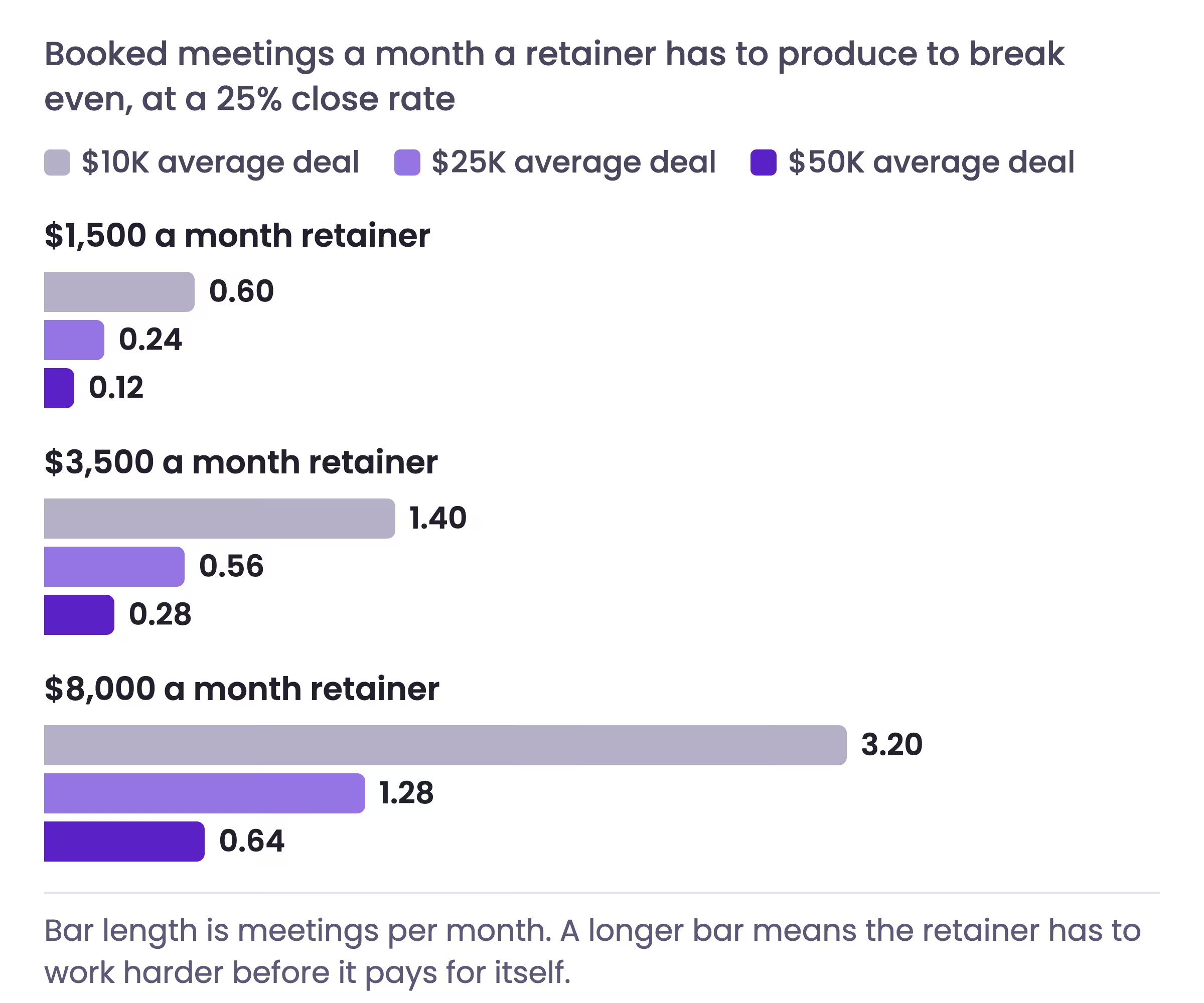
Two caveats keep this honest. The first is timing: profile views and impressions move within weeks, and inbound conversations lag them by six to ten weeks, so a month-one read tells you nothing. The second is attribution. Somebody who read your posts for four months and then replied to a cold email is content-sourced, and most CRMs will record that as outbound. Ask on the first call how they heard of you, and write the answer down.
When is a LinkedIn ghostwriter the wrong spend?
Three situations come up often enough to name.
You have no point of view yet. Ghostwriting turns opinions into posts. If the business has not decided what it believes about its market, a writer will produce competent posts about nothing, and the feed will read like everyone else's.
Your buyers are not on LinkedIn. Field service, local trades, some manufacturing and much of the public sector do not run their buying conversations there. Check where your last ten deals actually started before funding a feed.
You will not give up the hour. Every good process needs a recorded conversation with you in it, usually 30 to 45 minutes a fortnight. Founders who cannot protect that hour end up approving posts that sound generic, then blaming the writer.
If the point of view is the missing piece rather than the writing, start with how founders build a LinkedIn personal brand and come back to pricing once you know what you want to say.
What does a done-for-you LinkedIn ghostwriting engagement include?
For reference, here is the shape of a full-scope engagement, so you can hold a quote against it. Month one covers a voice interview, a profile rewrite and the first content bank. From month two the posts run on a fixed weekly cadence, comments are handled daily, and every month closes with a report covering impressions, profile views, inbound conversations and the posts that produced them.
Reachly runs that as a done-for-you service for B2B founders, with the same signal-based thinking we apply to outbound campaigns. Scope, cadence and how the engagement is measured are set out on the LinkedIn ghostwriting service page.
Get a scope and a price for your LinkedIn presence
We interview you, write in your voice, handle the comments, and report on the conversations your feed actually produces. Bring us a quote you are weighing up and we will tell you what it is missing.
See how LinkedIn ghostwriting works
Reachly's ghostwriting work is run by content strategist Vivian Ger.
LinkedIn ghostwriter cost FAQ
How much does a LinkedIn ghostwriter cost?
Between $1,000 and $9,000 a month in 2026. Most B2B founders land in the $1,500 to $4,000 band, which buys eight to twelve posts a month built from recorded voice interviews, plus a profile rewrite and basic reporting. Below $1,000 you are buying drafting only, and above $5,000 you are buying a team with comment engagement and pipeline reporting included.
How much do LinkedIn ghostwriters charge per post?
Per-post pricing typically runs from about $100 for a junior writer to $1,000 or more for a senior specialist, but very few serious engagements are priced this way. Almost all of them run as monthly retainers, because voice consistency depends on the writer working with you continuously rather than filling one-off orders.
What is the average cost of a ghostwriter?
On the freelance marketplaces, Upwork puts the median ghostwriter rate at $32 an hour with most work falling between $20 and $45 an hour. LinkedIn specialists sit slightly lower at a $25 median. Those numbers describe single tasks such as one post or a profile rewrite, so they are not comparable to an ongoing retainer.
What is a LinkedIn ghostwriter?
A writer who produces LinkedIn posts that publish under someone else's name, usually a founder or an executive. The work involves pulling opinions out of the named person through recorded interviews, shaping them into posts in that person's voice, and running a consistent publishing cadence so the account builds authority with buyers before any sales conversation.
What are the red flags when hiring a ghostwriter?
The clearest one is a request for your LinkedIn password, which breaches LinkedIn's User Agreement. Others are client samples that all read in the same voice, a process with no recorded interview in it, reach promised while comment engagement sits outside scope, a contract with no exit before month six, and reporting that shows impressions without profile views or inbound conversations.
Who is the best LinkedIn ghostwriter?
There is no single best one, because fit depends on whether the writer understands your market and your buyer. The practical test is three samples from three different clients that sound like three different people, plus the name of the writer who would be assigned to your account. A team that will not name the writer before you sign is selling you capacity rather than a person.
Is hiring a LinkedIn ghostwriter worth it?
It is worth it when the founder has a point of view and no time to write it, the buyers are active on LinkedIn, and the average contract value is large enough that a small number of inbound conversations covers the retainer. At a $25,000 average contract value and a 25 percent close rate, a $3,500 retainer breaks even at roughly one booked meeting every two months.
Is having a ghostwriter illegal?
No. Ghostwriting is a standard commercial arrangement and LinkedIn does not prohibit it. What LinkedIn's User Agreement does require is that the profile carries your real name and that you keep your credentials confidential and do not share or transfer your account. Handing over your password to a ghostwriter breaches that, so posts should be delivered to you or scheduled through delegated access.
Why would someone hire a ghostwriter for LinkedIn?
Because publishing consistently is what makes the channel work and it is the first task that slips when a founder is busy. A ghostwriter removes the writing bottleneck while keeping the opinions and the voice, so the account keeps building authority with buyers during the weeks a founder would otherwise post nothing.
Can I pay someone to write my LinkedIn profile?
Yes, and it is often the highest-return piece of the engagement. A profile rewrite covers the headline, the about section, featured links and the banner, so that the traffic your posts generate lands on something that explains what you do. It usually runs $500 to $1,500 as a one-off, or arrives folded into month one of a retainer.
Should you pay per post or on a monthly retainer?
A retainer, in almost every case. Per-post pricing pushes both sides toward volume and away from the interviews and editing that make posts sound like you. A retainer also gives the writer a reason to learn your market properly, since they are being paid for an ongoing relationship rather than a delivery.
How long before a LinkedIn ghostwriter produces leads?
Impressions and profile views usually move within the first three to four weeks, mostly from the profile rewrite and the first consistent posting. Inbound conversations lag those by six to ten weeks. Judging the engagement at month one measures the wrong thing, so set the first real review at month three.
Can an AI tool replace a LinkedIn ghostwriter?
An AI tool replaces the drafting, which is the cheapest part of the job. It does not run the interview that surfaces your opinions, decide what is worth saying this month, handle comments, or read the analytics and change direction. For a founder who already knows what they want to say, a tool plus an hour a week is a reasonable substitute for a low-end retainer.
What should be in a LinkedIn ghostwriting contract?
The named writer on your account, the interview cadence, the number of posts a month, whether comment engagement is included and under whose account it runs, the publishing method, what the monthly report contains, the notice period, and who owns the content bank if the engagement ends. Ownership of the content bank is the clause most often missing.
How do you measure whether a ghostwriting retainer is working?
Track four numbers monthly: impressions, profile views, inbound conversations started, and meetings booked that trace back to the feed. Impressions alone move easily and mean little. Ask every new inbound contact how they heard about you and record the answer, because content-sourced deals routinely get filed as outbound in the CRM.
Recommended service
LinkedIn Ghostwriting
Reachly writes and runs your LinkedIn presence so your profile builds authority and brings in inbound B2B leads.