


 Key Findings
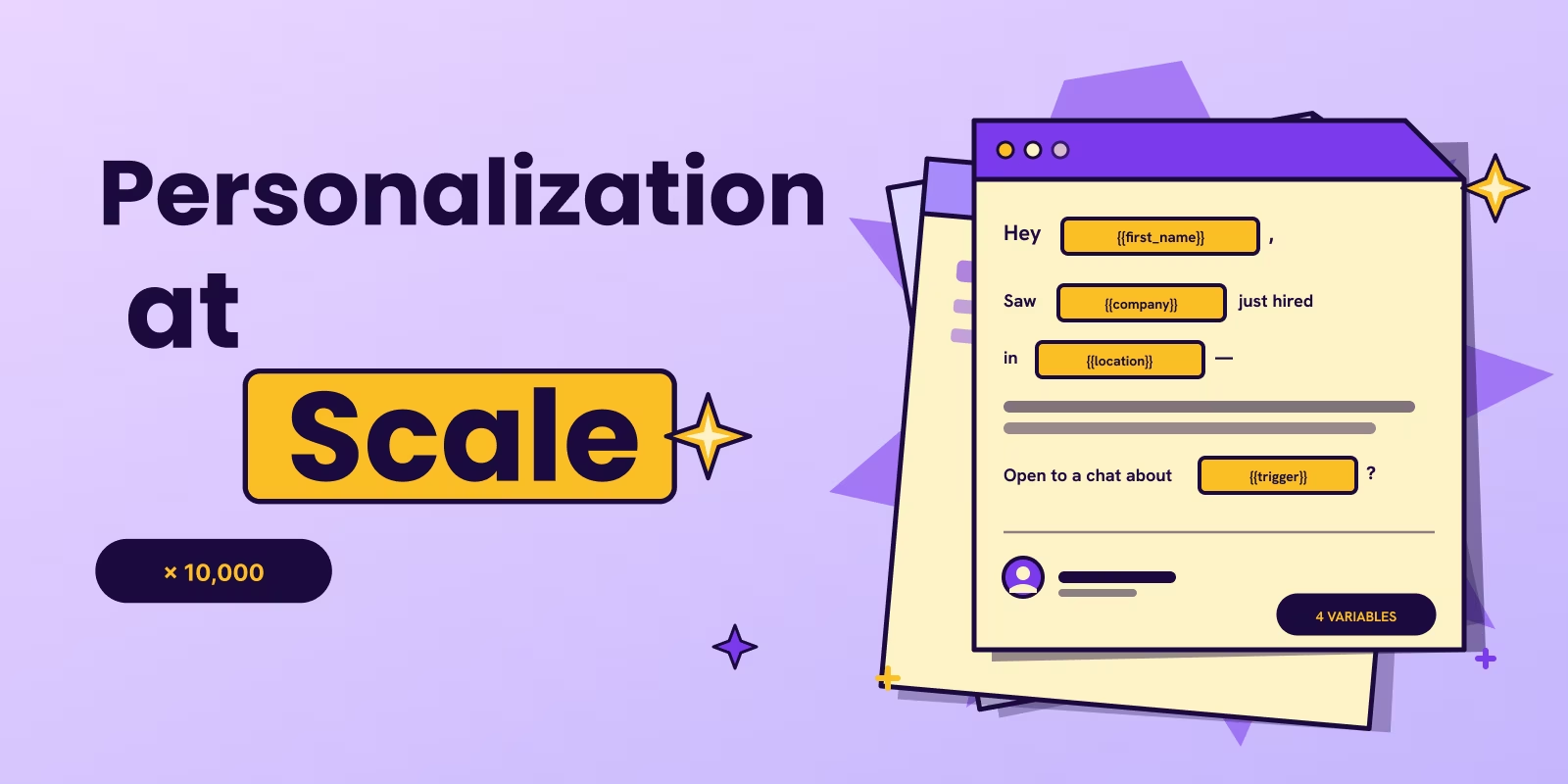
It starts before the email exists, inside your data model, account selection, trigger logic, and channel sequencing. Adding a first name is mail merge. Clever copy cannot save weak targeting.
Decide which accounts fit, who matters inside them, which trigger explains why now, which angle fits that trigger, and which channel goes first. Build a Total Addressable Customer view for the motion you are running, not just a broad ICP.
A signal has value when it changes what you say, who says it, or when you send. Pick one primary trigger and one supporting detail. Stacking four observations into the opener reads like surveillance.
Build one account narrative, then split by role: same story, different consequence for the VP, RevOps, and founder. Write if-then snippets, not full custom emails, and keep AI to short, constrained branches.
Let each channel do a different job under one narrative, not three disconnected pitches. Track positive reply rate, not opens, and when a sequence underperforms fix account quality, trigger, and role mapping before you touch the copy.
Most advice on personalization is bad. It treats personalization like a copywriting trick. Add a first name. Mention the company. Reference a recent post. Then hope the prospect mistakes effort for relevance.
That is not personalization. It is mail merge with better research.
Real B2B outbound personalization is operational. It starts before the email exists, inside your data model, your account selection rules, your trigger logic, and your channel sequencing. If those pieces are weak, clever copy will not save you. It just turns bad targeting into expensive spam across more surfaces.
In B2B outbound this matters more, because you rarely sell to one person. You sell into a buying committee, across mixed incentives, with timing that changes fast. One stakeholder cares about pipeline. Another cares about risk. Another cares about integration pain. If your system cannot hold a coherent account narrative while adjusting by role, you do not have personalization. You have message drift. We run this model across 400+ campaigns at Reachly, and the pattern is always the same: the system decides the outcome long before the copy does.
Everyone gets personalization wrong
Many teams think personalization means writing a unique email for every prospect. That is the wrong job.
The job is to reduce uncertainty before outreach starts. Which accounts fit. Which people matter inside those accounts. Which trigger explains why now. Which message angle belongs to that trigger. Which channel should carry the first touch. Once those decisions are right, the copy gets simpler.
This is why the conversation moved from creative to commercial. Companies that excel at personalization generate 40% more revenue from those activities than average players, according to Contentful's write-up on personalization at scale. That number kills the old idea that personalization is a nice extra for brand teams. It is a revenue system.
In outbound, the failure usually starts with the list. A weak list forces the writer to compensate with fake relevance. You see it everywhere. Generic problem statements. Forced compliments. Random podcast mentions. None of it fixes bad account selection.
The better way is boring at first. Build the machine. Define the market tightly, unify the data, attach real signals, write message variants around those signals, and keep the account story consistent across stakeholders. That is B2B outbound personalization.
Start with a constraint, not a database export
Good outbound starts with a constraint. If the target market definition is loose, everything downstream gets noisy. The wrong accounts enter the sequence, the wrong contacts get enriched, and the messaging team starts inventing relevance to fill the gap. That is how teams burn months.
A practical operating model starts with a unified, granular customer-data layer, and McKinsey ties that setup to a 10 to 15% revenue lift in leading programs through better activation and decisioning in its technology blueprint for personalization.
Do not start with ICP slides. Start with the sales reality. Ask four things. What deal are you trying to create, since new logo pipeline is not the same as expansion pipeline. What motion are you running, because founder-led, SDR-led, and agency-run outbound all need different list depth. What buying event usually creates urgency, since hiring, expansion, a tooling change, funding, or underperformance each lead to different outbound logic. And what account volume your team can actually work, because if reps can only handle thoughtful outreach to a narrow set each week, you should not build a giant target universe.
That gives you something more useful than a broad ICP. It gives you a practical account definition based on fit and likely timing. Stack data from sources like LinkedIn Sales Navigator, Apollo, Crunchbase, company websites, job boards, and your own CRM to answer one question per account: work it now, later, or not at all.
| Layer | What to check | Why it matters |
|---|---|---|
| Firmographic fit | Industry, region, size, business model | Filters out accounts that will never close |
| Motion fit | Team structure, market served, outbound maturity | Stops you pitching a motion they cannot use |
| Timing fit | Hiring, expansion, tool change, growth signals | Gives the outreach a reason to exist now |
| Access fit | Reachable decision-makers and buying roles | Prevents dead-end accounts with no path in |
If your data supplier says a record is verified, treat that as a clue, not a conclusion. Email data goes stale. Roles change. Domains change. Catch-all setups muddy the picture. Serious teams re-verify before launch, especially when the list was built from multiple sources. If you are cleaning records and enriching fields before sequencing, our guide on B2B data enrichment is worth reading first.
A few clean-list rules save campaigns. Match the account before the contact, because picking people first fills your CRM with reachable strangers. Keep role logic explicit, since "marketing leader" is too broad: define who owns the pain, who feels it, and who can block the deal. Check recency manually on edge cases, because a job title and a company page often tell you more than a vendor field. And store source confidence, so your team knows which fields to trust.
Build the engine with enrichment and real signals
Once the list is clean, the next job is timing. Not personal trivia. Not random compliments. Timing.
The strongest outbound personalization comes from attaching a plausible reason for contact to each account. That is the difference between "saw your company and thought I would reach out" and "you are probably dealing with this exact change right now." A common failure here is fragmented architecture. One tool says the company is hiring, another says headcount is flat, and your sequence pulls the wrong message branch. Only 49% of organizations meet customer expectations for personalized experiences, and siloed systems that create inconsistent profiles are a big part of that gap, per Bannerflow's write-up on personalization challenges and fixes.
Basic firmographics are not enough once you are writing to buying committees. You need state change: hiring signals, especially first or leadership hires that reveal the problem being solved; headcount movement that shifts capacity and tooling needs; funding and expansion that can justify urgency when it links to your offer; technographic changes, where a new tool or a missing one shapes your angle; and commercial intent like site visits or content engagement that helps you prioritize. If you are building these into prioritization, our breakdown of B2B intent data is a practical place to start, and the wider system sits inside our signal based outbound playbook.
A signal has value only when it changes what you say, who says it, or when you send it. Teams collect triggers, then write the same email anyway.
| Signal | What it likely means | Better outbound angle |
|---|---|---|
| Hiring first SDRs | Building outbound from scratch | Focus on ramp time, list quality, and reply handling |
| Hiring RevOps | Process cleanup is becoming urgent | Talk about workflow consistency and data quality |
| New sales leadership | Team may be reassessing pipeline creation | Lead with current gaps and speed to first meetings |
| New CRM or sales tool detected | The stack is changing | Talk about integration friction and process design |
A company hiring its first outbound team does not need a deep product pitch. It needs confidence that somebody understands the setup work. A mature team adding RevOps does not need "more leads." It needs cleaner execution. The trigger is not the personalization. The trigger tells you which problem deserves airtime.
Do not stack too many signals. More data can make the message worse. Feed Clay every enrichment source and cram four observations into the opener, and it reads like surveillance. Pick one primary trigger. Add one supporting detail if it sharpens the case. Clay is useful for assembling enriched account views and routing records into message branches, but the discipline is in the rule set, not the tool. If your team cannot explain why a signal should change the angle, that field should not control copy.
Craft messages that do not sound robotic
Good personalized messaging does not come from writing more. It comes from writing fewer branches with tighter logic. A common misconception is that personalization means infinite variation. It does not. With multiple stakeholders inside one deal, the better approach is structured variance, which comes from a small number of validated segment patterns and intent signals rather than chaotic one-off messaging, as Convert's write-up on personalization for B2B buying committees explains.
Start at the account level. Ask what is happening inside this company that makes your offer relevant now. That becomes the core message. Then split the language by stakeholder. Same narrative, different consequence.
| Stakeholder | What they care about | Same narrative, different wording |
|---|---|---|
| VP of Sales | Pipeline creation and rep productivity | "If you are building outbound coverage, weak data and inconsistent sequencing usually slow rep output." |
| RevOps | Process reliability | "If outbound volume is rising, routing, data freshness, and handoff rules usually break first." |
| Founder or CEO | Commercial efficiency | "If the team is pushing into a new market, outbound fails when it needs heavy oversight to hold quality." |
The account hears one commercial story, not three disconnected pitches. The easiest way to sound robotic is to over-template the whole email. The better way is modular. Keep a fixed structure, then swap in if-then snippets based on data you trust. If the company is hiring sales reps, the opener speaks to expansion pressure. If they use HubSpot, the body mentions workflow fit. If the trigger is a new market push, the call to action shifts toward testing a focused motion instead of a broad pitch. You are not asking AI or a rep to rewrite the whole message each time. You are asking the system to choose the right branch. For more role-aware patterns, our library on cold email personalization is a useful reference.
AI belongs in your snippets, never in your full email. The signal makes the first line land. Saw you just raised your Series A with Sequoia leading. That one line does the personalization. Then you write the rest yourself, because buyers are tone deaf to AI slop. The signal is the edge. The hand-written body is the trust.

AI copy gets uncanny fast if you let it produce too much of the message. Short, constrained snippet generation works better than full email generation. If your team uses AI in drafting, these best practices for humanizing AI emails are useful because they focus on making the output read like a person who has a reason to write. If a sentence could be sent to five different companies with no edits, it should not be in your personalized opener.
Human-sounding outbound usually has three traits. A credible observation, something the reader believes you could reasonably know. A narrow consequence, not "this helps sales teams" but "this usually creates a list quality and routing problem." And a low-friction ask, no giant calendar push if the message has not earned it. Keep the approved account narrative, role variants, and trigger snippets in one place, because if sales, an agency partner, and the founder all edit copy in separate docs, message drift starts fast.
Orchestrate the multichannel sequence
A personalized email on its own is fragile. People miss emails, ignore cold inboxes, skim on mobile, and mean to reply and forget. Modern personalization is a cross-channel operating model, not a one-channel trick, a shift Braze describes in its piece on cross-channel personalization.
Each channel should do a different job. Cold email carries the clearest problem statement. LinkedIn adds familiarity and recognition. Cold calling tests urgency and surfaces objections fast. The mistake is using all three to repeat the same script. We run the channel stack in that order, cold email, LinkedIn, cold calling, because seeing your name three times before the call makes the call land warm.
| Day | Channel | Purpose |
|---|---|---|
| Day 1 | Email #1 | Lead with the account trigger and a relevant problem |
| Day 3 | LinkedIn visit or light engagement | Build recognition before the next touch |
| Day 4 | Email #2 | Add a different angle or a short proof point |
| Day 6 | LinkedIn connection request | Keep it short and consistent with the email narrative |
| Day 8 | Call task | Check for urgency, routing, or a better contact |
| Day 11 | Email #3 | Close the loop with a direct, low-friction question |
| Day 14 | Final call or LinkedIn follow-up | Force a yes, no, later, or redirect |
How Reachly coordinates this at the campaign level: one strategist owns sequence and signal design, one ops lead owns infrastructure, one inbox manager owns reply handling. Email carries the heaviest personalization, LinkedIn supports recognition, and the call is informed by the trigger so it never goes generic.
Timing should follow signal strength. A strong trigger justifies faster follow-up. Weak triggers need lighter pressure. Tools like Smartlead for sending and mailbox management, HeyReach for the LinkedIn layer, and Clay for enrichment each handle a part of the system. The tool choice matters less than having one orchestration layer and one owner of sequence logic.
Keep AI on a short leash inside that fence. Use it for snippet drafting, subject line options, and role-based rewrites. Do not let it invent the strategy. For a practical example of AI used inside outbound workflows, this Applied piece on using Claude for personalized sales outreach is worth a read. The moment every touch sounds slightly different in tone, the buyer feels the machine behind it. One account narrative. One trigger. Controlled variants by role and channel.
Measure what matters and iterate
Most outbound dashboards are built to comfort the team, not tell the truth. Open rates look active. Click rates look clean. Activity counts make reps feel busy. None of that answers the only question that matters: did this motion create real sales conversations with the right accounts.
The cleanest operating metric is positive reply rate. Out-of-office messages, unsubscribes, angry replies, and auto-responses do not count. A positive reply shows interest, a redirect to the right person, a request for detail, or a willingness to talk. For context, 10 to 20% positive reply is normal in our campaigns and 35 to 40% is very good. If positive replies are weak, the issue could be account selection, trigger quality, role mapping, branch logic, or sequencing. Open rate alone tells you almost nothing.
More tailoring is not always better. Teams focus on orchestration and automation but spend less time proving causal lift, which is why holdouts and incrementality testing matter once the machine is running, a point made in McKinsey's piece on the first steps in personalization. Test one hypothesis at a time. Use holdout groups, because sometimes the simpler message wins when the trigger was not strong enough to carry a custom angle. Watch meeting quality, not just reply quality. And kill branches fast when a path keeps producing low-quality conversations.
When a sequence underperforms, do not rewrite everything. Check account quality, then trigger quality, then role mapping, then narrative fit across channels, then call-to-action friction. That order saves time. Most poor campaigns are not copy problems. They are targeting and logic problems wearing a copy costume. If you want to pressure-test reply quality against benchmarks, our outbound lead generation overview frames where personalization fits the wider motion.
Stop tinkering and build the machine
If you are constantly tweaking intros, testing clever subject lines, and rewriting the first sentence for the fifth time, you are probably fixing the wrong layer. B2B outbound personalization is a machine: a clean account definition, a trustworthy data layer, useful signals, controlled message branches, multichannel coordination, and tight measurement. Miss one piece and the rest starts lying to you.
The teams that get this right do not chase infinite custom work. They build repeatable rules. They know which signals deserve a message change, which roles need different framing, and which channels carry which part of the conversation. That is why the approach holds up. It does not depend on one rep, one writer, or one prompt. Build the system once, then keep making it harder for the wrong accounts to enter and easier for the right accounts to respond.
Build the machine, not just the copy.
Reachly runs done-for-you B2B outbound across cold email, LinkedIn, and cold calling, with account mapping, data enrichment, signal-based sequencing, reply handling, and meeting booking built in. Triple-certified across Clay, Smartlead, and HeyReach. Primal hit 4.57x ROI and 85+ SQLs in 6 months on this exact system.
See how Reachly works
FAQ
It is a system, not a copy trick. It starts before the email exists, in account selection, trigger logic, role mapping, and channel sequencing. The goal is to reduce uncertainty about who to contact and why now, so the message has a real reason to exist instead of a first name pasted into a template.
Use structured variance. Build one account narrative, then split it by role and swap in if-then snippets based on data you trust. The system chooses the right branch instead of a rep rewriting the whole message. Keep AI to short snippets, never the full email.
Hiring and leadership changes, headcount movement, funding and expansion, technographic changes, and account-level intent. A signal only matters if it changes what you say, who says it, or when you send. Pick one primary trigger plus one supporting detail, not four.
Positive reply rate, not opens or clicks. A positive reply shows interest, a redirect, a request for detail, or a willingness to talk. In our campaigns 10 to 20% positive reply is normal and 35 to 40% is very good. Weak replies point to targeting, trigger, or role mapping before copy.
Use AI for the signal-driven snippet, never the full email. The signal earns the open and a hand-written body keeps the trust, because buyers are tone deaf to AI slop. Let AI choose branches and draft snippets inside a fixed structure, then QC before send.
Recommended service
Outbound Lead Generation Services
Reachly builds and runs the whole outbound motion across email, LinkedIn, and phone, and books qualified meetings on your calendar.