
 Key Findings
Once you add employer taxes, benefits, tools, data, and management, a fully loaded in-house SDR runs $9,800 to $14,200 a month, roughly $120,000 to $170,000 a year per productive rep.
An SDR agency is sending in two to three weeks with infrastructure included, versus two to four months of hiring and ramp for an in-house rep. The cost is variable and can be paused, not a six-figure fixed bet.
When the motion is already proven and you want the pipeline and knowledge to live inside the company, an in-house SDR who knows your product deeply pays off, provided you budget honestly for ramp and turnover.
Use an agency to get live fast and find the winning offer, document the playbook, then hire in-house against proven results so the rep inherits a working system instead of learning outbound on your budget.
Across 400+ campaigns, weak offers keep reply rates near 0.5 percent regardless of who sends. Reachly moved a client from 0.5 to 1.6 percent on offer and copy alone, which is why the team you pick sets the ceiling and the offer decides whether you reach it.
A founder does the math on a napkin. One SDR, maybe seventy grand base, some commission, and pipeline starts flowing in a month or two. Six months later the seat has cost closer to a hundred and forty thousand fully loaded, the rep booked eleven meetings total, and half of those no-showed. Now the same founder is staring at an SDR agency proposal and wondering if outsourcing is just a faster way to waste money.
The SDR agency vs in-house SDR question is really three questions hiding in a trench coat: what does each one actually cost, how fast does each one produce pipeline, and who owns the risk when it does not work. Answer those and the choice stops being a gut call.
This is the operator version. Real cost lines, real ramp times, where an SDR agency wins, where an in-house team wins, and the hybrid setup most growing teams land on once the spreadsheet is honest.
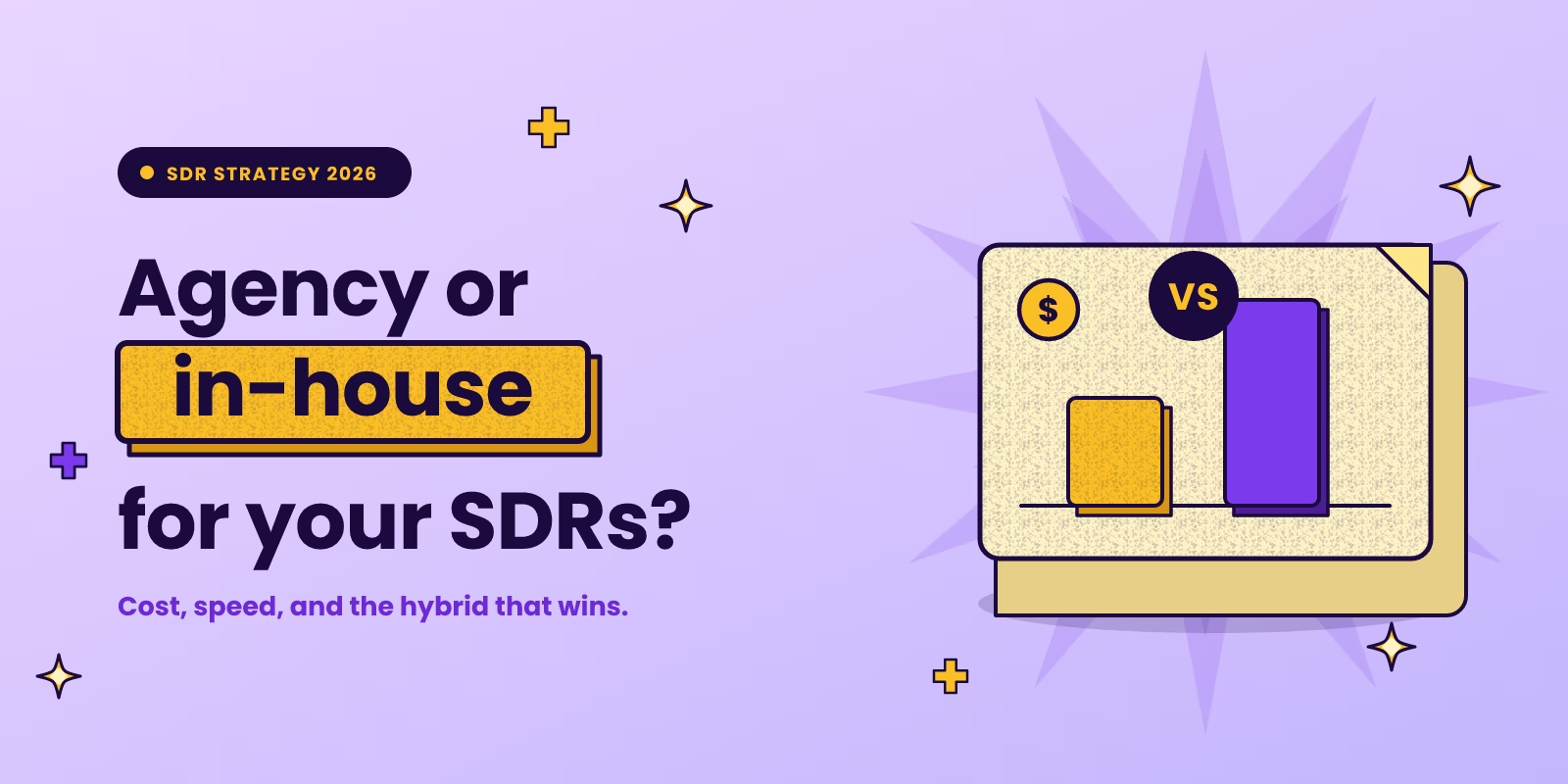
SDR agency vs in-house SDR: the short answer
An in-house SDR is an employee you hire, train, equip, and manage. You own the pipeline they build and the reputation they earn, and you also own every fixed cost and every month they spend ramping. An SDR agency, sometimes sold as outsourced SDR or SDR as a service, rents you a trained team plus the full sending stack on a monthly fee, live in weeks instead of months.
- Live in two to three weeks, no hiring cycle
- Domains, warmup, tools, and data included
- Sees what is working across many clients right now
- Monthly retainer, stop or swap with notice
- Best for testing offer-market fit fast on a lean team
- Shared attention, needs a tight brief to sound like you
- Two to four months from job post to full productivity
- You buy and run domains, tools, and data yourself
- Learns one market, on your budget
- Fixed cost of $120,000 to $170,000 a year, fully loaded
- Best for a proven motion you want to own long term
- Full control of brand voice and the calendar
So the real question is not which is better in the abstract. It is whether you need pipeline this quarter to learn if your offer works, or whether you already have a proven motion worth owning in your own building. That maps cleanly onto how modern outbound lead generation gets built in 2026.
What an in-house SDR actually costs
The salary is the smallest honest number in the whole exercise. A mid-market SDR base runs $55,000 to $70,000, and on-target earnings with commission push that to $75,000 to $90,000. Then the real bill arrives. Once you add employer taxes, benefits, the sending stack, data, verification, and the manager time it takes to keep one rep productive, industry cost breakdowns put a fully loaded in-house SDR between $9,800 and $14,200 a month per productive rep.
| Cost line | What it covers | Monthly range |
|---|---|---|
| Salary and commission | Base pay plus on-target commission (OTE) | $6,300 to $7,500 |
| Employer taxes and benefits | Payroll tax, healthcare, retirement, roughly 25 to 30 percent burden | $1,600 to $2,200 |
| Tools and data | Sequencer, dialer, contact data, email verification, warmup | $600 to $1,500 |
| Management and enablement | Manager time, coaching, call review, quota admin | $1,000 to $2,000 |
| Ramp and turnover drag | Three to six months to full output, plus SDR churn near 35 percent a year | $300 to $1,000 |
| Total per productive rep | What one working seat really costs each month | $9,800 to $14,200 |
Two numbers in that table do the real damage. The first is ramp: an in-house SDR takes three to six months to reach full productivity, and you pay full freight the entire time. The second is turnover. SDR is one of the highest-churn roles in B2B, so a chunk of every year is spent re-hiring and re-ramping the same seat. That is not a knock on the role. It is the reason the fully loaded cost is nearly double the salary you budgeted.
What an SDR agency actually does
An SDR agency, the same thing people search for as outsourced SDR services or sales development outsourcing, is not just rented headcount. A real one hands you a working outbound system: domains bought and warmed, a sending platform configured, contact data sourced and verified, sequences written, and a team running the day-to-day across cold email, LinkedIn, and cold calling. You brief the offer and the target market. They build and run the machine.
The cost model is the opposite of in-house. Instead of a fixed salary that exists whether or not it produces, you pay a monthly fee tied to a scope of work, and you can stop or change it with notice. There is no employer tax, no severance, no tool contracts in your name, and no three-month ramp on your payroll. A good agency is already sending for you inside two to three weeks, because the infrastructure and the playbooks already exist. The trade is control: your brand voice now lives partly in someone else's hands, which is why the brief and the feedback loop matter more than the logo on the invoice.
Our take: The underrated advantage of an agency is not price. It is pattern recognition. A team running four hundred campaigns sees which offers and angles are landing this month across many markets, long before any single in-house rep could learn it on one budget.
SDR agency vs in-house SDR: the honest comparison
Put the two side by side on the dimensions that actually decide the outcome, not just the sticker price. This is the outsourced SDR vs in-house comparison stripped to what changes your pipeline and your risk.
| Dimension | SDR agency | In-house SDR |
|---|---|---|
| Time to first send | Two to three weeks, infrastructure already exists | Two to four months including hiring and ramp |
| Cost structure | Monthly retainer, variable, cancel with notice | $120,000 to $170,000 a year fixed, per productive rep |
| Expertise | Cross-client patterns refreshed every month | Deep on your product, learned over time |
| Infrastructure | Domains, warmup, tools, and data included | You buy, configure, and maintain the whole stack |
| Control and brand voice | Shared, depends on the brief and feedback loop | Full, the rep sits in your building |
| Risk if it fails | Pause or switch providers | Sunk salary, severance, and team morale |
Read the table as a bet on time. If you already know your offer converts and you want the pipeline and the institutional knowledge to live inside the company for years, in-house wins even at the higher cost. If you are still proving that the offer lands and you cannot afford four months and a six-figure fixed cost to find out, the agency is the cheaper experiment by a wide margin.
When to build an in-house SDR team
Hire in-house when the motion is proven and permanent. You have product-market fit, a repeatable sales process, a manager who can coach outbound, and the budget to carry a rep through ramp and the occasional bad hire. In that world, an SDR who lives your product every day builds relationships and product knowledge no external team can match, and every meeting they book compounds inside your own walls.
In-house also wins when the sales cycle is highly technical or heavily relationship-driven, where the SDR needs to speak the buyer's language with real depth. Just budget honestly. A single seat is a six-figure commitment before it books a meeting, so the decision should look more like hiring an engineer than buying a tool. If you want the framework for turning that rep's output into qualified pipeline, our guide on how to qualify leads in sales is the standard we run.
When to hire an SDR agency
Hire an agency when speed and flexibility beat control. You are a founder or a lean team that needs pipeline now, you are testing a new market or a new offer, or you simply do not have the management bandwidth to run outbound well in-house. An agency gets you sending in weeks with infrastructure that already works, and it turns a scary fixed cost into a variable one you can stop if the numbers do not show up.
There is a deeper reason too. Outbound is a marketing experiment before it is a headcount decision, and agencies are built to run that experiment fast. The best ones treat cold email as a testing loop across offer, angle, CTA, copy, and audience, which is exactly the discipline behind a modern outbound sales strategy and the reason signal-based targeting matters more than raw volume.
Cold email is a marketing experiment. You test offer, angle, CTA, copy, and audience until something converts. Founders who will not budget for that test loop should not be running outbound in-house yet. An agency lives in the weeds across many clients, so it sees what is working right now faster than any single in-house team can learn it on one budget.

The hybrid model most teams miss
The framing of agency versus in-house breaks down the moment you watch a company that has done both. The winning pattern is rarely one or the other forever. It is a sequence: use an agency to find what works, then bring the proven playbook in-house once the economics justify a permanent seat.
This is why the outsourced SDR vs in-house debate has a false premise. The good outcome is not picking a side. It is sequencing them so the agency de-risks the experiment and the in-house hire inherits a machine that already books meetings. If you want the targeting layer that makes either version work harder, start with signal-based outbound.
The part the comparison misses
Here is the uncomfortable truth after four hundred campaigns. Neither the agency nor the in-house rep is usually why outbound fails. The offer is. We have watched teams with perfect infrastructure and clean lists sit at a 0.5 percent reply rate, then move to 1.6 percent with the same setup once the offer and the copy got direct. The team you pick sets your ceiling. The offer decides whether you reach it.
That reframes the whole cost question. A cheap in-house rep sending a weak offer is expensive. A pricey agency behind a sharp offer is the best money in the budget. Before you argue about the org chart, pressure-test whether your offer is something a buyer cannot easily say no to, and make sure the fundamentals in our guide to cold email best practices are in place.
How Reachly runs SDR as a service
If the goal is booked meetings rather than a perfectly staffed org chart, there is a cleaner answer than either extreme. Hand the motion to a team that already runs the full stack. Reachly is a triple-certified outbound agency operating cold email, LinkedIn, and cold calling as one system, live for a client in two to three weeks. Across 400+ campaigns we have booked 2,500+ meetings and generated over $3M in pipeline, with bounce rates under 3 percent and deliverability above 97 percent.
The proof looks like this. For Primal we produced 85+ qualified leads in six months, a 4.57x return, and break-even by month three, with an 8 percent average positive reply rate and zero added headcount on their side. That is the agency case in one line: pipeline in weeks, no six-figure fixed bet, and a playbook you can bring in-house later. See how it works on the Reachly homepage, run the numbers through the ROI calculator, or read how the pieces fit in our guide to outbound lead generation.
Sales operations at Reachly are handled by Utkrusht Gupta, who keeps campaign data and sequencing in order across accounts. SDR as a service from Reachly covers the list, the sequence and the reply handling under one monthly fee.
SDR agency vs in-house SDR FAQ
Usually for the first year, yes. A fully loaded in-house SDR runs $120,000 to $170,000 a year once you add employer taxes, benefits, tools, data, and management, and you pay it through a three to six month ramp. An SDR agency turns that fixed cost into a monthly retainer with infrastructure included, so the total first-year cost is often lower and far less risky. Over several years, a productive in-house rep can become the cheaper option per meeting.
Three to six months to reach full productivity is the typical range, and you pay full compensation the entire time. Add the hiring cycle before it and you are often four months from job post to a rep booking meetings reliably. An SDR agency is usually sending inside two to three weeks because the domains, warmup, tools, and playbooks already exist.
A full-service SDR agency, also sold as outsourced SDR or SDR as a service, builds and runs your outbound system: buying and warming domains, configuring a sending platform, sourcing and verifying contact data, writing sequences, and working cold email, LinkedIn, and cold calling day to day. You brief the offer and the target market. They build the machine and book the meetings.
Neither wins automatically. An agency books meetings faster early because the infrastructure and playbooks are ready and it recognizes winning patterns across many clients. A strong in-house rep can match or beat that once fully ramped on a proven motion. In both cases the offer and copy decide the reply rate far more than who employs the sender.
Yes, and it is often the smartest setup. Use an agency to get live fast and find the winning offer, document the playbook, then hire in-house against proven results so the new rep inherits a working system. Many teams keep the agency on deliverability, infrastructure, and new-market tests while in-house owns the core motion.
Recommended service
Outbound Lead Generation Services
Reachly builds and runs the whole outbound motion across email, LinkedIn, and phone, and books qualified meetings on your calendar.