

 Key Findings
Signal-based outbound produces better pipeline than volume-based outbound. Reaching a prospect when something has just changed in their business, a new hire, a funding round, a tool switch, generates significantly stronger reply rates and meeting quality than reaching the same prospect on an arbitrary schedule. Timing is a lever most agencies ignore.
Multi-channel outreach is not optional in 2026. Single-channel campaigns, whether email-only or LinkedIn-only, leave a significant portion of your addressable market untouched. The strongest GTM outbound systems run cold email, LinkedIn, and calling as a coordinated sequence, not as separate efforts bolted together.
Most outbound fails because of targeting, not copy. Teams that are getting poor results from outbound typically blame the messaging first. The actual problem is usually the list: no signal layer, no enrichment, and no reason why those specific people should care about that specific offer right now.
APAC is a specialist market that most agencies are not built for. Buyer communication preferences, deliverability norms, and the relative importance of LinkedIn versus email differ materially across Singapore, Southeast Asia, and Australia compared to North American and European markets. Running a standard Western playbook into APAC without adaptation consistently underperforms.
Infrastructure decides whether a campaign scales or collapses. Unwarmed domains, unsafe LinkedIn connection volumes, and sequences without deliverability monitoring all produce the same outcome: a campaign that looks fine in week one and quietly stops landing by month two. The infrastructure layer is where most agencies cut corners because clients do not see it until it breaks.
The operating model behind the strongest companies on this list is GTM engineering, which builds the data, signal, and sending layers as one system instead of staffing them with SDRs. The linked guide covers the role, the stack, 2026 salary bands, and the metrics worth holding any partner to.
A claygency is the label for an agency running Clay as its data layer with signal-based triggers and multichannel execution, and only 3 of the 12 companies reviewed here publicly document that setup. Treat the term as a question to ask a shortlist rather than a badge to take at face value.
Choosing a GTM lead generation partner in 2026 is not the same decision it was two or three years ago. The bar has moved. Buyers are harder to reach, inboxes are more competitive, and the agencies that still run volume-first campaigns without a data layer underneath them are quietly bleeding clients.
The companies worth working with today are the ones that treat outbound as a system: signal-based targeting to reach the right people, multi-channel execution to reach them across more than one surface, and proper infrastructure so the whole thing does not collapse after a few weeks of sending. That is a meaningfully different standard from what most agencies offer.
This article reviews twelve GTM-focused lead generation companies currently operating in 2026. We wrote it, so Reachly is listed first. The rest are covered as honestly as we can manage.
| Company | Type |
|---|---|
| Reachly Us | Done-for-you & done-with-you GTM agency |
| SalesCaptain | AI communication platform |
| ColdIQ | Done-for-you outbound agency |
| Lead Assassin | Outbound email agency |
| OneAway | Multi-channel growth studio |
| Sales Automation Systems | Outbound automation service |
| LeadBird | Done-for-you outbound agency |
| FullFunnel | ABM consulting and training |
| RevPartners | RevOps and GTM engineering |
| StackOptimise | Signal-based outbound agency |
| EarLeads | GTM engineering agency |
| Navreo | AI-powered outbound automation |
Five Things Worth Knowing Before You Choose
Timing beats volume every time. Reaching a prospect when something has just changed in their business, a new hire, a funding round, a tool switch, produces dramatically better results than reaching them on a Tuesday because that is when your sequence happened to fire. Signal-based agencies outperform volume-first shops for this reason.
Single-channel outbound is a ceiling. Running cold email alone means you are invisible on LinkedIn, where most senior B2B buyers spend time every day. The strongest campaigns layer email, LinkedIn, and calling into a single coordinated motion, not three separate efforts running in parallel.
Reachly's outbound sales strategy guide has a sample 14-day sequence that layers email, LinkedIn and a call.
GTM and lead generation are not the same thing. A lead generation agency gets you contacts and meetings. A GTM agency aligns those meetings to how your sales team actually closes deals: the right ICP, the right message, the right channel, at the right moment in the buyer's cycle.
APAC is a different market. Buyer preferences, deliverability norms, and the balance between email and LinkedIn as primary channels vary significantly across Singapore, Australia, and the wider APAC region. Most agencies on this list were built for North American or European markets and have little operational experience in the region.
Infrastructure is unglamorous but critical. Cold email sent from unwarmed domains lands in spam. LinkedIn outreach run at high volume without proper connection-building gets accounts flagged. The infrastructure layer is what determines whether a campaign that works in week one still works in month four.
What GTM Lead Generation Actually Means
Lead generation at its simplest means finding buyers and getting them into a pipeline. GTM lead generation means doing that in a way that is designed around how your specific business goes to market: your ICP definition, your positioning, your sales motion, and the buying triggers that indicate a prospect is actually ready to have a conversation.
The practical difference shows up in pipeline quality. Standard lead gen fills a calendar. GTM-aligned lead gen fills a calendar with people who match the deals your team can close.
Most GTM lead generation companies fall into one of three operating models. Done-for-you agencies own the full execution, from infrastructure through to booked meetings, and hand you the output. GTM engineering firms build the systems but leave the execution with your team. Consulting and training firms teach the methodology and help you develop the capability internally over time. The rest of this article covers examples of all three.
If the third model is the one you are weighing, our complete guide to GTM engineering covers what the role owns, the stack it runs on, and what the function costs to buy or to staff.
What Is a Claygency, and Which of These 12 Companies Qualifies?
A claygency is a GTM lead generation agency built around Clay as its central data and orchestration layer, with signal-based targeting and coordinated cold email, LinkedIn, and cold calling execution in every campaign. The term started circulating in the Clay community in 2024 and is now the accepted label for this type of operator. Of the 12 companies reviewed here, 3 publicly document Clay at the center of their delivery, and every one of the 12 should be able to answer the three-pillar test below in under a minute.
A claygency runs on three pillars. Data first: Clay sits at the center, pulling from 75+ providers with waterfall enrichment so no prospect slips through. Signals second: hiring moves, funding rounds, tech stack changes, website visits, content engagement, so campaigns fire on what a company is doing rather than on static ICP fit. Channels third: cold email through Smartlead, LinkedIn through HeyReach, and cold calling sequenced together, so a prospect sees the same name across three touchpoints before anyone picks up.
A traditional lead generation agency runs campaigns off a list. A claygency builds a system that keeps producing after the first campaign ends. The table below is the version of that difference a buyer can check in a sales call.
| Factor | Traditional Lead Gen | Claygency |
|---|---|---|
| Data source | Bought Apollo lists, scraped LinkedIn, static CSVs | Live waterfall enrichment across 75+ sources via Clay |
| Targeting logic | Firmographic filters (industry, size, title) | Real-time buying signals (hiring, funding, tech stack, intent) |
| Personalization | First-name variable and company name tokens | AI-generated openers based on enriched context per lead |
| Channels | Usually email only, occasionally LinkedIn | Email, LinkedIn, and phone coordinated as one sequence |
| Infrastructure | One domain, shared mailboxes, inconsistent warmup | Dedicated sending domains, mailbox rotation, deliverability monitoring |
| Reporting | Opens, clicks, sends | Positive reply rate, meetings booked, pipeline generated |
| Speed to launch | 4 to 8 weeks | 2 to 3 weeks |
| Outcome ownership | Delivers replies, handed off to client | Delivers meetings, handles appointment setting through to the call |
The gap shows up in reply quality rather than in send volume. On Primal, a signal-based build across evergreen and trigger campaigns held an 8% positive reply rate and produced 85+ SQLs in 6 months. Someone who posted about churn 48 hours ago is a different prospect from someone pulled off an industry filter.
A real Claygency does not just use Clay to find leads and push them to a sequencer. A real Claygency uses Clay to layer multiple signals across the client's total addressable market, then tiers and scores companies based on which signals matter most. We run trigger campaigns at the same time as evergreen ones, so we catch companies that just hired, just lost a champion, or just raised a round. Evergreen plus triggers, not one or the other.

On the 12 companies reviewed above, here is how the label lands. Reachly holds Clay Solutions Partner status alongside Smartlead and HeyReach, and runs Clay as the data layer on every account. ColdIQ is an Elite Clay partner and builds Clay-first cold email campaigns. RevPartners holds Elite accreditation with both Clay and HubSpot, though it sells RevOps architecture rather than booked meetings, which makes it a claygency by stack and a consultancy by engagement model.
The other nine run signal-based outbound on stacks they do not publish in detail, so treat the claygency label as a question to ask them rather than a badge to assume. Ask which tool holds your data, which signals trigger a campaign, and what you keep on day 91 if the engagement ends.
Agency vs Platform: Which One Do You Actually Need?
This is worth settling before you start comparing names on a list.
A done-for-you agency makes sense when your team does not have the bandwidth, technical infrastructure, or outbound expertise to run campaigns properly in-house. You pay more, but the execution is handled and the meetings arrive on your calendar.
A self-serve platform like Clay, Apollo, or Smartlead gives your team the tooling to run campaigns themselves. The cost is lower but the requirement on your internal team is much higher. Expertise, time, and process all have to come from your side.
Most of the companies reviewed below are agencies. If you are comparing tools rather than services, that is a separate evaluation.
The 12 Best GTM Lead Generation Companies in 2026
1. Reachly
Reachly runs done-for-you outbound campaigns built around a signal-first approach to targeting. Before any outreach goes out, the team identifies which prospects are showing active buying signals: companies that are hiring for relevant roles, have just closed a funding round, have recently switched tools in their stack, or where a key decision-maker has just moved in. Outreach is timed to land when those triggers are fresh, not when a sequence schedule happened to fire.
Campaigns run across cold email, LinkedIn, and cold calling in a coordinated sequence, not as separate efforts. Reachly manages the full infrastructure layer: domain setup and warmup, enrichment via Clay, sequencing via Smartlead, and LinkedIn outreach via HeyReach. The team holds Clay Solutions Partner status plus partner status with Smartlead and HeyReach, which is not common, and reflects the depth of operational knowledge built from running campaigns across real client accounts.
Reachly's sharpest edge is APAC. The agency has operational experience running campaigns across Singapore, Australia, Malaysia, and the broader APAC region, which is a market most outbound agencies have never actually worked in. For any B2B company selling into or expanding within the re
| Type | Done-for-you & done-with-you GTM agency |
| Best for | B2B companies in APAC and globally wanting signal-based, multi-channel outbound |
| Channels | Cold email, LinkedIn, cold calling |
| Key differentiators | Signal-first targeting via Clay enrichment waterfalls, Clay Solutions Partner, APAC-native with Singapore and SEA market experience, full infrastructure management included |
| Ideal client | B2B SaaS, professional services, and technology companies selling into APAC or wanting to build global outbound pipeline |
| Website | reachly.co |
2. SalesCaptain
SalesCaptain is an AI communication platform that handles inbound lead capture and response automation. It is not an outbound agency. What it does is unify phone, SMS, webchat, and social messaging into a single inbox and lets teams deploy AI voice and text agents that answer queries, screen leads, book appointments, and filter spam calls without any human involvement.
The use case for SalesCaptain in a GTM context is as the inbound layer that sits on top of your outbound motion. When campaigns generate responses and callback requests, SalesCaptain handles that volume automatically rather than letting enquiries fall through the cracks outside business hours.
| Type | AI communication platform (software) |
| Best for | Businesses needing 24/7 AI-powered inbound lead handling, voice agents, and automated response |
| Channels | Phone, SMS, webchat, social messaging |
| Key differentiators | Two-minute AI agent setup, 70% reduction in cost-to-serve, 3x faster speed-to-lead, unified inbox across all inbound channels |
| Ideal client | Businesses with significant inbound enquiry volume that want automated qualification and routing rather than manual follow-up |
| Website | salescaptain.com |
3. ColdIQ

ColdIQ has become one of the most visible names in the outbound agency space, largely because of the content and research they publish alongside their client work. Their GTM survey of 62 senior executives, their own ARR growth breakdown, and their consistent presence in outbound communities have built real brand recognition.
Their execution is Clay-first. As an Elite Clay partner, they sit at the top tier of the Clay partner programme globally, and the campaigns they build reflect that technical depth. They are primarily a cold email agency with LinkedIn as a supporting channel, and their client base sits predominantly in North America and Europe.
| Type | Done-for-you outbound agency |
| Best for | B2B companies in North America and Europe wanting data-driven outbound execution |
| Channels | Cold email (primary), LinkedIn (supporting) |
| Key differentiators | Elite Clay partner status, strong content and research publishing, fast campaign onboarding, experienced outbound team across multiple verticals |
| Ideal client | B2B companies wanting a well-resourced, Clay-native outbound agency with a documented track record |
| Website | coldiq.com |
4. Lead Assassin
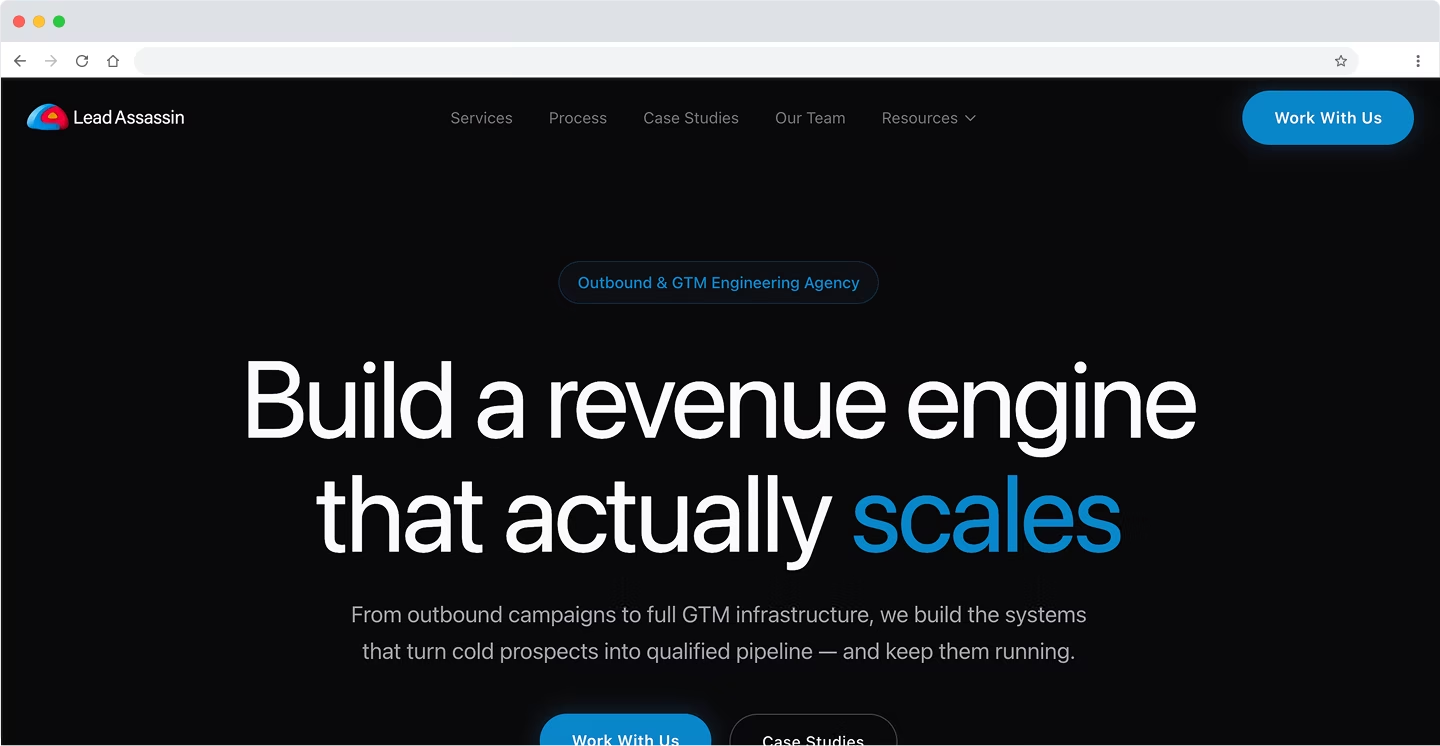
Lead Assassin is a cold email appointment-setting agency that handles the outbound execution for B2B founders and sales teams who want qualified meetings without managing the infrastructure themselves. Their model covers list building, email setup, sequence writing, and initial outreach, delivering booked meetings directly to the client's calendar.
| Type | Outbound email agency |
| Best for | B2B companies wanting to test cold email outbound without building internal infrastructure |
| Channels | Cold email |
| Key differentiators | Fully managed execution, low internal involvement required, entry point for teams without an existing outbound function |
| Ideal client | Early-stage B2B companies wanting to validate outbound before investing in a full multi-channel system |
| Website | leadassassin.io |
5. OneAway

OneAway calls itself a growth studio rather than an outbound agency, and the distinction is earned. They build integrated growth systems across cold email, LinkedIn, content, SEO, and Reddit, and use AI to power the research and personalisation underneath each channel. For B2B SaaS companies that want outbound and inbound channels working as a single motion rather than separate initiatives, OneAway is one of the few agencies actually built to do that.
Client results they have published include 102 sales conversations generated within a campaign window, nine new customers in a single month with a 45% close rate on demos, and 17 leads in 48 hours. Their focus is firmly on growth-stage SaaS.
| Type | Multi-channel growth studio |
| Best for | B2B SaaS companies wanting outbound and inbound channels built into a single integrated system |
| Channels | Cold email, LinkedIn, content, SEO, Reddit |
| Key differentiators | Five-plus channel coverage, AI-powered research and personalisation underneath each channel, integrated rather than siloed growth motion |
| Ideal client | Growth-stage B2B SaaS companies that want more than campaign execution |
| Website | oneaway.io |
6. Sales Automation Systems
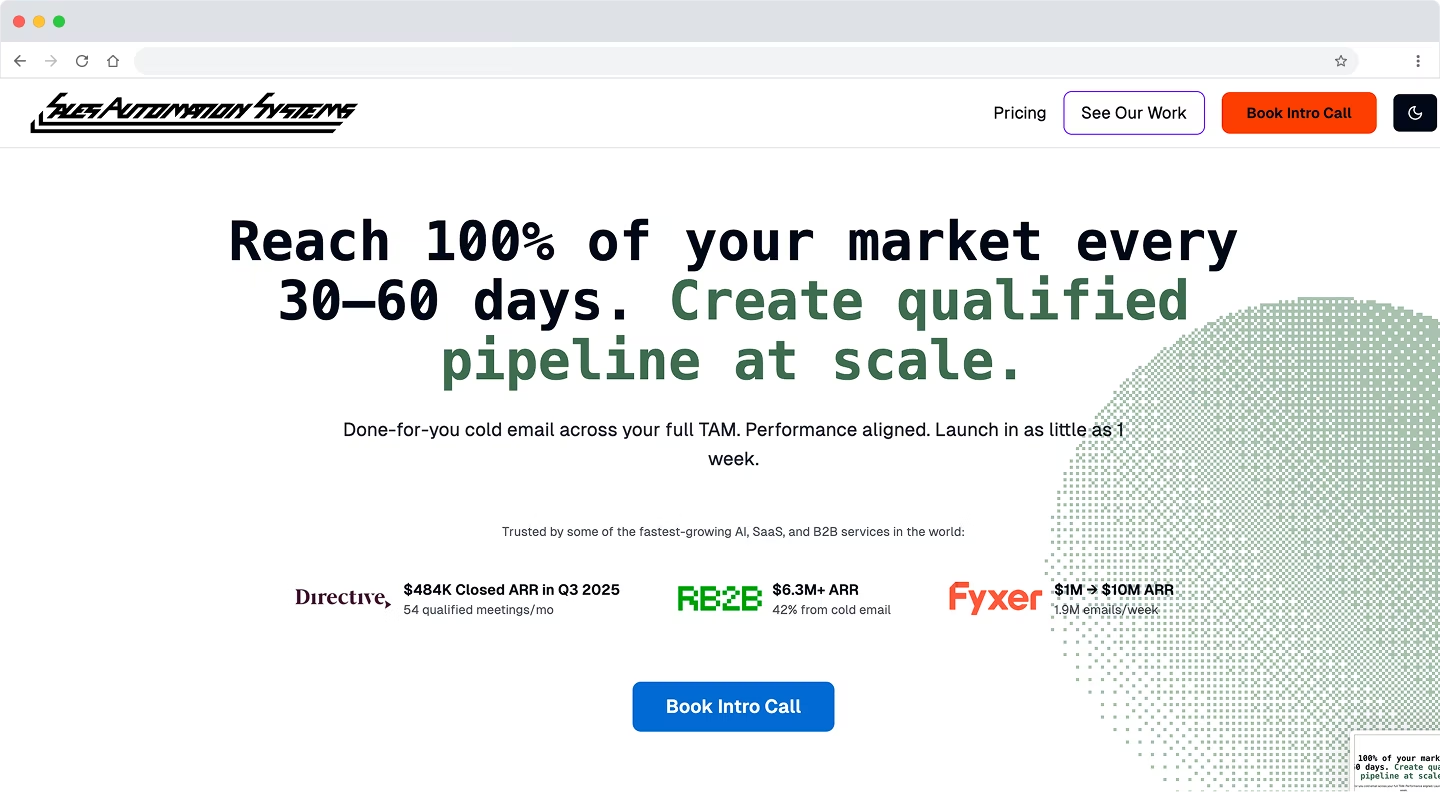
Sales Automation Systems builds automated outbound pipelines for B2B teams. Their model is positioned between a self-serve tool and a full-service agency: they provide the infrastructure and automation setup without managing the day-to-day execution. It is a sensible fit for teams that already have their ICP and messaging sorted but need the technical layer built without taking on an agency retainer.
| Type | Outbound automation service |
| Best for | B2B teams with validated messaging that need outbound infrastructure without full agency management |
| Channels | Cold email |
| Key differentiators | Automation-first model, lower cost than full-service agencies, useful for teams that want to run their own campaigns with infrastructure support |
| Ideal client | B2B teams ready to scale outbound execution but not yet ready to hire an agency |
| Website | salesautomation.systems |
7. LeadBird

LeadBird operates as a fully managed multi-channel outbound agency with direct CRM integration included across all channels as standard. They run email, LinkedIn, and cold calling under a single plan, sync everything into the client's CRM, and handle the full outreach execution without requiring the client to manage any of the moving parts.
Their scale is notable: 4.8 out of 5.0 on G2, over 1,000 active clients, and more than two million cold emails sent per month. Their pricing is transparent with no hidden fees across any channel.
| Type | Done-for-you outbound agency |
| Best for | B2B companies wanting fully managed multi-channel outreach synced directly into their CRM |
| Channels | Cold email, LinkedIn, cold calling |
| Key differentiators | Multi-channel execution with CRM sync as standard, 4.8/5.0 G2 rating, single transparent pricing plan, 1,000-plus active clients |
| Ideal client | B2B companies wanting one agency to manage all outbound channels without stitching together separate vendors |
| Website | leadbird.io |
8. FullFunnel

FullFunnel is not a lead generation agency in any operational sense. It is a consulting and training firm run by Andrei Zinkevich that helps B2B revenue teams build internal account-based marketing capability rather than outsourcing it. Their model is designed for companies with high-ACV products and complex sales cycles that want to develop the GTM function in-house rather than remain dependent on an external agency indefinitely.
They also publish a widely followed Substack newsletter on ABM, demand generation, and full-funnel B2B strategy.
| Type | ABM consulting and training |
| Best for | B2B revenue teams with high-ACV products wanting to build internal ABM and demand generation capability |
| Channels | Consulting programmes, training, ABM strategy |
| Key differentiators | Builds internal capability rather than agency dependency, deep ABM methodology, content published through Substack with tens of thousands of subscribers |
| Ideal client | B2B companies with long sales cycles and high ACV that want to own their demand generation function over time |
| Website | fullfunnel.io |
9. RevPartners
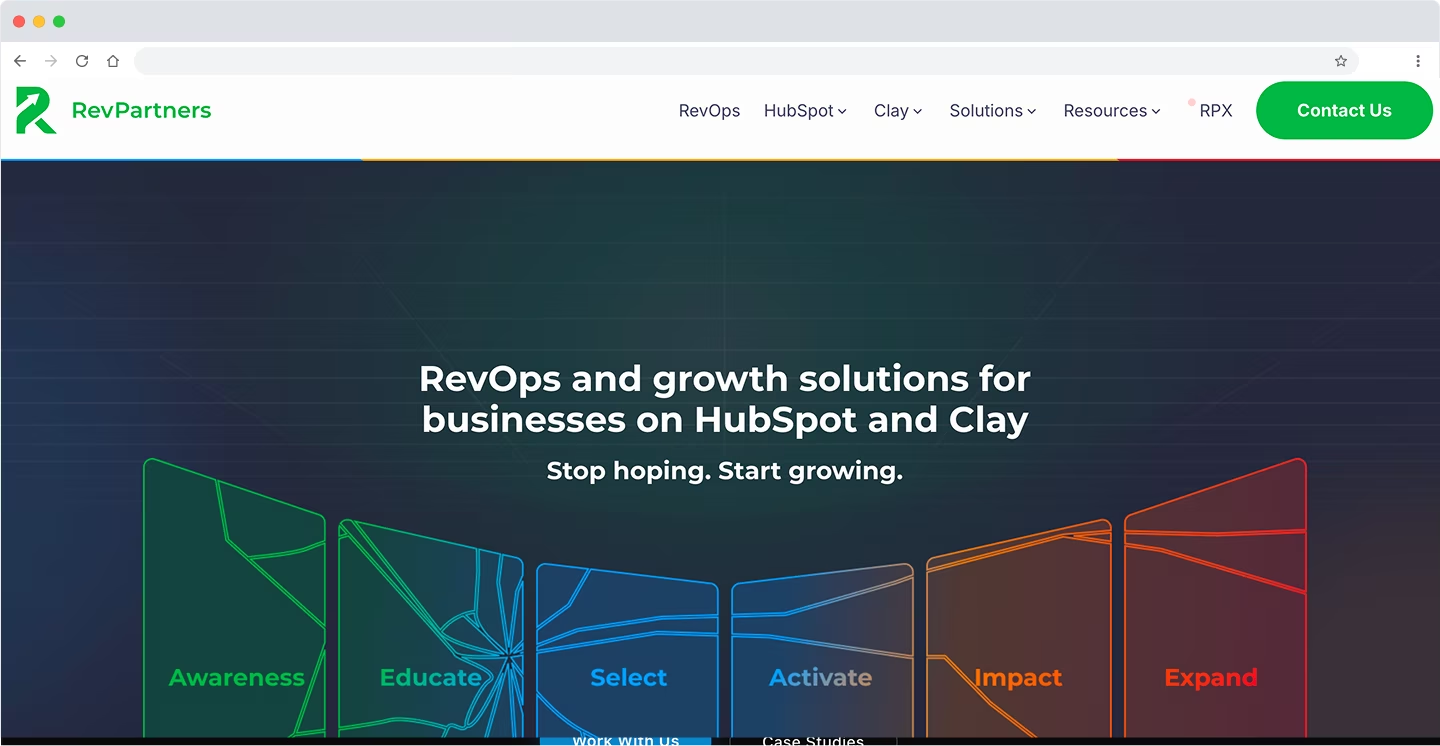
RevPartners works at the intersection of revenue operations and GTM engineering. They hold Elite accreditations with both HubSpot and Clay, a combination they describe as unique in the market, and they focus on building and repairing the underlying GTM architecture before, or alongside, campaign execution.
The practical value of RevPartners shows up most when a company has grown past a basic CRM setup and is experiencing the operational chaos that comes from disconnected systems: CRM data that does not sync to outbound tools, pipeline reporting that nobody trusts, and sales and marketing working from different datasets.
| Type | RevOps and GTM engineering consultancy |
| Best for | HubSpot-first B2B teams needing GTM infrastructure properly designed and built |
| Channels | RevOps implementation, HubSpot architecture, Clay integration |
| Key differentiators | Elite accreditations with both HubSpot and Clay, focuses on infrastructure before campaigns, solves the systems problems that make outbound underperform |
| Ideal client | B2B companies running HubSpot that need proper GTM architecture before scaling outbound |
| Website | revpartners.io |
10. StackOptimise

StackOptimise is a signal-based outbound agency that positions itself clearly against agencies that learn their craft on client budgets. Their team has 15 years of combined SDR and account executive experience from actually working in sales before building campaigns for clients, and they use a $150,000 enterprise tech stack to operationalise signal-triggered outreach at scale.
Clients have full visibility throughout: messaging gets approved before it goes out, lead lists are reviewable, and there is a live dashboard tracking every lead in real time. They report 28 to 50 qualified ICP leads per month for clients with defined target markets.
| Type | Signal-based outbound agency |
| Best for | High-ticket B2B service businesses that want outreach triggered by live buying signals |
| Channels | Cold email, LinkedIn |
| Key differentiators | Signal-based methodology, $150k enterprise tech stack, team with direct sales practitioner experience, full campaign transparency and client approval before launch |
| Ideal client | High-ticket B2B businesses with a defined ICP and a target market of at least 5,000 prospects |
| Website | stackoptimise.com |
11. EarLeads

EarLeads operates as a GTM engineering agency: they build custom outreach, content, and paid channel systems directly into the client's own infrastructure, so the client walks away owning and controlling everything that was built. There is no ongoing agency dependency unless the client wants it.
Their published numbers include $7 million in pipeline generated, 5,000-plus accounts created, over 4,700 in organic traffic growth, and 50-plus inbound demos booked. They run across LinkedIn, email, Reddit, and paid advertising, and price on an outcome-linked model.
| Type | GTM engineering agency |
| Best for | B2B SaaS companies wanting custom GTM systems built into their own infrastructure |
| Channels | LinkedIn, email, Reddit, paid ads |
| Key differentiators | Client owns everything built, outbound and inbound treated as a single system, outcome-linked pricing, $7M in pipeline generated across clients |
| Ideal client | B2B SaaS companies with product-market fit that want a scalable GTM operation they can run independently |
| Website | earleads.com |
12. Navreo

Navreo builds AI-powered sales systems for agencies and consultancies that want to generate more pipeline without adding sales headcount. Their AI SDR runs prospecting, qualification, and outreach at a volume that would not be achievable with human SDRs alone. Alongside the outbound layer, they help clients build LinkedIn content systems that generate inbound enquiries running in parallel with outreach campaigns.
They have published results including 181 meetings booked in a single quarter and LinkedIn content generating over 2.1 million views across client accounts. The model is specifically designed for service businesses where delivery obligations compete with time for new business development.
| Type | AI-powered outbound and content automation |
| Best for | Agencies and consultancies wanting AI SDR automation and LinkedIn content systems |
| Channels | LinkedIn, cold email, AI SDR |
| Key differentiators | AI SDR running outreach at scale, LinkedIn content system generating inbound alongside outbound, sector-specific experience with agencies and consultancies, 181 meetings in one quarter |
| Ideal client | B2B agencies and consultancies wanting to grow pipeline without hiring SDRs |
| Website | navreo.ai |
How to Find the Right Partner for Your Situation
Different GTM problems need different solutions. Here is how to read the list above based on what is actually broken.
Your targeting is wrong. Low reply rates and poor meeting quality usually mean the list is off rather than the copy. Agencies built on signal-based enrichment, where each prospect has a reason to hear from you based on something real happening in their business, will consistently outperform agencies that build lists from job title and company size alone.
You are only using one channel. If your outbound is email-only you are invisible to the portion of your market that primarily engages on LinkedIn. If it is LinkedIn-only you are capped on volume. The agencies that run all three channels in sequence produce more pipeline from the same target list.
Your systems are broken before the campaign even starts. If your CRM is a mess, your pipeline reporting is unreliable, and sales and marketing are working from different data, fixing that should come before or alongside outbound. RevPartners is built for exactly this problem.
You want to own the function long-term. EarLeads and FullFunnel both leave you with something to run yourself after the engagement. If you want to internalise GTM capability over time rather than stay on a retainer indefinitely, those are the right starting points.
Owning the function internally means hiring for it, and the pay band is what decides whether that beats the retainer. The GTM engineer salary ranges are broken out by level, region, and company stage so you can price both sides of the choice.
You are selling into APAC. Reachly is the only agency on this list with genuine regional depth in Singapore, Australia, and the wider APAC region. Buyer behaviour, deliverability norms, and the relative weight of LinkedIn versus email all differ meaningfully from Western markets, and most agencies on this list have no operational experience to draw on when it comes to navigating those differences.
GTM-native providers are a subset of a larger market. If you want the broader field, including traditional and performance-based shops, see our ranking of the top B2B lead generation agencies in 2026.
If your gap is paid media, content or ABM rather than outbound, our comparison of the best demand generation agencies for B2B covers the agencies that run those channels.
What Are the Red Flags When Hiring a Claygency?
Not every agency calling itself a Claygency in 2026 earns the name. A few warning signs.
🚩They cannot name their tool stack. A real Claygency will tell you in 30 seconds: Clay for data, Smartlead or Instantly for email, HeyReach for LinkedIn, plus whatever intent signal layer they use. Vague answers mean they are a traditional agency with a Clay account.
🚩They charge for a 50-page strategy deck before execution. Healthy Claygencies can tell you within two calls what the engagement looks like, what it will cost, and roughly how your first 30 days go. Diagnostic phases that bill $20K+ before anyone touches a sequence are a scope-creep signal.
🚩They report on opens and clicks. Opens are broken by Apple Mail Privacy Protection. Clicks are broken by link-tracking disabled clients. Any Claygency still leading with these metrics in 2026 is reporting activity, not outcomes.
🚩They cannot produce named case studies. "We have helped hundreds of clients" with no named logos and no specific numbers means the results probably do not exist. Real Claygencies publish specifics.
🚩They are vague about the infrastructure ownership model. The "always own the infrastructure" rule gets repeated everywhere, but it is too simple. In practice, ownership depends on the engagement type. Done-With-You clients own the tools from day one (Clay workspace, Smartlead account, HeyReach seats, domains, mailboxes) and pay the extra tool costs, typically $2,000+/month on top of agency fees. Done-For-You clients run on the agency's infrastructure because that is the whole point of DFY, the client is paying not to touch the software. Both models are legitimate. The actual red flag is an agency that gets vague when you ask about it. A good Claygency will tell you clearly which tools are in your name, who owns the sending domains, and what transfers to you if you end the engagement. Dodging that question is the warning sign, not the ownership model itself.
Three Reasons Most Outbound Fails
The targeting has no signal layer underneath it. A list built on firmographics alone gives you people who roughly match your ICP. A list built on enrichment and signals gives you people who roughly match your ICP and have a reason to care about what you are selling right now. The difference in meeting quality between those two lists is significant.
The timing is arbitrary. Most campaigns reach out on day one of a sequence regardless of what is happening in the prospect's world. Signal-based outbound inverts that: you reach out when something relevant has just happened. A company just hired a Head of Sales. A Series B just closed. A competitor just got acquired. Those moments are the ones where a cold message lands differently.
The infrastructure degrades under use. Domains that were not warmed properly, LinkedIn accounts running at unsafe connection volumes, and sequences that do not have deliverability monitoring built in all produce the same outcome: a campaign that works initially and then quietly stops landing. The infrastructure layer is what most agencies underinvest in because it is not visible to the client until it breaks.
Get more meetings with the people who matter, 100% done for you.
We don't spray and pray. We use real buying signals to reach the right people at the right time, then run coordinated outreach across email, LinkedIn, and phone with messaging that earns replies.
Get Started
FAQs
A GTM lead generation company helps B2B businesses build pipeline that is actually aligned to how their product is positioned and how their sales team closes deals. Rather than generating contacts and handing them over, a GTM-focused agency works backwards from your ICP, your channels, and your buying cycle to build an outbound system that produces qualified meetings rather than just activity.
The GTM distinction matters because it changes what gets measured: not leads generated but pipeline created.
Signal-based outbound means your outreach is triggered by specific events happening in a prospect's business rather than sent on a pre-set schedule to a static list. A funding round, a new senior hire, a relevant tool adoption, or a competitor move are all signals that a prospect may be in a different buying position than they were six months ago.
Reaching out when a signal fires means your message arrives with context. Reaching out on a Tuesday because the sequence scheduled it means your message arrives as noise.
A standard lead gen agency focuses on generating meetings. A GTM agency takes responsibility for making sure those meetings are with people who are actually a fit for what you sell and are reachable through how you sell it. That means they think about ICP alignment, messaging architecture, channel mix, and buying triggers rather than just list size and send volume.
The output looks similar in the short term but the pipeline quality diverges quickly.
Done-for-you outbound agencies typically sit between $2,500 and $10,000 per month depending on how many channels are covered, how technically sophisticated the data layer is, and the complexity of the target market. Agencies that hold certified partnerships in Clay, Smartlead, or HeyReach tend to price at the higher end of that range.
The right question is not which agency is cheapest but which one produces qualified pipeline at a cost per meeting that makes commercial sense for your average deal size.
Most properly built campaigns produce first replies within two to three weeks of launch. Qualified meetings with decision-makers who have genuine buying context typically start building between weeks four and eight as the team iterates on copy, targeting, and timing based on early response data.
Any agency promising closed revenue in the first month is setting unrealistic expectations.
Not for outbound execution. A done-for-you agency handles prospecting, sequencing, follow-up, and inbox management entirely. What you need internally is someone to attend the booked meetings and feed back to the agency on lead quality so targeting can be refined over time.
The agencies that perform best are the ones where that feedback loop runs consistently, not the ones where the client goes silent after onboarding.
Cold email remains the highest-volume channel for scalable outbound. LinkedIn is essential for reaching senior buyer personas who treat it as a primary professional communication channel. Cold calling works well as a third layer for high-ACV deals where written outreach alone does not generate enough traction.
The campaigns that perform best in 2026 treat all three channels as parts of a single sequence, not as separate programmes running independently.
Yes, but only when it is built properly. The agencies and founders who say outbound is dead are typically describing volume-first, signal-free, single-channel outbound, which does produce weak results.
Signal-based, multi-channel outbound with proper infrastructure produces consistent pipeline for B2B companies at all stages. The channel has not broken. The old playbook has.
The buyer preferences, platform habits, and deliverability landscape across APAC markets do not match what most Western outbound playbooks assume. In Singapore and Australia, LinkedIn plays a larger relative role in B2B communication than in North America. Deliverability rules and spam filtering behaviour differ by market and provider.
Running a standard North American playbook into Singapore without modification is one of the most common and expensive mistakes B2B companies make when entering the region.