
A cold email follow up is the message a prospect receives when they did not answer your first email, sent in the same thread and stopped the moment they reply. Reachly sends exactly one: two emails per sequence, five to six days apart, and the follow up asks whether the topic sits with a colleague. Prospects who still do not reply move to LinkedIn, then get a new sequence with a new angle six to ten weeks later.
Key Findings
- Reachly runs two emails per sequence, five to six days apart, so one follow up. Longer sequences collect more spam reports and wear out sending domains faster than they add replies.
- The follow up that earns Reachly the most replies is one line: "Would this be something of interest, or does {{subject}} sit with {{colleague_name}}?"
- Prospects who ignore both emails move to LinkedIn: a connection request with no note, then up to four messages spread over two to four weeks.
- Six to ten weeks later the same prospects get a fresh sequence with new messaging, sent to a list that is re-verified if it is older than three months.
- Answering fast is worth more than another step. Two Reachly clients with similar offers turned 67 percent and 43 percent of positive replies into meetings. The first answered in under 15 minutes, the second in 40 to 50.
- Plan on one positive reply per 400 to 600 emails sent. No positive replies after 1,000 emails, with a healthy reply rate, means the offer or angle has to change.
Reachly builds and runs these sequences for clients across cold email, LinkedIn and cold calling. See the cold email agency page for how the service works.
How many cold email follow ups should you send?
One, when the offer is right. Reachly sends two emails to each prospect and stops. Thibault Garcia, Reachly's founder, gives the reason directly: the longer the sequence, the more people report you as spam, and every report lands on the sending domain.
That runs against most published advice. The usual sequence has four to six follow ups across about three weeks, and Saleshandy's study of 53 million cold emails found its best performing sequences had that shape. Both positions hold up, because they protect different things.
A long sequence collects the late replies. A two email sequence protects the mailboxes every future campaign depends on, and sends the non-repliers to a different channel instead of a fifth email.
| Setting | Reachly two email sequence | Common long sequence | Source |
|---|---|---|---|
| Emails per prospect | 2 | 5 to 7 | Reachly; Saleshandy |
| Follow ups | 1 | 4 to 6 | Reachly; Saleshandy |
| Sequence length | 5 to 6 days | 20 to 21 days | Reachly; Saleshandy |
| Sends for 1,000 prospects | About 2,000 | 5,000 to 7,000 | Arithmetic |
| Mailbox days used, at 15 sends a day | About 133 | 333 to 467 | Arithmetic |
| What happens to non-repliers | LinkedIn, then a new sequence in 6 to 10 weeks | Sequence closes | Reachly operating standard |
What the extra steps are worth
Saleshandy's dataset is the best public measure of what later steps return. The first follow up produced 26.41 percent of all positive replies, the second 10.88 percent, and everything after that 7.23 percent.
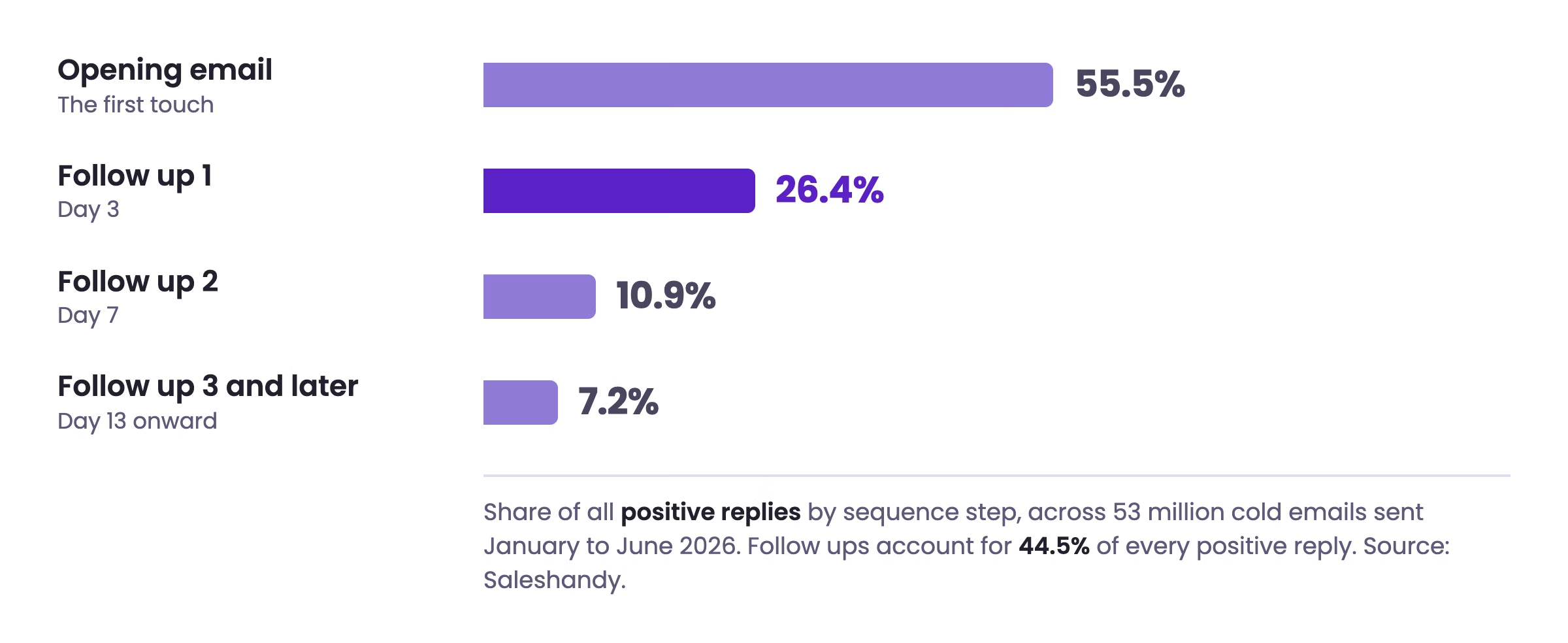
Read the other way, steps three onward carried about 18 percent of positive replies in that study. Reachly gives those up on purpose and goes after the same people again on LinkedIn and in a later sequence, where a new message has a better chance than a fifth version of the first one.
Why Reachly stops at two
Spam reports compound. A prospect who ignored two emails and then receives a third, fourth and fifth is the person on the list most likely to press the report button, and an average message can get a mailbox flagged once enough people do.
Mailbox capacity is fixed. Reachly sends 12 to 15 emails per mailbox per day, never more than 15 on Google and 10 to 12 on Outlook. Every follow up step spends capacity that could have reached a new prospect.
The offer decides the result. Thibault's position, from client campaigns, is that the offer is still the number one factor behind positive replies. Repeating a weak offer four more times does not rescue it, and a strong one usually gets its answer within the first two emails.
When should the cold email follow up go out?
Five to six days after the first email. That gap puts the follow up on a different day of the week from the opener, so it reaches the prospect at a different point in their week.
The rest of the cadence runs on another channel and a longer clock. Here is the full path one prospect takes through a Reachly campaign.
Two details keep the timing honest. Send the follow up in the original thread, so the prospect sees the first email underneath it. And let an out of office reply pause the sequence rather than end it: Reachly moves those prospects into a short subsequence that opens with "Hope you had a good time while {{reason_for_OOO}}" and goes out after the return date.
What should the cold email follow up say?
One question that takes seconds to answer. The follow up that earns Reachly the most replies is:
"Would this be something of interest, or does {{subject}} sit with {{colleague_name}}?"
It works for three reasons. It offers two easy answers and both are useful: a yes starts a conversation, and a name moves you to the right person with an internal referral. It takes a few words to answer. And naming a real colleague shows the email was researched.
The colleague name has to be real. Pull a second contact at the same account while building the list, someone whose role plausibly owns the topic, and merge that name in. A made up or mismatched name throws away the credibility the line depends on.
The two email sequence, ready to load
EMAIL 1                     day 0
SUBJECT: {{first_name}}'s pipeline
STOP IF: reply, bounce, unsubscribe

Hi {{first_name}},

I see you just hired {{new_employee}}. {{one_line_problem}}

{{one_line_offer}}

If I recorded a short video on how this would work
for your team, could I send it over?

{{sender_first_name}}


EMAIL 2                     day 5 to 6
SUBJECT: (reply in the same thread)
STOP IF: reply, bounce, unsubscribe
PAUSE IF: out of office, resume after the return date

Hi {{first_name}},

Would this be something of interest, or does
{{subject}} sit with {{colleague_name}}?

{{sender_first_name}}
Email 1 opens with the trigger when there is one. When there is not, Reachly opens with "I came across you while looking for {{company_type}} in {{state}}". Keep the body to 60 to 80 words, and write "your company" or "your team" rather than merging in the company name, because nobody says a legal company name out loud.
The checks every sequence passes before launch
Reachly runs the same pre-launch list on both emails:
- Spintax on the copy, so no two prospects receive identical text
- A spam word check, for words such as get, buy, free and now
- One merge field in the subject line, two to four words long
- No links in email 1, and only in email 2 if one is unavoidable
- Plain text, with tracking switched off
- Read aloud, it sounds like a person talking
- It fits on one iPhone screen without scrolling
What happens when both emails get no reply?
The prospect moves to LinkedIn, and later back to email with something new. Neither step repeats the original message.
The LinkedIn follow up
Reachly sends the connection request with no note, and only to people who are active on LinkedIn. One to three days after the request is accepted, the first message goes out and points straight back at the email:
"I reached out via email but thought it'd be easier to chat here."
After that, no more than four messages in total, spread across two to four weeks. LinkedIn has no out of office, so a prospect who is away receives every message at once when they return, which is why the spacing is wide. Client profiles average a 20 to 25 percent acceptance rate, and the best ones reach about 30 percent.
Adding LinkedIn after email adds meetings, especially when the client has four or five profiles to send from instead of one. For The Great Room, a premium co-working operator in Singapore and Australia, multichannel LinkedIn and email sequencing on signal-based lists moved meetings from about two per quarter to about two per month.
The re-engagement sequence
Six to ten weeks after the first email, prospects who never replied get a new two email sequence with new messaging: a different angle, a different offer, or a fresh trigger. Before it goes out, any list older than three months is re-verified, because people change jobs and the bounce rate climbs.
This is where the replies a long sequence would have chased on step five come back. Two months on, the prospect gets a message that is actually new, from a sender whose name they may now recognize from LinkedIn.
Have the sequences built, sent and answered for you
We map your total addressable market, attach buying signals, run the follow ups across cold email, LinkedIn and cold calling, and hand you the replies. Flat monthly retainer from $3,500, first meetings within 10 days on pre-warmed domains, or 5 to 6 weeks from kickoff on branded domains.
See how it worksWhat happens after a prospect replies?
Speed decides whether a positive reply becomes a meeting, and it matters more than any extra follow up step. Two Reachly clients with similar risk reversal offers, similar social proof and a similar deal size converted positive replies into meetings at very different rates.
| Client | Average time to answer an interested lead | Positive replies turned into meetings | Source |
|---|---|---|---|
| Client A | Under 15 minutes, in working hours | 67% | Reachly clients, MasterInbox |
| Client B | 40 to 50 minutes | 43% | Reachly clients, MasterInbox |
The only real difference between the two was how fast their sales team got to the interested leads Reachly handed over. At Reachly's volumes a 24 point gap is a lot of meetings. Set an alert on positive replies and make one person responsible for answering inside 15 minutes.
Reachly filters negative replies out with AI labeling before anyone reads them, so the person answering only sees the conversations worth having.
How do you know if the follow up sequence is working?
Read the numbers in order. These are the ranges Reachly gives clients, and they move with sending volume, the offer, and how much cold email the audience already receives.
| Metric | Range | What it tells you | Source |
|---|---|---|---|
| Overall reply rate | 1 to 4%, out of office included | Whether the emails reach the inbox | Reachly client ranges |
| Reply rate on a very good campaign | 4 to 6%, out of office included | The top of the range | Reachly, Smartlead campaigns |
| Positive reply rate | 10 to 30% of replies | Whether the offer lands | Reachly client ranges |
| Emails per positive reply | 1 per 400 to 600 sent | The number to plan volume against | Reachly client ranges |
| Bounce rate | Under 2% | List quality and domain health | Reachly operating standard |
When to pause or change a campaign
Reachly sets its kill criteria before launch, so nobody argues about them three weeks in.
| Signal | Threshold | Action | Source |
|---|---|---|---|
| Mailbox reply rate | Below 0.5% | Rotate the mailbox out for 1 to 2 weeks | Reachly operating standard |
| Smartlead warm-up score | Below 95% | Rotate the mailbox out | Reachly operating standard |
| Bounce rate | Above 2% | Rotate the mailbox out | Reachly operating standard |
| Domain on a blacklist | Listed on MXToolbox | Retire the domain | Reachly operating standard |
| Positive replies | None after 1,000 emails, with a healthy reply rate | Change the angle or the offer | Reachly operating standard |
Reply rate is the trigger Reachly prefers, because it moves first. By the time the warm-up score drops, the mailbox is already in trouble. To keep rotation from cutting volume, Reachly holds about 30 percent of sending infrastructure in reserve, ready to switch on. The inbox rotation guide covers how that works.
Diagnosing a sequence that underperforms
- Check the overall reply rate with out of office replies included. Out of office replies arriving means the emails are reaching inboxes.
- Run an inbox placement test to confirm it.
- Check the bounce rate.
- Read the replies. If people answer "no thanks" or "not interested", delivery is fine and the problem is the offer.
The follow up comes last in that order. A campaign that reaches inboxes and still has no positive replies after 1,000 emails needs a new offer, and a third or fourth follow up repeating the old one only adds spam reports. If the first two checks fail, start with the cold email deliverability guide.
How do you follow up without being annoying?
Send fewer emails and make each one easy to answer. In practice that comes down to five habits.
- Stop at two emails. The prospect never gets a third or fourth nudge from the same mailbox.
- Give the follow up a job. The colleague question asks for something small and specific.
- Leave the meeting request out of cold email. Ask a question, or offer something useful such as a short video.
- Change channel instead of adding steps. LinkedIn reaches the same person without another inbox hit.
- Wait before trying again. A new sequence six to ten weeks later reads as a new conversation.
Which conditions should stop a follow up sequence automatically?
Any reply, a hard bounce, an unsubscribe, or a match on the suppression list. Stop conditions are where the expensive mistakes happen: a follow up sent after somebody already said yes costs the meeting, and one sent after a hard bounce costs domain reputation.
Scope reply detection to the prospect rather than the mailbox. When you rotate inboxes, a reply to any of them has to halt every remaining step, on email and on LinkedIn.
Keep one suppression list across every campaign: unsubscribes, current customers, open opportunities and anybody who asked to be left alone. Per campaign lists are how a customer ends up receiving cold outreach.
Running these checks by hand stops working at a few dozen prospects a day, which is the point where automated email follow ups take over.
Which follow up templates work for different buyers?
Each template below is a version of email 2 or of the LinkedIn step. All of them ask a small question and none of them ask for a meeting. Use the colleague line as the default, and these when the buyer gives you a reason to change it. For first emails, the cold email templates library has openers by ICP.
Founder: the one line reframe
{{first_name}}, one thing I left out.

The reason I wrote now: {{trigger}}. Teams at your stage
usually handle that by {{common_approach}}, which works
until {{breaking_point}}.

Is that on your plate this quarter, or later in the year?
Founders read for relevance before they read the offer. Naming the trigger explains why the email arrived now, and the closing question lets them defer without ignoring you. A founder who says later in the year has given you a date.
VP of Sales: the number they track
{{first_name}}, one number in case it is useful.

{{peer_type}} teams we work with sit at {{benchmark}}
on {{metric}}. The change was {{mechanism}}, with no
extra volume.

Would it help if I sent how that was set up?
A sales leader is measured on a number you can name. Putting the claim on their scoreboard and naming the mechanism keeps it from reading as another vendor promising pipeline.
Head of Growth: the teardown
{{first_name}}, I went ahead and did the work.

I put together a short teardown of your {{channel}}:
three things working and two costing you {{cost_area}}.

Want me to send it over?
The ask is permission to send something, which is a much lower bar than a meeting. Only send it if the teardown exists.
Enterprise buyer: the reroute
{{first_name}}, I may have aimed this at the wrong desk.

If {{topic}} sits with someone else on your team, a name
is all I need.
A version of the colleague line for buyers where you do not have a second contact yet. It turns silence into a referral and asks for nothing about the offer.
LinkedIn: the first message after acceptance
Hi {{first_name}}, I reached out via email but thought
it'd be easier to chat here.

{{one_line_question}}
Short and in lowercase is fine here. On LinkedIn the message has to look like a person typed it, so leave out formatting, links and anything that reads as a template.
Re-engagement: weeks 6 to 10, new thread
SUBJECT: {{first_name}}'s {{topic_short}}

Hi {{first_name}},

I came across you while looking for {{company_type}}
in {{state}}. {{new_trigger_or_angle}}

{{new_offer_in_one_line}}

Would this be useful for your team right now?
Treat this as a first email to someone you have never written to. The offer or angle has to be different from the first round, or the prospect gives it the same answer.
Which subject line should a follow up use?
None of its own. Email 2 goes in the same thread, so it keeps the original subject and the prospect sees both emails together. A new subject only comes in with the re-engagement sequence six to ten weeks later.
| Position | Subject line | Why | Source |
|---|---|---|---|
| Email 2 | None, reply in the same thread | The first email sits underneath as context | Reachly operating standard |
| Email 1 or re-engagement | {{first_name}}'s pipeline | Two words, lowercase, different for every prospect | Reachly operating standard |
| Email 1 or re-engagement | {{company_name}}'s AI | Names the topic, reads like a note between colleagues | Reachly operating standard |
| A/B control only | your workflow, crm build | A fixed subject to test against, never sent in volume | Reachly operating standard |
Varying the subject per prospect is safer for deliverability than one fixed line sent to everyone, which mailbox providers can fingerprint. Avoid a fake re: on a thread that never existed. It is deceptive under CAN-SPAM and the prospect notices straight away.
How do you stay compliant when you follow up?
Rules differ by region and this is a summary rather than legal advice, so check your own obligations before you send at volume.
In the United States, CAN-SPAM applies to commercial email whether or not the recipient opted in. It requires accurate header information, a subject line that is not deceptive, a valid physical postal address, a working opt out mechanism, and that you honor an opt out within 10 business days. A fabricated re: prefix and a spoofed sender name both sit on the wrong side of that.
In the EU and the UK, cold outreach to a business contact needs a lawful basis under GDPR, and legitimate interest is the one most B2B senders rely on. That basis is not automatic. It requires that the message is relevant to the person's professional role, that you tell them where their data came from, and that you stop when they object.
A two email sequence makes the last part easier: a prospect who objects has at most one more email in the queue, and the suppression list stops it.
Cold email follow up FAQ
What is the 3 email rule?
It is shorthand for ending a cold sequence after three emails to the same person, on the logic that the third unanswered message is where persistence turns into noise. Reachly runs a tighter version with two emails and counts the LinkedIn message as the third touch. Treat the number as a ceiling: a prospect who has not answered three messages should come out of the sequence and wait for a different offer later.
How do you write a cold outreach email?
Start from the offer, because it decides more of the result than the wording. Every top performing Reachly client runs an offer that is hard to refuse, such as a free audit, free samples of the work, or a result guarantee where the client pays nothing if a target is missed. Then write the email around one trigger and one question, short enough to read on a phone without scrolling. The what is cold email guide covers the rest of the channel.
How do you follow up without saying "follow up"?
Open with the new thing instead of a reference to the old email. A question about who owns the topic, a number the prospect tracks, a short teardown, or a reason the timing matters this month all work as a first line. Phrases like just following up, circling back and bumping this up tell the prospect nothing has changed since the email they ignored, so they get the same silence.
What is a gentle follow-up email I can write?
Two lines that make a no easy to say: "No worries if the timing is off. Should I check back in {{month}}, or is this not a priority this year?" Both answers help you. A month puts the conversation on a calendar, and a no lets you suppress the contact and spend the send on someone else.
What are examples of good follow-up emails?
Good ones are short and carry one new element. After a prospect asked you to come back later: "You mentioned {{month}} would be better, so here I am. Is {{topic}} still on the list?" After a positive reply that went quiet: "Did the video answer your question, or is there someone else I should walk through it?" After a missed meeting: "Looks like today did not work out. Want to pick another time this week or next?"
How do you say follow up in a nice way?
Ask something the person can answer in a few words, give them an easy way out, and skip the apology. "Sorry to bother you again" draws attention to the interruption. "Is this still on your radar, or should I close the loop?" respects their time and still gets an answer, usually within the same day.
Recommended service
Cold Email Agency
Reachly runs cold email end to end: dedicated infrastructure, signal-led copy, and replies handled until a meeting is booked.