
 Key Findings
Headline range from seven major studies. The operator rule for B2B first-touch outbound in 2026 is tighter at 70 to 80 words.
Per 2026 benchmark data. That is why the first touch carries the strictest length discipline in the sequence.
Day 1 at 70 to 80 words. Day 3 at 50 to 70. Day 5 at 60 to 90. Day 8 bump at 20 to 35. Day 12 close at 30 to 50.
A 50-word email built on a real account signal outperforms a generic 90-word email. If the personalization is weak, no length saves the draft.
These are the five bloat patterns every long cold email is built from. Knowing them makes the rewrite faster.
Length is the third lever, not the first. If infrastructure is broken or subjects are getting filtered, no email is short enough to save the campaign.
Primal's campaign and The Great Room's campaign both ran first-touch emails under the 80-word ceiling. Short, relevant, signal-built.
Most cold emails get ignored because they read like mini brochures. Three paragraphs about the company, a feature stack, a soft ask buried at the bottom. The prospect scans the first line, decides this is going to cost them attention, and archives.
The fix is not a clever subject line or a new template library. It is to stop sending brochures.
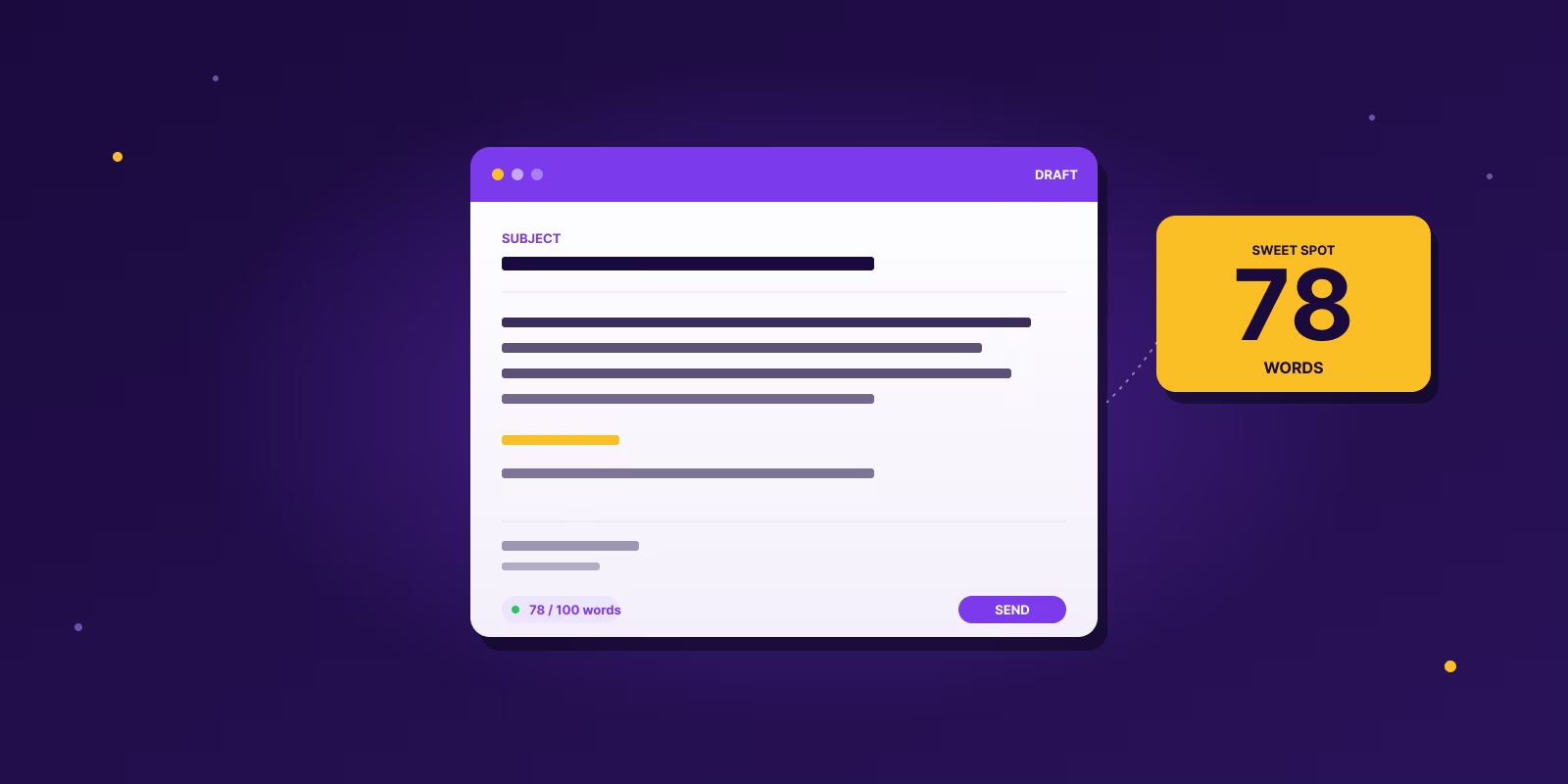
If you take one rule from this article, take this one. For first-touch outbound in 2026, keep the email under 80 words. The broader operating range across all sequence steps is 50 to 125 words. Anything longer needs a real reason to exist.
This guide walks through what seven well-cited studies say about cold email length, where they agree, where the operator rule has to override the data, and a worked rewrite that takes a 160-word cold email down to 78.
The short answer
50 to 125 words is the safe operating range for cold email. First touches sit at the lower end. Follow-ups can stretch toward the upper end if they earn it. Anything past 150 words is rarely worth sending.
That headline holds up across the major studies on email length, including Overloop's email length analysis and the 2026 benchmark data showing 58% of replies still come from the first-touch email per Instantly's 2026 benchmark report.
Two things change the picture for B2B outbound specifically:
- First-touch emails should be shorter than the headline range. Most studies aggregate cold email across use cases. For real B2B outbound where the prospect did not opt in, first touches under 80 words consistently outperform first touches in the 80 to 125 range.
- Sentences matter more than words. A 95-word email written as three tight sentences reads faster than an 80-word email written as ten short fragments. Aim for 4 to 6 sentences in the first touch, never more than 8.
What the seven studies actually say
Six of seven sources land near 50 to 125. The convergence is the headline. The differences live in what they recommend you do with that range.
| Source | Recommended length | Use it for |
|---|---|---|
| Boomerang's reply-rate study | 50 to 125 words | Baseline for net-new outreach |
| HubSpot template library | 3 to 5 sentences | Sentence discipline, not just word count |
| Lemlist personalization research | 40 to 60 words when signal is strong | When the personalization line is real |
| Outreach.io sequencing research | Varies by step, 50 to 200 words | Match length to sequence stage |
| Mailchimp industry benchmarks | Industry-dependent | Reality-check after the draft is done |
| Yesware sales-outcome analysis | 50 to 125 words for cold | Linking length to meetings and deals |
| Neil Patel's email length guide | 50 to 125 words plus A/B testing | Synthesis and a testing framework |
Take the convergence as the rule, not the average. The exceptions and the practical operator overrides live underneath that 50 to 125 headline.
The 70 to 80 word rule for first touches
Why 70 to 80 words specifically? It is the natural length of an email that does exactly three things: name a reason this is the right prospect, propose one value frame, ask one question. Once you add explanation, social proof, feature lists, or company history, you slide past 100 words without realizing.
The Reachly cold email agency team writes to this ceiling on every first touch, then lets follow-ups carry the proof points that did not fit.
Match length to sequence stage
Treating the whole sequence as one email is the most common mistake in length debates. Step one has a different job than step three.
The modern outbound sales strategy Reachly runs treats every step as a different unit of work. Length follows the work.
| Day | Channel | Length target | Why |
|---|---|---|---|
| Day 1 | LinkedIn visit + connection + Email #1 | 70 to 80 words | Signal-driven opener. One reason, one ask. Earns the right to send Email #2. |
| Day 3 | Email #2 (new angle) | 50 to 70 words | One fresh angle. Not a recap. Restating Email #1 is what kills follow-up reply rates. |
| Day 5 | LinkedIn message or Email #3 | 60 to 90 words | One proof point or operator perspective. Social proof can fit here if it is specific. |
| Day 8 | Email #4 (one sentence, easy out) | 20 to 35 words | The bump. "Worth 15 minutes this month or should I close the loop?" |
| Day 12 | Call + final email | 30 to 50 words | Close the loop. The shortest email in the sequence. |
How Reachly coordinates this at the campaign level: one rep owns sequence design, one ops lead owns infrastructure, copy is QA'd against the length ceiling before launch.
This is the standard Reachly sequence template. Coordinating it across cold email, LinkedIn, and cold calling is where the real lift comes from. Length on email is one input. Channel rhythm is the multiplier.
Personalization buys brevity
Every word in a cold email either proves relevance or moves the prospect toward the ask. There is no third category.
Strong signal-based outbound personalization buys you the right to send fewer words. A first touch built on a real account signal (a funding event, a leadership change, a hiring spike, a tech-stack shift) can sit at 50 to 60 words and outperform a generic 90-word email that explains too much. Weak personalization works the other way. If the only specificity is "I saw you work at [Company]," no amount of length will save the draft.
The workflow that makes this practical:
- Pull signals with Clay. Funding rounds, hiring activity, tech-stack changes, LinkedIn engagement, traffic decline.
- Score the signal. Strong, medium, or weak. Calibrate length to the strength.
- Write to the signal, not the persona. Personas produce 130-word emails. Signals produce 70-word emails.
- Send via Smartlead. Segmented campaigns per signal strength so length and copy match the trigger.
The result is what every long-cold-email writer thinks they are delivering and rarely is. Specific. Short. Easy to reply to.
Worked example: 160 words down to 78
Here is the same offer at two lengths. The first is the bloated version most outbound teams write. The second is what survives the cut.
Hi [First name],
I hope this email finds you well. I'm reaching out because I lead growth at our agency, and we work with companies in the SaaS space to help them generate qualified outbound pipeline through multichannel campaigns combining cold email, LinkedIn outreach, and cold calling.
I noticed [Company] is growing fast and your team has been hiring SDRs over the last quarter. We've worked with similar companies to fill the top of the funnel while your SDR team focuses on closing. Our average client books 35 to 50 qualified meetings per month within the first 90 days.
Some of the things we do differently include signal-based targeting, deeply personalized outreach, and a multichannel approach that means we don't rely on email alone. Many of our clients see a 3 to 5x ROI on their investment with us in the first six months.
Would you be open to a 15-minute call this week to explore whether we'd be a fit?
Thanks,
[Sender]
Hi [First name],
Saw [Company] hired three SDRs last quarter. More pipeline pressure on them, not less.
We run signal-based outbound across email, LinkedIn, and phone for SaaS teams in a similar spot. Their SDRs got back roughly 40 hours a week to focus on closing instead of prospecting.
Worth 15 minutes this month to see if it fits?
Thanks,
[Sender]
The five bloat patterns to cut
Every long cold email is long for one of five reasons. Knowing the patterns makes the rewrite faster.
- Throat-clearing. "I hope this finds you well." "I wanted to reach out because." Cut every word that exists before the prospect-specific opener.
- Sender introduction. Three sentences about who you are and what your company does. The prospect can read the signature.
- Feature stacking. Listing two or three things you do well. Pick one. The other two go in Email #2 or Email #3.
- Stat dumping. "We've helped 200 clients book 5,000 meetings worth $100M in pipeline." One number tied to one comparable beats three numbers in aggregate.
- Soft CTAs. "Let me know if you'd be open to chatting." Specific beats soft. "Worth 15 minutes this month?" is shorter and gets more responses.
Diagnose a 0% reply rate campaign in this order: infrastructure first, then subject line, then length, then tone, then offer. Length is the third lever, not the first. If your infrastructure is broken or your subject lines are getting filtered, no email is short enough to save the send. The email deliverability guide covers the infrastructure layer in full.
Length is a follow-up problem too
Most teams shorten their first email then bloat every follow-up.
The bump email at Day 8 should be 20 to 35 words. The closing email at Day 12 should be 30 to 50. Both should feel lighter than the rep wants to make them. Restraint protects reply rates better than another paragraph ever will.
For practical follow-up structure, see automated email follow-ups. Each step in the sequence has its own job, and adding length to do a job a different step already covers is the fastest way to drag the whole campaign reply rate down.
How Reachly applies the 70 to 80 word rule
We use the 70 to 80 word ceiling on every first-touch sequence we build for clients. Primal's campaign, the one that hit 4.57x ROI and signed 6 deals in 6 months, ran 76 word first-touch emails on average. The Great Room's coworking campaign, which closed a $250K contract with face-to-face meetings going from 2 per quarter to 2 per month, ran 71 word first-touch emails on average.
Both campaigns hit positive reply rates above the 8% benchmark we use as a floor. Neither was magic. They were short, relevant, and built on real account signals.
The most overlooked part of cold outbound is not length. It is the offer. A 70-word email with a weak offer still fails. A 70-word email with a strong offer, built on a real signal, is what books the meeting. Length is the discipline that exposes whether the offer is actually strong.
Short emails that book meetings. Not brochures.
Reachly runs cold email, LinkedIn, and cold calling for B2B teams across APAC, USA, Canada, UK, and ANZ. Triple-certified across Clay, Smartlead, and HeyReach. Primal hit 4.57x ROI on 76-word first-touch emails. The Great Room closed a $250K contract on 71-word first-touch emails. We write to the length ceiling so your offer carries the weight.
Book a Call
Frequently asked questions
50 to 125 words is the safe range across most cold email benchmark studies. For first-touch B2B outbound in 2026, the operator rule is tighter: under 80 words. Anything past 150 rarely earns a reply.
Keep the first email between 50 and 80 words. The job of the first touch is to earn the right to send a follow-up, not to explain the entire offer. Lead with one reason, name one outcome, ask one question.
Yes. Reply rates drop sharply once emails get past 125 words, and they drop again past 150. The strongest reply-rate band sits between 50 and 125, with first touches doing best at the lower end. Length is a screening mechanism: if your email needs scrolling, you have probably said too much.
Mostly shorter. Email #2 should be 50 to 70 words with one new angle. Email #3 can stretch to 60 to 90 if it carries a real proof point. The bump email at Day 8 should be 20 to 35 words. The closing email at Day 12 should be 30 to 50 words. Restating the first email is what kills follow-up reply rates.
Four to six sentences in the first touch. Never more than eight. Sentence count matters more than word count once you are inside the 50 to 125 word range. A 95-word email written as three tight sentences reads faster than an 80-word email written as ten short fragments.
Not if the personalization is real. A 50-word email built on a strong account signal (a funding round, a leadership change, a hiring spike) outperforms a generic 90-word email that explains too much. If the only specificity is "I saw you work at [Company]," no length is going to save the draft.
Three reasons. Mobile-first reading habits punish long emails by default. Cold prospects have not opted in, so attention is the scarce resource. And length is a forcing function on prioritization: if you cannot say it in 80 words, the offer or the targeting is probably weak. Length exposes weak strategy faster than it solves it.
70 to 80 words for first-touch emails. 50 to 70 for second touches. 60 to 90 for third touches if they carry a real proof point. 20 to 35 for the bump email at Day 8. 30 to 50 for the closing email at Day 12. Primal's 4.57x ROI campaign averaged 76-word first touches. The Great Room's $250K contract campaign averaged 71-word first touches.
Recommended service
Cold Email Agency
Reachly runs cold email end to end: dedicated infrastructure, signal-led copy, and replies handled until a meeting is booked.