
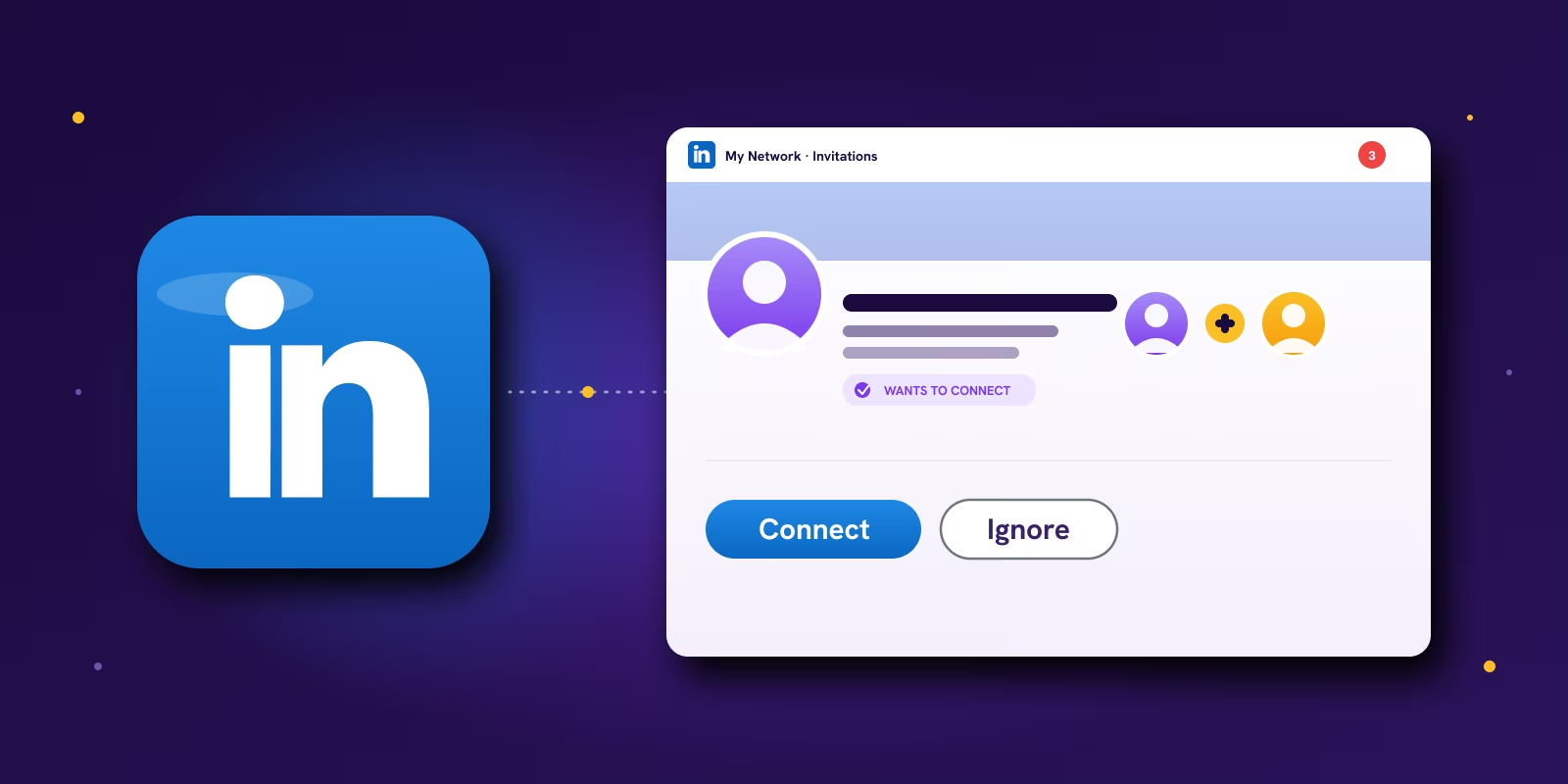
The average B2B prospect sees 50+ pending connection requests in their inbox at any given moment. Most go straight to ignore.
If you are running outbound on LinkedIn in 2026, the connection request message is the first thing the prospect ever sees from you. The note has 200 characters on a free account, 300 on Premium, and roughly two seconds of attention to earn a click on Accept. Get it right and your acceptance rate sits around 20 to 25% on cold lists, and closer to 30% on the strongest profiles. Get it wrong and you sit at 8 to 12% while burning your sender reputation in the process.
This guide is the operator version of the LinkedIn outreach playbook we run for B2B clients. 11 templates by ICP, the rules that govern all of them, the contrarian empty-note play, and where the message slots into a full multichannel sequence. Templates that do not read like a chatbot wrote them, plus the reasons each one earns the click.
Why the LinkedIn connection request message decides the whole sequence
LinkedIn limits free users to 200 characters in a personalized invite. Premium and Sales Navigator users get 300. Free accounts also cap personalized invites at 3 per month unless you are messaging an open profile, a fellow group member, or a 2nd-degree connection through certain paths. Most B2B outbound operators run a Premium or Sales Navigator seat for this reason alone.
The math behind that 200-character limit matters. Connection acceptance on a generic templated note averages 8 to 12% on cold B2B lists. A signal-anchored personalized note pushes that to 25 to 35%. A Reachly pilot run into Thai SaaS buyers hit 35% acceptance and 47% LinkedIn reply rate when paired with email. The same campaign on the default LinkedIn note would have produced one-third the connections.
Acceptance is not the end goal. The connection opens a free 1st-degree message, which is where most of the actual conversation happens. If you skip the note and the prospect ignores the blank request, you never get to send that follow-up and you book no meeting.
The connection request message is the cheapest variable in the whole funnel. It is also the one most teams set on autopilot.
How long should a LinkedIn connection request message be?
Short. Always.
Under 200 characters covers every free account. Under 300 covers Premium. The data we see across 400+ campaigns says that the messages that get accepted at the highest rates land between 90 and 180 characters. Below 90 they read as low effort. Above 180 they read as a pitch. The sweet spot is one signal, one ask, no sign-off.
LinkedIn shows the message in a preview pane that crops at roughly 150 characters on mobile. Anything past that is hidden until the prospect taps to expand. Half of B2B users on LinkedIn are on mobile. Lead with the signal in the first 150 characters or the rest does not get read.
The empty connection note: when to skip the message entirely
Here is the contrarian play almost no top-10 article will tell you about.
For cold B2B outbound, an empty connection request (no note attached) often outperforms a personalized one. Why: LinkedIn classifies invites without notes as lower-effort, which paradoxically gets them auto-routed into a different acceptance queue. Acceptance rates we see on empty notes for cold lists run between 18 and 26%, comparable to mid-tier personalized notes, with zero copywriting cost.
The empty note works when the prospect has no easy reason to recognize you, when you have a strong post-acceptance opener ready, and when you are running volume across a clean ICP. It fails when the prospect needs context to accept (post-event, mutual connection, shared alumni, recent post engagement). In those cases, the note is the lever.
Run an A/B. Half your campaign with an empty note, half with the best personalized note you can write. Whichever wins keeps going. Most B2B SaaS lists we have tested converge inside a 5-point spread, which tells you the note is not always the lever you think it is.
5 rules every LinkedIn connection request message follows
Before any template, the rules. These apply to every ICP, every note, every campaign.
| Rule | What it means | Why it matters |
|---|---|---|
| One signal, one ask | Reference one specific fact about them. Make one specific request. | Two signals reads as research dump. Two asks reads as a pitch. |
| No pitch in the note | Save the offer for after acceptance. The note earns the connection only. | Pitching pre-acceptance drops accept rate by 40 to 60% on every test we run. |
| Lowercase, conversational | "hey [name]" not "Dear Mr. Smith". Treat it like a real LinkedIn DM. | Formal copy reads as a template. Conversational reads as a human. |
| Under 180 characters | Fits the mobile preview. Forces you to cut filler. | Above 180, half the message gets hidden until the prospect taps expand. |
| Specific over flattering | "saw your post on X" beats "love what you are doing". | Generic praise pattern-matches to spam. Specific reference earns the click. |
Read every template below through these rules. The ICP changes. The pattern does not.
11 LinkedIn connection request message templates by ICP
Templates are starting points, not copy-paste. Adapt the signal, keep the structure.
1. The B2B founder or CEO.
hey {first_name}, saw {company} just hit Series A. building something in the {industry} space and wanted to follow your work as it scales. open to connecting?
Why it works: ties to a real funding signal, signals you have done basic research, no pitch. Founders accept signal-anchored requests at higher rates than any other ICP we run.
2. The Head of Sales, RevOps, or Growth.
{first_name}, your post on {topic} last week was the cleanest take I have read on the topic this quarter. running outbound on the {function} side too, would love to connect.
Why it works: function-level peers respond to peer framing, not buyer framing. Lead with the post reference, not the credentials.
3. The CMO or marketing leader.
hi {first_name}, came across your work at {company} while researching how teams in {vertical} are running demand gen in 2026. would value the connection.
Why it works: marketers respond to "researching" framing because that is the job they do every day. No pitch. No flattery. One reason.
4. The signal-anchored prospect (funding, hiring, leadership change).
{first_name}, saw {company} is hiring 3 SDRs. running outbound for B2B teams hitting the same scale point, happy to share what is working if useful. open to connecting?
Why it works: hiring is one of the strongest buying signals for outbound services. The note ties directly to it and offers value upfront.
5. The post-event or conference contact.
{first_name}, great chat at {event} on {topic}. would love to keep the conversation going here. connecting.
Why it works: warm context is free permission. Treat the note as a continuation of the in-person moment, not a fresh pitch.
6. The content engager (commenter, sharer, frequent poster).
hey {first_name}, your comment on {post_author}'s piece about {topic} stuck with me. agreeing with you on {specific_point}. let us connect.
Why it works: people who engage publicly want their engagement noticed. Reference the specific point, not "your comment was great."
7. The mutual connection introduction.
{first_name}, we are both connected to {mutual_name}. she mentioned you when we were talking about {topic} last month. would love to connect.
Why it works: borrowed trust is the highest-converting signal on LinkedIn. Name the mutual, name the context, do not hide the ask.
8. The recruiter outreach (for sales reps).
hi {first_name}, noticed you place {role_type} candidates in {city or vertical}. {year_count} years in B2B sales, exploring new roles for the back half of 2026. open to connecting?
Why it works: recruiters scan for fit signals in seconds. Lead with the criteria they filter on, not your career story.
9. The alumni or former colleague.
hi {first_name}, fellow {school or company} alum here. saw your move to {current_role} and wanted to connect. always good to follow what other {school_year}s are building.
Why it works: shared history is one of the few unfakeable signals. Use it sparingly and only when it is real.
10. The post-acceptance opener (sent 1 to 3 days after they accept).
thanks for connecting {first_name}. quick question, how are you currently handling {specific_pain} at {company}? we work with a lot of teams in your space and curious if it is still the same headache.
Why it works: this is the message that comes 1 to 3 days after acceptance, once the connection note has done its job. Open with a question, lowercase, no pitch. The connection request only earns you the right to send this.
11. The empty connection note (intentional).
[no note attached]
Why it works: explained in the section above. For cold B2B prospects with no warm context, the empty note often matches or beats a personalized one. Always A/B against your best note before defaulting.
For more on adapting these to specific outbound segments, the modern outbound sales strategy post covers how the LinkedIn touch fits into the full cold email, LinkedIn, cold calling sequence.
Where the connection note fits in the 2026 multichannel sequence
The connection request is Day 1, Touch 1. Everything that comes after assumes the prospect is now connected.
| Day | Channel | Action | Why |
|---|---|---|---|
| Day 1 | Profile visit, then connection request (note or empty per ICP) | Earn the connection, get on their radar | |
| Day 1 | Cold email #1, signal-anchored, 70 to 80 words | Parallel channel, same signal, same day | |
| Day 3 | Cold email #2, new angle, no restating Email #1 | Different angle keeps the sequence alive | |
| Day 3 to 4 | Post-acceptance message (Template #10) if connected | Question-first, lowercase, no pitch | |
| Day 8 | Email + LinkedIn | Email #4 (one sentence, easy out) plus LinkedIn nudge | The "wrong person?" forward is often the lever |
| Day 12 | Phone + Email | Cold call, then final close-the-loop email | Phone after they have seen your name 4 times |
How Reachly coordinates this at the campaign level: one ops lead owns infrastructure, one strategist owns sequence design, and the LinkedIn cadence is run through HeyReach so empty notes, personalized notes, and post-acceptance messages route from the same connected sender.
Two patterns matter inside this sequence. First, the connection request is paired with the email on the same day. They reinforce each other. Second, the post-acceptance message waits one to three days. Same-day post-acceptance messaging reads as automated and tanks reply rates by 20 to 30%.
If you want the full LinkedIn-first version of this sequence, the 2026 LinkedIn lead generation playbook walks through cadence, tooling, and the signals that earn the open.
Mistakes that tank your acceptance rate
Stop doing these. Every one of them is on a top-3 ranking article we audited and every one of them is wrong.
The "I see we share connections" opener. Everyone shares connections on LinkedIn. Saying so adds nothing and burns 30 characters.
The compliment without specifics. "Love what you are doing at {company}" reads as a template because it is one.
The instant pitch. Anything in the note that mentions your service, your tool, or your calendar link will drop acceptance by 40 to 60%. Save the pitch for post-acceptance.
The "quick question" without a question. If you tease a question and do not ask one, the prospect ignores the note.
The "thought leader" framing. "I thought we should connect because we are both thought leaders in {industry}" is a self-disqualifying sentence.
The sign-off. You have 200 characters. "Best regards, {your_name}, {your_title}, {your_company}" eats 60 of them for zero value. LinkedIn shows your name and title under the note already.
What Reachly runs differently
We run LinkedIn outreach as one of three coordinated channels, never alone. The connection request is one move inside a sequence built on a signal-based targeting layer. Each prospect gets a connection request, a same-day cold email, a post-acceptance follow-up, and a phone touch within 12 days. The sequencing is what produces the 25 to 35% acceptance rates and the 47% LinkedIn reply rates we have seen on Thailand pilots.
The execution lives in HeyReach (code REACHLY) for the LinkedIn cadence, Smartlead for the email layer, and Clay for the signal enrichment that decides which note variant each prospect gets. The connection request copy is a function of the signal, not the seat doing the sending.
For B2B teams looking to run this internally, the cold email best practices for 2026 post covers the email side of the same sequence. Together they make up the full multichannel motion.
LinkedIn outreach that books the meeting. Across 400+ campaigns.
Reachly is a triple-certified outbound agency (Clay, Smartlead, HeyReach) running done-for-you cold email, LinkedIn, and cold calling for B2B teams across APAC, USA, Canada, UK, and ANZ. We write the connection requests, time the post-acceptance follow-ups, and run the email and phone layer alongside. Primal hit 4.57x ROI in 6 months. The Great Room closed a $250K contract on the same playbook.
See how Reachly works
FAQ
Free LinkedIn accounts allow 200 characters per personalized invite, capped at 3 personalized invites per month. Premium and Sales Navigator accounts get 300 characters and unlimited personalized invites. The notes that perform best on B2B outbound sit between 90 and 180 characters, which keeps the full message visible on mobile.
Not always. Warm contexts (post-event, mutual connection, recent post engagement) need a note. Cold B2B prospects with no warm context often accept an empty connection request at similar rates to a generic personalized one. Always A/B test before defaulting to one or the other.
25% is the working benchmark on cold B2B lists with signal-anchored notes. 8 to 12% is normal for generic templates. Reachly hit 35% on a Thailand pilot in 2025 by tying notes to fresh hiring and funding signals. Above 35% is exceptional and usually means a warm or semi-warm list.
Yes, through InMail with a LinkedIn Premium or Sales Navigator subscription, through a shared group, or if their profile is set to Open. For most B2B outbound programs, the connection request is the cheaper move because it converts the prospect to a 1st-degree connection and opens free messaging.
Wait one to three days. Then send a short, lowercase, question-based message. No pitch in the first message. Ask about the pain point your service solves and gauge whether they recognize it. Same-day post-acceptance messages read as automated and drop reply rates by 20 to 30%.
The safe ceiling is 100 per week on a warmed account, or about 20 per business day. LinkedIn began enforcing tighter weekly caps in 2024 and continues to throttle accounts that send too many requests too fast. Newer accounts should stay under 50 per week until the account has been active for at least 90 days.
Browser-based automation (chrome extensions running off your personal session) gets flagged faster than cloud-based tools that route from a dedicated IP. Tools like HeyReach use cloud-based architecture with human-pattern delays, which is the safer option for B2B outbound programs running daily volume. Send caps and warmup still apply.
Recommended service
LinkedIn Outreach Agency
Reachly runs signal-led LinkedIn campaigns that open conversations with your ICP, from targeting through follow-up.