

.png)
 Key Findings
Tracking 30+ signals with equal weight produces flat reply rates. The Reachly stack runs 5 categories with a 30/25/20/15/10 weighting, derived from 400 plus campaigns. Funding gets 30%, headcount swings 25%, tech stack changes 20%.
A funded company that is also hiring converts at roughly three times the rate of either signal alone. Funded + hiring produced a 12 to 16% positive reply rate across Reachly campaigns versus 6 to 9% for funding in isolation.
Pricing page visits and LinkedIn engagement go cold inside 14 days. Funding announcements and leadership hires hold 60 to 90 days. Earnings call mentions reset every quarter. The competitive window before every other vendor arrives is 2 to 4 weeks on the high-velocity signals.
Competitor tool removals fire a 12 to 18% positive reply rate when fresh, the highest in the entire stack. The window is 30 days. Leadership hire + uninstall combined produces 14 to 20% positive reply rate, the highest stacked pair Reachly has measured.
The signal stack does not save a generic email. The opener references the signal. The body delivers a specific offer (deliverable, time-bound, low-friction). Primal's 4.57x ROI came from running this combination across four signal-based campaigns, not from the signals alone.
Most "buying signals" articles give you 30 indicators with equal weight. Teams plug them all into a scoring tool, run a campaign, and reply rates do not move. The problem is not the list. The problem is treating every signal as if it carries the same predictive weight.
A funded company hiring SDRs and uninstalling a competitor tool is one prospect. A company that visited your homepage once is another. They should not enter the same sequence.
This article walks through 16 buying signals Reachly runs across 400 plus campaigns for B2B clients, the actual reply rates each one produced, the message angle each one calls for, and the shelf life on each before it goes cold. Every number comes from real campaigns, including the Primal case study referenced throughout.
What a buying signal actually is, and what it is not
A buying signal is a real-world event or behavior that shifts a prospect from "not in market" to "considering a change." Funding announcements, leadership hires, traffic declines, competitor uninstalls, content engagement on a category problem.
The opposite of a buying signal is a static attribute. Industry, headcount band, revenue tier. Those tell you who fits the ICP. They do not tell you when to send the email.
Reachly runs five signal categories. Inside those, 16 distinct triggers that have produced replies in production. Every signal below has been tested across multiple campaigns, in different markets (APAC, North America, EMEA), at different deal sizes ($30K monthly retainer to $250K contracts).
The deeper logic on the intent layer sits in signal-based outbound and the B2B intent data guide.
The 5 categories Reachly runs across every campaign
The categories are not equal. Two stacked signals from different categories convert at roughly three times the rate of either signal alone. That is the multiplier the scoring matrix below is built on.
Company-level buying signals (6 examples with reply rates)
These are the signals most teams have heard of. Most teams also use them wrong. The signal is not the funding round. The signal is the intersection of the funding round, the role they are hiring for, and how recently the round closed.
1. Funding announcement (Series A or later)
Trigger: a Series A, B, or C round closes in the last 60 days. Strongest when paired with an ICP fit and a category match. A SaaS company raising for sales hiring is a stronger signal than a hardware company raising for R&D.
Message angle: reference the round, congratulate briefly (one sentence, no fawning), then connect the round to the operational pain it creates. New funding usually means hiring pressure, GTM scaling, and a 90-day window where new vendors get evaluated. That is your hook.
Reply rate observed: 6 to 9% positive reply rate when paired with role-specific outreach.
Shelf life: 60 to 90 days. After that, every other vendor in the category has reached them.
2. SDR or marketing hiring sprint
Trigger: a company posts 3+ open SDR or marketing roles within 30 days. Catches companies in scale mode before competitors arrive.
Message angle: address the hiring pressure directly. "Hiring four SDRs in a month usually means the existing team is buried." Then offer the operational fix that lets them hit pipeline targets without hiring all four.
Reply rate observed: 7 to 11% positive reply rate. Among the highest in our experience for company-level signals.
Shelf life: 30 to 45 days.
3. New leadership hire (VP, director, C-suite)
Trigger: a new VP of Sales, Head of Marketing, or CRO joins within the last 90 days.
Message angle: new leaders have a 90-day window where they evaluate vendors and tools without inherited bias. Reference the hire briefly, then offer something to put on their first-90-day plan.
Reply rate observed: 5 to 8% positive reply rate.
Shelf life: 60 to 90 days from the hire date.
4. Headcount swing of 25%+ in a quarter
Trigger: company headcount grew or shrank by 25 percent or more in the last quarter.
Message angle: growth means scaling pain. Shrinkage means cost pressure and tool consolidation. Both are openings, the message just changes. For growth, lead with the pain of doubling pipeline without doubling reps. For shrinkage, lead with the pain of doing more with fewer tools.
Reply rate observed: 4 to 7% positive reply rate.
Shelf life: 90 days.
5. Recent acquisition or merger
Trigger: company announces or completes an acquisition in the last 60 days.
Message angle: integration and consolidation are predictable pain points after any acquisition. Marketing teams merge, sales teams merge, tech stacks merge. Each merge is a vendor decision in motion. Lead with the integration pain, not the deal itself.
Reply rate observed: 5 to 8% positive reply rate.
Shelf life: 90 days.
6. Earnings call mention of a strategic priority
Trigger: public company earnings call mentions a specific initiative ("sales productivity," "GTM efficiency," "outbound investment").
Message angle: quote the CEO's exact language back. Reference the initiative. Connect your offer to the priority directly. This is the rare case where direct quoting works because they said it on the record.
Reply rate observed: 8 to 12% on the rare occasions you hit a real match.
Shelf life: 30 days. The earnings call cycle moves fast and the next quarter resets the priorities.
Website and behavioral signals (3 examples)
These are the signals nobody sees but you. Most prospects who visit your site never fill out a form. RB2B and similar tools surface the individual visitor identity even without a form fill, which turns anonymous traffic into a workable list.
7. Pricing page visit (without form fill)
Trigger: an identified prospect visits your pricing page in the last 14 days.
Message angle: do not say "I saw you visited our pricing page." That is creepy and burns the relationship. Reference the broader use case the pricing page would have answered. "Most companies looking at our pricing are deciding between hiring an SDR team and outsourcing the function."
Reply rate observed: 9 to 13% when the prospect is also in ICP.
Shelf life: 14 days.
8. Decreasing organic traffic
Trigger: target company's traffic is declining quarter over quarter, especially on commercial pages. Used by Reachly in the Primal campaign as one of four signal-based tracks.
Message angle: traffic decline often means SEO problems they have not fixed yet, or a content engine that has slowed. The opening references the trend without judgment, then offers a diagnostic.
Reply rate observed: in the Primal campaign, this signal contributed to the 8% positive reply rate average across all four signal-based tracks.
Shelf life: 60 days.
9. Solutions or feature page visit
Trigger: a prospect engaged with a specific solution page (e.g., "for revenue teams," "for marketing leaders").
Message angle: the page they visited tells you the use case they are evaluating. Lead with that use case, not the generic pitch. A prospect on the "for revenue teams" page wants the revenue framing. The "for marketing leaders" page wants the marketing framing.
Reply rate observed: 7 to 10% positive reply rate.
Shelf life: 14 days.
LinkedIn signals (3 examples)
LinkedIn is the most underused signal source in B2B. Most teams use it for sourcing, not for triggering. Reachly runs LinkedIn signals through Trigify and Sales Navigator to catch engagement on specific content.
10. Engagement on category content
Trigger: prospect liked, commented on, or reshared a post about a category problem within the last 14 days.
Message angle: reference the topic, not the post itself. "Saw the conversation on [topic]" reads less stalker than "Saw you liked the post on [topic]." Then offer the operator angle.
Reply rate observed: 6 to 9% positive reply rate.
Shelf life: 14 to 21 days.
11. Recent job change or promotion
Trigger: prospect changed jobs or got promoted within the last 60 days.
Message angle: new role means new mandate, which means new vendor evaluations. Congratulate briefly, then connect to the role's likely first-60-day priority. The new VP of Sales is rebuilding the SDR motion. The new CMO is reviewing the content engine. Match the offer to the role transition, not the company.
Reply rate observed: 8 to 12% positive reply rate.
Shelf life: 60 days from the move.
12. Posts about a specific pain point
Trigger: prospect publicly posted about a pain point that maps to your offer (e.g., "our pipeline forecasts have been off by 30% all year").
Message angle: reference the post directly. This is the rare case where direct reference works because they wrote it publicly and want engagement on it. Acknowledge the post, then connect.
Reply rate observed: 10 to 15% positive reply rate when the match is tight.
Shelf life: 14 days.
Technographic signals (2 examples)
Technographic signals are noisier than the others. They fire often, and most fires are false positives. But when they hit, they catch the highest-intent prospects in the dataset.
13. Competitor tool installed
Trigger: target company added a competitor tool to its stack within the last 90 days.
Message angle: do not bash the competitor. Reference the use case the competitor solves and offer the differentiated angle (better integration, lower cost, faster setup, deeper APAC coverage, whichever is true).
Reply rate observed: 5 to 8% positive reply rate.
Shelf life: 90 days, then they are entrenched.
14. Competitor tool uninstalled
Trigger: target company removed a competitor tool from its stack within the last 60 days.
Message angle: this is the highest-intent signal in the technographic category. They were a paying customer. They left. Lead with a one-line acknowledgment ("noticed you parted ways with [tool]") and offer the migration path.
Reply rate observed: 12 to 18% positive reply rate. Highest in the entire signal stack when fresh.
Shelf life: 30 days.
Intent signal combinations, the multiplier
Single signals are useful. Stacked signals are decisive. Across 400 plus campaigns, Reachly observed that two signals firing on the same account in the same window converts at roughly three times the rate of either signal alone.
The 30/25/20 weighting that drives Reachly's scoring matrix:
The 30/25/20 split was not a guess. It came from one pattern we kept seeing across the 400 plus campaigns we have run. A funded company that was also hiring converted at roughly three times the rate of either signal in isolation. Tech stack changes were noisier, but when they fired they caught the highest-intent prospects in the dataset. The weights are not theoretical. They are what the campaigns paid out.

The two stack patterns Reachly sees most often:
15. Funded + hiring (the highest-converting pair in the stack)
Trigger: company raised in the last 60 days AND is hiring 3+ revenue roles in the last 30 days.
Message angle: tie the funding to the hiring. "Raising and hiring four SDRs at the same time usually means the team is feeling the pipeline pressure already." Then offer the fix that buys time before the new hires ramp.
Reply rate observed: 12 to 16% positive reply rate. Three times the rate of either signal alone.
Shelf life: 45 days.
16. New leader + competitor uninstall
Trigger: a new VP or director joined in the last 90 days AND a competitor tool was removed in the last 60 days.
Message angle: the new leader is auditing the stack. The uninstall is the decision, not the question. Position your offer as the replacement, not as the alternative under evaluation.
Reply rate observed: 14 to 20% positive reply rate.
Shelf life: 30 days.
The full mechanics of running these inside a Clay table sit in the Clay workflow for cold email walkthrough.
Buying signal vs false positive (how to tell the difference)
Not every fired signal is real. Three rules to filter false positives:
- The signal has to map to your offer. A funding announcement at a company that does not need your category is not a buying signal. It is noise wearing a hat.
- The signal has to be fresh. Anything older than its shelf life is public data dressed up as intent.
- The signal has to combine with at least one other indicator (ICP fit, role match, or a second signal). A single signal alone is a coin flip. Two stacked are a coin with a thumb on the scale.
The practitioner test: if your AI-generated opener could be sent to a hundred different prospects with one find-and-replace, the signal underneath is not strong enough.
If your AI-generated opener could be sent to a hundred different prospects with one find-and-replace, it is not personalization. Real personalization references something the prospect did, said, or experienced in the last 30 days. Anything older than that is just public data dressed up to look custom.
What a signal-based campaign actually looks like
Primal is the cleanest production example of the signal stack. Primal ran one evergreen campaign targeting CMOs and CEOs in industries Primal had strong case studies in, plus four signal-based campaigns built on the categories above:
- Hiring marketing roles (company-level signal)
- Raised funding (company-level signal)
- Decreasing traffic (website behavioral signal)
- Not on page 1 of Google (website behavioral signal)
Across six months, the four signal-based campaigns produced:
- 4.57x ROI across the engagement
- 85+ SQLs generated
- 6 deals signed
- 35% CAC reduction
- 8% positive reply rate average across the four signal tracks
- Break-even at month 3
The 12-day sequence that ran on top of every signal track:
The mistake every team makes with signals
The whole signal stack does not save a generic offer. Most cold emails fail before signals even matter, because the body talks about the company sending the email instead of addressing a specific pain point the prospect actually has.
Not having an offer is the biggest mistake that every single company is doing. Those CEOs get cold emails every other day. You need to have something that's too good for them to say no to. That's the offer, which is the most overlooked part of every cold outbound campaign.
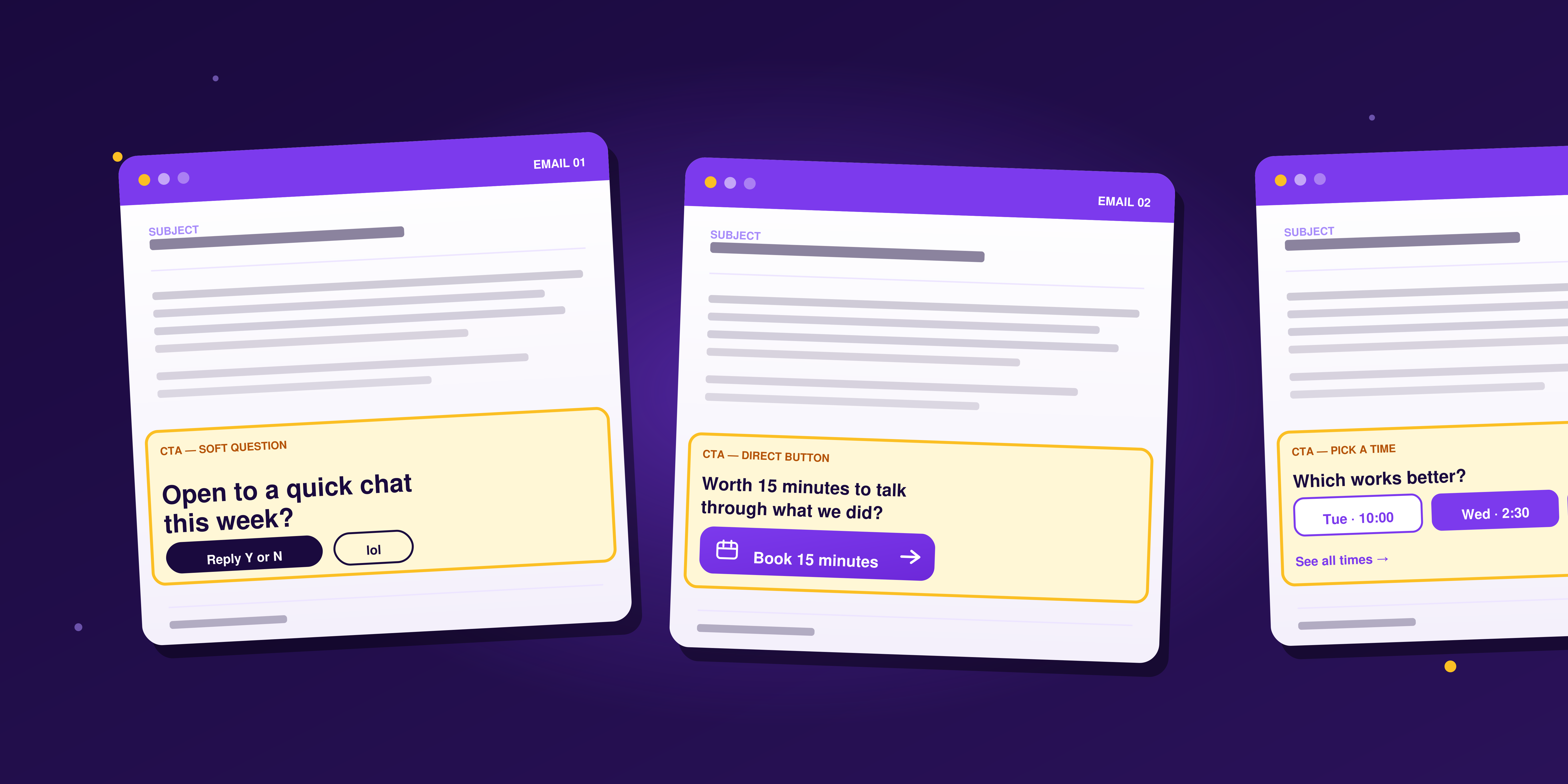
The fix is the same in every signal-based campaign. The opener references the signal. The body delivers a specific offer (a deliverable, time-bound, low-friction). The CTA is a yes or no reply, not a calendar link. More on body construction in cold email best practices for higher reply rates in 2026, and the full operational handoff in the modern outbound sales strategy guide.