

 Key Findings
Who runs senders, how many accounts you handle, and who owns replies decide the right tool faster than any demo.
Sender rotation, separated client workspaces, and centralized reply handling fit agencies running many LinkedIn profiles in parallel.
Conditional paths, A/B testing, and LinkedIn-plus-email inside one product fit founders and small teams running deliberate outreach.
Provisioning, reply coverage, lead hygiene, and reporting absorb hours that never show up on the pricing page.
Lists, copy, activity patterns, and team oversight matter more than any built-in safety feature on either platform.
Choosing between HeyReach and Expandi is not really a tool decision. It is a decision about who runs outbound, how many LinkedIn accounts they have to manage, and how much operational mess your team can absorb before reply handling falls apart.
A founder running their own prospecting wants different things from the platform than an agency coordinating 25 client LinkedIn accounts. The two products were built for those two jobs. Pick the one that fits your job and the rest gets easier.
Reachly is one of APAC's few triple-certified outbound agencies (Clay, Smartlead, HeyReach), and we run client outreach across both products every week. Here is what the actual operating differences look like once you stop comparing dashboards.
Overview
| Criteria | HeyReach | Expandi |
|---|---|---|
| Best fit | Agencies and teams managing many LinkedIn accounts | Solo reps, founders, small teams |
| Core model | Multi-account LinkedIn operations | LinkedIn plus email automation for individual users |
| Pricing model | Agency plan with unlimited accounts at $1,999 per month according to Expandi's comparison | Per account pricing starting at $99 per month or $79 annually according to Expandi's comparison |
| Main strength | Sender rotation, separated client workspaces, unified inbox | Smart sequences, deeper personalization, multichannel workflows |
| Main weakness | Less sophisticated sequence logic | Gets messy and expensive once many accounts are involved |
| Owns daily execution well when | Account managers handle several client senders inside one workspace | Individual operators tune one or two senders with high care |
| Who usually wins | Agencies running many client senders | Operators who want precision over volume |
The HeyReach review and "HeyReach vs. Expandi" question most articles get wrong
Most comparisons rank features. That gives you a tidy chart and no actual answer. The harder question is whether your outbound is a single seat workflow or a multi sender operation, because the platforms were built for different versions of that question.
Teams pick the wrong tool when they start the buying process with feature lists. They ask about A/B testing, inboxes, personalization, or CRM sync before they answer who owns campaigns day to day, how many senders need oversight, whether LinkedIn is the whole motion or one channel inside a wider modern outbound system, and how much admin the team can absorb without slowing reply handling.
Those four questions decide the winner faster than any demo.
A rule we apply when scoping new client setups: pick the platform that matches the operating burden you actually carry. A solo SDR running their own LinkedIn account does fine without agency-grade sender management. A team coordinating 20 client profiles inside a shared reply queue needs more than a single user workflow can provide.
Use this frame before reading any further:
- Volume model. One account run deeply, or many accounts in parallel.
- Channel model. LinkedIn only, or LinkedIn plus email inside the same motion.
- Team model. One operator's tool, or a shared system several people manage every day.
Once you answer those three, the heyreach review side of the conversation gets simple.
The two operating models behind the products
HeyReach and Expandi feel different the minute you start using them because they were built for different jobs.
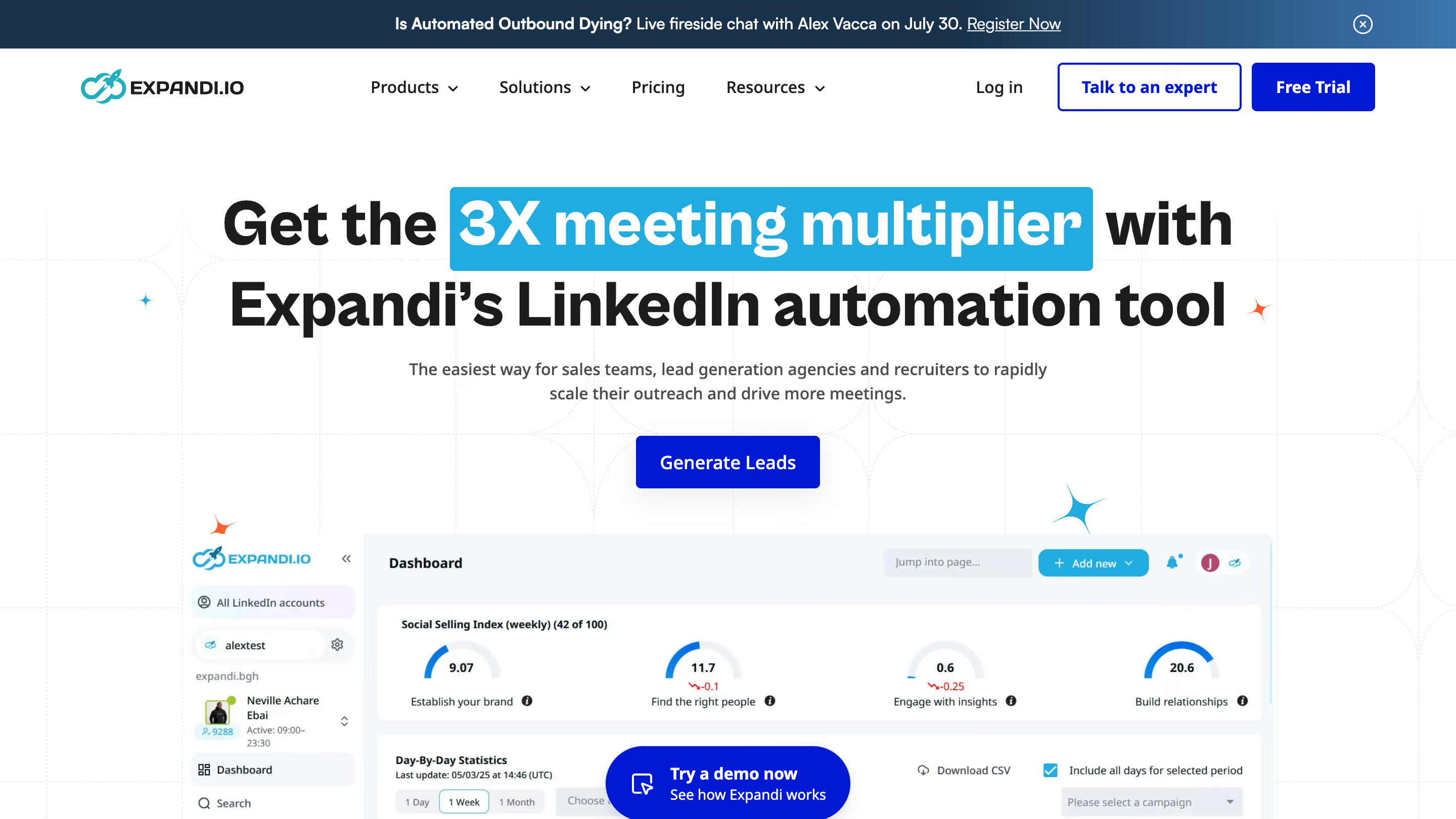
Expandi is closer to a rep's outbound workstation. One person, or a small team, gets tighter control over sequence logic, message variation, and multichannel follow up. The product rewards operators who care about what happens at each step, not just how many accounts are active.
That is why solo reps and small teams get along with it faster. You can build campaigns around prospect behavior, prioritize replies, and keep LinkedIn and email closer together without running two products in parallel.
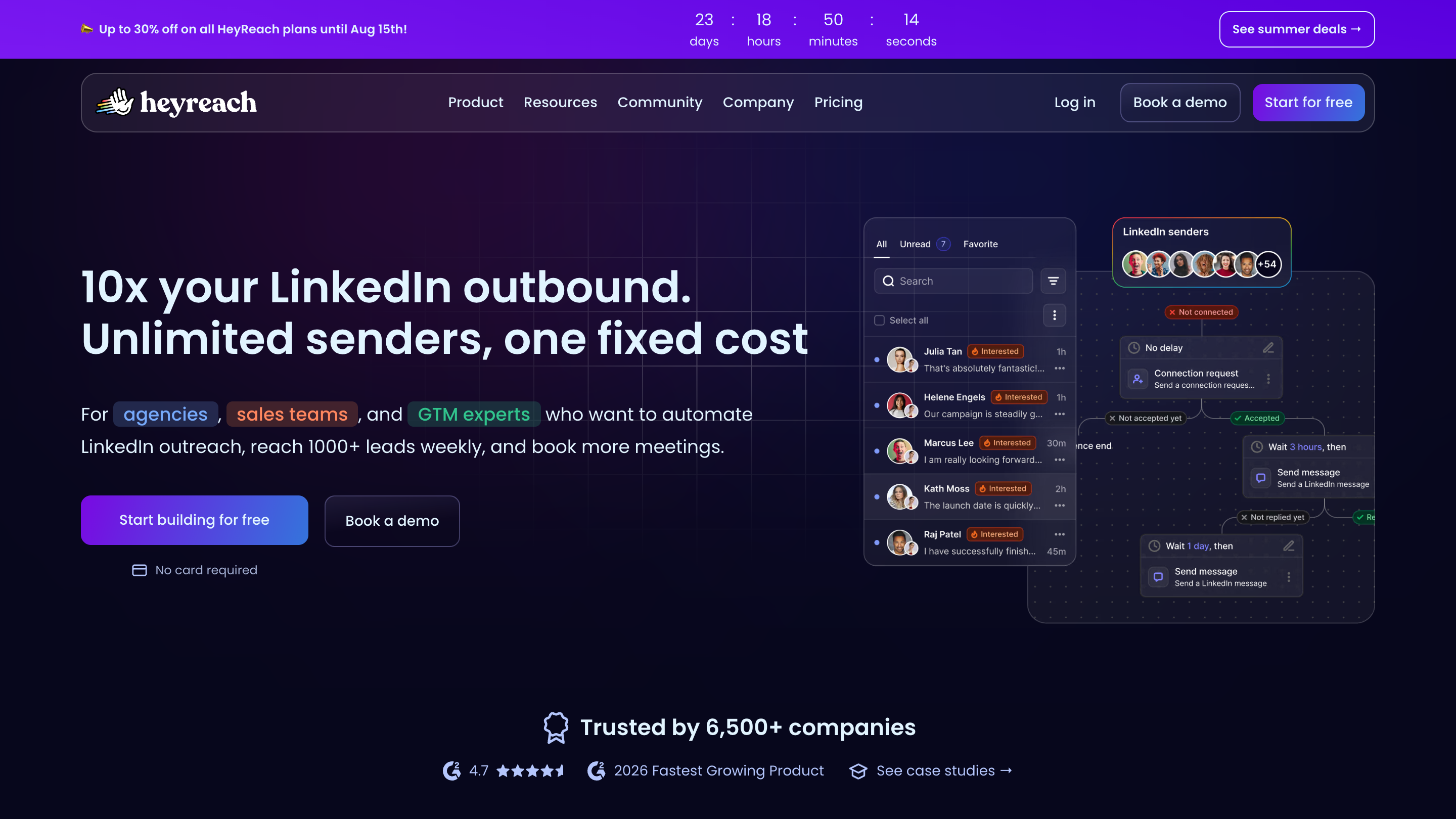
HeyReach is closer to an agency control panel. Agencies have a different headache: managing many LinkedIn accounts, keeping client work separated, rotating senders, and centralizing replies without turning every campaign into a coordination problem.
According to Gojiberry's comparison of HeyReach and Expandi, HeyReach supports unlimited LinkedIn accounts on its agency plan and is built around sender rotation and separated client workspaces, while Expandi's workspace and role-based controls fit smaller teams better. That is the split.
The practical consequence is simple. HeyReach feels natural when the job is operational control across many senders. Expandi feels natural when the job is tighter campaign craftsmanship from a smaller seat count.
A founder can run HeyReach. It just feels oversized when you are only managing your own account. An agency can run Expandi. It creates more account sprawl, billing sprawl, and day to day management overhead once the client list grows past five.
For context on where LinkedIn fits inside software-company outbound, LinkedIn marketing for software firms frames it as part of a broader demand capture and trust-building system.
For agencies, the failure mode is rarely "the sequence lacked one condition." The failure mode is account management, reply handling, and ownership breaking the system. The right tool is the one that does the most to prevent that break.
For a closer look at the actual prospecting side of LinkedIn, the guide on LinkedIn prospecting workflows focuses on the targeting and messaging discipline that matters whatever product sits underneath.
How HeyReach and Expandi compare across five operating questions
The difference shows up in the operating model.
A team running Expandi spends more time inside the sequence builder. A team running HeyReach spends more time managing senders, inboxes, and campaign coverage across accounts. Both can book meetings. They ask the operator to solve a different problem.
Campaign setup. Expandi starts with campaign logic. You build around triggers, follow ups, conditions, and message flow. That suits operators who want tight control over how a prospect moves between steps.
HeyReach starts with account coordination. The setup is about assigning senders, keeping client activity separated, and making sure campaigns stay organized once several LinkedIn accounts are active at the same time. That matters more than fancy sequence design when the real job is running outreach at volume across many profiles.
Both products still depend on list quality and offer quality. Neither one fixes weak targeting, which is why we anchor every Reachly client setup on a signal-based outbound layer in Clay before either product gets turned on.
Personalization. Expandi has the stronger personalization engine.
According to Salesforge's comparison of HeyReach and Expandi, Expandi has the edge in personalization and safety with cloud-based automation and adaptive smart sequences keyed to prospect behavior. HeyReach focuses more on sender rotation and lacks Expandi's advanced templating and dynamic elements.
That matches what we see in client setups. Expandi is the stronger pick for teams that want outreach to respond to prospect behavior inside the sequence. It gives you more room to test message structure, add conditional paths, and run campaigns that do not feel purely linear.
HeyReach handles personalization at a competent baseline. The product's value sits elsewhere, especially once campaign management becomes a bigger burden than message logic.
Teams that care most about message branching and touch-level optimization get more mileage from Expandi. Teams that care most about keeping many senders coordinated, visible, and productive get more mileage from HeyReach.
Multi-account management. HeyReach earns its keep here.
Once several LinkedIn accounts are running at the same time, operational overhead becomes the bottleneck. Reply handling, workspace separation, visibility across senders, lead deduplication. These start to matter more than whether one step in a sequence has an extra condition.
HeyReach handles that environment well. The platform was built for shared operations rather than individual seat performance.
Expandi supports teams, with the caveat that it still operates like a collection of well-managed accounts rather than one shared system for multi-sender outreach. Fine for a founder or a small outbound team. Heavy for an agency or B2B appointment setting team managing many client profiles, where it adds manual oversight that a multi-account product would handle natively.
Once you're running outreach across 10 or more client LinkedIn accounts, watching the senders is the actual job. We've seen clients pick the most sophisticated platform on the market and still get accounts restricted, because nobody owned the reply queue. The product helps. The person sitting behind it decides whether the system holds together.

Account safety philosophy. Both products talk about safety. The risk model is different.
Expandi keeps a single account's behavior more controlled through cloud automation and behavior-aware sequencing. That works best when you are protecting a smaller number of accounts and want close control over how each one behaves.
HeyReach spreads activity across a sender pool. Pressure on any single profile drops. The trade off is that safety now depends on how well the whole sender pool is managed.
Neither option removes platform risk. Expandi asks you to manage the behavior of each account carefully. HeyReach asks you to manage a larger sender system carefully. The shape of the operational burden changes depending on which platform you choose.
Reporting and workflow visibility. Expandi gives sales teams better visibility into sequence behavior. You can inspect step performance, watch reply patterns, and adjust campaign logic with precision. Useful when one SDR team is trying to improve conversion inside a narrower set of campaigns.
HeyReach is better for managers who need oversight across many active senders. The question becomes whether replies are being handled, campaigns are still moving, and no sender is creating avoidable account risk. Drilling into one underperforming sequence step is the wrong scale of question for that job.
| Workflow need | Better fit |
|---|---|
| Fine tuning sequence behavior | Expandi |
| Monitoring many sender accounts | HeyReach |
| LinkedIn plus email in one motion | Expandi |
| Agency inbox control across many client profiles | HeyReach |
| Sender rotation across a pool of accounts | HeyReach |
| Conditional logic and A/B testing inside sequences | Expandi |
Pricing and the real cost once outreach becomes operational
The monthly subscription is the smallest line item once outbound becomes an operating system instead of a side task.
Expandi is easier to justify at low volume. One founder, one SDR, or a small team can live with per-account pricing because the surrounding admin stays manageable.
The math changes once you manage outreach across several client accounts or a larger outbound team. The real cost starts showing up in labor, oversight, and the mistakes that come from managing too many moving parts across separate seats.
We have seen agencies pick the cheaper subscription and end up with the more expensive setup within a month, because seat management cost more than the savings.
Software buyers anchor on list price because it is concrete. Total cost of ownership is the number that determines margin, and it is harder to see.
On a per-account model, the team usually absorbs extra work in places like:
- Provisioning and permissions for each account
- Campaign setup repeated across seats
- Reply coverage spread across multiple inbox views
- Lead list hygiene and duplicate prevention across senders
- Client reporting cleanup
- QA checks to catch broken sequences or inconsistent copy
None of that appears on a pricing page. Someone still has to do it.
That is the operating model difference most heyreach vs expandi comparisons miss. Expandi works well when one operator wants close control over a small set of accounts. HeyReach wins when the job is coordinating many senders without piling up manual admin around them.
A working knowledge of the LinkedIn algorithm and platform behavior patterns helps, with the caveat that it does not remove the cost of running a fragmented outreach setup. When your team does not want to own the tooling, the setup, and the day-to-day risk management, a done-for-you outbound service often becomes the cheaper decision because it removes the labor line item.
Simple buying rule:
- Use Expandi when you want account-level control and the admin stays contained inside a small book of business.
- Use HeyReach when you are running outreach as a multi-account operation and need the platform to reduce coordination work.
Sender reputation and what platform safety actually means
This is the part buyers care about most, and the part the market is least honest about.
Anyone promising you a fully safe automation setup is overselling. LinkedIn risk works like email deliverability. You manage it. A tool does not remove it.
According to La Growth Machine's comparison of Expandi, HeyReach, and LGM, there is a real gap in public quantitative data on LinkedIn ban rates for either product at agency scale. The vendors talk about safety features like sender rotation or smart sequences. Hard numbers from the field are still scarce.
That matters because most safety claims in the category are anecdotal. Buyers end up making decisions based on vendor language and forum chatter, which is a weak basis.
The risk shape differs by product.
Expandi keeps one account's behavior controlled through cloud-based execution and smarter sequence behavior. Useful when one person or a small team runs deliberate outreach from a limited set of accounts.
HeyReach spreads activity across a sender pool. Useful when the volume problem is distributed by design. A solid operational answer for agencies, with the trade off that safety now depends on how the whole pool is run.
The tool matters. The bigger drivers of safety are lists, copy, activity patterns, lead overlap rules, and team discipline. Most LinkedIn restrictions we see in client audits come from repetitive copy and weak targeting, not from either platform's setup defaults.
To understand the platform side of this better, the breakdown of the LinkedIn algorithm and how activity gets interpreted is a useful companion read.
When HeyReach is the right pick
You manage outbound as an operation. You need many LinkedIn accounts under one roof, cleaner reply consolidation, and less chaos across client work.
According to Derrick App's comparison of HeyReach, Expandi, and Derrick, HeyReach is built for agencies running many accounts in parallel and consolidating replies from numerous senders, while Expandi's mobile integration, A/B testing, and CSV lead imports fit solo reps or small teams. That matches our experience.
Pick HeyReach when:
- You run outreach across many LinkedIn accounts at once
- You need client workspace separation
- You want one place to monitor replies across all senders
- You care more about operational control than fancy sequence branching
- You plan to use sender rotation as part of your safety model
For most agencies, this is the right call. We use HeyReach across most client accounts at Reachly, and code REACHLY trims the first month for new users.
When Expandi is the right pick
You are a founder, SDR, or small sales team. You care about sequence logic, testing copy, and mixing LinkedIn with email without running two separate tools.
Pick Expandi when:
- You manage a small number of LinkedIn accounts
- You want more control over message logic and conditional paths
- You want LinkedIn and email closer together inside one product
- You plan to use A/B testing and richer personalization variables
When the team is small, those advantages are real.
When the answer is neither
If your team is already stretched, buying software adds another half-finished internal process for you to manage. You still need targeting, data cleanup, copy, sequencing, inbox handling, cold email reply discipline, and meeting qualification. The tool covers part of that chain.
If you are exploring the agency route, what a LinkedIn outreach agency actually handles is a practical place to start.
The pattern we see across audits: teams arguing about which automation platform to buy when the actual gap is the offer.
Not having an offer is the biggest mistake that every single company is doing. Those CEOs get cold emails every other day. You need to have something that's too good for them to say no to.
Switching from Expandi to HeyReach (or the other direction) will not fix a campaign that is being ignored because the offer is weak. Worth checking before any tool migration.
Skip the tool juggling. Get meetings booked.
Reachly runs cold email, LinkedIn, and cold calling for B2B teams across APAC, USA, Canada, UK, and ANZ. Triple-certified across Clay, Smartlead, and HeyReach. Primal hit 4.57x ROI, 85+ SQLs in 6 months, and 6 deals signed on this exact stack. The Great Room signed a $250K contract with face-to-face meetings going from 2 per quarter to 2 per month, zero added headcount.
Frequently asked questions
Yes, with a caveat. HeyReach feels oversized when you are only running one LinkedIn profile. If your job is to book meetings out of your own account, Expandi or a lighter single-seat product fits better. HeyReach starts earning its price once a second or third sender enters the mix and reply handling needs to live in one queue.
You can. You will spend more time managing seats, billing, and reply handling across client workspaces. Once an agency crosses 8 to 10 client accounts, the admin overhead of running Expandi across them usually overtakes whatever feature edge it had inside the sequence builder. Most agencies that try it switch to HeyReach inside 3 to 6 months.
It depends on the bottleneck. When meetings are low because messaging needs better logic and follow up structure, Expandi tends to win. When meetings are low because reply handling is messy across many senders and replies are sitting in the wrong inbox for 2 to 3 days, HeyReach removes the bigger blocker. Diagnose the actual bottleneck before changing tools.
Both manage risk, neither removes it. Public ban-rate data for either product at agency scale is thin. Account safety comes from lists, copy, activity patterns, and team discipline more than any built-in setting. Our Thailand LinkedIn pilot kept connection acceptance at 35% and reply rate at 47% on clean targeting alone, with the platform safety settings on default.
HeyReach is the default for client work because we run a multi-sender operation across many B2B accounts. Reachly is HeyReach certified and one of APAC's few triple-certified agencies (Clay, Smartlead, HeyReach). Use code REACHLY for the first-month discount on the agency plan. For founders running their own LinkedIn account, Expandi or a lighter single-seat option usually fits better.
Not as your full stack. Both products are strongest when LinkedIn sits at the center of the system. If your motion needs cold email, LinkedIn, and cold calling working together, you will pair either tool with Smartlead for cold email, Clay for signal-based targeting, and a calling layer for the final touch. That is the Reachly setup across every client we run. See how Reachly runs the full motion.
Recommended service
Outbound Lead Generation Services
Reachly builds and runs the whole outbound motion across email, LinkedIn, and phone, and books qualified meetings on your calendar.