
Sales pipeline vs sales funnel comes down to what you count: the sales pipeline is the list of open deals your team works one at a time, and the sales funnel is the conversion rate of a whole group of buyers from first touch to meeting. In cold outbound the funnel narrows fast, to about 1 positive reply per 400 to 600 emails sent, so the two need separate reports and one clear rule for when a buyer moves from the funnel into the pipeline.
Key Findings
- The funnel measures rates across a cohort of accounts. The pipeline tracks individual deals by stage, value and age. Mixing them is how forecasts fill up with deals that were never real.
- The handoff point is the qualified meeting. Reachly only counts a meeting as pipeline when the person matches the ICP agreed in TAM mapping, and 80 to 90% of meetings qualify when that mapping is done well.
- Outbound funnel ranges from Reachly campaigns: 1 to 4% of emails get a reply, 10 to 30% of replies are positive, and 10 to 25% of raw emails are catch-all before verification.
- Every pipeline stage needs written proof to move, such as a budget owner and timeline logged after discovery. A stage that runs on a feeling like "warm" inflates the forecast.
- Better funnel targeting shows up as pipeline quality. The Great Room saw about 30% drop-off on Reachly outbound leads against about 50% from digital channels.
- Teams with under 20 active deals and founder-led sales need clean notes and a few hard stages, and can skip a full funnel model.
What is the difference between a sales pipeline and a sales funnel?
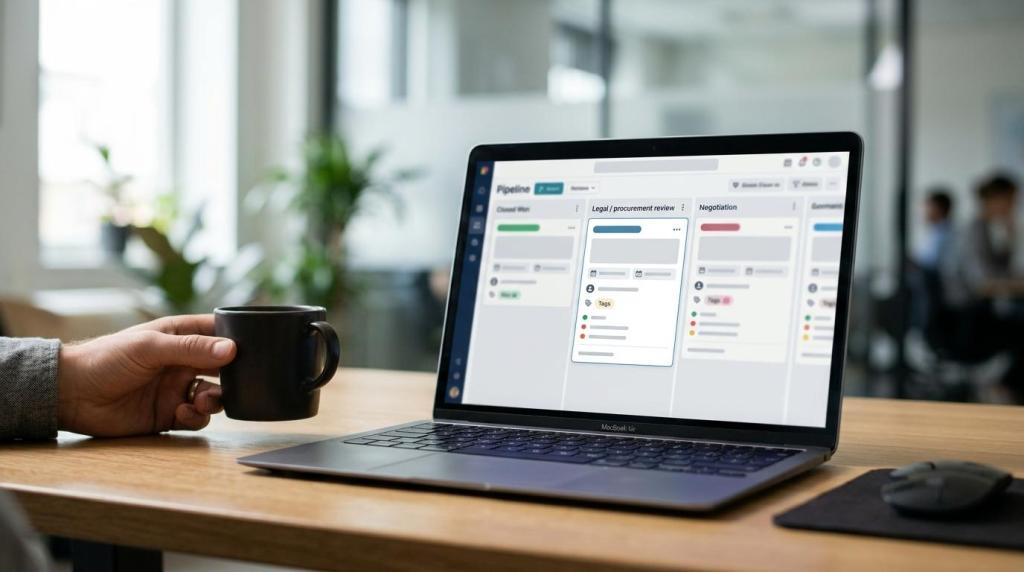
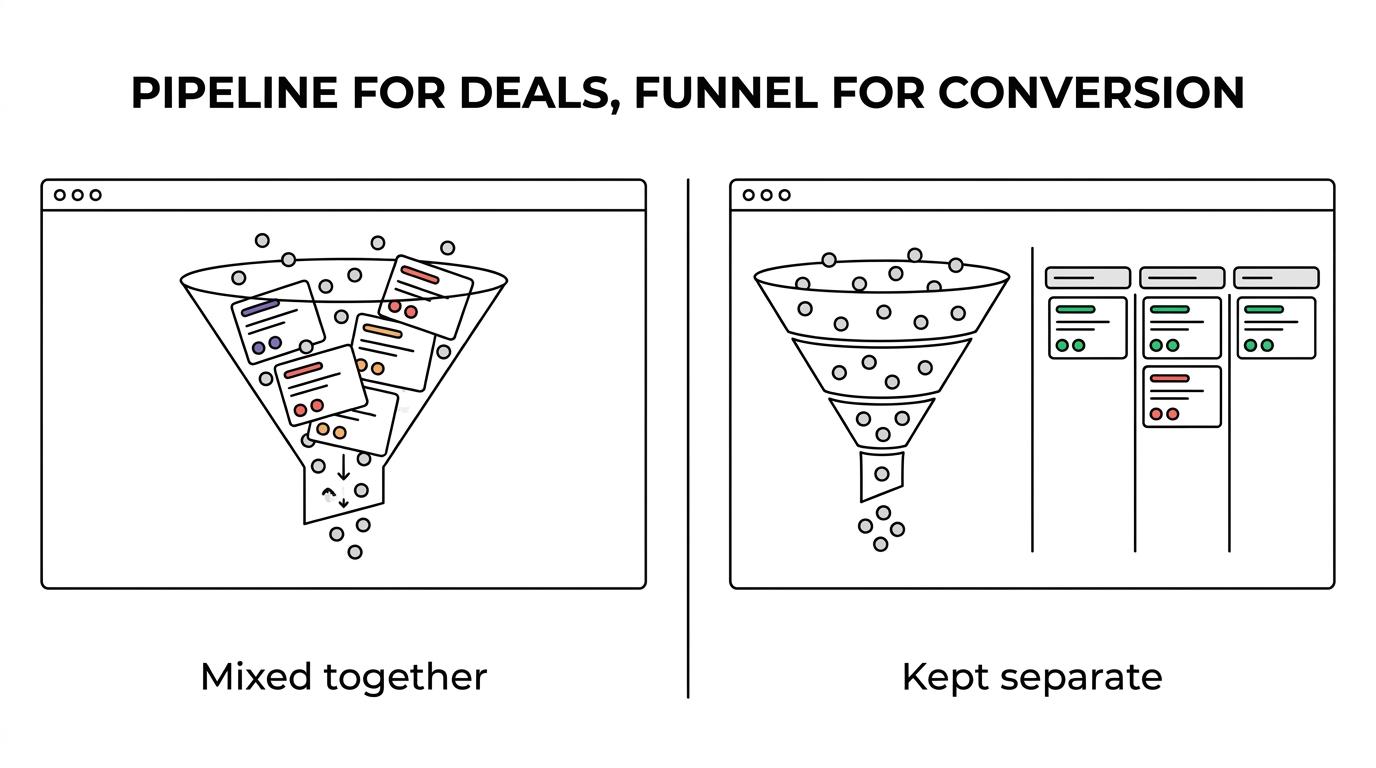
The pipeline is your internal operating view: which deals are open, what stage each one is in, what it is worth, what is blocking it, and what will likely close this quarter. The funnel is your market conversion view: how many accounts entered at the top, what share replied, what share became qualified, and where volume drops off.
One is read deal by deal, the other is read as percentages across a group. That single difference decides who owns each report, which meeting it belongs in, and what goes wrong when you confuse them.
| Category | Sales pipeline | Sales funnel |
|---|---|---|
| Purpose | Manage open opportunities to a close | Measure how buyers convert from stage to stage |
| Point of view | Seller and revenue team | Buyer behavior and channel performance |
| Unit | One account or deal | A cohort, segment or source |
| Measured in | Deal count, value, stage, age | Conversion rates and drop-off |
| Usual owner | Sales leader and account executives | Marketing, RevOps or the outbound team |
| Read in | Weekly deal reviews and forecast calls | Monthly or campaign reviews |
| Best use | Forecasting, coaching, deal strategy | Budget, channel mix, messaging tests |
| Failure mode | False pipeline coverage and a missed forecast | Wrong budget and bad channel assumptions |
Where the funnel hands off to the pipeline
The two models meet at one point, and most reporting arguments come from teams that never agreed where it is. In outbound, Reachly puts the line at the held meeting with a person who matches the ICP set during TAM mapping. Everything above that line is funnel and is judged by rates. Everything below it is pipeline and is judged deal by deal, with proof required at each stage. The funnel ranges in the map are Reachly operating benchmarks from outbound campaigns, as Thibault Garcia, Reachly's founder, gives them.

Those ranges move with volume, offer and market. The useful part is the shape: a list of thousands narrows to a handful of meetings, so a funnel report is a rate problem, while the pipeline below the line is a short list of named deals.
Why do B2B teams keep mixing up pipeline and funnel reporting?
Because the classic picture is simple. Buyers start at the top, move down, and some of them buy. It is easy to present and it is wrong often enough to cause real damage.
Gartner's research on the B2B buying journey describes six buying jobs: problem identification, solution exploration, requirements building, supplier selection, validation and consensus creation. Buyers loop back through them in any order. Your deal can look late stage in the CRM while the buying group is still arguing about the problem.
That mismatch creates reporting noise from both sides. Funnel reports imply a clean progression from one stage to the next. Pipeline reports assume a stage means the same thing on every deal. Both only hold up when the stage definitions are written down and enforced.
The short version: the funnel is directional and the pipeline is operational. One helps you diagnose conversion. The other helps you run revenue.
How should a B2B team use the sales funnel?
Use the funnel to test how a market responds to a message, offer or channel, long before anyone closes. If the cold email reply rate is healthy but qualified opportunities stay flat, the funnel shows the leak weeks before the forecast does.
That is especially useful in outbound, where the first question is whether your ICP, offer and angle get the right people to reply at all. Thibault Garcia gives the ranges Reachly plans around:
"Ballpark figures are 1-4% overall reply rate (depending on your volume) and 10-30% positive reply rates (depending on your offer), another good way to look at it is to try and generate 1 positive reply every 400-600 emails sent." Thibault Garcia, Founder, Reachly
Read your funnel against those ranges and the leak usually points to one cause:
- Source to verified contact: a large drop means stale data. Raw lists Reachly pulls carry 10 to 25% catch-all emails before verification.
- Sent to reply: under 1% usually means the offer or the angle, once deliverability is ruled out.
- Reply to positive reply: plenty of replies with few positive ones points at targeting, since the wrong people are answering.
- Positive reply to meeting held: this one depends on how fast your team answers interested leads, and slow replies leak meetings.
Once a meeting qualifies, switch to the pipeline. From that point you need deal-level visibility, and a percentage chart stops helping.
What stages belong in a B2B sales pipeline?
A B2B sales pipeline should be built from verifiable deal states. If a rep cannot show why a deal moved, the stage is too soft. Good stage design is boring on purpose, because each stage has a real exit test that someone other than the rep can check.
| Stage | Proof needed to move on | Who confirms it |
|---|---|---|
| Meeting held | The person matches the ICP agreed in TAM mapping and turned up | SDR or outbound team |
| Discovery completed | Problem, budget owner and timeline written in the CRM | Account executive |
| Solution fit confirmed | The buyer agrees the offer solves the stated problem | Account executive, checked in deal review |
| Proposal sent | Pricing and scope shared with the decision maker | Account executive |
| Legal or procurement | Contract, security or vendor review has started | Sales leader |
| Closed won or lost | Signed contract, or a written loss reason | Sales leader |
Two quick tests tell you whether a stage is usable:
- Good stage: the rep can show evidence that the account earned the move.
- Bad stage: the stage is really a feeling, like "interested" or "warm".
If your stage names still sound like marketing language, fix them before you touch forecast math. For a stage-by-stage build, see this guide on how to build a B2B sales pipeline, and use lead qualification rules to decide what counts as a qualified meeting.
Which metrics belong to pipeline management and which belong to funnel analysis?
A clean rule helps here. If the metric helps you manage a live deal, it belongs to the pipeline. If it helps you spot conversion patterns across a group, it belongs to the funnel.
| Metric | Belongs to | The question it answers |
|---|---|---|
| Deal count and pipeline value | Pipeline | How much is open right now? |
| Stage aging and slippage | Pipeline | Which deals are stuck, and for how long? |
| Win rate by stage | Pipeline | Where do we lose deals we were chasing? |
| Pipeline coverage | Pipeline | Is there enough open value to hit the target? |
| Time to close | Pipeline | How long does a qualified deal take? |
| Reply rate and positive reply rate | Funnel | Does the market respond to this offer? |
| Reply to meeting rate | Funnel | Do interested leads turn into meetings? |
| Meeting to qualified opportunity | Funnel, at the handoff | Are we booking the right people? |
| Conversion by source or channel | Funnel | Which channel deserves more budget? |
Teams get in trouble when they cross these wires. A rep cannot coach a late-stage account with top-of-funnel conversion charts, and marketing cannot fix channel mix using only pipeline coverage. The full list of outbound numbers worth tracking is in this post on outbound sales KPIs.
Can one CRM report show both?
Yes, from the same deal records, as two saved views. Give every deal a source field and a created date. The funnel view groups deals by source and month and shows conversion between stages. The pipeline view filters to open deals and shows stage, value and days in stage. Keep them on separate dashboards so nobody reads a conversion rate as a forecast.
This split matters even more when you run multichannel outreach across cold email, LinkedIn and cold calling. Each channel feeds the funnel at a different rate, and all of them should hand off into one shared pipeline once a meeting qualifies.
When does funnel thinking break down in outbound?
It breaks down the moment every positive signal gets counted as pipeline. Clicks, replies and booked meetings with accounts outside the ICP all belong in the funnel. Pipeline starts at the qualified meeting.
This is where outbound teams fool themselves. Activity climbs, the funnel looks busy, and the forecast never moves because the pipeline below the handoff line is still empty.
The fix is upstream, in targeting and the offer. When reply rates sit low on good data and good infrastructure, the cause is usually the offer, so Reachly tests offers and angles before it adds volume. More emails into a weak offer only make the top of the funnel bigger.
The same logic applies to stage discipline. If your funnel produces meetings with the wrong buyers, your pipeline review becomes cleanup work instead of revenue work. To fill the pipeline with the right buyers in the first place, the Reachly pipeline generation guide covers targeting, sending volumes, and how long it takes.
How did better pipeline control improve lead quality for The Great Room?
The Great Room shows the gap between more leads and better opportunities, and the outbound work Reachly ran for them is summarized below.
The meeting count is the funnel win. The drop-off rate is the pipeline result: fewer of the people entering the sales process fell away, because they matched the ICP before they were handed over. If you sell into a long sales cycle, that difference matters more than volume, since half the opportunities disappearing after first contact wipes out any gain at the top.
Who should not spend weeks redesigning pipeline and funnel models?
If you have a tiny TAM, founder-led sales, and fewer than 20 active deals, do not overbuild this. You need clean notes, a few hard stages and honest qualification. A complicated funnel dashboard will not save a weak market fit.
The same is true before product-market fit. Stage labels, weighted pipeline math and conversion dashboards are no substitute for an offer people want. Fix ICP fit and offer clarity first, and structure starts paying off after that.
What should you fix first if your team uses pipeline and funnel as the same thing?
- Fix the language. In your next revenue meeting, define pipeline as open qualified opportunities and funnel as conversion across a broader audience.
- Write the handoff rule. One sentence that says when a meeting becomes a deal, for example "the person matches the ICP and the meeting was held".
- Separate the dashboards. Funnel by source, segment and conversion point. Pipeline by stage, age, amount, owner and close probability.
- Enforce stage exit criteria. Put the proof for each stage in the CRM and check it in every deal review.
If you run outbound lead generation services or an internal SDR team, the handoff rule is the piece that keeps both reports honest. Only move accounts into pipeline when they meet the criteria your sales team will actually accept.
The sales funnel shows how buyers narrow. The sales pipeline shows which opportunities are real and what happens next. B2B teams need both, with forecasts, coaching and deal control running on the pipeline.
Fill the top of your funnel with buyers who match your ICP
Reachly maps your TAM, runs signal-based outbound across cold email, LinkedIn and cold calling, and hands your team meetings that meet the entry rule for your pipeline.
Book a call with Reachly
Frequently asked questions
What is a sales pipeline?
A sales pipeline is the set of open opportunities your team is working, each sitting in a stage with a value and an owner. Teams usually judge its health by coverage, the ratio of open pipeline value to the revenue target for the period. This guide on pipeline coverage ratio works through how much you actually need.
What does a sales funnel include?
The classic marketing funnel has four stages, often written as awareness, interest, decision and action, or AIDA. An outbound funnel uses more concrete steps that you can count: accounts in the target list, verified contacts, emails sent, replies, positive replies and meetings held. Both end at the same place, the point where a buyer becomes a real opportunity.
What is another name for a sales pipeline?
You will hear deal pipeline, opportunity pipeline and deal flow. CRMs name the records differently too: HubSpot calls them deals, Salesforce calls them opportunities. The term sales cycle is related but describes the time a deal takes to close, rather than the deals themselves.
What are the 5 stages of a sales pipeline?
A common five-stage version is prospecting, qualification, meeting or discovery, proposal, and close. Four-stage versions merge prospecting and qualification into one step. When outbound feeds the pipeline, prospecting and the first reply live in the funnel, so the pipeline itself starts at the qualified meeting.
Which CRM is best for managing sales pipelines?
Small teams tend to pick Pipedrive or HubSpot because stages and deal views work out of the box, and Salesforce suits larger teams that need custom objects and strict permissions. The CRM matters less than the setup: written exit criteria per stage, a source field on every deal, and separate saved views for funnel conversion and open pipeline.