
Account based marketing helps lean B2B teams win more pipeline with tight target lists, buying signals, and simple multichannel outreach.
Account based marketing works for lean B2B sales teams when you keep the account list tight, tie outreach to real buying signals, and judge success by pipeline instead of activity. Gartner reported in May 2025 that tech providers running ABM programs still see pipeline lifts above 11% versus traditional demand generation programs or prospecting. If you have one AE, one founder, and no room for waste, that matters more than another list of 10,000 names.
A lot of teams hear “ABM” and picture big ad spend, custom microsites, and a six-month setup. That version exists. It is just not the one a lean team needs. The practical version is much closer to focused outbound with stricter account selection, better timing, and cleaner measurement.
What does account based marketing look like for a lean B2B sales team?
For a small team, account based marketing is not a brand exercise. It is a targeting system.
You pick a narrow set of accounts that fit your ICP, map the likely buying group, watch for signs that timing is right, and then reach out with a message built for that account set. The channel stack is simple: cold email, LinkedIn, cold calling. The hard part is not the channel. The hard part is choosing the right accounts and having an offer worth replying to.
Thibault Garcia, founder of Reachly, puts it plainly: “Every client gets the same question before we write a single email. If you had thirty seconds with your dream client, what would you offer them? If the answer takes longer than thirty seconds, we do not have an offer yet.”
That is the part many lean teams skip. They think ABM means personalization. It usually means discipline.
After that, the difference becomes clearer:
-
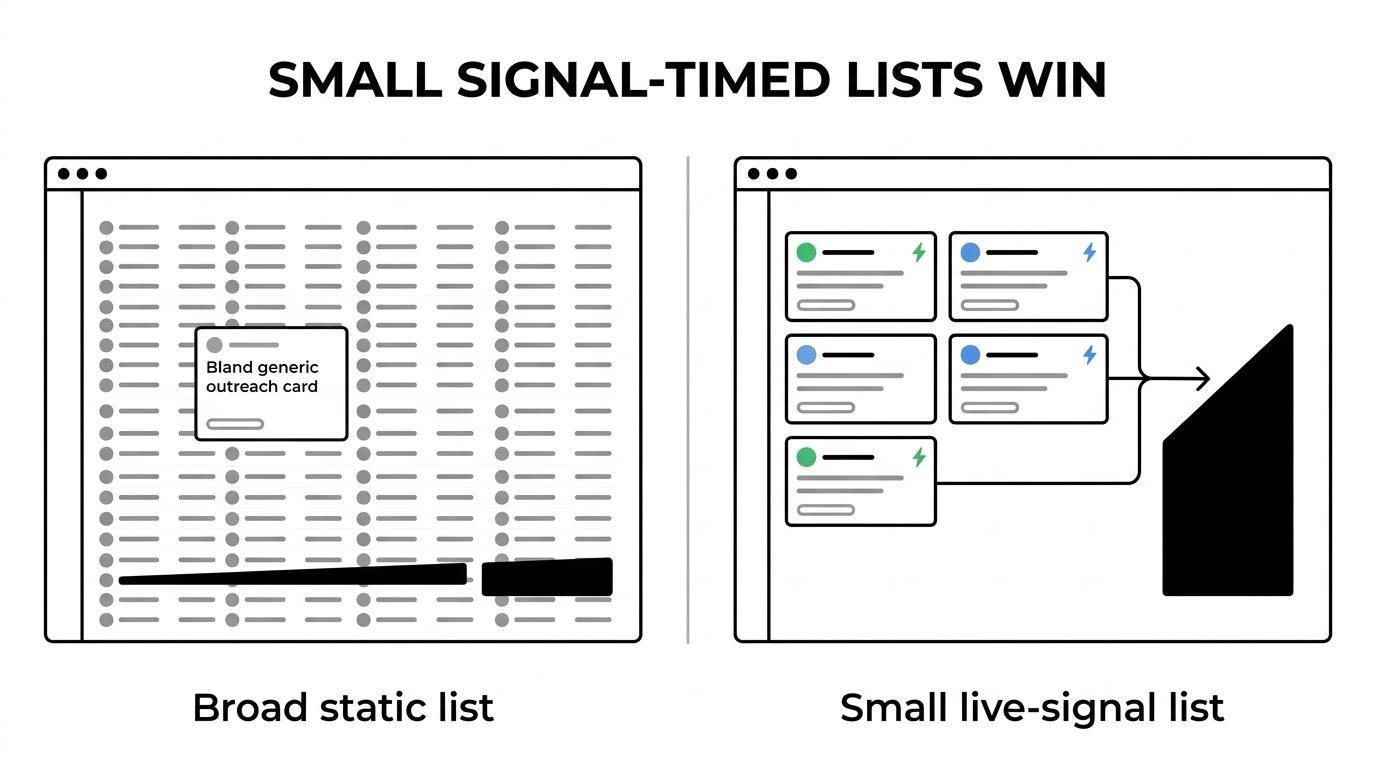
Broad prospecting: large lists, weak timing, generic pain points
-
Lean ABM: small account sets, live signals, one clear offer
-
fewer accounts
-
more context
A team with limited headcount gets more from 75 accounts with real timing than 7,500 pulled from a static database last quarter.
Why does account based marketing work better with buying signals than static lists?
Static target account lists go stale fast. Signals tell you who has a reason to care right now.
At Reachly, signal-based targeting usually starts with company-level and behavior signals built in Clay. That can include hiring, funding, leadership change, tech stack change, headcount growth, website visitor ID, ranking drops, or LinkedIn engagement. The point is not to pile on data. The point is to know why this account should hear from you this week.
Garcia has a strong view here: “Hiring is the signal I trust most. A company spending money on headcount is a company that is growing, and growth is what creates the problem we solve.”
That matters because signal shelf life is short. In most markets, you have about 2 to 4 weeks before competitors show up with the same idea. If your ABM program runs on a list built once a quarter, you are already late.
Signal-based ABM also fixes the fake personalization problem. You do not need a six-line opener about a podcast episode nobody on the buying team remembers. You need a reason to write. “Saw you’re hiring three SDRs” or “noticed your team just added HubSpot and Sales Navigator roles” is enough if the offer fits.
Which account based marketing metrics matter for lean teams?
If you judge ABM by opens, clicks, or top-of-funnel volume, you will kill a good program too early. Gartner’s 2025 guidance on ABM measurement is clear on this point. Account and pipeline metrics matter more than old demand gen dashboards.
Here is the short version of the market data behind that view.
[markdown] | Source | Year | Finding | Why it matters for lean teams | | --- | ---: | --- | --- | | Gartner | 2025 | Tech providers running ABM programs continue to see pipeline lifts over 11% versus traditional demand generation or prospecting. | The upside shows up in pipeline, not vanity metrics. | | Gartner | 2025 | 61% of B2B buyers prefer an overall rep-free buying experience. | Outreach has to be relevant and low-friction. Pushing for a meeting too early hurts you. | | Dun and Bradstreet | 2023 | 64% of respondents said their company is currently using an account-based strategy. | ABM is already common. You are not early. Execution is the edge. | | Dun and Bradstreet | 2023 | 21% said they were not using an account-based strategy but planned to in the next 12 months. | More teams are moving this way, which makes timing and message quality more important. | | Gartner | 2025 | ABM success should be measured with account and pipeline metrics, buying group behaviors, and attribution. | A lean team needs fewer metrics, but the right ones. | [/markdown]For daily management, we care about five things. Are the right accounts getting touched? Are the right people replying? Are replies turning into qualified meetings? Are those meetings becoming SQLs and pipeline? Is CAC moving in the right direction?
A few operator benchmarks help keep you honest. Positive reply rate in cold email often sits in the 10% to 20% range when the offer and list are right. Thirty-five to 40% is very good. On LinkedIn, a 25% connection acceptance rate is a decent benchmark, and one Thailand pilot hit 35% acceptance with reply rates up to 47%.
Do not obsess over meeting volume in week one. The goal of a cold email is a reply, not a meeting. No reply, no meeting.
How should lean teams run account based marketing across cold email, LinkedIn, and cold calling?
Lean ABM works when each channel has one job.
Cold email gets the first response. LinkedIn adds familiarity and another reply path. That role fits broader B2B practice too, and Jakob Wikström notes in his breakdown of LinkedIn marketing for B2B companies that the platform tends to work best when it supports trust and visibility around an existing sales motion rather than trying to carry the whole motion alone. Cold calling is used after there is context, not as a blind volume play. That mix is why a small team can stay present in a target account without burning hours on manual follow-up.
The setup matters just as much as the copy. If you skip authentication, warmup, or list re-validation, your ABM campaign will look like a message problem when it is really an inbox problem.
Garcia is blunt about the send setup: “Four weeks of warmup before a single real email goes out. There is no version of this that goes faster, and everyone who tries to find one pays for it within a month.”
Here is a lean execution view:
[markdown] | Channel | Job in the ABM motion | What it costs you | Rule that matters | | --- | --- | --- | --- | | Cold email | Start the conversation with a signal-based opener | 14 to 30 days of warmup, domain setup, deliverability risk if rushed | Keep the first email to 60 to 80 words, no links, clear offer | | LinkedIn | Raise recognition and pick up replies from non-email users | Daily review time, light manual work, slower ramp | Empty connection note, wait 1 to 3 days after acceptance, then send a short lowercase message | | Cold calling | Turn warm accounts into live conversations | Rep time, lower volume, needs account context | Use it after email and LinkedIn touches, not as a stand-alone list hit | [/markdown]As of August 2026, mailbox caps are tight. Google sits around 15 emails per mailbox per day. Outlook sits around 10 to 12. That pushes lean teams toward better targeting, which is good news if your TAM is well defined and your offer is strong.
The technical floor is not optional. SPF, DKIM, DMARC, and a custom tracking domain all need to be in place. ESP-to-ESP matching helps too. Google to Google. Outlook to Outlook. Any list older than 3 months should be re-validated before send.
This is also where tools earn their place. We usually map TAM, enrichment, and signals in Clay, AI Ark, Apollo, and LinkedIn Sales Navigator, verify through ZeroBounce or MillionVerifier, send through Smartlead, and handle LinkedIn execution in HeyReach. That does not make ABM easy. It just removes avoidable failure.
What do account based marketing results look like in live B2B campaigns?
The cleanest proof is when focused targeting produces revenue without extra headcount.
Take The Great Room. Before the engagement, internal outbound was producing about two face-to-face meetings per quarter. During the partnership, that moved to about two meetings per month. Outbound leads also saw roughly 30% drop-off after qualification, compared with about 50% from paid and organic channels, and the work contributed to about $250,000 in closed contract value. No added headcount.
Then there is Primal. Reachly helped generate 85+ SQLs in 6 months, cut CAC by 35%, and produce 4.57x ROI. The campaign broke even in month three and helped close 6 deals. That is what lean ABM is supposed to do. Fewer wasted touches. More movement in pipeline.
Those case studies are not proof that every target account strategy will work. They are proof that small, focused programs can produce measurable results when the list, signal, offer, and follow-up are tight.
Across Reachly’s work more broadly, the pattern is consistent. Reachly has served 50+ B2B clients, run 400+ campaigns, and generated $3M+ in pipeline. The teams getting the best results are not the ones with the biggest lists. They are the ones with the clearest reason to contact a small set of accounts now.
When should a lean B2B team skip account based marketing?
ABM is not the answer to every pipeline problem.
If your average contract value is under $5,000, if you still do not know what offer gets a reply, or if your TAM is tiny enough for the founder to work it by hand, a formal ABM motion is often too much process too soon. Outbound multiplies a sales process you already have. It does not invent one.
Garcia says it well: “A tiny, very specific market is a job for the founder and a keyboard. Automation just burns through the list faster.”
You should probably skip ABM for now if this sounds like you:
- low ACV with short sales cycles
- no proof yet that your offer converts
You should also pause if your team thinks ABM will save weak messaging. It will not. A narrow list only makes a bad offer fail faster.
What should you do next if you want account based marketing without extra headcount?
Start with 50 to 100 accounts, not 1,000. Pick two or three buying signals that match your offer. Write one reason to reach out, one low-friction ask, and one reply goal. Then run the motion across cold email, LinkedIn, cold calling for 3 to 4 weeks and judge it by account engagement, qualified meetings, pipeline movement, and CAC.
If you want that built and run for you, Reachly does it as a done-for-you outbound system with signal-based targeting, reply handling, and meeting booking. You can see how the model works on the outbound lead generation services page, or book the meeting through the appointment setting services page if you want a live review of your target accounts, offer, and current outbound setup.
Account based marketing is a fit for lean teams when it stays narrow, timed, and tied to revenue. The teams that win here do not send more. They choose better accounts, show up at the right moment, and keep the ask cheap until interest is real.
- Key finding: ABM beats broad prospecting for lean teams when account selection is signal-based and measurement stays tied to pipeline.
- Key finding: The real work is offer quality, timing, and channel coordination, not heavy personalization or bigger volume.