


Apollo pricing runs from $0 to $149 per seat per month in 2026. Apollo.io sells four plans: Free, Basic at $49 per seat billed annually or $65 billed monthly, Professional at $79 or $99, and Organization at $119 or $149 with a three-seat minimum. Every paid seat comes with a monthly allowance of credits, and credits are what you spend to reveal an email (1 credit) or a phone number (8 credits). We checked every figure on this page against Apollo's pricing page on September 30, 2026.
Key Findings
- Apollo charges per seat: Basic $49, Professional $79 and Organization $119 per seat per month on annual billing, or $65, $99 and $149 billed monthly.
- Annual billing saves 24%, but you pay for the year upfront and cannot switch back to monthly until the term ends.
- A credit costs about 2.5 cents on monthly billing and about 2 cents on annual, on every paid plan. Upgrading buys features, not cheaper data.
- A phone number costs 8 credits, so on Basic monthly one mobile number costs about 21 cents against under 3 cents for an email.
- Credits expire at the end of each billing cycle, and add-on credits renew automatically every month until you remove them.
- Buying 45,000 emails a month, the data behind the 30,000-email month on our outbound lead generation page, takes 8 to 18 seats and costs about $1,170 to $1,192 a month on monthly billing.
How much does Apollo cost per month in 2026?
Apollo costs $49 to $119 per seat per month on annual billing and $65 to $149 on monthly billing, depending on the plan. The Free plan stays free with no time limit. Every seat on an account has to be on the same plan, so a team of five on Professional pays for five Professional seats even if only two people need the extra features.
| Plan | Billed monthly | Billed annually | Credits per seat | Daily email sends | Source |
|---|---|---|---|---|---|
| Free | $0 | $0 | 75 a month | 250 | Apollo pricing page |
| Basic | $65 per seat | $49 per seat | 2,500 a month | 250 | Apollo pricing page |
| Professional | $99 per seat | $79 per seat | 4,000 a month | Unlimited | Apollo pricing page |
| Organization | $149 per seat, 3 seat minimum | $119 per seat, 3 seat minimum | 6,000 a month | Unlimited | Apollo pricing page |
Several of the guides ranking for this search still quote Basic at $59 a month. The live page says $65 on monthly billing, so budget from that number.
Where the Free plan stops
Free gives each seat 75 credits a month, one mailbox, two sequences per team and 250 sends a day. That is enough to test the database and the sequencer. It is not enough to feed a real list: 75 credits reveal 75 emails, or nine phone numbers.
The real entry price of Organization
Organization is listed at $119, but the three-seat minimum means the smallest possible bill is $357 a month on annual billing or $447 on monthly. What you get for that is unlimited Google and Microsoft mailboxes plus 15 SMTP mailboxes per user, custom reports, single sign-on, Salesforce custom objects and the option to use your own LLM API key.
What the add-ons cost
| Add-on | Billed monthly | Billed annually | What it adds | Source |
|---|---|---|---|---|
| Inbound | $149 per team | $119 per team | Website visitor identification up to 50,000 companies a month, 100 tracked domains, 5,000 form enrichments a month | Apollo pricing page |
| Advanced Dialer | $149 per team | $119 per team | International, parallel and power dialing, local presence numbers | Apollo pricing page |
Both add-ons are priced per team rather than per seat, and Apollo marks the pricing as introductory, so check it again before you sign.
How do Apollo credits work?
Apollo credits are the currency for data. Revealing a verified email costs 1 credit, a phone number costs 8, and enrichment costs 1 to 8 depending on what comes back, per Apollo's credit documentation. Credits are pooled across the whole team and granted at the start of each billing cycle, so a five-seat Basic account on monthly billing starts every month with 12,500 credits to share.
| Action | Credits | Cost on Basic, monthly | Cost on Basic, annual | Source |
|---|---|---|---|---|
| Verified email | 1 | 2.6 cents | 2.0 cents | Apollo pricing page |
| Phone number | 8 | 20.8 cents | 15.7 cents | Apollo pricing page |
| Enrich a record | 1 to 8 | 2.6 to 20.8 cents | 2.0 to 15.7 cents | Apollo pricing page |
| AI research | 1 per run | 2.6 cents | 2.0 cents | Apollo pricing page |
| US dialer | 1 per 30 seconds | 5.2 cents a minute | 3.9 cents a minute | Apollo pricing page |
| Email waterfall enrichment | Usually 1 to 4, sometimes 20 or more | 2.6 to 10.4 cents typical | 2.0 to 7.8 cents typical | Apollo API docs |
| Phone waterfall enrichment | Usually 8 to 25, sometimes 45 or more | 20.8 to 65 cents typical | 15.7 to 49 cents typical | Apollo API docs |
Unused credits expire
Credits reset at the start of each billing cycle and nothing rolls over. That applies to plan credits and to credits you bought as an add-on. A team that reveals most of its list in the first week of the month and then sequences for three weeks is paying for credits it never uses.
Add-on credits renew by themselves
Extra credits are bought with a slider under Manage Subscription. They are charged immediately and then renew every billing cycle until you drag the slider back to zero. A one-off top-up for a big list becomes a monthly charge unless someone remembers to remove it.
Does a higher Apollo plan make credits cheaper?
No. Divide each plan's price by its credits and a credit costs between 2.48 and 2.60 cents on monthly billing and between 1.96 and 1.98 cents on annual billing, whichever plan you are on. Professional gives you 60% more credits than Basic for 52% more money, and Organization gives you 50% more than Professional for 51% more money.
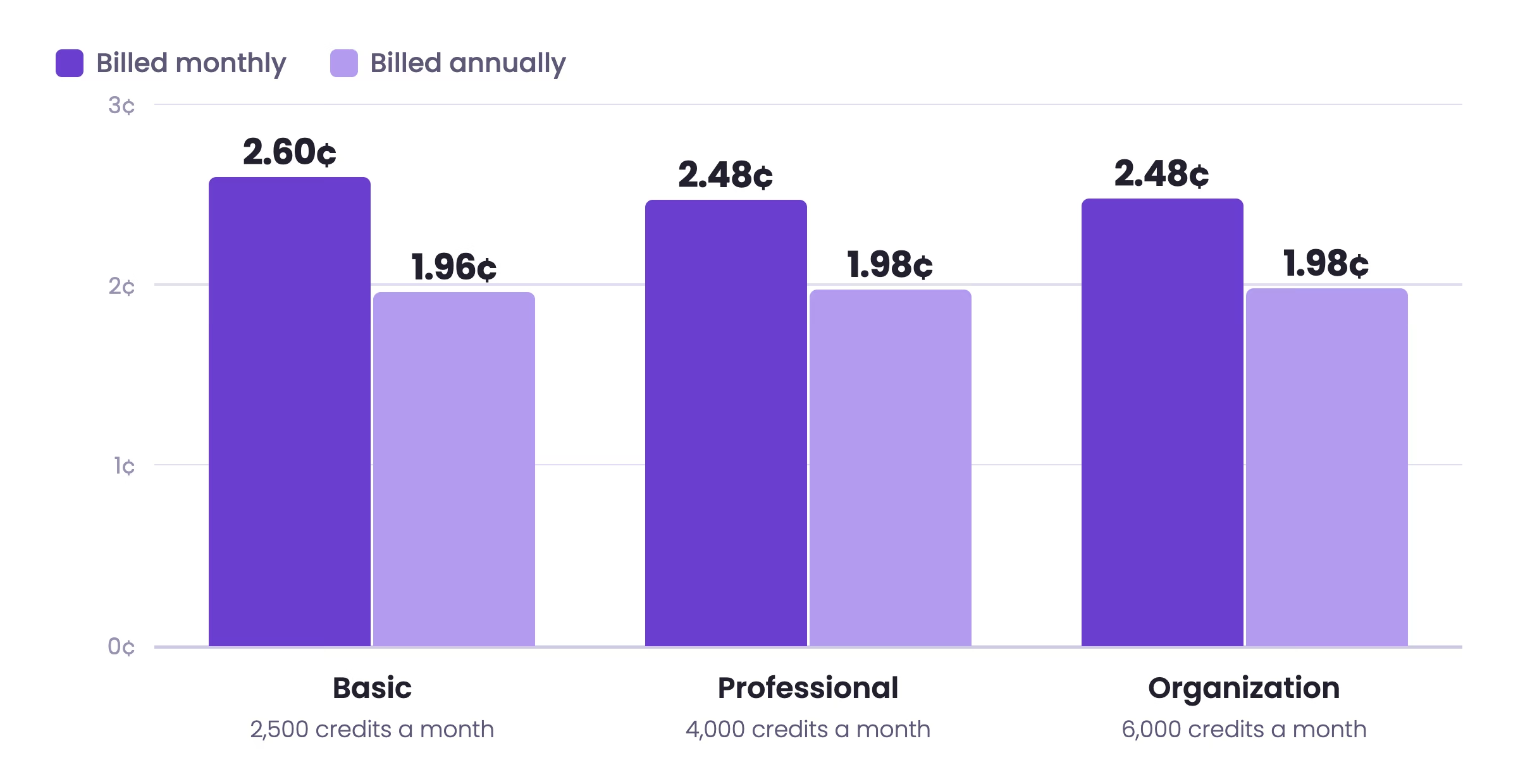
So the reason to move up a plan is never the data. Moving from Basic to Professional buys unlimited daily sends, unlimited mailboxes, A/Z testing, call recording and 250,000 more AI words a month. If your team only needs more emails, adding Basic seats gets you the same credit price as upgrading everyone.
The one lever that does change the price of data is billing term. Annual billing takes about a quarter off every credit on every plan.
What does Apollo cost for a real outbound program?
Our outbound lead generation services page publishes the full bill for 30,000 cold emails a month for one client. The data line in that bill is 45,000 leads. If you bought those 45,000 emails through Apollo at 1 credit each, here is what it would take on each plan.
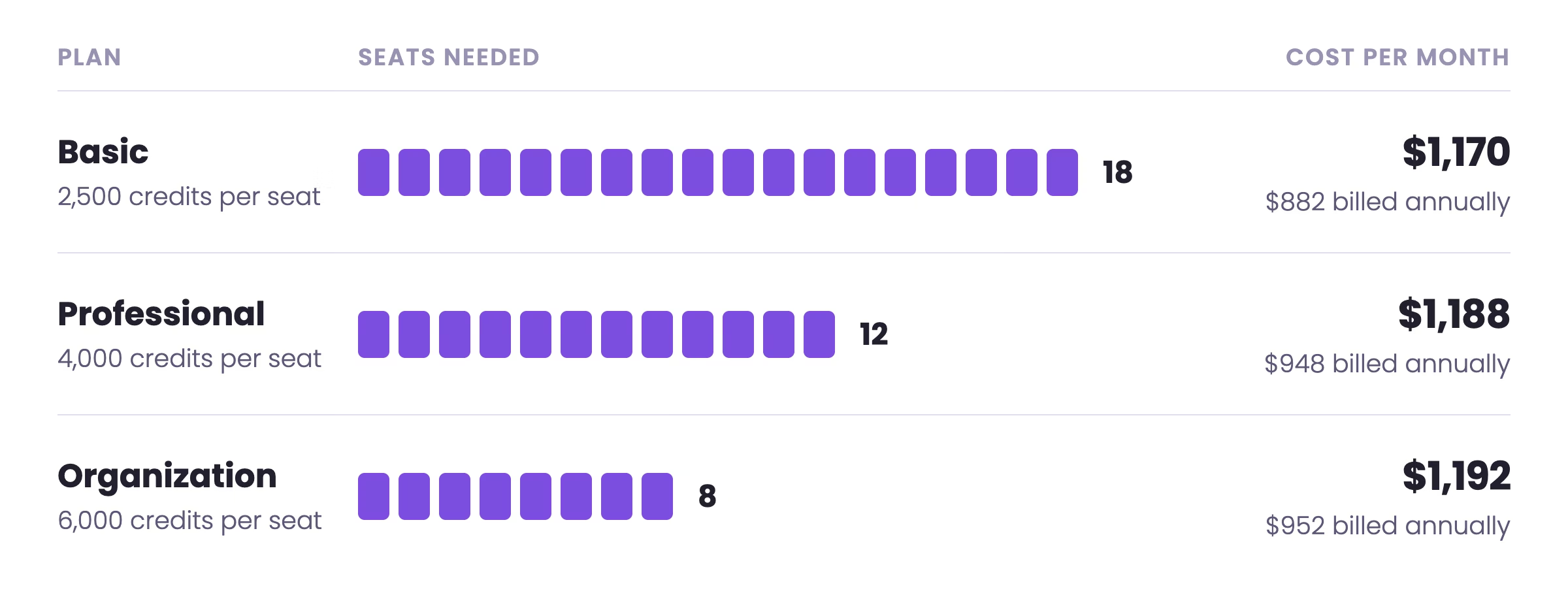
| Plan | Seats needed | Credits you get | Billed monthly | Billed annually |
|---|---|---|---|---|
| Basic | 18 | 45,000 | $1,170 | $882 |
| Professional | 12 | 48,000 | $1,188 | $948 |
| Organization | 8 | 48,000 | $1,192 | $952 |
How the Apollo line compares with the rest of the bill
On the same service page, the data for this month costs about $450 all in, at roughly one cent a lead, and verification of the 45,000 leads costs about $500. Apollo lands at $882 to $1,192 for the data alone, before any verification. For a team sending at this volume, data is one of the biggest lines in the budget, larger than the sequencing software at $50 to $150 a month.
The numbers assume 1 credit per email. If you run Apollo's email waterfall, which checks other vendors when Apollo has no match, the docs put typical usage at 1 to 4 credits, so the real bill can be higher.
Work out your own credit budget
Swap in your own volumes. The formula below is the one we used for the table.
Contacts to reach per month           = C
Share you also want a phone number for = P   (0.2 means 20%)

Credits needed per month = C x 1  +  C x P x 8

Seats needed = credits needed / credits per seat, rounded up
   Basic 2,500   Professional 4,000   Organization 6,000 (minimum 3 seats)

Monthly bill = seats x price per seat
   Monthly billing: Basic $65   Professional $99   Organization $149
   Annual billing:  Basic $49   Professional $79   Organization $119

Example: 10,000 contacts, 20% with phones
   10,000 + 16,000 = 26,000 credits
   Basic: 11 seats x $65 = $715 a month
Phones move the number more than anything else. In the example, 2,000 phone numbers cost 16,000 credits, more than the 10,000 emails.
Is Apollo monthly or annual billing better?
Annual billing is 24% cheaper, and it is the better deal once you know your volume. On annual billing a Basic seat gets its 30,000 credits for the year upfront, so a team can reveal a large list in one month without buying add-ons.
The catch is flexibility. You can switch from monthly to annual at any time, and Apollo credits what you already paid. Going the other way means canceling and waiting for the annual term to run out, and mid-term downgrades on annual plans are not allowed. Monthly downgrades take effect immediately with no refund for the rest of the cycle.
Our rule for a new tool: run one or two months on monthly billing, measure how many credits the team actually burns, then move to annual at that seat count.
Which Apollo plan should you choose?
Pick the plan by the features your heaviest user needs, then add seats for data, because every seat has to be on the same plan and credits cost the same on all of them.
| Your situation | Plan | Why |
|---|---|---|
| Testing the data before you buy | Free | 75 credits a month is enough to check match rates on your ICP |
| One or two reps sending under 250 emails a day each | Basic | Cheapest seat, same credit price as the higher plans |
| Full-time reps running several mailboxes each | Professional | Unlimited sends and mailboxes, A/Z testing, call recording |
| A team of three or more that needs SSO or custom reports | Organization | Security and reporting features, 15 SMTP mailboxes per user |
| You mostly need mobile numbers | Test before committing | At 8 credits a number, phones eat a plan fast |
Where Apollo is weaker
Apollo is good value for emails and expensive for phones. At 8 credits a number, a list where you want every mobile costs nine times as much as the same list with emails only. The same-plan rule also hurts mixed teams, and credits that expire every cycle punish uneven months.
If those limits matter, compare it with the tools built around them. We cover that in Apollo alternatives, Clay vs Apollo and Apollo vs ZoomInfo. For the Clay side of the comparison, see Clay pricing or try Clay.
Skip the seat math
Reachly runs the data, the sending infrastructure and the replies for you on one flat monthly retainer, and hands you qualified meetings.
See how it works
FAQ
Is Apollo AI free to use?
Yes, in a limited way. The Free plan includes 5,000 AI writing words a month and AI research runs are charged at 1 credit each, so they come out of the same 75 monthly credits. Paid plans raise the writing allowance to 250,000 words on Basic, 800,000 on Professional and 1,000,000 on Organization.
Can I get Apollo for free?
You can use the Free plan with no time limit. There is also a free trial of the paid plans that includes 75 credits and most features of the plan you pick; when it ends, the account drops back to Free unless you upgrade.
How much does Apollo AI cost per month?
There is no separate AI charge on the standard plans. AI writing is included up to each plan's word limit, AI research uses credits, and Organization lets you plug in your own LLM API key so AI usage is billed by your model provider instead.
Is Apollo AI worth it?
It is worth it for teams that mainly need verified emails and a sequencer in one place, because a credit costs about 2 cents on annual billing. It is weaker for phone-heavy calling teams. Apollo's pricing page cites a 4.7 out of 5 rating from 9,690 reviews, which says more about ease of use than about data quality in your specific market, so test match rates on your own ICP.
Why was Apollo shut down?
The Apollo that shut down was Apollo for Reddit, a third-party Reddit app that closed on June 30, 2023 after Reddit started charging for API access. It has nothing to do with Apollo.io, the sales platform, which is still running.
What is Apollo AI used for?
Sales teams use it to find contacts, reveal emails and phone numbers, write and send sequences, and research accounts before outreach. Apollo says more than 600,000 companies use the platform.