
B2B demand generation strategy for 2026: use buying-group targeting, intent signals, proof-led messaging, and multichannel outreach.
A B2B demand generation strategy in 2026 needs four parts: buying-group coverage, signal-based targeting, proof-led messaging, and coordinated cold email, LinkedIn, cold calling. Buyers now use an average of 10 sales channels, according to McKinsey’s 2025 report, so single-channel programs break long before pipeline does.
That shift changes the job. You are not trying to push one lead through one funnel anymore. You are trying to create demand across several people, several touchpoints, and a buying window that often starts before anyone fills a form.
What changed in B2B demand generation strategy in 2026?
The old model assumed one champion, one form fill, and a clean handoff to sales. That is not how buyers behave now. They research alone, compare vendors across multiple channels, and bring coworkers into the deal before a rep ever sees the account.
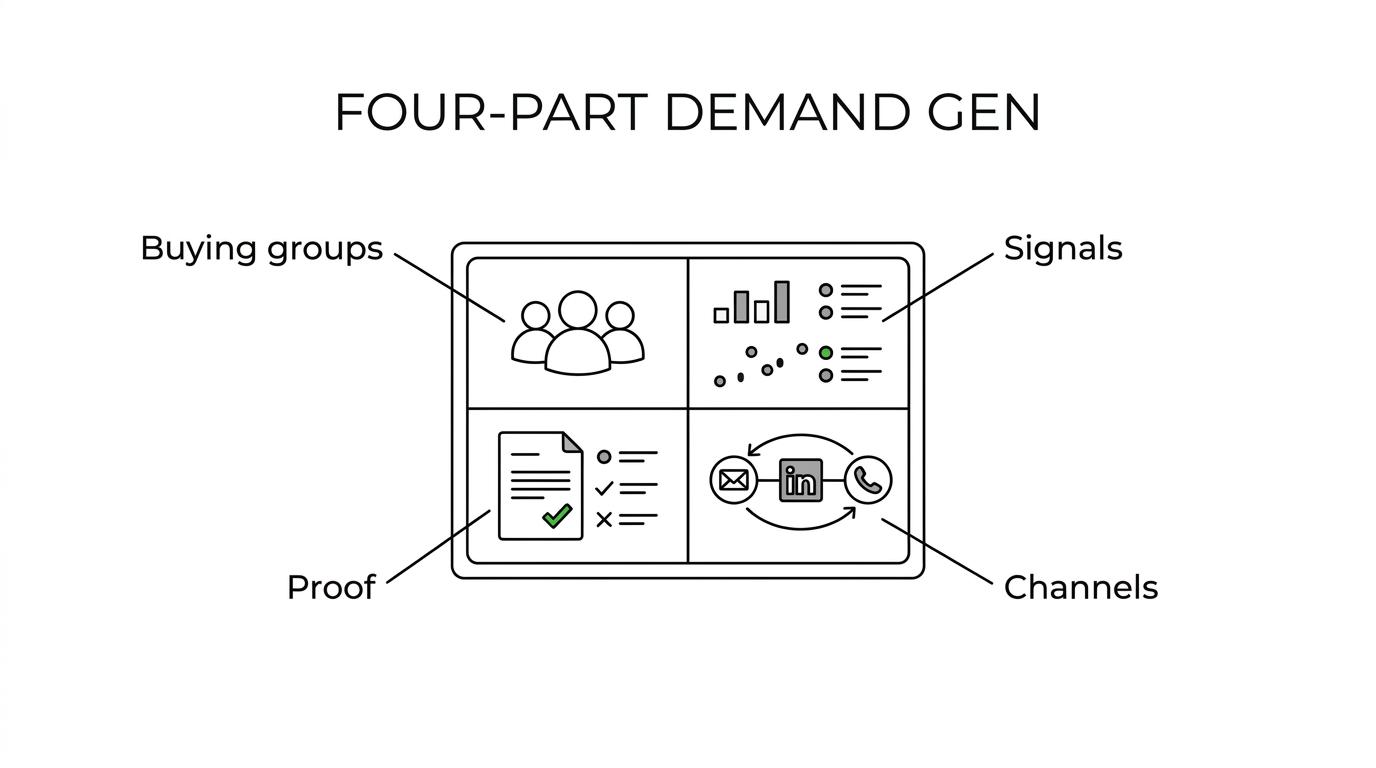
The practical result is simple. Demand generation now depends less on volume and more on timing, trust, and message consistency.
[markdown] | Source | Year | What changed | What it means for your demand gen | | --- | --- | --- | --- | | McKinsey | 2025 | Decision-makers use an average of 10 sales channels | Your message needs to stay consistent across more than one channel | | McKinsey | 2025 | More than half said they may switch suppliers after a poor cross-channel experience | Broken handoffs kill demand you already paid to create | | Gartner | 2026 | 67% of B2B buyers prefer a rep-free experience | Your proof and clarity need to carry more of the sale | | Gartner | 2026 | 45% used AI during a recent purchase | Buyers compare claims faster, so vague copy gets filtered out | | LinkedIn | 2025 | Almost 70% of marketers increased brand awareness budget | Trust-building content is not a side project anymore | | Forrester | 2025 | Demand programs need to focus on buying groups, not just individuals | One contact in CRM does not equal demand in-market | [/markdown]If your current plan is one paid campaign, one nurture track, and one SDR sequence, you are probably measuring activity while the buyer is moving somewhere else.
Why do buying groups change B2B demand generation strategy?
A real B2B deal rarely sits with one person. You may get interest from a head of marketing, then lose the deal because finance, operations, or a regional lead never bought into the change.
That is why lead-centric demand gen underreports reality. It tells you one person engaged. It does not tell you whether the account has enough internal support to move.
Your strategy should map roles before you write copy. In practice, that means building messaging for the people who feel the pain, the people who own the budget, and the people who fear implementation risk.
A simple buying-group map usually starts here:
- Economic buyer: payback period, risk, contract size
- Functional owner: workflow impact, team capacity, time to value
- User or operator: daily friction, manual work, missed output
- short internal proof points
- role-specific objections
This is where value clarity matters. If every persona gets the same pitch, none of them feels like you wrote it for their job.
How should you build a signal-based demand generation strategy?
Signal-based demand generation starts with a harder question than “who fits our ICP?” It asks, “who fits our ICP and has a reason to care this month?”
That second part is where most teams miss. A clean TAM is useful. A clean TAM with current intent is what creates replies.
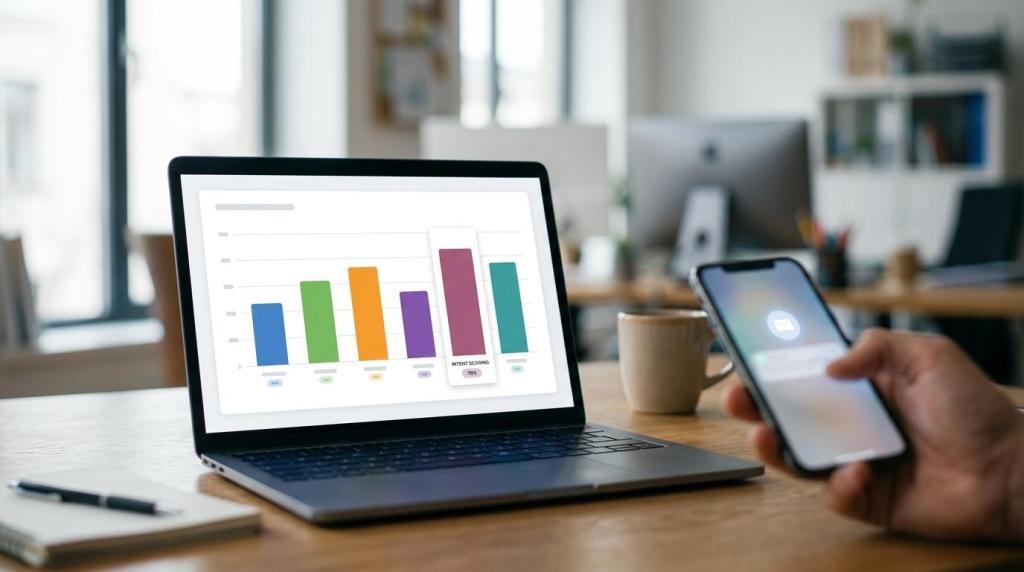
At Reachly, signal-based outbound usually pulls from four buckets: company-level changes, website or behavior data, LinkedIn activity, and intent scoring. The point is not to pile up data. The point is to rank who gets contacted first.
A practical signal stack looks like this:
- Company-level signals: funding, hiring, leadership changes, tech stack changes, headcount growth, M and A
- Website signals: visitor ID, traffic decline, ranking gaps
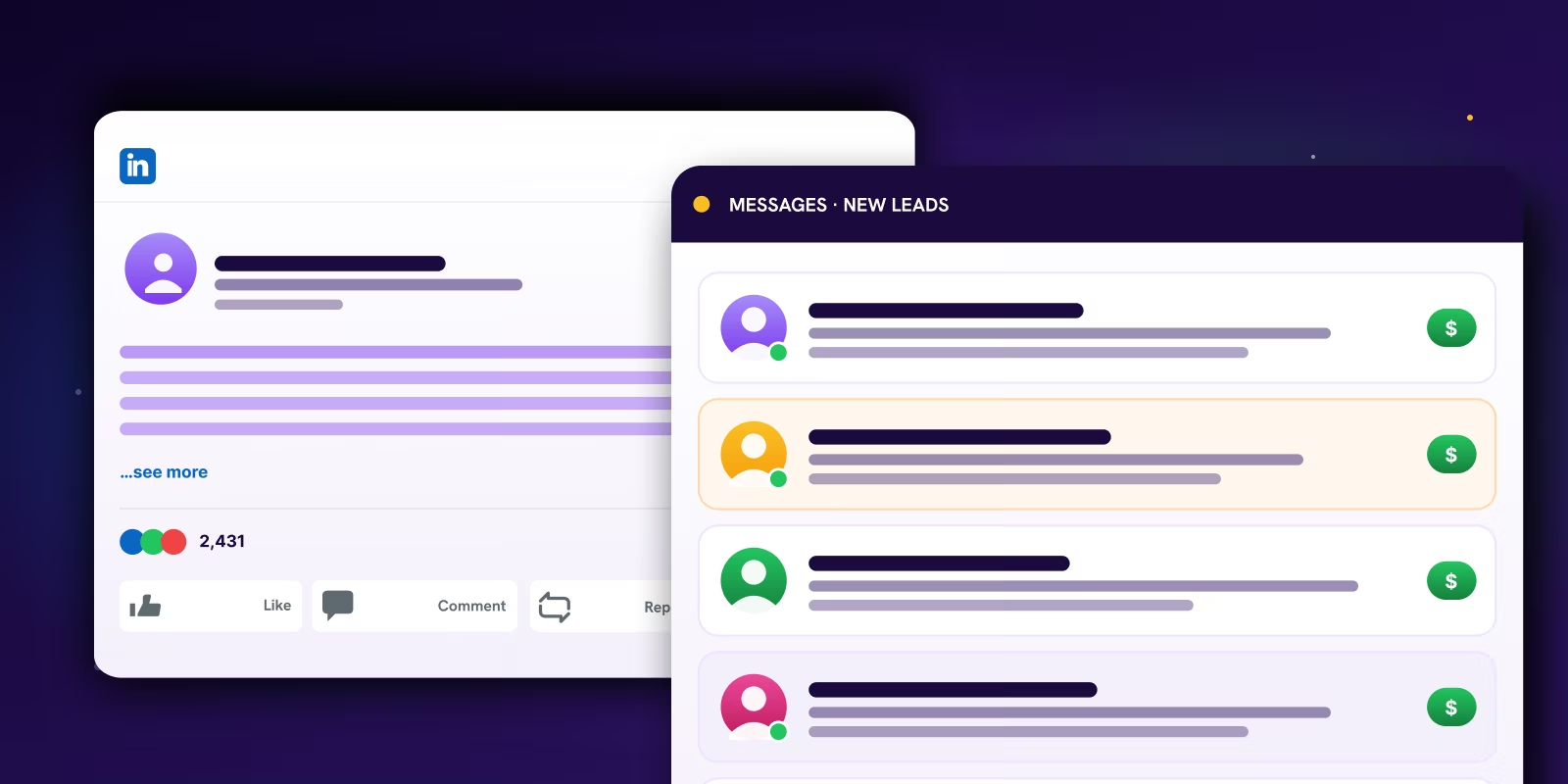
- LinkedIn signals: engagement, job changes
- Intent scoring: funding 30%, headcount growth 25%, tech stack change 20%
Signals also expire fast. In most markets, shelf life is 2 to 4 weeks before someone else reaches the same account.
Thibault Garcia, founder of Reachly, puts it bluntly: “Hiring is the signal I trust most. A company spending money on headcount is a company that is growing, and growth is what creates the problem we solve.”
That is the core mechanism. You are not creating interest out of thin air. You are showing up when there is already movement.
What channels belong in a B2B demand generation program?
You do not need every channel. You need the right channels doing different jobs.
Cold email is still the fastest way to test angle, audience, and offer. LinkedIn adds trust and reaches adjacent buying-group members. Cold calling is what you use after interest exists, or when you need to route to the right owner.
That is why Reachly’s stack stays fixed: cold email, LinkedIn, cold calling. Each channel covers a different gap in the buying process, and each one has a different cost.
[markdown] | Channel | What it does in demand gen | Useful benchmark | Main cost | | --- | --- | --- | --- | | Cold email | Creates first replies and tests offer fast | Positive reply rate 10 to 20% is normal, 35 to 40% is very good | 14 to 30 days of warmup, domain setup, list verification | | LinkedIn | Builds familiarity and reaches adjacent buying-group members | 25% acceptance is a good benchmark, one Thailand pilot hit 35% | Operator time and strict touch limits across 2 to 4 weeks | | Cold calling | Converts warm interest and finds the right stakeholder | Best used after email and LinkedIn, not as a volume channel | Rep time and tighter list quality requirements | [/markdown]If you want one place to see how this stack fits into a full outbound system, start with Reachly’s outbound lead generation services and LinkedIn outreach agency pages.
How do you write proof-driven messaging for B2B demand generation?
Proof beats polish. Buyers do not need a clever opener. They need a reason to believe you are relevant, credible, and worth replying to.
That usually means four things in the first message: a real trigger, a clear problem, a concrete offer, and a low-friction ask. If one of those is missing, reply rates drop.
At Reachly, the goal of a cold email is a reply, not a meeting. No reply, no meeting. That changes the CTA, the email length, and the offer.
Thibault Garcia says it best: “Every client gets the same question before we write a single email. If you had thirty seconds with your dream client, what would you offer them? If the answer takes longer than thirty seconds, we do not have an offer yet.”
The copy itself stays short. In 2026, 70 to 80 words is the working range. No links in the first email. No wall of text. No calendar link asking a stranger for half an hour.
A few patterns keep working:
- Lead with proof: a sample, audit, benchmark, or specific result
- Use a soft ask: ask permission to send something useful
- no links in email one
- direct, question-based copy
You can see this in Reachly’s results with Primal, where the campaign produced 85+ SQLs in 6 months, cut CAC by 35%, and returned 4.57x ROI. You also see it in The Great Room, where face-to-face meetings went from about 2 per quarter to about 2 per month, with zero added headcount and about $250K in closed contract value.
The offer is the lever. A Series A client sending 20,000 to 30,000 emails a month moved reply rate from 0.5% to 1.6% after switching to direct, question-based copy, a lead magnet, and a stronger offer. Same channel. Better ask.
What does a multichannel B2B demand generation sequence look like?
A working demand generation sequence in 2026 is shorter than most teams think. Long email chains burn domain reputation and hide a weak first message.
The email piece should usually be two sends, 6 to 7 days apart. LinkedIn and cold calling carry the rest of the touch pattern.
[markdown] | Day | Touch | Why it exists | Cost or risk | | --- | --- | --- | --- | | 1 | LinkedIn profile visit, connection request, Email #1 | Puts your name in two places at once | Requires warmed domains and verified data | | 6 or 7 | Email #2 with a new angle | Tests whether the first angle or the offer was weak | Too many follow-ups hurt reply quality | | 8 to 10 | LinkedIn message after acceptance | Adds context without crowding the inbox | Keep it short and lowercase | | 12 to 14 | Cold call plus final nudge | Routes interest and catches warm accounts | Best on smaller, higher-fit lists | [/markdown]Two technical rules matter here.
First, every list older than 3 months gets re-validated before send. Tools like ZeroBounce and MillionVerifier are cheaper than a damaged domain.
Second, warmup is not optional. The floor is 14 to 30 days, and 30 days is safer because Google now adds a yellow banner to mail from domains younger than 30 days.
If you are building the stack yourself, Reachly’s outbound tools page is a good place to compare what belongs in the workflow.
What should you measure in a B2B demand generation strategy?
If you only measure form fills or meetings booked, you diagnose too late. Demand gen needs leading indicators.
Start with inbox health and account engagement. Then move down to qualified meetings and pipeline.
The core scorecard usually includes these numbers:
- Bounce rate: under 3%
- Deliverability score: above 97%
- LinkedIn acceptance: 25% is a solid benchmark
- Positive reply rate: 10 to 20% is normal, 35 to 40% is very good
One underrated metric is out-of-office replies. They prove you are landing in the inbox, even when the recipient is unavailable.
When a campaign hits 0% replies, diagnose in this order: infrastructure, subject line, email length, tone, offer. Most teams rewrite copy first because it is visible. That is usually the wrong first move.
When does this B2B demand generation strategy fail?
It fails when the market is too small, the offer is weak, or the economics do not work.
If your average contract value is under $5,000, founder-led outreach usually makes more sense than building full infrastructure. If you do not have product-market fit, outbound is still a gamble. If your TAM is tiny, automation burns the list faster than it creates pipeline.
A few cases should slow you down:
- low ACV offers
- no clear proof or case studies
- unclear handoff between marketing and sales
- Tiny TAM: founder outreach beats automation
- No process: outbound multiplies confusion
- Weak offer: volume just creates more silence
Demand generation is not a replacement for product-market fit. It is a way to put a good offer in front of the right accounts while the signal is still fresh.
What should you do next if your B2B demand generation strategy is flat?
If your team is sending volume with no signal, collecting leads with no buying-group coverage, or running disconnected channel tests, fix the system before you add more spend.
Reachly has served 50+ B2B clients, run 400+ campaigns, generated $3M+ in pipeline, and is rated 4.9 by 50+ leaders. If you want a done-for-you system built around signal-based targeting, multichannel outreach, reply handling, and appointment setting, book the meeting through Reachly’s outbound lead generation services page or pressure-test the numbers with the ROI calculator.
The short version is this: B2B demand generation in 2026 works when you match real buying signals with proof-led messaging across cold email, LinkedIn, cold calling. It gets weaker when you rely on one channel, one lead, or one generic CTA.
Key findings: buying groups matter more than single leads, omnichannel interaction is now buyer behavior, signals expire in 2 to 4 weeks, and the offer still decides whether demand turns into pipeline.