


Apollo pricing starts at $49/seat, but real cost depends on credits, phones, and overflow. See what usable contacts truly cost in 2026.
Apollo starts at $49 per seat per month on annual billing, or $65 on monthly billing, but that is not the number that decides whether it is cheap. The real number is cost per usable contact. Based on Apollo’s public pricing page checked October 4, 2026, plus Reachly’s verified plan and credit math, Apollo lands at roughly 1.96 to 2.60 cents per credit before overflow usage, with verified phone numbers costing 8 credits each.
That is why Apollo often looks cheaper on the pricing page than it does inside a working outbound motion. If you mostly need verified emails, it stays inexpensive. If you need phones, waterfall enrichment, or extra credits every month, the bill climbs fast.
What does Apollo cost before you use any extra credits?
Apollo’s paid plans are Basic, Professional, and Organization. The list prices below come from Apollo’s public pricing page, checked October 4, 2026. Reachly also verified the included monthly credit figures used in the cost calculations.
[markdown] | Apollo plan | Annual billing | Monthly billing | Minimum seats | Included monthly credits per seat | | --- | ---: | ---: | ---: | ---: | | Basic | $49 | $65 | 1 | 2,500 | | Professional | $79 | $99 | 1 | 4,000 | | Organization | $119 | $149 | 3 | 6,000 | [/markdown]The first thing to notice is that Apollo does not let you mix plans inside one account. All seats sit on the same plan. On Organization, you also have a 3-seat minimum, so your real starting point is $357 per month on annual billing, or $447 month to month.
The second thing to notice is that credits are pooled across the team. That helps if one rep burns more credits than another, but it also makes usage harder to spot if nobody is checking the account closely.
After the seat price, three rules matter more than most buyers expect:
- Credits expire each billing cycle: unused credits do not roll over.
- All seats share one plan: you cannot put one user on Basic and another on Professional.
- Add-on credits renew automatically: if you do not remove them, they keep billing.
How much does an Apollo credit really cost in 2026?
This is where Apollo pricing gets clearer. If you divide seat price by included credits, the plan itself barely changes your per-credit cost. The billing term changes it more than the plan does.
Reachly’s verified math puts Apollo’s effective per-credit cost in a tight band. On annual billing, it sits between 1.96 and 1.98 cents. On monthly billing, it sits between 2.48 and 2.60 cents.
[markdown] | Apollo plan | Cost per credit, annual billing | Cost per credit, monthly billing | | --- | ---: | ---: | | Basic | 1.96 cents | 2.60 cents | | Professional | 1.98 cents | 2.48 cents | | Organization | 1.98 cents | 2.48 cents | [/markdown]If you came here asking how much Apollo costs, this is the short answer that matters. Apollo is not materially cheaper per credit on higher plans. You are mostly paying for more included credits, more seats, and plan features, not for cheaper unit economics.
That matters when you compare Apollo to the way your team actually works. If your reps burn through credits every month and you buy extras anyway, annual billing is usually the cheaper move. If you are still testing whether Apollo will become a core data source, monthly billing buys flexibility, but every contact costs more.
What does one exported contact cost on each Apollo plan?
Apollo says a verified email costs 1 credit, and it does not charge more than 1 credit per contact for email. Apollo also says a verified phone number costs 8 credits. That one rule changes how you should think about Apollo.io pricing.
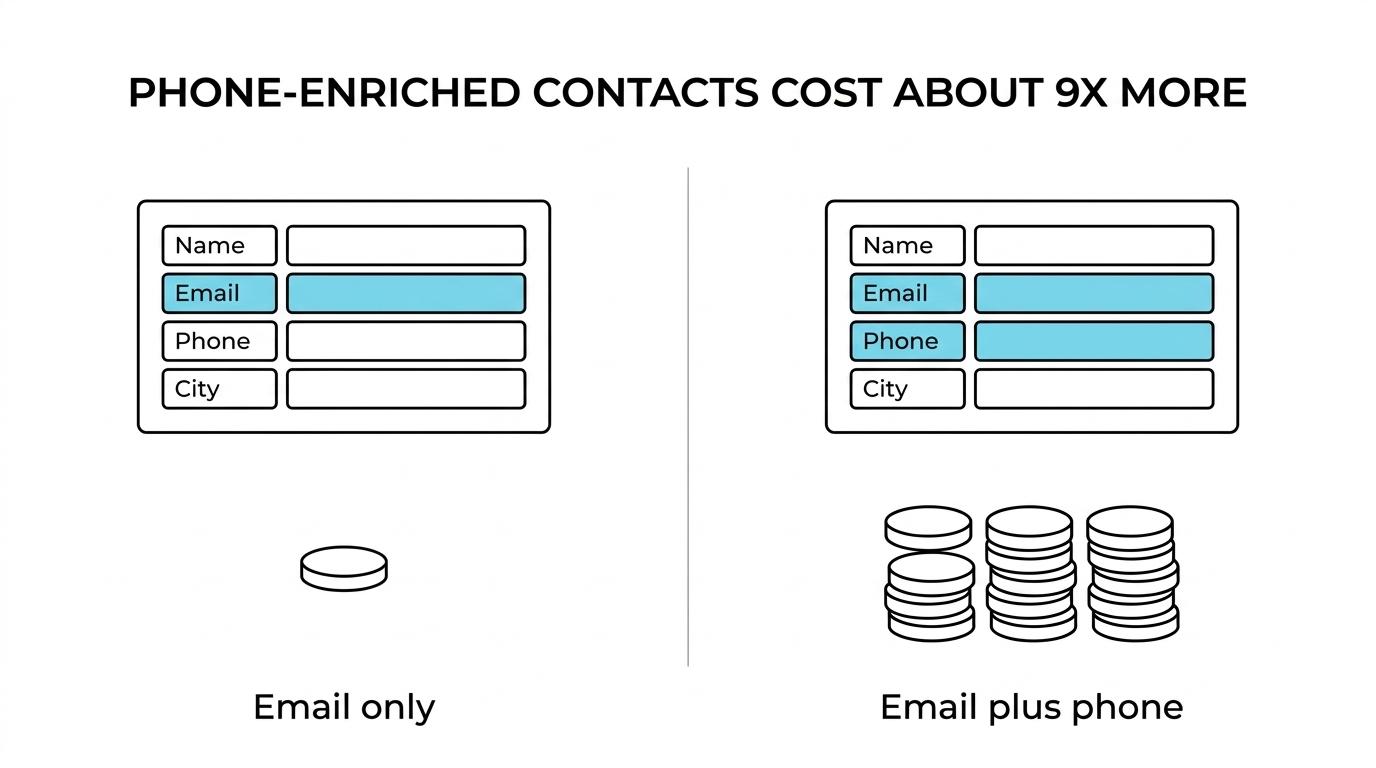
If you export one contact with a verified email only, your effective unit cost matches the per-credit number above. If you export one contact with both a verified email and a verified phone, your cost is 9 credits.
[markdown] | Apollo plan | Email-only contact, annual billing | Email-only contact, monthly billing | Email + phone contact, annual billing | Email + phone contact, monthly billing | | --- | ---: | ---: | ---: | ---: | | Basic | 1.96 cents | 2.60 cents | 17.64 cents | 23.40 cents | | Professional | 1.98 cents | 2.48 cents | 17.78 cents | 22.28 cents | | Organization | 1.98 cents | 2.48 cents | 17.85 cents | 22.35 cents | [/markdown]That is the cleanest way to look at Apollo credits cost. Email-heavy outbound is cheap. Phone-heavy outbound is not. The difference is not small. One phone-enriched record costs about the same as eight extra email records.
There is one caveat. This math assumes the contact is actually usable once exported. It does not cover stale data, missing fields, or the extra work of repairing lists later.
When does Apollo pricing jump above the list price?
It jumps when your workflow stops being email-first.
Phone lookup is the biggest cost driver. A team that wants direct dials for every contact will burn credits far faster than a team that only needs verified emails. Apollo’s own docs also show credit usage for dialer activity, including connected US and international calls in 30-second increments on the relevant plans.
Waterfall enrichment is the second watchout. Apollo’s docs and Reachly’s verified usage notes show that email waterfall can use 1 to 4 credits in typical cases, with higher usage possible. That means your real cost per usable email can move above 1 credit per contact when Apollo has to go outside its own match.
A few cost traps show up repeatedly once teams are live in the product:
- unused credits dying at renewal
- phone lookups consuming 8 credits each
- dialer usage burning credits in 30-second blocks
- add-on credits billing again until removed
The cheap-looking seat price usually survives only when the workflow stays simple. Build list, reveal email, send.
That split between simple email outreach and a more layered sales motion is also why We Are VOIP, in its review of top 3CX integrations for SMB teams, emphasizes how quickly reporting and rep workflows get more complex once calling tools, CRM data, and outreach systems all have to work together.
Where did Apollo data stop being enough for us?
Apollo is good value as a first-pass database. We use it. We do not treat it as the only source.
Across 400+ campaigns, the breaking point has been easy to spot. Apollo stops being enough when the segment needs better coverage or better freshness than Apollo alone can give. That shows up first on niche markets, international coverage, senior contacts, and phone-heavy lists.
At Reachly, that is the point where Apollo gets pushed into a waterfall with other sources. We use tools like Clay, Apollo, LinkedIn Sales Navigator, Icypeas, LeadMagic, BetterContact, ZeroBounce, and MillionVerifier because one provider rarely gives the match rate and verification quality a live campaign needs by itself.
Thibault Garcia, founder of Reachly, puts it plainly: “Cheap data is the most expensive thing in outbound. You pay for it later in bounces, in burned domains, and in the three weeks you spend blaming your copy.”
That is the operational read on Apollo pricing. The platform is cheap when it carries the job by itself. It gets more expensive when its gaps force a second provider into the process.
Which Apollo plan fits the way you prospect?
The right plan depends less on team size than on contact type. If you mainly need verified business emails, the lower plans can work well. If you need phones and heavier exports, the plan name matters less than your actual credit burn.
[markdown] | Your workflow | Best Apollo fit | Why it fits | Watchout | | --- | --- | --- | --- | | Solo founder or one rep, email-first | Basic | Lowest seat cost, enough credits for testing | Monthly billing gets expensive fast if you keep buying add-ons | | Small team, regular email prospecting | Professional | More included credits, better buffer for pooled usage | Still not meaningfully cheaper per credit than Basic | | Team with multiple reps on one system | Organization | Shared credits and admin controls fit team use | 3-seat minimum raises the true starting cost | | Phone-first outbound | Apollo alone is usually not enough | Credits disappear fast on direct dials and dialer usage | Real bill often includes the whole stack | [/markdown]If you are choosing between plans, start from workflow, not feature comparison. Count how many verified emails you need, how many phones you need, and how often you run out of credits today. That gets you closer to the real number than the pricing page does.
When should you skip Apollo and look elsewhere?
If your outbound motion depends on direct dials, Apollo can still be part of the stack, but it usually should not be the whole stack. Eight-credit phone reveals change the math too much.
If your TAM is tiny and each bad record hurts, the cheapest database is often the wrong database. You need higher confidence, not more raw volume.
Apollo becomes a weaker fit in a few specific cases:
- Phone-first teams: direct dials eat credits quickly.
- Small, high-value TAMs: stale data costs more than the seat fee.
- Coverage gaps outside core segments: you end up paying for a second provider anyway.
If you are already comparing tools, read our breakdown of Apollo alternatives after this, then compare it with our post on Clay pricing. Those two pages answer the next question buyers usually have once price alone stops being enough.
What should you do next if Apollo pricing looks cheap on paper?
If you want a simple answer, here it is. Apollo is a good buy for email-heavy outbound. It gets expensive when your team needs verified phones, overflow credits, or frequent waterfall enrichment. That is why the real question is not “how much does Apollo cost,” but “how much does one usable contact cost in my motion?”
If you want help mapping that before you buy, look at Reachly’s outbound tools stack and our outbound lead generation services. If you are already running outbound and want the data layer, infrastructure, and targeting tightened up around real signals, book the meeting with Reachly.
Key findings recap:
- Apollo’s list price starts low: $49 per seat annually for Basic, $65 month to month.
- Billing term matters more than plan tier: annual pricing lands around 1.96 to 1.98 cents per credit, monthly around 2.48 to 2.60 cents.
- Phone data changes the economics: one verified phone number costs 8 credits.
- Apollo is strongest for email-first outbound: once data quality forces a waterfall, Apollo is no longer the whole cost.