
Discovery call questions for outbound meetings: start with context, uncover pain, then qualify timing and decision process in 15 minutes.
The best discovery call questions for outbound-booked meetings fit inside 15 minutes. Start with 2 context questions, move to 3 questions on current process and pain, then finish with timing and decision process. If you open with budget, authority, and a canned checklist, you burn trust before the real conversation starts.
That happens a lot with outbound. A prospect replied to a cold email, LinkedIn message, or cold calling touch because the message matched a moment. They did not show up asking to be interrogated.
Across 400+ campaigns, 2,500+ calls booked, and $3M+ in pipeline generated, the pattern is stable. The first few questions decide whether the meeting becomes a real opportunity or a polite dead end.
Why do discovery call questions need to change for outbound meetings?
Outbound meetings start colder than inbound ones. Even when the reply looks warm, the buyer is still asking a quiet question in their head: was that message lucky, or do you actually get my situation?
That is why generic discovery breaks here. If your first move is, “What keeps you up at night?” or “Can you tell me about your business?” you sound like you did no work before showing up.
This is also where the outside guidance lines up with what we see in live campaigns. Salesforce frames discovery around the prospect’s status quo versus ideal state. HubSpot pushes open-ended questions, timing, decision process, and clear next steps. Our version is simpler. Start from the signal or context point that got the meeting, then earn the right to ask harder questions.
If your outbound is already producing meetings through B2B appointment setting services, this is the layer that decides whether those meetings turn into pipeline.
What order should discovery call questions follow on an outbound meeting?
You do not need 20 questions. You need the right 6 to 8, in the right order.
The flow below is the one we keep coming back to because it mirrors how trust gets built on a cold first meeting.
[markdown] | Stage of the call | Example question | What you are testing | Cost of getting it wrong | | --- | --- | --- | --- | | Context | “I reached out because you’re hiring 3 AEs. Is that tied to a new revenue push?” | Whether the signal was real | You sound random fast | | Current process | “How are you handling this today?” | Status quo | You pitch into the wrong setup | | Pain | “Where does that process break?” | Real friction | You get surface-level interest only | | Impact | “If nothing changes this quarter, what gets missed?” | Business weight | You chase nice-to-have deals | | Timing | “Is this active now, or more of a later project?” | Urgency | You force demos for next year problems | | Decision process | “If this looked useful, who else would weigh in?” | Buying path | You book the wrong next meeting | | Next step | “Would a working session make sense, or should we leave it here?” | Fit and momentum | You create fake pipeline | [/markdown]The order matters because each question earns the next one. Context lowers resistance. Current process gives you the status quo. Pain and impact tell you whether the issue has enough weight to keep going.
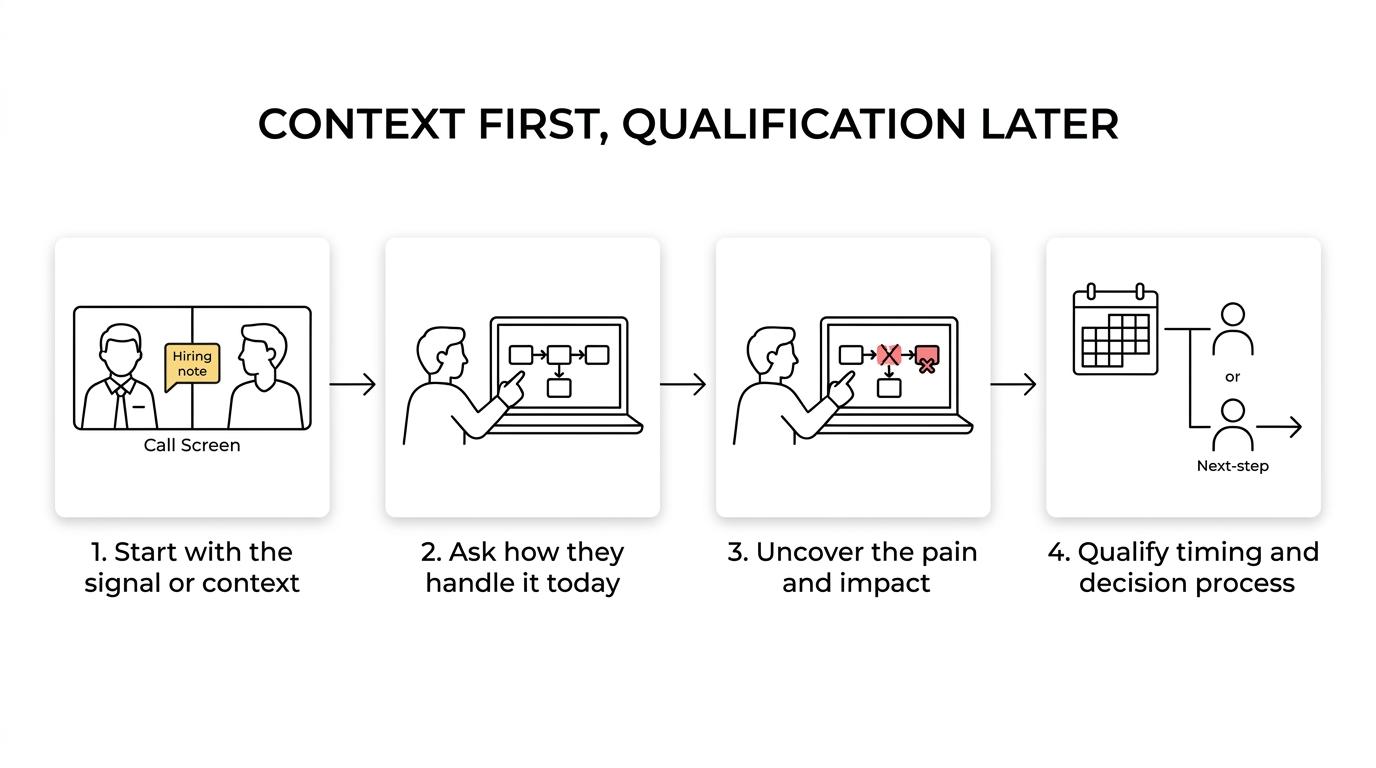
Once that is clear, timing and decision process feel normal. Asked too early, they feel like qualification theater.
Which discovery call questions work best in the first five minutes?
The first five minutes should sound like a smart continuation of the outbound message. Not a fresh script. If the meeting came from a hiring signal, start there. If it came from a tech stack change, start there. If it came from website behavior or a leadership change, use that.
A good opener proves you know why you are talking. A bad opener makes the prospect repeat facts you could have checked in 60 seconds.
These are the first-minute questions we use most often:
- Signal check: “I reached out because you’re hiring SDRs. Is that tied to a push into a new segment?”
- current setup
- What changed: “What happened internally that made this worth looking at now?”
- friction point
- Success picture: “If this were fixed in the next 90 days, what would be different?”
Those work because they are open-ended without being vague. They give the buyer room to answer in their own language, and that language usually hands you the next two questions.
One more thing matters here. Do not stack questions back to back. Ask one, let them finish, then follow the thread that shows up.
How do you move from context to pain without sounding scripted?
This is where people start to sound robotic. They get one decent answer, then jump straight into a qualification form.
The fix is simple. Use the prospect’s last sentence as the bridge into the next question. If they say, “We’re growing fast and handoffs are messy,” your next question is not “What is your budget?” It is “Where do those handoffs usually break?”
A few lines do this well:
- “How are you handling that today?”
- “What part of that process causes the most friction?”
- “When that slips, what gets hit first?”
- “What have you tried already?”
That is the cleanest route from context into pain. It also gets you the status quo versus ideal state view that Salesforce talks about, without saying it out loud like a framework.
You are not trying to sound clever here. You are trying to get a real answer on what is broken, how the team handles it today, and what happens if nothing changes.
What discovery call questions should you avoid on a first outbound meeting?
Some questions are not wrong. They are just too early.
Budget is the easy example. On a cold first meeting, budget questions often get bad answers because the buyer has not decided whether the problem is worth solving with you yet. Ask it before pain is clear, and you invite a brush-off.
The same goes for questions the buyer expects you to know already. “How many employees do you have?” or “What does your company do?” tells them you came in empty-handed. HubSpot is right on this point. Buyers assume you already did basic homework.
These are the ones to keep off the opening part of the call:
- Too early: “What’s your budget for this?”
- authority checks
- Too lazy: “Can you walk me through what your company does?”
- website facts
- Too pushy: “Are you ready to book the next meeting today?”
There is another one worth killing. Do not ask five questions in a row without saying what you are hearing. A short recap like “got it, so the issue is less lead volume and more low-fit meetings” shows you are listening and keeps the conversation human.
How should you qualify timing and decision process on a 15-minute discovery call?
Once pain is clear, you can get direct. This is the part many reps either rush or avoid.
You need to know whether the issue is active now, whether there is a reason to change, and how a buying decision actually gets made. Not your internal CRM field version of that. The real version.
These questions work because they are specific but low-friction:
- “Is this a this-quarter issue, or something for later?”
- “What usually has to happen internally before you change a process like this?”
- “Who else would want to see this if it looked useful?”
- “Are you trying to fix this before a specific date?”
The goal here is not to trap the prospect. It is to leave with a shared next step, or to leave cleanly. That lines up with HubSpot’s view of a good discovery call outcome, and it matches what happens in practice.
If the answers are vague, that is still useful. Vague timing usually means low urgency. Vague decision process usually means the person is interested but not close enough to the problem.
When do these discovery call questions stop working?
Discovery questions do not fix a weak meeting source. If the offer is off, the list is off, or the signal is stale, the meeting will feel thin no matter how well you run it.
We have seen that on live outbound. A Series A client sending 20,000 to 30,000 emails a month moved reply rate from 0.5% to 1%, then up to 1.6% after switching to direct, question-based copy, a lead magnet, and a stronger offer. The offer was the lever. Better meetings started before the meeting itself.
This also does not need to become a formal process for every company. If your average contract value is under $5,000, or your market is tiny and account-led, a founder having a direct conversation often beats a layered discovery script. Same if you have not found product-market fit yet. In that case, your goal is learning, not qualification discipline.
A booked meeting is not proof of fit. It is proof that somebody was willing to reply.
What should you do next if your outbound meetings keep stalling?
If you are booking meetings but discovery goes nowhere, the fix is usually earlier in the chain. The offer might be weak. The signal may be too broad. The outbound copy may promise a conversation the product cannot support. That is why Reachly runs signal-based outbound across cold email, LinkedIn, cold calling, with targeting, reply handling, and meeting booking tied together in one system.
You can see how that looks in Primal, which generated 85+ SQLs in 6 months, and The Great Room, which went from 2 face-to-face meetings per quarter to 2 per month with zero added headcount. If you want help fixing the full chain, not just the script, start with Reachly’s outbound lead generation services or review the team’s approach to LinkedIn outreach. If you want a live teardown of your current first-meeting flow, book the meeting with Reachly.
Here is the short version. Good discovery call questions for outbound meetings start with context, move into current process and pain, then qualify timing and decision process once the buyer is engaged. If the meeting feels weak from minute one, check the offer and targeting before you rewrite the script.
Key findings from these discovery call questions:
- Start here: use the signal or context point that got the meeting
- open-ended questions beat checklist interrogation
- Ask later: timing, decision process, and budget only after pain is clear
- stop after 15 minutes with a shared next step or a clean disqualification
- Check upstream: weak meetings usually start with a weak offer, stale signals, or poor targeting