
Cold email is a one-to-one business email sent to someone who has never heard from you, written around a specific reason to contact them, with one ask: a reply. It is the email version of a cold call. Reachly runs cold email for B2B companies, and in our client campaigns each email is 60 to 80 words, carries no links, and goes out as a two-email sequence sent five to six days apart. This page covers what the term means, how a campaign works from list to booked meeting, the laws and inbox rules that apply, and what it costs to run.
Key Findings
- A cold email goes to one named person you have no prior relationship with, gives a reason tied to their role or company, and asks for a reply.
- Targeting and honesty separate it from spam: one recipient, a real sender with a real address, a relevant reason, and an easy way to opt out.
- Cold email is legal in the US under the CAN-SPAM Act, which covers business-to-business email too: honest headers and subject lines, a postal address, and opt-outs honored within 10 business days. Canada's CASL is stricter and needs consent, express or implied.
- Gmail asks every sender to keep spam complaints under 0.3%. Gmail and Outlook both require SPF, DKIM and DMARC from domains sending more than 5,000 messages a day.
- Reachly's working rules: 60 to 80 words, no links, two emails five to six days apart, bounce rate under 2%, and first qualified meetings in 5 to 7 weeks. The full method is on our agency service page.
- A 30,000-email month for one client runs on 72 domains and 180 mailboxes. Most of the cost sits in infrastructure and data, and the sending software is the cheapest line.
- Primal's campaigns averaged an 8% positive reply rate and produced 85+ sales qualified leads in six months.
What does cold email mean?
The word cold describes the relationship, not the tone. The person on the other end is not expecting you: they have not opted in, bought from you, or spoken to you before. The term comes from cold calling, and it works the same way. Once someone replies, the thread is warm, and every message after that is a conversation.
A message counts as a cold email when four things are true:
- No prior relationship. The recipient never subscribed, never bought, and never met you.
- One recipient. It is written to one named person in a specific role, even when software does the sending.
- A reason. Something about their company makes the message relevant now. Reachly calls that a buying signal: a new hire, a funding round, a jump in headcount.
- One ask. The goal of the first email is a reply. The meeting comes after.
Who sends cold email
Sales teams send most of it, to open conversations with accounts that fit their ideal customer profile. Founders use it to reach investors and first customers, recruiters use it to reach candidates, and job seekers use it to reach hiring managers directly. PR teams and SEO teams use it for press and link requests.
This page is written for the B2B sales use, because that is where the volume, the laws and the inbox rules bite hardest. The definition is the same when you write to a hiring manager, and the FAQ below covers the differences. For the sales version end to end, our best practices guide goes deeper on each step.
What a cold email looks like
Here is an example written for this page to the same rules Reachly uses in client campaigns. The trigger comes first, the body stays under 80 words, there are no links, and it closes on one question that is easy to answer.
Subject: your new Head of Growth

Hi Dana,

I see you just hired a Head of Growth. A new growth lead
usually inherits a pipeline target before the channels to
hit it are in place.

We build outbound for B2B teams in that spot: the lists, the
sending domains and the replies, so the new hire has
meetings to work with in their first two months.

Worth a short conversation, or is outbound already covered?

Thibault
Each line has one job. The first line proves the email was written to this person and names why now. The second line names a problem the reader probably has because of that trigger. The third says what we do in terms of their situation. The last line asks a question they can answer in one word, and it gives them a polite way to say no.
For 30 more, sorted by situation, see our cold email templates. The rules behind the length are in email length, and the subject line rules are in the subject lines guide.
How is cold email different from spam, email marketing and warm email?
The four get confused because they share an inbox. They differ on who the recipient is, why they are getting the message, and what the sender wants back.
| Cold email | Spam | Email marketing | Warm email | |
|---|---|---|---|---|
| Relationship | None yet | None, and none wanted | Subscriber or customer | Already in contact |
| Who gets it | One named person in a target role | Anyone with an address | Everyone on a list | One person you know |
| Why them | A reason tied to their role or company | No reason | They opted in | An ongoing conversation |
| Sender | A real person with a real name and address | Often hidden or faked | A brand | A person they recognize |
| Goal | A reply | A click or a sale | Clicks, purchases, retention | The next step |
| US legal basis | CAN-SPAM rules, no opt-in needed | Breaks CAN-SPAM | CAN-SPAM, usually with opt-in | CAN-SPAM if it promotes something |
The line that matters most in practice is the one between cold email and spam, and inbox providers draw it with complaint data. A message that enough recipients report gets treated as spam, however good its targeting was. That is why the infrastructure in the next section exists, and why our guide to avoiding the spam folder starts with the list rather than the copy.
How does cold email work, from list to booked meeting?
A single email is easy to write. A campaign is a system with six moving parts, and most of the work happens before the first message goes out. This is the order Reachly runs it in, with the timing from our client engagements.
Build the list around a signal
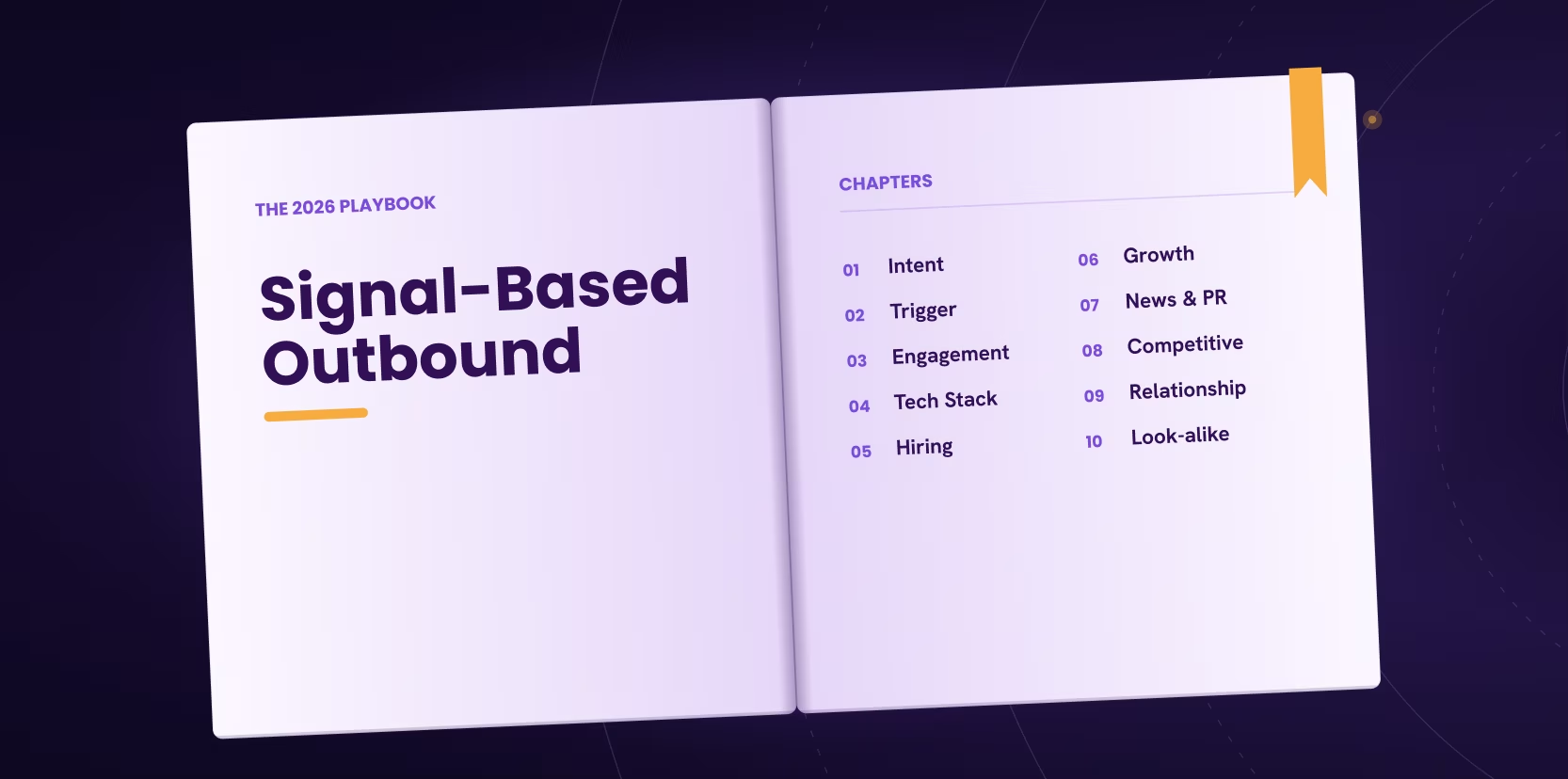
Every list starts with accounts, not contacts. We define the ideal customer profile, then filter for a live trigger, such as a new marketing hire, a funding round or falling organic traffic. The trigger becomes the first line of the email, so one list carries one signal. Our B2B buying signals guide ranks the signals that convert, and the signal-based outbound playbook shows how to turn each one into a campaign.
Verify every address
Every contact gets verified before it is loaded. We hold bounce rate under 2% and treat anything above 5% as a level that risks provider blocks, because bounces are one of the first things a mailbox provider reads. The process and the tools are in email verification.
Send from dedicated, authenticated domains
Outreach never goes out from the company's main domain. Reachly buys secondary domains, sets up SPF, DKIM and DMARC, and warms them for 4 weeks before real volume, so a bad week can never reach the domain your invoices and customer email depend on. The setup is in SPF, DKIM and DMARC setup, the timeline in how long to warm up a domain, and the rotation rules in inbox rotation.
Write one short email per signal
The email names the trigger first, stays between 60 and 80 words, carries no links and asks one question. Personalization means matching the message to the signal, which is covered in cold email personalization. The ask itself is the offer, and a weak offer sinks good copy; see offer examples.
Follow up once, in the same thread
Our client sequences run two emails, five to six days apart, while LinkedIn and the phone carry the other touches. Timing, wording and when to stop are in our cold email follow up guide.
Turn replies into meetings, then measure
A reply is the start of the sale, so every one gets triaged within the day: interested, not now, wrong person, or opt-out. Qualified replies become meetings, which is where the first ones land in weeks 5 to 7. Judge the campaign on positive reply rate rather than opens, and compare yours with the response rate benchmarks.
Is cold email legal?
Yes, in the US, the UK and most of the EU, as long as the email follows the rules of the country the recipient is in. The US law is the loosest: the FTC CAN-SPAM guide requires no prior consent, but it does apply to business email, stating that the law "makes no exception for business-to-business email." Canada is the strictest of the four markets below.
| Market | Law | Can you email a business contact without consent? | What each email must carry | Maximum penalty | Source |
|---|---|---|---|---|---|
| United States | CAN-SPAM Act | Yes | Honest header and subject line, your postal address, a working opt-out honored within 10 business days | Up to $53,088 per email | FTC |
| United Kingdom | PECR and UK GDPR | Yes for companies and LLPs. Sole traders and some partnerships count as individuals and need consent | Your identity and a valid address to opt out | Set by the ICO per case | ICO |
| European Union | GDPR and each country's ePrivacy law | Depends on the country. Legitimate interest can cover B2B email in some; Germany requires prior consent | Identity, a lawful basis, a privacy notice and an opt-out | Up to 20 million euros or 4% of global turnover | GDPR Art. 83 |
| Canada | CASL | Only with consent. Implied consent covers an address the person published openly, with no statement refusing messages, when the email fits their role | Your identity and an unsubscribe mechanism | Up to $10 million per violation for a business | CRTC |
The US rules in full come to eight requirements, and the ones sales emails most often break are the postal address and a real opt-out. A sales email with neither is out of compliance even if it went to one person. This table is a summary to help you scope a campaign. It is not legal advice, so check with counsel before you email into a new country.
What do Gmail and Outlook require from cold email senders?
Since February 1, 2024, Google requires every sender to Gmail accounts to set up SPF or DKIM, have valid forward and reverse DNS, use TLS, and keep the spam rate shown in Postmaster Tools below 0.3%. Google recommends staying under 0.10%. Domains sending more than 5,000 messages a day to Gmail also need SPF and DKIM together, a DMARC record aligned with the From address, and one-click unsubscribe on marketing mail.
Outlook set the same bar for domains sending more than 5,000 emails a day: SPF and DKIM must pass, and DMARC must be at least p=none and aligned with one of them. Enforcement started on May 5, 2025, and non-compliant mail is junked or rejected with a 550 5.7.515 error.
The complaint rate is the number that ends campaigns. You can read yours for free in Google Postmaster Tools, and the wider fixes are in our deliverability playbook.
Does cold email still work in 2026?
Yes, when the list is built on a real signal and the infrastructure holds up. For Primal, a marketing services company in Thailand, Reachly ran one evergreen campaign into CMOs and CEOs plus signal-based campaigns on hiring, funding and falling search traffic. The campaigns averaged an 8% positive reply rate, produced 85+ sales qualified leads and 6 new deals in six months, cut cost per acquisition by 35%, and returned 4.57x on the engagement, breaking even at month three.
For The Great Room, a premium co-working operator in Singapore and Australia, Reachly's outbound meetings dropped off at about 30%, against about 50% from paid channels, and contributed to a contract worth about $250K. Email worked there alongside LinkedIn, which is how Reachly runs every campaign: cold email, LinkedIn and cold calling together.
What stopped working is the high-volume, low-relevance version. Gmail's 0.3% ceiling means a campaign that annoys one recipient in 300 is already in trouble. If you are weighing email against the phone, cold email vs cold call compares the two.
What does it cost to run cold email at volume?
Software is the cheap part. This is the stack Reachly runs for one client sending 30,000 emails a month, as published on our outbound lead generation page.
| Line item | What Reachly runs | Cost |
|---|---|---|
| Domains | 72 dedicated sending domains | About $900 one-off |
| Mailboxes | 180 mailboxes | $640 a month |
| Data | 45,000 leads, enriched | About $0.01 a lead, $450 |
| Verification | 45,000 verification credits | About $500 |
| Sequencing software | One sending platform | $50 to $150 a month |
| People | One GTM engineer, or an operator plus a strategist | $2,500 to $5,000 a month |
Two ratios in that table explain how volume works without burning domains. It comes to 2.5 mailboxes per domain, and 30,000 emails spread over 180 mailboxes is about 167 per mailbox a month, or roughly 8 a working day. On top of that, about 30% of the infrastructure is held in reserve, so a tired mailbox can come out of rotation without pausing the campaign. Volume comes from spreading the sends thin across many mailboxes, so each one keeps a low daily count.
Reachly runs that whole stack, plus the copy and reply handling, on a flat monthly retainer from $3,500. To model what a campaign would return for your deal size, use the ROI calculator, or see how an agency engagement works on our agency page.
Which cold email guide should you read next?
Every guide on the Reachly blog covers one part of the system above. Start with the stage you are stuck on.
| Stage | Guide | What it answers |
|---|---|---|
| Targeting | B2B buying signals | Which triggers are worth building a list on |
| Targeting | Signal-based outbound playbook | How a signal becomes a campaign |
| Data | Email verification | How to keep bounces under 2% |
| Infrastructure | SPF, DKIM and DMARC setup | The three DNS records and how to check them |
| Infrastructure | How long to warm up a domain | The ramp schedule and when a domain is ready |
| Infrastructure | Email warm-up | What warm-up does and which tools run it |
| Infrastructure | Inbox rotation | Spreading volume across mailboxes |
| Infrastructure | Domain reputation | What damages a sending domain and how to recover |
| Deliverability | Deliverability playbook | Why emails stop landing and the fixes in order |
| Deliverability | Avoiding the spam folder | The causes of spam placement, list first |
| Deliverability | Google Postmaster Tools | Reading your Gmail spam rate |
| Copy | Templates | 30 templates sorted by situation |
| Copy | Subject lines | What gets opened, and what triggers filters |
| Copy | Email length | Why short emails get more replies |
| Copy | Personalization | Matching the message to the signal |
| Copy | Offers | Asks that prospects say yes to |
| Copy | Signatures | What to put under your name |
| Copy | Spintax | Varying copy without breaking it |
| Sequence | Follow-up guide | How many follow-ups, when, and what to say |
| Sequence | Automated email follow-ups | Setting follow-ups to run on their own |
| Volume | Sending 5,000 a day | The infrastructure behind high volume |
| Results | Response rates | What reply rate to expect |
| Results | Benchmarks | The metrics worth tracking |
| Results | ROI calculator | Forecasting pipeline from a campaign |
| Tools | Sending software | Sending platforms compared |
| Channels | Cold email vs cold call | When to use which |
| Strategy | Best practices | The full playbook in one place |
Hand the whole system to Reachly
Reachly builds the lists and the sending domains, writes the copy, handles every reply and books qualified meetings on your calendar, on one flat retainer from $3,500 a month.
Book a call with Reachly →
FAQ
What is the 30/30/50 rule for cold emails?
There is no single version of it. Searching the phrase turns up at least three different rules: a content split of 30% personalization, 30% value and 50% call to action; an effort split of 30% list, 30% copy and 50% follow-up; and a set of targets of 30% opens, 30% replies and 50% of replies converting. None of them traces back to a study, so treat the phrase as a reminder that follow-up and targeting carry as much weight as the first email, and nothing more.
What is the 3 email rule?
It usually means stopping after three emails to someone who has not answered. There is no official version, and the right number depends on how many other channels you run. Reachly's client sequences stop at two emails, because LinkedIn and the phone carry the later touches, and a third email to the same silent inbox adds more complaint risk than replies.
Does cold emailing work for getting a job?
Yes, and it follows the same shape as a sales email: one person, a reason, one small ask. Write to the hiring manager or a future teammate instead of a careers inbox, name the role or the project that made you write, and ask for a short call or a pointer to the right person. CAN-SPAM covers commercial messages that advertise a product or service, so a personal job inquiry generally falls outside it, but honesty about who you are still decides whether you get a reply.
Should I attach a CV to a cold email?
Leave it out of the first email. An attachment from a stranger is one more thing for a filter to scan and a reason for a careful reader not to open the message. Put the two or three facts that matter in the body and offer to send the CV if they want it. Reachly's sales emails carry no links for the same reason.
How many cold emails should I send in a day?
Count per mailbox, not per company. A new domain should send nothing beyond warm-up traffic for its first four weeks, and after that the safe number per mailbox stays low. In the 30,000-email month above, each of 180 mailboxes averages about 8 sends a working day. If you need more, add mailboxes and domains instead of pushing each one harder; how to send 5,000 cold emails a day shows the build.