Learn how meddic sales qualification improves outbound meetings by uncovering pain, buying process, and real deal potential early.
If your outbound meetings keep turning into polite demos that go nowhere, MEDDIC is usually a better filter than BANT. It gives you 6 things to check on a deal, metrics, Economic Buyer, Decision Criteria, Decision Process, Identify Pain, and Champion, so you can tell whether a meeting has real sales value or just calendar value.
That matters fast in outbound. You worked to get the reply, book the meeting, and get the right person to show up. If that first conversation does not tell you whether there is business pain, buying motion, and a path to power, your pipeline gets padded with deals that were never real.
What does MEDDIC mean on an outbound meeting?
MEDDIC came out of PTC in 1996, which is a useful clue about how to use it. It was built for complex B2B deals, not as a light lead form checklist. That is why it still holds up when you sell into multi-stakeholder accounts with longer cycles.
On an outbound meeting, MEDDIC is not a script you read top to bottom. It is a frame for what you need to leave with. You are trying to learn whether the account has a reason to buy, how it will buy, and who can move the deal forward inside the company.
[markdown] | MEDDIC element | What it means on a first outbound meeting | What good looks like | | --- | --- | --- | | Metrics | The economic impact of solving the problem | A number, target, or cost tied to the pain | | Economic Buyer | The person with final buying authority | You know who they are and how to reach them | | Decision Criteria | How they will judge solutions | Clear technical, commercial, or risk criteria | | Decision Process | The steps from interest to signature | Timeline, stakeholders, and approval steps | | Identify Pain | The business problem worth fixing | Specific pain, not vague curiosity | | Champion | An internal person who will sell for you | Someone with influence and motivation | [/markdown]If you sell to enterprise, upper mid-market, or any account with 2 or more serious stakeholders, this is the minimum you need to track. A rep who leaves the meeting with only “interested, follow up next week” has not qualified the deal.
A few source points are worth keeping straight because people mix the frameworks together.
[markdown] | Source | Year | What it supports | | --- | ---: | --- | | PTC / MEDDICC | 1996 | MEDDIC started inside PTC for complex sales | | IBM BANT template | 2013 | BANT asks whether budget is identified and approved | | The Sales Engineer’s Handbook | 2021 | MEDDIC is used as a formal sales-process framework | [/markdown]What should qualify before the meeting even happens?
MEDDIC starts on the meeting, but meeting quality starts much earlier.
In outbound, the first qualification layer is account selection. If the ICP is outside your ICP, the meeting was weak before anyone joined Zoom. That is why TAM mapping matters so much. At Reachly, a qualified meeting matches the ICP agreed in TAM mapping, and 80 to 90% of meetings qualify when that mapping is done well.
That is the part teams skip when they complain that qualification frameworks do not work. The framework did not fail. The list failed, or the targeting failed, or the offer attracted curiosity instead of buying intent. Thibault Garcia, founder of Reachly, puts it plainly: “Outbound multiplies the sales process you already have. When there is no process, there is nothing to multiply.”
This is also why the goal of a cold email is a reply, not a meeting. The meeting is where you pressure-test the reply. If you want the mechanics behind that handoff, this breakdown of B2B appointment setting services covers the ops layer, and this page on outbound lead generation services shows how signal-based targeting sits upstream of qualification.
The best outbound teams separate two ideas that often get blurred together:
- Pre-meeting qualification: ICP fit, market fit, signal fit
- In-meeting qualification: MEDDIC evidence, buying motion, stakeholder map
- Post-meeting qualification: next step quality, access to power, deal viability
When those three layers stay separate, your pipeline gets cleaner fast.
What questions should you ask on the first outbound meeting?
You do not need to force every MEDDIC letter into the first 20 to 30 minutes. You do need enough evidence to decide whether this deserves a second meeting.
Start with pain and urgency, because those open the rest. If the pain is weak, there is usually no reason to chase metrics, buying process, or a champion. After that, move into how they evaluate solutions and who else is involved.
[markdown] | MEDDIC area | Question that sounds natural on a first meeting | What you are listening for | | --- | --- | --- | | Identify Pain | What pushed this up the priority list now? | A live business issue, not casual research | | Metrics | If this got fixed, what changes in revenue, cost, speed, or risk? | Numbers, targets, or operational impact | | Decision Criteria | When you compare options, what matters most? | Buying rules and tradeoffs | | Decision Process | If this moves forward, what usually happens next on your side? | Steps, approvals, procurement, legal | | Economic Buyer | Who besides you would need to sign off on this? | Access to budget power | | Champion | Who is most invested in getting this solved internally? | Internal pull and influence | [/markdown]A good first meeting often gets you 3 solid answers, 2 partial answers, and 1 gap you need to work in follow-up. That is fine. What is not fine is leaving with six blanks and calling it pipeline.
There are a few patterns that usually mean the deal is weaker than it looks.
- Prospect likes the idea but cannot name a business problem
- No buying path: nobody knows what happens after a demo
- No power map: “I’ll show this around internally”
- Budget talk comes up too early, before value is clear
- No internal owner: interest exists, but nobody will carry it
The biggest mistake is turning MEDDIC into an interrogation. If your questions sound like a CRM audit, the meeting gets stiff and the answers get worse. Ask them in the flow of the conversation, then document them cleanly right after. The cost here is rep discipline. Every meeting needs six fields filled and a next-step note while the details are still fresh.
Why is MEDDIC better than BANT for outbound meetings?
BANT still has a place. It is just a smaller frame.
IBM’s BANT template centered budget identification and approval, along with authority and need. That works when the deal is simple, the buyer set is small, and budget is already defined. It breaks down when the real blockers are internal politics, unclear buying criteria, or the absence of a champion.
[markdown] | Framework | Best fit | What it checks well | What it misses in complex outbound | | --- | --- | --- | --- | | BANT | Short-cycle deals, lower ACV, fewer stakeholders | Budget, authority, need, timeline | Decision rules, internal process, champion strength | | MEDDIC | Mid-market and enterprise deals, longer cycles, multiple stakeholders | Economic impact, buying authority, criteria, process, pain, champion | Less direct focus on procurement and competition | | MEDDPICC | Enterprise deals with procurement complexity | Everything in MEDDIC plus Paper Process and Competition | More admin load on early-stage deals | [/markdown]If you book outbound meetings into founders, heads of sales, revenue leaders, or department owners, BANT often feels too light.
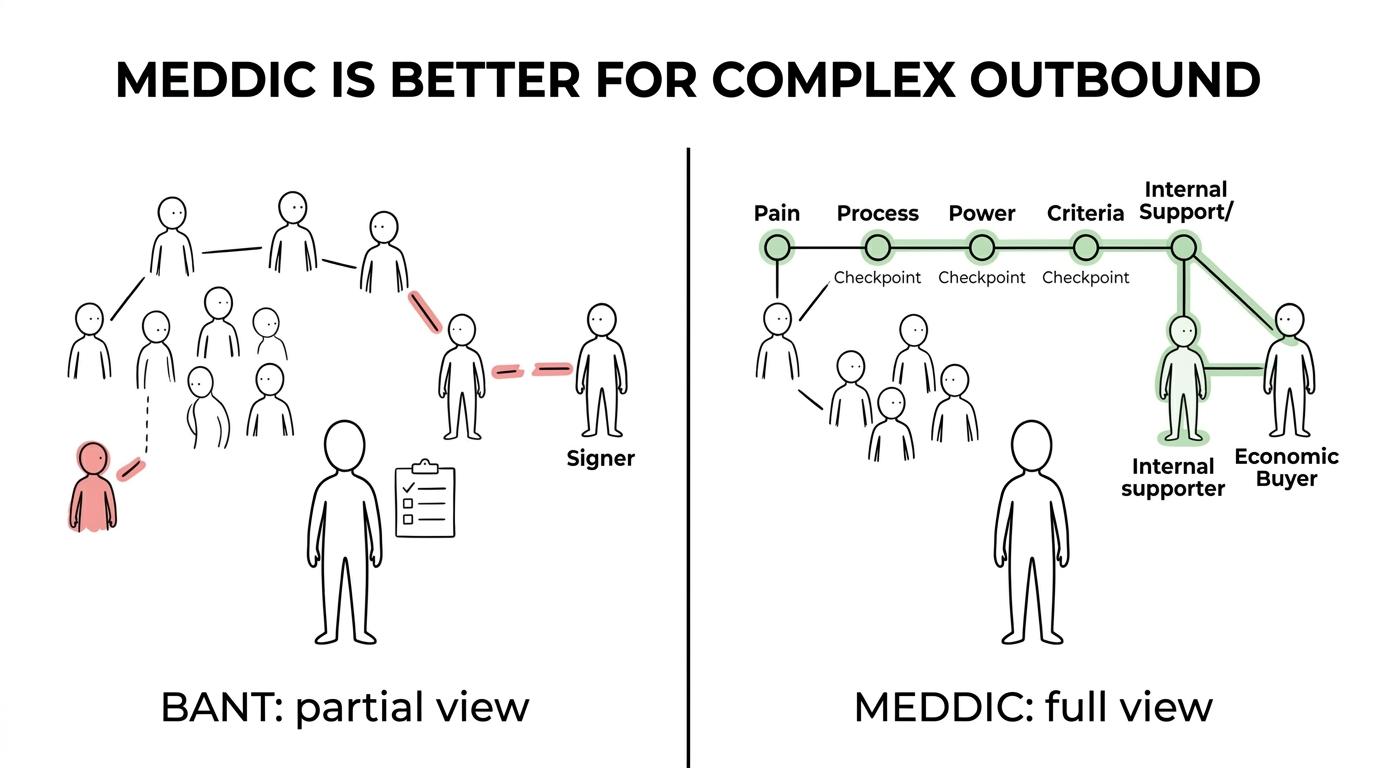 Budget is rarely clear on the first meeting. Sometimes there is no approved budget yet, and the pain still deserves a serious sales process. MEDDIC handles that better because it asks whether the problem is important enough to create budget, not just whether budget already exists.
Use BANT when these conditions are true:
- Low complexity: one buyer or a very small buying group
- Short cycle: the deal moves in days or a few weeks
- Clear spend line: the budget already exists
- Transactional motion: little need for internal selling
Use MEDDIC when a deal can stall because of people, process, or proof.
How do you score a meeting when MEDDIC is incomplete?
You should expect incomplete MEDDIC on a first outbound meeting. That is normal. What matters is whether the missing pieces are discoverable or fatal.
A simple way to score the meeting is to split it into three buckets. First, is the account a fit. Second, is the problem real. Third, is there a credible path to a buying decision. If you get yes, yes, and maybe, that is usually worth a second step. If you get yes, maybe, and no, it probably is not.
[markdown] | Meeting outcome | What it means | What to do next | | --- | --- | --- | | Strong | Clear pain, fit, buying path, and likely champion | Book the next meeting with specific stakeholders | | Workable | Fit and pain are real, but buying path is still fuzzy | Follow up with targeted questions and stakeholder ask | | Weak | Fit exists, but pain or urgency is thin | Nurture lightly or disqualify | | Dead | No fit, no pain, or no path to power | Close it out | [/markdown]This is where reps often overvalue enthusiasm. A prospect can be warm, polite, and curious without being qualified. If there is no route to the Economic Buyer and no internal person who will carry the deal, your odds drop hard after the meeting.
When procurement and competition shape the deal early, move up to MEDDPICC. The extra P and C matter when legal review, security review, or incumbent vendors can stall the motion for months. If your deals regularly die after verbal interest, that is usually the clue.
What should you do next if your meetings look qualified but still stall?
When outbound meetings stall, the issue is usually one of three things. Your TAM mapping is too loose, your first meeting is not getting to pain and process fast enough, or your reps are treating interest like qualification. Yuvau Digital frames the same problem in B2B lead growth terms: when targeting and problem-message fit are weak upstream, sales teams inherit conversations that look active but lack the substance to move forward.
That is why the handoff between targeting and qualification matters so much. Reachly has run 400+ campaigns, booked 2,500+ calls for clients, and the cleanest pipelines always start with tighter account selection, not a prettier discovery script. You can see that in the case studies for Primal and The Great Room, where outbound value came from getting in front of the right accounts and moving real opportunities forward.
If your team is booking meetings but too many fail basic qualification, fix the upstream system before you rewrite your whole discovery process. A signal-based outbound program should send reps into meetings with a reason for the account to care, not just a person who agreed to talk.
Here is the short version:
- MEDDIC fits outbound complex sales: it checks economics, process, power, pain, and internal support
- BANT is lighter: good for simple deals, weak for multi-stakeholder buying
- Qualified starts before the meeting: ICP and TAM mapping decide meeting quality early
- First meeting goal: enough proof to justify the next step, not perfect completion of all 6 fields
If you want help fixing meeting quality from the top of funnel down, Reachly builds outbound lead generation systems that combine cold email, LinkedIn, and cold calling with signal-based targeting, reply handling, and meeting booking. The fastest way to tighten qualification is to book the meeting with the right accounts first, then run MEDDIC on conversations that were worth having.