

Demand generation vs lead generation: see how B2B teams separate awareness from capture, then align CTAs, metrics, and handoff.
If 81% of buyers research vendors before talking to sales, demand generation and lead generation are not the same job. Demand generation gets you noticed early. Lead generation captures that interest later, turns it into a form fill or a reply, and gives sales something real to work with.
That sounds simple. The part that trips teams up is what changes after you accept that split. Your content changes. Your CTA changes. Your scorecard changes. Your sales handoff changes too.
What is the actual difference between demand generation and lead generation?
The cleanest way to think about it is this: demand generation creates interest before the buyer raises a hand. Lead generation captures that interest once they do.
Current vendor and analyst sources mostly agree on that point. Salesforce frames demand gen as the broader motion, with lead gen downstream. Gartner makes the same practical point from a measurement angle. MQLs matter, but they should not be the main scoreboard for demand generation.
[markdown] | Source | Year | What it says | What you should take from it | | --- | ---: | --- | --- | | Salesforce | 2026 | 81% of sales reps report that buyers research brands on their own before connecting with sales | Buyers often build a shortlist before your form or SDR ever shows up | | Salesforce | 2026 | Demand gen builds awareness, trust, and interest. Lead gen captures contact information | These motions connect, but they are not interchangeable | | Gartner | 2026 | MQLs should identify sales-ready buyers or an area to fix, not be the main measure of demand gen success | Demand gen should be tied to pipeline and business impact, not just form volume | [/markdown]Here is where the split becomes useful in practice.
[markdown] | Area | Demand generation | Lead generation | What actually changes | | --- | --- | --- | --- | | Goal | Create awareness and interest | Capture contact details or replies | You stop asking every campaign to do both | | Content | Ungated education, proof, category framing | Gated assets, demos, audits, reply-based offers | The asset and CTA change | | Audience state | Problem-aware or solution-curious | Ready to evaluate or talk | Messaging gets more direct | | Sales handoff | Usually indirect or delayed | Immediate follow-up | Routing and speed matter more | | Main measure | Pipeline influence, branded demand, engagement | Qualified leads, meetings, conversion | You track different success signals | [/markdown]If you force a lead-gen scorecard onto a demand-gen program, it looks weak. If you ask demand-gen content to produce instant meetings, it usually disappoints.
What changes in your content, offers, and calls to action?
Demand generation content gets read without friction. Lead generation content asks for a next step. That is the big operational difference.
Salesforce and LinkedIn both describe demand gen as ungated and lead gen as gated. That matches what most B2B buyers actually do. They read your site, your posts, your case studies, and your category pages long before they fill out a form. If your only good material sits behind a gate, you are asking strangers to trust you too early.
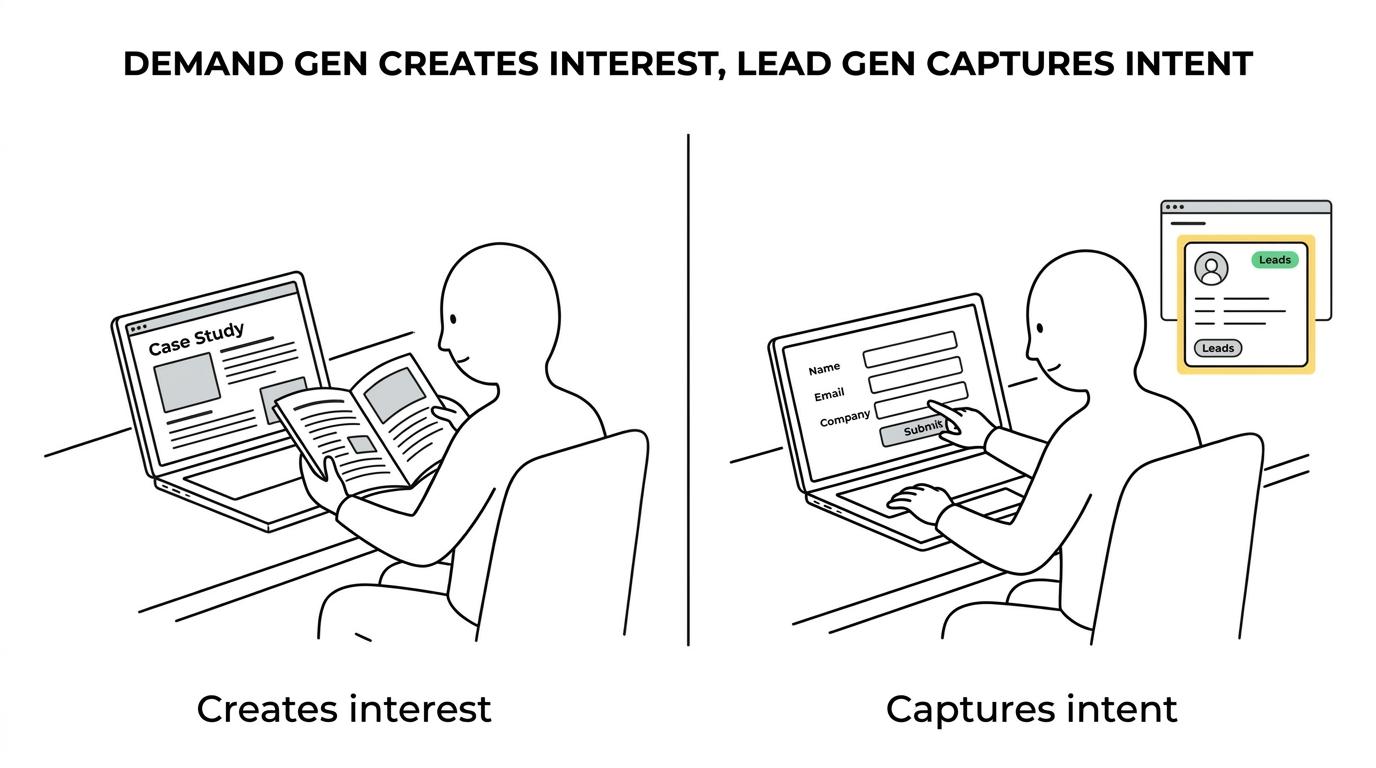
Lead generation starts when you ask for something back. That might be an email address for a webinar. It might be a demo request. In outbound, it might be something even lighter: a reply to a good offer.
After that shift, the assets and CTAs stop looking the same.
- Ungated articles
- Customer proof
- Product comparison pages
- Demand gen CTA: read this, subscribe, share internally
- Lead gen CTA: get the audit, request the webinar, reply if relevant
This matters in outbound too. A cold email is not demand gen content in the classic sense, but it still follows the same logic. You do not ask a cold prospect for the most expensive thing they own, which is their time, unless the message has already earned it.
Thibault Garcia, founder of Reachly, puts it plainly: “A first email that asks for a meeting is asking a stranger for the most expensive thing they own, which is their time. Ask for something cheap first.”
That is why reply-based CTAs work better than calendar links in first-touch outreach.
What changes in measurement from demand generation to lead generation?
The fastest way to confuse your team is to grade both motions on one metric. Demand generation and lead generation should not share the same scoreboard.
Demand generation should be tied to business impact, not just captured names. That can mean pipeline sourced, pipeline influenced, direct traffic from target accounts, branded search movement, content consumption by ICP accounts, or repeat visits from the right companies.
Lead generation is narrower. You care about captured contacts, qualified replies, meetings, show rate, opportunity creation, and pipeline conversion from those leads.
[markdown] | Motion | Primary measure | Secondary checks | Bad habit | | --- | --- | --- | --- | | Demand generation | Pipeline impact | Target account traffic, content engagement, branded demand | Treating MQL volume as the win | | Lead generation | Qualified leads and meetings | Lead-to-opportunity rate, reply quality, speed to follow-up | Counting every form fill as equal | [/markdown]Gartner’s point on MQLs is useful here. MQLs are a signal, not the finish line. If MQLs are rising but pipeline is flat, something broke between attention and sales follow-up. If content engagement is high but no one converts, the offer is usually weak or the CTA asks too much.
For teams that already own revenue, this is less about definitions and more about accounting. You need to know which motion paid for what.
What changes for sales follow-up when demand turns into lead generation?
Once demand becomes a lead, speed matters more than content volume. The work changes from education to qualification.
That handoff is where a lot of B2B teams lose money. Marketing celebrates the form fill. Sales sees a weak lead, late follow-up, or no clear reason to reply. Everyone blames the channel.
In practice, lead generation needs tighter routing and sharper asks. If someone downloads a category guide, sales should not jump straight to a meeting request. If someone asks about pricing or replies to outbound with a specific pain point, the follow-up can be much more direct.
At Reachly, we treat the first job of outbound as getting the reply. No reply, no meeting. That one rule cleans up a lot of bad follow-up behavior.
For multichannel work, the channel stack matters too. Cold email, LinkedIn, cold calling should support the same conversion moment, not run as separate mini-campaigns with different stories.
Where does outbound fit between demand generation and lead generation?
Outbound usually sits on the lead generation side. You are reaching out to start a sales conversation, not just publishing content and waiting.
Still, good outbound borrows from demand generation. It teaches. It frames the problem. It makes the buyer curious enough to reply. That is why signal-based outbound works better than list blasting. You are not just contacting a job title. You are reaching an account at a buying moment.
The mechanism matters. A company-level signal like hiring, a leadership change, or a tech stack shift gives you a reason to write now. That signal has a shelf life of about 2 to 4 weeks. Miss it, and you are back to sending a generic note that sounds like everyone else.
Garcia says, The offer is where most campaigns win or lose.
We have seen that play out repeatedly. A Series A client sending 20,000 to 30,000 emails a month moved reply rate from 0.5% to 1%, then up to 1.6%, after switching to direct, question-based copy with a lead magnet and a stronger offer. Same market. Same channel. Better offer.
That is also why outbound ships in 3 to 4 weeks gives you feedback fast. Reachly has served 50+ B2B clients and run 400+ campaigns. In most cases, outbound ships in 3 to 4 weeks and tells you quickly whether the market cares about your offer. Inbound content takes longer to compound.
You can see the effect in public case studies too. Primal hit an 8% positive reply rate average, generated 85+ SQLs in 6 months, and reduced CAC by 35%. The Great Room moved face-to-face meetings from 2 per quarter to 2 per month and closed a $250K contract without adding headcount.
When should you prioritize demand generation, lead generation, or both?
If your category is crowded and buyers do a lot of research before talking to sales, demand generation deserves more attention. If your ICP is clear, your offer is proven, and you need meetings this quarter, lead generation usually deserves the bigger share.
Most B2B teams do not need to pick one forever. They need to know which problem they are solving right now.
- Prioritize demand generation: buyers do not know you, your sales cycle is long, and trust is the bottleneck
- Prioritize lead generation: buyers know the category, sales needs qualified conversations, and the offer already converts
- Use both when your market knows the problem but has no strong preference for vendor
A simple test helps. If people consume your content but do not convert, your lead gen offer or handoff is weak. If outbound gets low reply volume even with solid deliverability, the market may not know or care enough yet, or your offer is not sharp enough.
Who should keep this simple instead of building two separate motions?
Not every B2B team needs a full demand-gen and lead-gen machine. Some teams need focus more than structure.
If your average contract value is under $5,000, keep your lead generation simple for now. Founder-led outreach, a clean offer, and fast follow-up usually beat a heavy content program and a long form stack.
If you do not have product-market fit, both motions get harder. Demand gen can create attention for the wrong thing. Lead gen can fill the pipeline with people who were never a fit.
Tiny TAMs need restraint too. If your market is 300 accounts, you should know those accounts by name. That is a job for precise outbound and direct sales work, not a giant reporting framework that separates every touch into a different marketing bucket.
If you already know you need more qualified meetings from a defined ICP, Reachly builds outbound lead generation services around signal-based targeting, cold email, LinkedIn, and cold calling, then handles reply management and appointment setting. If you want to see whether outbound is the missing link between attention and pipeline, book the meeting with Reachly.
The short version is simple: demand generation creates attention and trust, while lead generation captures intent and routes it to sales. If you score them separately, build different CTAs for each, and tighten the handoff, the split becomes useful instead of academic.