HeyReach pricing in 2026 starts at $79 per sender, drops with volume, and scales to $2,999/month for up to 300 senders.
HeyReach pricing in 2026 starts at $79 per sender per month on monthly billing, drops to $59 per sender once you reach 10 senders, moves to $999 per month for 25 senders or $1,399 per month for 50 senders, and tops out at $2,999 per month for up to 300 senders. The main thing to get right is the billing model. HeyReach charges per sender, not per teammate, which means the value changes fast once you run a sender-heavy LinkedIn motion.
That pricing structure makes HeyReach a much better fit for teams running serious LinkedIn volume than for founders testing one profile on the side. If you are comparing tools, that one detail matters more than the headline price.
What is HeyReach pricing in 2026?
This pricing snapshot is based on public 2026 sources, including the official HeyReach help center update dated September 11, 2026. SaaS pricing changes, so you should confirm the live page before you buy.
The official materials show five plan types: Growth, Agency, Unlimited, Custom, and Early Stage. Billing is available monthly, quarterly, and annually, with annual billing carrying the lowest public rate.
The public source set is clear on sender limits and billing. It is less clear on a full feature-by-feature gate between plans. So the safest way to read HeyReach pricing is by sender count, billing cycle, and access model.
[markdown] | Source | Year | What it confirms | | --- | ---: | --- | | HeyReach Help Center | 2026 | Five plans, Growth pricing, billing-cycle discounts | | HeyReach Pricing Page | 2026 | Per-sender model, trial, Agency bundles, Unlimited cap | | Revexa | 2026 | Cross-check on public pricing, trial terms, Early Stage program | [/markdown]How do HeyReach plans compare?
If you want the short version, Growth is the entry tier, Agency is where the math starts improving, and Unlimited only makes sense if you can actually use a large sender pool.
[markdown] | Plan | Public price | Sender allowance | Billing options | Best fit | Notes | | --- | ---: | ---: | --- | --- | --- | | Growth | $79 per sender monthly for under 10 senders | Flexible | Monthly, quarterly, annual | Small teams | Annual drops to $63 per sender monthly equivalent | | Growth | $59 per sender monthly for 10+ senders | Flexible | Monthly, quarterly, annual | Teams growing past single digits | Annual drops to $47 per sender monthly equivalent | | Agency | $999 monthly | 25 senders | Monthly | Agencies and larger outbound teams | Better unit economics than Growth | | Agency | $1,399 monthly | 50 senders | Monthly | Larger sender pools | Lower cost per sender than 25-seat bundle | | Unlimited | $2,999 monthly | Up to 300 senders | Monthly | High-volume teams with strong ops | Capped “unlimited” tier | | Custom | Contact sales | Varies | Custom | Edge cases | Not publicly priced | | Early Stage | Not public | Varies | Custom | Under $250k ARR and under 5 people | Discounted program | [/markdown]The trial is also worth noting. The public pricing materials show a 14-day trial with up to 3 LinkedIn accounts and no credit card required. That matters if you want to test the workflow before committing to a sender pool.
When does the HeyReach per-sender math get better?
This is where most buyers make the wrong comparison.
If you compare HeyReach to a normal seat-based tool, Growth can look expensive. If you compare it to the workload of running many LinkedIn senders across one team, the picture changes. The Agency and Unlimited tiers are built for that second use case.
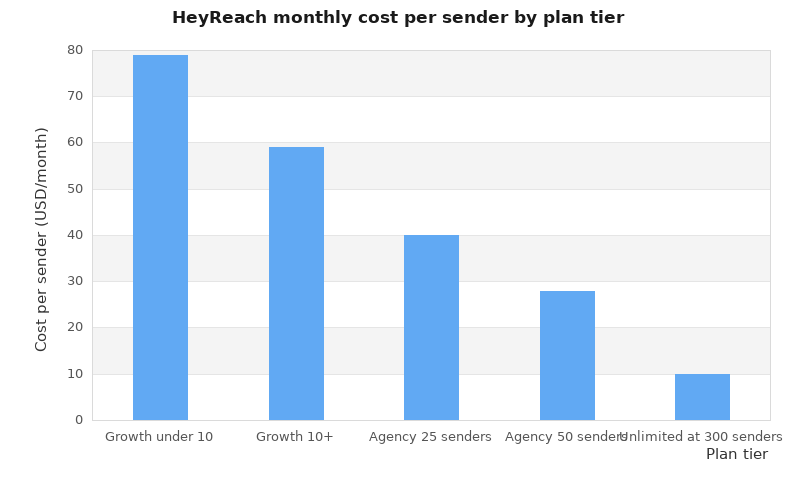
Here is the monthly math on public list price:
- Growth under 10 senders: $79 per sender
- Growth at 10 or more senders: $59 per sender
- Agency 25-sender bundle: $39.96 per sender
- Agency 50-sender bundle: $27.98 per sender
- Unlimited at the 300-sender cap: $9.99 per sender
That does not mean Unlimited is “cheap.” It means the plan is priced for teams that already know how to keep many sender accounts active, safe, and productive. If you only plan to use 20 or 30 senders, the sticker price will hurt more than the unit economics help.
Annual Growth pricing also cuts the cost by about 20 percent versus monthly. At the public annual rates, you land at $63 per sender under 10 senders and $47 per sender at 10+ senders.
What do you actually get from HeyReach pricing?
The biggest thing you get is sender-based billing instead of user-based billing. That means HeyReach does not charge by teammate, VA, or client seat in the same way many sales tools do. If multiple people need visibility into the same operation, that pricing model is usually better.
You also get a pricing ladder that matches how LinkedIn outbound teams actually grow. Start with a few senders, move into a fixed bundle, then move to a capped high-volume tier if the motion works.
If you want a product view beyond the pricing page, see this HeyReach review.
What you do not get from HeyReach pricing is the rest of the outbound system. The tool handles one layer. It does not replace ICP work, Sales Navigator workflows, offer testing, copy, reply handling, or meeting booking. That part matters because software is rarely the bottleneck.
After the subscription, the real work usually sits here:
- ICP and TAM mapping
- Sales Navigator workflows
- Messaging and offer tests
- Reply handling
- Account safety and pacing
If your LinkedIn motion is weak, a tool will not fix it. It will just let you run the weak motion faster.
What extra costs sit outside HeyReach pricing?
The software line item is only one part of the budget. The hidden cost is operator time.
You still need list quality, targeting logic, message testing, and a process for managing replies. If LinkedIn is part of a bigger outbound motion, you also need the other channels to work together in the right order: cold email, LinkedIn, cold calling.
At Reachly, LinkedIn is never run as a disconnected tool purchase. It sits inside a signal-based system. The standard pattern is light on LinkedIn volume and heavy on timing: empty connection note, wait 1 to 3 days after acceptance, then a short lowercase question-based message, with no more than 4 to 5 touches across 2 to 4 weeks.
That setup cost is not measured only in money. It is also measured in risk. Push too hard, use bad targeting, or let too many people improvise messaging, and you burn sender accounts instead of booking the meeting.
Who should buy HeyReach, and who should skip it?
HeyReach makes sense if you already know LinkedIn will be a real acquisition channel for you. That usually means one of three things. You have a repeatable offer, enough TAM to support multiple sender accounts, and someone who can actually run the motion.
It is a strong fit for agencies, outbound teams, and founder-led sales motions that are moving into a multi-sender setup. The Agency bundle pricing makes that pretty clear.
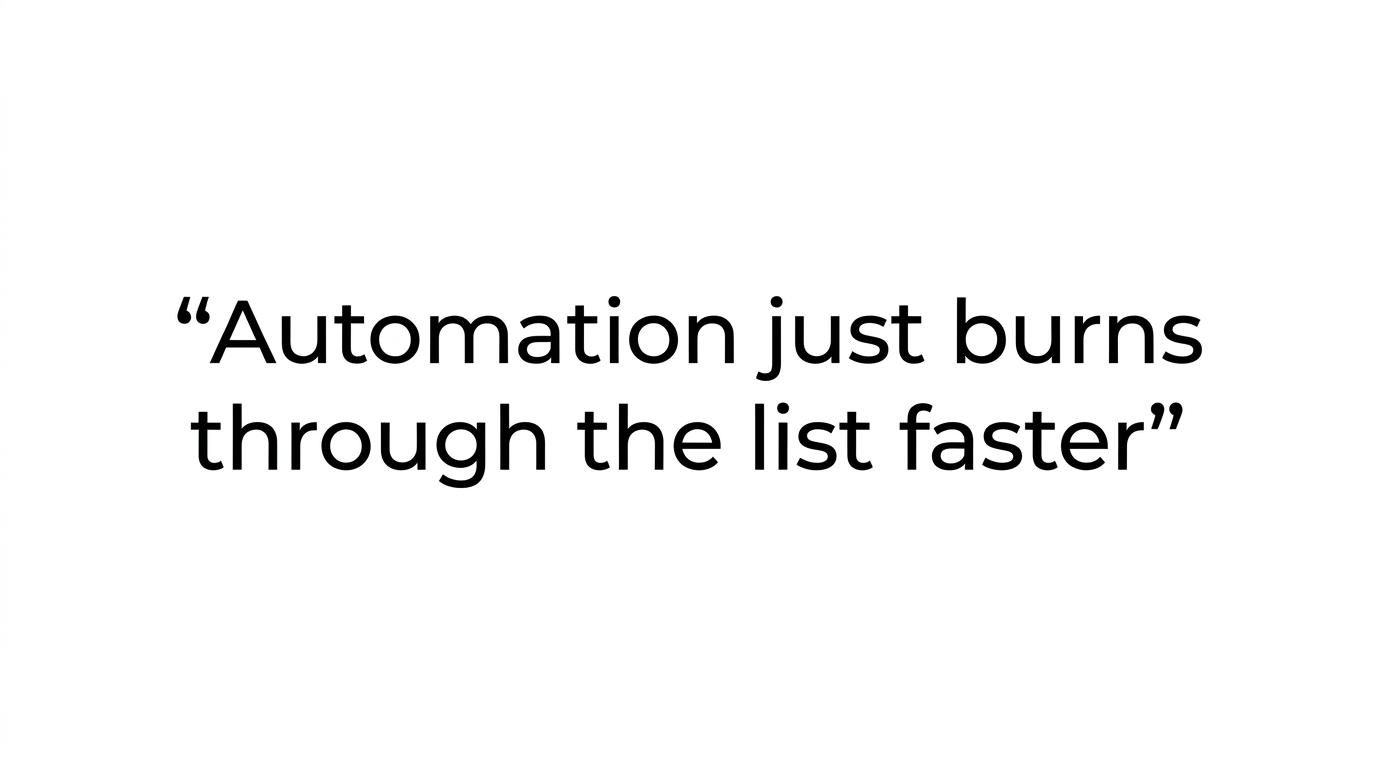
You should think twice if your market is tiny, your offer is still fuzzy, or you are only testing one or two profiles. Thibault Garcia, founder of Reachly, puts it plainly: “A tiny, very specific market is a job for the founder and a keyboard. Automation just burns through the list faster.”
The Early Stage program is relevant here too. Public source material says it is meant for companies under $250,000 ARR with fewer than 5 people, and the price is not published. If you fit that profile, ask about it before paying list price.
Is HeyReach pricing good value for agencies and larger teams?
Usually, yes.
The jump from $79 per sender on Growth to $39.96 per sender on the 25-sender Agency bundle is big enough to matter. The 50-sender bundle pushes that further. If you are managing several clients or several internal segments, that pricing is easier to justify than stacking individual sender fees forever.
That is one reason Reachly uses HeyReach in production work. Reachly has run 400+ campaigns, served 50+ B2B clients, and is certified in Clay, Smartlead, and HeyReach. When you are building LinkedIn into a real outbound engine, sender-based pricing is easier to work with than seat-based pricing.
The caveat is simple. Lower cost per sender only helps if the underlying motion works. A bad offer spread across 25 or 50 senders is still a bad offer.
What should you do if LinkedIn is only one part of outbound?
If LinkedIn is one lane inside your outbound system, buy for the whole motion, not just the software. That means matching sender count to TAM, keeping touches light, and making sure your offer can earn replies before you add volume.
That matters more than tool selection. A Series A client sending 20,000 to 30,000 emails a month moved reply rate from 0.5 to 1 percent, then up to 1.6 percent, after switching to direct question-based copy, a lead magnet, and a stronger offer. The tool did not create that lift. The offer did.
You see the same pattern in multichannel work. With The Great Room, face-to-face meetings moved from 2 per quarter to 2 per month with zero added headcount. The channel mix worked because the system worked.
If you want LinkedIn run inside a signal-based outbound program, start with Reachly’s LinkedIn outreach agency page or see the full outbound lead generation services offer. If you want help mapping sender count, offers, and the right mix of cold email, LinkedIn, cold calling, book the meeting with Reachly.
HeyReach pricing in 2026 is easy to summarize once you strip it down to the billing model. Small teams pay per sender, larger teams win on bundles, and the capped Unlimited tier only pays off if you can actually use it.
Key takeaways:
- Entry pricing: $79 per sender monthly, or $59 per sender at 10+ senders
- Agency bundles
- High-volume ceiling: $2,999 monthly for up to 300 senders
- 14-day trial with no card
- Early Stage program exists, but public pricing does not list the rate