Sales cadence that books more meetings: use two cold emails, LinkedIn follow-up, and selective calls to lift replies and intent.
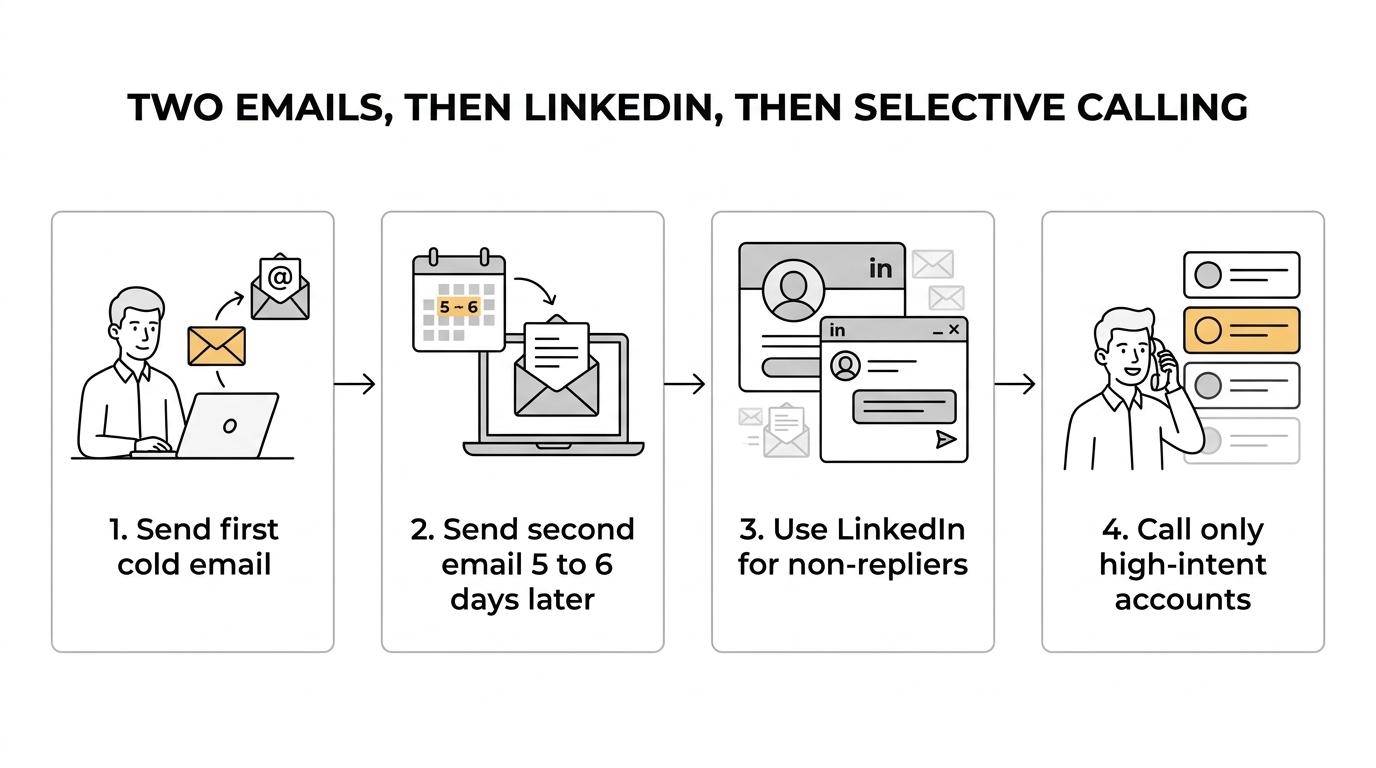
A sales cadence that books meetings is usually shorter than most teams make it. The version we see work most often is two cold emails sent 5 to 6 days apart, then LinkedIn for people who did not reply, with cold calling used only on the highest intent slice. That structure matches what the numbers show. In Salesloft’s 2026 study of 338 million cadence emails, sellers who paired calls with email booked 166 meetings per 10,000 emails, versus 37 for email-only sellers.
What is a sales cadence in multichannel outbound?
A sales cadence is the order, spacing, and channel mix behind your outreach. Not just when you send email one and email two, but when LinkedIn shows up, when a rep should call, and when you stop before the whole thing turns into noise.
That last part matters more than most teams admit. A bloated cadence usually means the first message was weak, so the team keeps adding touches to avoid fixing the offer. We do not treat cadence length as a badge of effort. We treat it as a response to how buyers actually behave.
The practical version is simple. Your cadence should create a few clean chances to reply, not ten different chances to ignore you.
Why does a multichannel sales cadence book more meetings than email only?
Email still does most of the work in outbound. But email alone leaves money on the table, especially when the market is tight and every inbox looks the same. LinkedIn gives you another path to attention. Cold calling gives you a direct path to intent, but only if you use it with discipline.
The proof is pretty clear. External data says mixed-channel cadences produce more meetings. Reachly’s own case work says the same thing when the system is built around signal-based targeting, reply handling, and meeting booking.
[markdown] | Source | Year | Data point | What it means | | --- | ---: | --- | --- | | Salesloft | 2026 | 338 million cadence emails analyzed across 65,413 sellers | Large enough sample to trust directional findings | | Salesloft | 2026 | Email-only sellers booked 37 meetings per 10,000 cadence emails | Email on its own has a lower ceiling | | Salesloft | 2026 | Sellers who made a call for every email booked 166 meetings per 10,000 emails | Adding calls materially lifts meetings | | Reachly, The Great Room | 2025 | Face-to-face meetings went from about 2 per quarter to 2 per month | Coordinated outbound can create a steadier meeting flow | | Reachly, The Great Room | 2025 | Funnel drop-off was about 30% from Reachly leads versus about 50% from paid leads | The channel mix affects downstream quality, not just top-of-funnel volume | | Reachly, Primal | 2025 | 85+ SQLs in 6 months, 4.57x ROI, 35% CAC reduction | A good cadence only matters when the offer and targeting also convert | [/markdown]There is one caveat. “More channels” does not mean “more touches everywhere.” If you call every account with no signal and no context, you burn rep time fast. If you message every LinkedIn connection with the same pitch, replies dry up just as fast.
What sales cadence does Reachly use across cold email, LinkedIn, and cold calling?
For most outbound campaigns, we keep the sales cadence short. Two emails, spaced 5 to 6 days apart, then LinkedIn for the people who did not reply. Cold calling sits behind that, not in front of it, and only for accounts where the signal says the timing is real.
Thibault Garcia, founder of Reachly, puts it plainly: “Two emails, five or six days apart. That is the whole sequence. The first message is where the money is, and it is an eighty-twenty situation.”
Here is the cadence structure we like for cold email, LinkedIn, cold calling when the list is well-targeted and the offer is worth hearing.
[markdown] | Day | Channel | Action | Why it exists | Cost or risk | | --- | --- | --- | --- | --- | | 1 | Cold email | Email 1 with a signal opener and soft CTA | Gets the first reply chance in the inbox | Copy time and deliverability risk if infrastructure is weak | | 1 or 2 | LinkedIn | Profile visit and connection request, usually no note | Creates familiarity without spending the ask yet | Low time cost, weak results if acceptance rate is low | | 6 or 7 | Cold email | Email 2 with a new angle, not a bump | Gives the offer one more real shot | Too close feels pushy, too late loses timing | | 8 to 10 | LinkedIn | Short lowercase message after acceptance | Reaches non-repliers in a second channel | Manual review or HeyReach setup time | | 10 to 14 | Cold calling | One focused call for high-intent accounts | Best used when the signal is fresh and the account matters | Rep time is the real cost | | 45 to 75 | Cold email or LinkedIn | Re-engage with a fresh angle | Lets you reuse a good list without hammering it | Requires a new offer or new reason to write | [/markdown]That is a cadence, not a flood. It respects buyer attention and your own infrastructure. It also fits how reply behavior actually works. If the first email and the second email both fail, a seventh follow-up usually does not rescue the sequence.
How should each step in the sales cadence be written?
The first email should aim for a reply, not a meeting. That sounds obvious, but most cadence copy still asks a stranger for thirty minutes before earning ten seconds of attention. A better first step is a soft ask or a routing question.
The email itself should stay around 70 to 80 words. No fake personalization. No links in the first email. No paragraph about your company. If it does not fit on a phone screen in one pass, cut it.
LinkedIn should not repeat the email. Use it as a different doorway. Empty connection note first. Wait 1 to 3 days after acceptance. Then send a short question-based message in plain language.
A few rules keep the whole cadence readable:
- Email one: signal opener, one problem, one ask
- Email two: new angle, not “just bumping this”
- LinkedIn message: lowercase, short, one question
- CTA: ask for permission or routing, not a calendar commitment
This is where many teams overcomplicate the job. Personalization is mostly a data problem. If the targeting is loose, no clever first line saves the cadence.
When should cold calling enter the sales cadence?
Cold calling works best when you treat it like a precision tool. We use it after email and LinkedIn have already created context, or when the account shows a strong reason to call right now. Buying intent, leadership change, tech stack change, headcount growth, and M&A are all stronger reasons to spend rep time than a generic ICP fit.
That matches what we see in campaigns. Cold calling still works. It just works better when it follows signal-based outbound instead of trying to carry the whole sequence by itself.
Good reasons to add a call into the cadence are pretty narrow:
- recent hiring
- a fresh leadership move
- buying intent from website or LinkedIn activity
- a named account list where each logo matters
If none of those apply, the call is usually a time cost, not a conversion step.
What setup work has to happen before the sales cadence starts?
A good sales cadence still fails if the setup is sloppy. Before a single live send, you need working infrastructure, verified data, and enough time to warm domains properly. Four weeks is the safer number. Google now adds a yellow banner to mail from any domain younger than 30 days, so rushing warmup is just asking for trouble.
As of November 2026, we keep sending caps conservative. Around 15 emails per day per Google mailbox, and 10 to 12 for Outlook. SPF, DKIM, DMARC, and a custom tracking domain all need to be in place. Any list older than 3 months gets re-validated before sending. Bounce rate needs to stay under 3%, and deliverability score needs to stay above 97%.
The tooling stack matters here because it removes guesswork. We usually see teams run signal research in Clay, Apollo, and LinkedIn Sales Navigator, sending in Smartlead, LinkedIn tasks in HeyReach, and email verification through ZeroBounce or MillionVerifier. The cost is not just the software. It is 3 to 4 weeks of setup time and the risk of hurting domain reputation if you skip steps.
How do you know if the sales cadence is working?
The first thing to watch is not meeting count. It is reply behavior. If no one replies at all, you usually have an infrastructure issue, a bad subject line, or copy that reads like a template. If people reply “not interested,” your deliverability is probably fine and the offer is what needs work.
We diagnose weak cadences in a fixed order: overall reply rate including out-of-office replies, inbox placement, bounce rate, then the offer. Copy comes later than most teams expect. A campaign with healthy replies and zero positive intent after 1,000 emails has already told you something important. The market is not buying that angle.
The core benchmarks we use look like this:
- Bounce rate: under 3%
- Deliverability score: above 97%
- LinkedIn acceptance rate: 25% is a healthy benchmark
- Positive reply rate: 10 to 20% is normal, 35 to 40% is very good
The caveat is simple. Benchmarks only matter when the list is tight. A wide, lazy list can make decent metrics look better than the pipeline that follows.
Who should not use this sales cadence?
If your average contract value is under $5,000, keep it lean and do the outreach yourself for now. The math is tighter, the margin for error is smaller, and a full outbound system is harder to justify. The same goes for a tiny TAM. If your market is fifty dream accounts, that is a founder-and-keyboard problem, not a sequence problem.
You should also skip a formal cadence if you do not have product-market fit or a repeatable sales process. Outbound multiplies what already works. When there is nothing to multiply, the cadence just exposes that faster.
That is not bad news. It is useful news. A short outbound test can still tell you quickly whether the offer has a pulse.
What should you do next if you want this sales cadence built for you?
If you want this built as a working system, not a one-off sequence, start with Reachly’s outbound lead generation services. If LinkedIn is the missing piece in your current motion, look at the LinkedIn outreach agency page. If the problem is not replies but handoff and scheduling, the right next page is B2B appointment setting services. From there, you can book the meeting with Reachly and get a view on offer, list quality, channel mix, and infrastructure.
Short version: a sales cadence that books meetings is short, multichannel, and built around buyer timing. Two emails 5 to 6 days apart, then LinkedIn for non-repliers, with cold calling reserved for the accounts that have earned the effort.
Key findings recap:
- Keep the cadence short: two real email attempts beat seven weak follow-ups
- Use channel mix with purpose: cold email, LinkedIn, cold calling works when each step has a job
- Earn the reply first: the meeting comes after the reply, not before it
- Protect infrastructure: 30 days of warmup, verified data, and low sending caps keep the cadence alive
- Judge the offer hard: after 1,000 emails and healthy replies, no positives means rewrite the offer, not the sequence