How to write a cold email that gets replies comes down to six choices: a two-word lowercase subject line, 60 to 80 words of body copy, zero links, an opening line built on something that just happened to the prospect, a call to action that asks permission instead of asking for a meeting, and one follow-up 5 to 6 days later. Reachly sends about 1M emails a month for its clients, and this is the spec that copy follows. Its campaigns land a 1 to 5% reply rate, and 10 to 30% of those replies are positive. Six example emails written to the spec follow below.
Key Findings
- Reachly keeps the subject line to two lowercase words with one real variable, such as {first_name}'s pipeline, so no two leads get the same subject.
- The body runs 60 to 80 words with zero links. A link goes in email 2 only when it cannot be avoided.
- The opening line names a live trigger, like a new hire. With no trigger, it says where you found them.
- The ask is permission ("could I send it over?"), which is a smaller yes than 30 minutes on a calendar.
- Two emails, 5 to 6 days apart, then stop. Thibault Garcia, Reachly's founder, calls the first message "where the money is at".
- A working campaign earns one positive reply per 200 to 600 emails. Past 600, fix the offer before touching the copy.
- The spec comes from 1,000+ campaigns Reachly has run, and it is how every Reachly cold email campaign is written.
What does a cold email that gets replies look like?
A cold email that gets replies is short enough to read on a phone in one go, specific to one person, and easy to say yes to. Below is an example written to the spec, with each part marked against it.
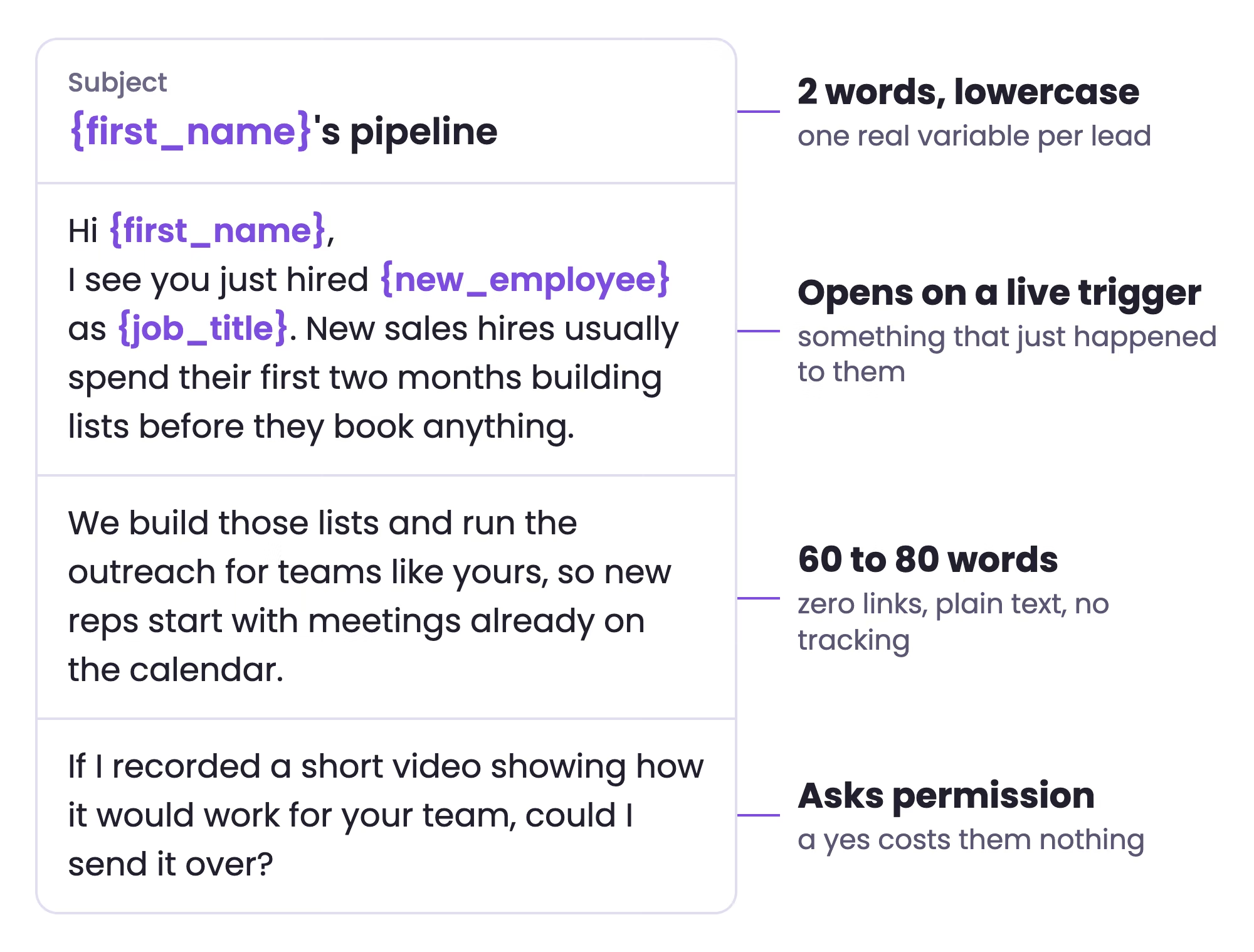
The table is the full spec, including the rules the figure leaves out.
| Part | Reachly spec | Why |
|---|---|---|
| Subject line | 2 words, lowercase, one real variable | A subject that changes per lead is safer for deliverability than one line sent to everyone |
| Body length | 60 to 80 words | Readable on a phone screen in one pass |
| Links | 0 in email 1. Only in email 2, and only if unavoidable | Links are a spam signal, and nothing in email 1 needs a click |
| Opening line | A live trigger, or where you found them | It proves the email was written for this person |
| Call to action | Ask permission to send something | A yes costs the prospect nothing |
| Sequence | 2 emails, 5 to 6 days apart | The first message earns most of the positive replies |
| Names in copy | "your company", never the company or industry name | People do not say their legal company name out loud, so it reads like a mail merge |
| Format | Plain text, zero tracking | Tracking adds a pixel and rewritten links, and Reachly does not use open rate to judge a campaign |
How long should a cold email subject line be?
Two words most of the time, and never more than four. Reachly writes them in lowercase with one variable, so the subject reads like a note from a colleague and changes for every lead.
The variable has to be real. {first_name}'s pipeline works because the first name is always filled. {new_employee} or {tool} only work when the campaign is built on that signal, so the field is never blank.
Thibault's reason is deliverability first: "I tend to really like subject lines that are dynamic, just because, from a deliverability standpoint, it's a lot safer for you to do so than to have the same subject line across every email." The full set of patterns, with examples, is in the cold email subject lines guide.
How long should a cold email be?
60 to 80 words, counted from the greeting to the question mark. That is about four short paragraphs: the trigger, the problem it usually creates, what you do about it, and the ask.
The test Reachly uses is a phone screen. If the whole email does not fit on an iPhone without scrolling, it is too long. In Thibault's words: "you want the email to be short, direct and easily digestible. It shouldn't be complicated to understand what you offer and why you should say yes to that email."
The reasoning behind the word range is in why cold emails should be 70 to 80 words. This post sets the floor at 60 because a trigger-based opener often says enough on its own.
Should a cold email include links?
No links in the first email. Reachly allows one in the second email, and only when the reply depends on it.
A link in a cold email from a new domain is one more thing a mailbox provider can score against you, and it asks the reader to leave the email before they have answered it. The permission-based ask removes the need: if they say yes, the link goes in the reply, where it is expected.
The same logic covers images, attachments and HTML signatures. Campaigns go out as plain text, matched to the sending provider, with open and click tracking switched off.
Open tracking stopped being worth the risk anyway. Since iOS 15, Apple's Mail Privacy Protection "stops senders from using invisible pixels to collect information about the user" (Apple), so open rates no longer say who read the email. Reachly judges campaigns on replies instead.
How do you write the opening line of a cold email?
Start with something that actually happened to them recently. "I see you just hired {new_employee}" is Reachly's default pattern, because hiring is public, recent and tells you what the team is trying to grow.
When a lead has no signal, the opener says how you found them instead: "I came across you while looking for {company_type} in {state}." It is honest, and it still gives a reason for the email to exist.
Some signals work better as targeting than as copy. Thibault ranks them like this:
| Signal | Mention it in the email? | How Reachly uses it |
|---|---|---|
| Hiring | Yes | Shows growth, and names the team that will feel the problem |
| Job change | Yes, for dream accounts | Strong on one person, too rare to carry a high-volume campaign |
| Tech install | Yes, carefully | "I see you're using X" works when you are sure they use it and it is relevant |
| Negative reviews | Yes, if you fix that complaint | Useful for SaaS buyers whose users complain about the problem you solve |
| Funding | No, a P.S. at most | Overused. A reason to reach out, a weak thing to open on |
| Ad spend | No | Shows the company is investing in marketing. Keep it in the list logic |
The full method for picking and stacking signals is in cold email personalization. Signal-based campaigns are also where the numbers move: Reachly's signal-based campaigns run a 2 to 8% reply rate with 15 to 35% of replies positive, against 1 to 5% and 10 to 30% across all campaigns.
What should a cold email call to action ask for?
Ask for permission to send something small. One of Reachly's two standard asks is "If I recorded a video, could I send it over?" A yes costs the prospect ten seconds, and the reply itself is the goal of email 1.
Asking for 30 minutes in the first email asks a stranger for a meeting before they have agreed there is a problem. Reachly treats the meeting as the second step: get the reply, then book the meeting in the thread.
What you offer to send matters more than the wording. Thibault's bar for a testable offer is that it is "almost too good to be true" or carries a guarantee, such as a free sample of the work, a free audit, or a result by a date or the client does not pay.
How many follow-ups should a cold email get?
One. Reachly sends two emails per sequence, 5 to 6 days apart, then stops. Non-repliers move to LinkedIn rather than getting a third email.
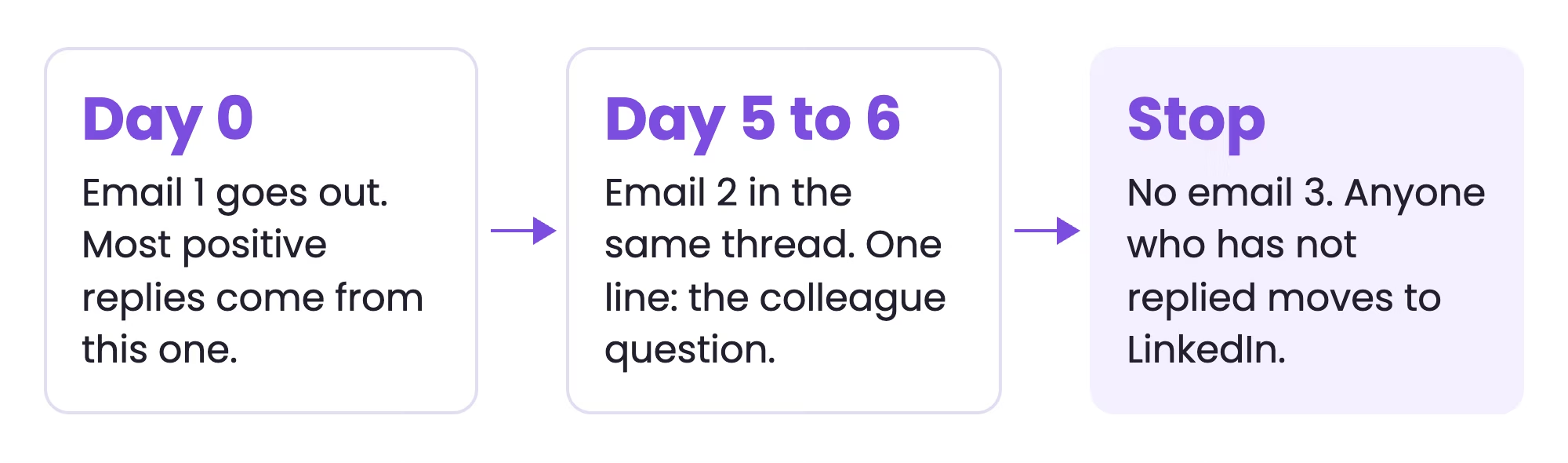
The follow-up goes in the same thread and is a single line. The one that earns the most replies for Reachly is: "Would this be something of interest, or does {subject} sit with {colleague_name}?" It gives the reader an easy way to say yes or to point you to the right person.
The case for stopping at two is that the first message carries the campaign. Thibault puts the split at 80/20: "1st message is where the money is at." Timing and wording for the second email are covered in detail in the two-email follow-up sequence.
What do cold emails written to this spec look like?
Below are six examples written for this page, one for each situation Reachly's campaigns start from. Every one follows the spec: a two-word subject, 60 to 80 words, no links, a permission ask. Swap the variables and the offer for your own. Example 1 also shows the one-line follow-up that goes on day 5 or 6.
Example 1: when they just hired
Use it when a target account posts or fills a role on the team your offer helps. Hiring is public, recent and names the team that will feel the problem. (66 words.)
Example 2: when they just changed jobs
Use it on dream accounts when the buyer started a new role in the last 90 days. Thibault rates job changes strong on one person and too rare to carry a high-volume campaign. (67 words.)
Example 3: when they use a specific tool
Use it only when you are sure they run the tool and it is relevant to your offer, which is Thibault's condition for naming one. (71 words.)
Example 4: when their reviews show a problem you fix
Use it for SaaS buyers whose users complain, in public reviews, about the exact problem your product solves. (67 words.)
Example 5: when they just raised a round
Use the funding as the reason to reach out, then open on what the money changes. Thibault calls funding overdone as an opener and keeps it to a P.S. at most. (66 words.)
Example 6: when there is no signal at all
Use Thibault's fallback opener when a lead has no trigger. It is honest about how you found them, which still gives the email a reason to exist. (65 words.)
What does a bad cold email look like after a rewrite?
Most cold emails that fail break several rules at once. Here is a typical one, written for this page, and the same pitch rewritten to the spec.
Before
99 words, a 8-word subject line, a calendar link and a request for 30 minutes.
After
65 words, a two-word subject, no links, and a question that costs ten seconds to answer.
| Part | Before | After |
|---|---|---|
| Subject line | 9 words, a question about growth plans | 2 words, lowercase, one variable |
| Opening line | "I hope this email finds you well" and a self-introduction | The new office they just opened |
| Body length | 99 words | 65 words |
| Links | A calendar link | None |
| Names in copy | {company_name} three times | "your team" |
| The ask | 30 minutes next week | Permission to send a short video |
How do you check a cold email before it goes out?
Reachly runs every campaign through the same pre-launch check before a single email is sent. Half of it is about the copy, and half is about whether the copy will reach an inbox at all. The bar for the second half is public: both Google's sender guidelines and Yahoo's sender best practices ask senders to keep their spam rate below 0.3%.
The relevance line comes from Thibault's rule that the list is the copy. If fewer than 90% of the people receiving it can use the offer, fix the list before touching a word of the email.
How do you know if a cold email is working?
Count emails sent per positive reply. Reachly plans every campaign around that ratio, because it already includes deliverability, targeting and the offer in one number.
| Emails per positive reply | Verdict | What Reachly does next |
|---|---|---|
| 200 to 300 | Very good | Scale the volume on the same angle |
| 300 to 600 | Good | Keep it running and test one variable at a time |
| More than 600 | Not good enough | Check inbox placement, then the offer, before rewriting copy |
| 0 after 1,000 sent | Angle is dead | Retire it, as long as out-of-office replies prove the emails are landing |
Volume changes the math too. Across Reachly campaigns, sends of 50 emails or fewer reply at 5.8%, against 2.1% for large sends. Smaller, tighter sends reply better, so a large list needs a stronger offer to hold the same rate.
When the ratio slips, Thibault diagnoses in a fixed order: overall reply rate including out-of-office replies (are we landing in inboxes?), an inbox placement test, the bounce rate, and only then the replies themselves. A run of "no thanks" replies means delivery is fine and the offer is the problem. The benchmarks behind these ranges are in cold email response rates.
Cold email FAQ
How do you write an email to get a reply?
Make the reply the goal, then make the offer worth replying to. Reachly sets up campaigns to earn replies rather than meetings, with question-based copy and a lead magnet as the offer, because nobody books a meeting before they have answered. Thibault says the one thing Reachly's top-performing clients share is "an excellent offer, or an offer, as Alex Hormozi would say, which is too good to say no to." Copy rules get an email read. The offer gets it answered.
What is cold emailing?
Cold emailing is sending a one-to-one business email to someone who has not heard from you before, about a problem they are likely to have. It is legal in most B2B markets when you identify yourself, give a way to opt out and honor it, though the rules differ between the US, the EU and Australia. In the US, the FTC's CAN-SPAM guide makes no exception for business-to-business email: it asks for an accurate sender, a physical postal address and opt-outs honored within 10 business days. The definition, the legal lines and how it differs from spam are in what is cold email.