



Overview
RedEngage is a GEO (generative engine optimization) agency. It gets B2B brands cited when buyers ask ChatGPT, Perplexity and Gemini for a recommendation. Before Reachly, every client came from inbound, and two rounds of paid ads had produced almost nothing.
Reachly built RedEngage's outbound on email and LinkedIn, aimed at companies showing four buying signals: falling search traffic, recent funding, fast headcount growth, and a new marketing hire. After a testing phase on offers, audiences and markets, RedEngage went from 1 to 2 meetings a week to 5+ a week. Up to 27 October 2026, that took about 26,800 emails and 5,400 LinkedIn connection requests.
The Challenge
1) Every client came from inbound
RedEngage's first year ran on referrals and word of mouth. The team tried outreach in-house, but nobody had run outbound before, and it went nowhere.
2) Paid ads brought window shoppers
Next came a Google Ads contractor, then an agency running LinkedIn and Meta ads for about $6k a month including ad spend. The few people who replied wanted to learn what GEO is. They were not looking to hire anyone.
We worked with one agency that promised us seven calls scheduled in the first two weeks. After three months, nothing happened. Not a single call scheduled.
 Michal HajtášFounder, RedEngage
3) A new category needs the right timing
GEO is new, and plenty of buyers still suspect it is a scam. A cold email that lands when nobody at the company is thinking about AI search gets ignored. RedEngage needed to reach companies at the moment the question was already on someone's desk.
The Solution
Reachly ran RedEngage's outbound end to end, from list building to the first reply, with two motions running side by side.
Evergreen campaign
An always-on campaign on email and LinkedIn to companies that fit RedEngage's buyer profile: B2B companies with about 10 to 100 employees in tech, or 100 to 250 in traditional industries. The emails went to co-founders, marketing directors and heads of growth or marketing, with the CEO as a backup when a company had too few of those.
The evergreen list started from falling search traffic. When a growing company's organic traffic drops, its buyers are often getting their answers from ChatGPT instead of clicking through, which is the exact problem RedEngage fixes.
Signal-based campaigns
Every company also had to show a reason to care now. Reachly filtered on four signals:
| Signal | The rule | Why it means timing |
|---|---|---|
| Organic traffic falling | Search traffic to the website down over recent months | Buyers are getting answers from AI instead of clicking through |
| Recent funding | Seed, Series A or B, raised in the last 12 months | There is budget, and investors want growth |
| Headcount growth | 30%+ growth in the last 12 months | The company is scaling and spending more to get found |
| Hiring a marketing role | SEO, content, growth or marketing lead role, posted in the last 30 days | AI visibility is about to land on someone's desk |
Funding came first. Results went up when the headcount growth filter was added, and in UT's view, growth was the stronger fit of the two. A company that grew its team by a third in a year is spending to be found, and AI search is the newest place to be found.
The hiring signal became its own trigger campaign. When a company posts a job for an SEO manager, a content lead or a head of growth, someone is about to own the question "where do we show up when buyers ask ChatGPT?". Those emails went to the hiring manager, usually the founder, CEO or CMO, and never to HR or recruiters.
Three audiences, one winner
Reachly tested three audiences in parallel and kept what worked:
- Tech-savvy B2B: booked most of the meetings, with the most qualified companies.
- "Boring" industries (manufacturing, construction, transportation): decent results, with a few companies outside the ICP.
- High-end brick and mortar: scrapped, because the results were poor.
Markets rolled out the same way, one wave at a time:
- US and UKThe first markets, for both the evergreen and the hiring trigger campaigns.
- Canada and AustraliaAdded next. Canada went on to post the best reply rate of any campaign.
- Germany, the Netherlands and the Middle EastThe first markets outside the English-speaking core.
- All of Europe plus New ZealandWhere the campaign runs today.
Implementation
The first email
The first email went live on 24 July. It makes one claim and asks one small question. The offer is a short video, so saying yes costs the reader nothing.
A second email follows six days later in the same thread and asks whether the video should go to a named colleague instead. That gives the reader an easy way to point to the right person.
Testing the offer, market by market
Reachly split-tested three offers: a short video, a free AI visibility check and a quick call. The winner changed with the market:
| Campaign | Best offer | Reply rate |
|---|---|---|
| Evergreen, Canada | Short video | 1.78% |
| Evergreen, UK | Short video | 1.75% |
| Evergreen, US | 15-minute callthe video got 0.61% | 1.00% |
| Hiring trigger, US + UK | Free snapshot vs competitorsthe video got 0.93% | 1.47% |
Email reply rate of the best version in each campaign, 24 July to 27 October 2026. Across all email the reply rate sits at about 0.7% to 0.8%.
Two patterns stood out. US buyers replied more to a direct 15-minute call than to a video. And companies that were hiring wanted something about themselves: a free snapshot of where they sit next to their competitors in ChatGPT got 1.47% replies, against 0.93% for the video.
The hiring trigger email
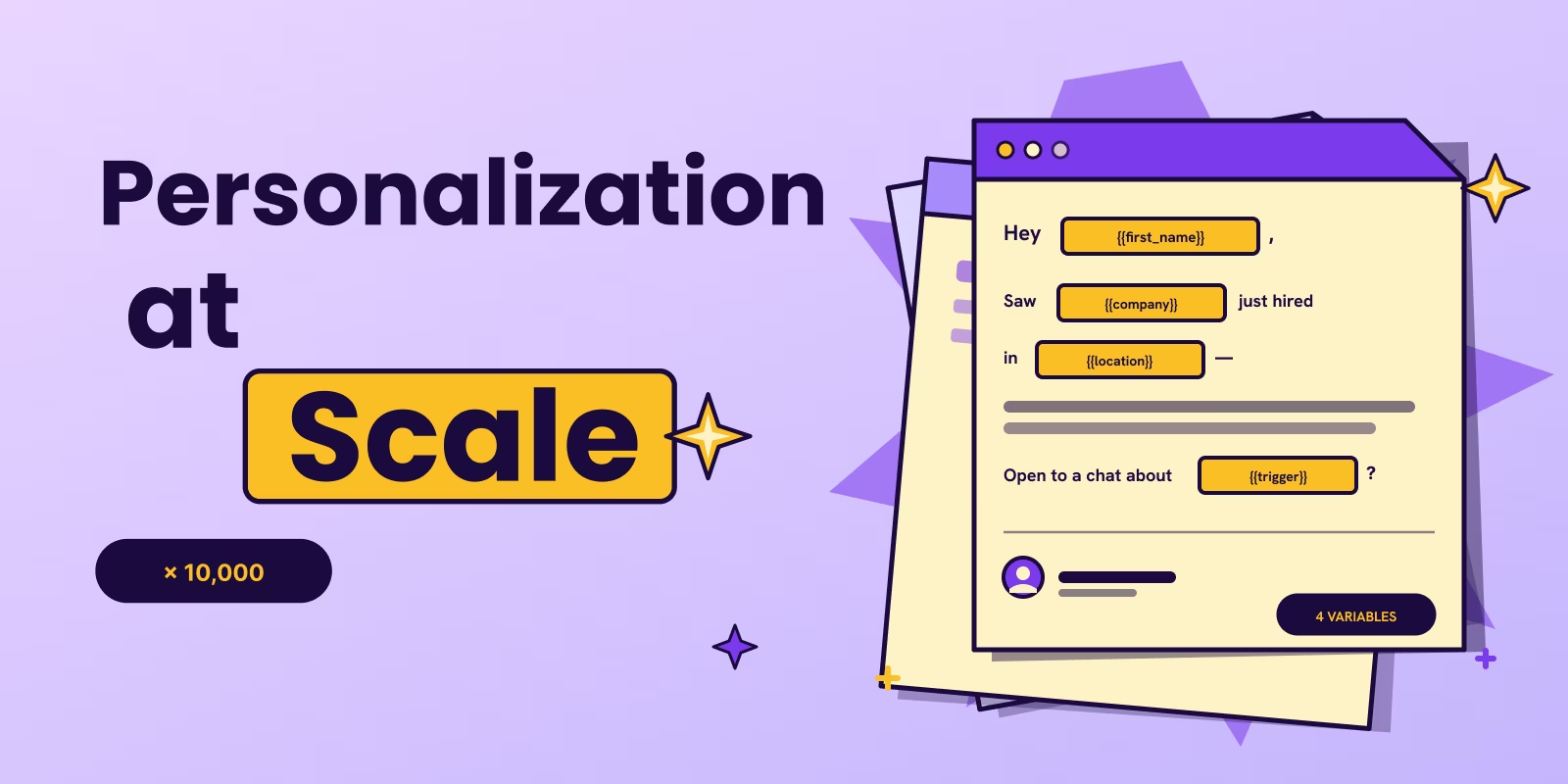
The trigger email opens on the job post, names the problem that comes with it, and offers the snapshot. Each line rotates between three versions, and the role is cut down to one of four values (an SEO manager, a content lead, a growth marketer or a marketing lead) so it always reads naturally.
LinkedIn alongside email
On LinkedIn, the connection request goes out with no note. Once accepted, four short messages follow over about two weeks. About 14% to 16% of requests are accepted.
- Request
Sent blank, with no note. Withdrawn after 21 days if not accepted.
- Day 1
Thanks for connecting, first name. Quick one, have you looked where company stands when people search for company type on ChatGPT/Perplexity yet?
- Day 4
I asked because we've been doing this for a while, and the gap between who AI names and who it doesn't is usually quick to close. If my team put together an audit of where you stand in LLM rankings, would you be interested?
- Day 9
I could also share a few case studies if that helps? Or should I reach out to colleague instead?
- Day 16
Hi first name, if getting cited by AI isn't a priority right now, no worries. Glad to be connected!
A Slack ping for every interested lead
Reachly handles the replies until a lead is interested. Then RedEngage's sales rep gets a notification in Slack and picks up the conversation.
They just get a notification in our Slack channel. They know it's an interested lead and they need to respond ASAP. Doing all of that in-house would take us a crazy amount of time.
Michal HajtášFounder, RedEngageThe Results
- 5+ a weekMeetings booked, up from 1 to 2 a week before
- ~32,200Touches sent: ~26,800 emails and ~5,400 LinkedIn requests
- 1.78%Best email reply rate (Canada, video offer)
Before Reachly, RedEngage booked 1 to 2 meetings a week. It now books 5+ a week, and Michal says most of them are a strong fit for its ICP.
Positive replies grew as the campaign scaled into new markets and the weaker offers were cut:
- Month 2: ~11 positive repliesThe testing phase. Offers, audiences and markets were all still being split-tested.
- Month 3: ~13 positive repliesReplies kept climbing as the campaign scaled into more markets.
- Month 4: ~22 positive repliesDouble month 2.
- Month 5, first 9 days: ~11 positive repliesAs many in nine days as in all of month 2.
I knew we had to be patient. But I'm very impatient, generally speaking, so I struggled to keep trusting the process. Then the results started coming in.
Michal HajtášFounder, RedEngageClosing Thoughts
RedEngage sells something many buyers have only just heard of. Ads reached people who were curious about GEO. Outbound reached companies that had just raised money, grown fast or hired someone to own search, at the moment the question became their problem.
The offer mattered as much as the timing. No single message won everywhere, so Reachly tested it per market and per signal, and kept the version each audience replied to.
I feel like I am lighter. I don't have that burden on my shoulders.
Michal HajtášFounder, RedEngageWhy Reachly?
RedEngage chose Reachly after an ads agency spent three months without booking a call. Reachly said up front that outbound starts with testing, then ran the lists, the signals, the copy and the replies, so RedEngage's sales rep only steps in when a lead is interested.