

Discover the best time to send cold email: Tuesday to Thursday, 8–11 a.m. local time, with reply rate and triggers guiding tests.
If you need one default answer for the best time to send cold email, use Tuesday through Thursday, 8:00 a.m. to 11:00 a.m. in the prospect’s local time. Reachly, a B2B outbound lead generation agency, has published that baseline from 400+ campaigns, and Twilio SendGrid’s 2023 benchmark report points the same direction: business-hour sends beat overnight sends, and weekends are weak.
TL;DR: Summary
- The best time to send cold email is usually Tuesday through Thursday, 8:00 a.m. to 11:00 a.m. in the recipient’s local time, and Reachly’s published guidance from 400+ campaigns supports that baseline.
- A real trigger inside 72 hours beats any fixed send slot, so funding, hiring, leadership changes, or relevant LinkedIn activity should move you faster than a calendar rule.
- Judge send-time tests by reply rate first, not open rate, because Apple Mail Privacy Protection makes opens noisy.
- Avoid weekends and very early hours. Twilio SendGrid reported the biggest engagement drop from 2 a.m. to 6 a.m. and stronger unique opens during normal business hours.
- If your campaign has 0 percent replies, timing is probably not the first issue. Check infrastructure, subject line, length, tone, and offer before you keep changing the clock.
There is no single magic minute that saves a weak sequence. Timing matters, but it sits behind list quality, inbox placement, and the offer, so the right move is to start with the proven morning window and only break it when your data or a real buying signal gives you a reason.
What does the cold email timing data actually say?
The public data points to one baseline: Reachly’s 400+ campaign guidance and Twilio SendGrid’s 2023 report both favor prospect-local business hours, with midweek mornings standing out for cold outreach.
Use this timing chart as your starting point. Public note: the agency’s published guidance gives the winning windows, not hour-by-hour percentages, so the table below sticks to what is supported in public material released from April 10, 2026 through September 2026.
[markdown] | Source | Sample and date range | Strongest supported window | Weak window | What to trust most | | --- | --- | --- | --- | --- | | Reachly published guidance | 400+ B2B campaigns, public timing guidance published Apr 10, 2026 to Sep 2026 | Tuesday to Thursday, 8:00 a.m. to 11:00 a.m. local time | No public recommendation for weekends or off-hours | Open and reply trend together | | Reachly follow-up guidance | Public guides published Apr to Sep 2026 | Late morning local time, with Wednesday strong for follow-ups | Waiting a full week after an engagement signal | Reply behavior | | Twilio SendGrid 2023 | 2023 benchmark report | Business hours, 9:00 a.m. to 6:00 p.m., Monday highest opens | 2:00 a.m. to 6:00 a.m., weekends low volume | Unique opens, not cold-email reply quality | [/markdown]If you are tuning an active sequence, the takeaway is simple. Start with prospect-local morning sends, then test weekday differences inside that zone before you try afternoon or off-hours ideas.
Twilio SendGrid’s data matters here because it gives a sanity check across a much larger email universe. Cold email is not the same as lifecycle email, but both still compete with the same workday rhythm, which is why business hours keep showing up as the safer send band.
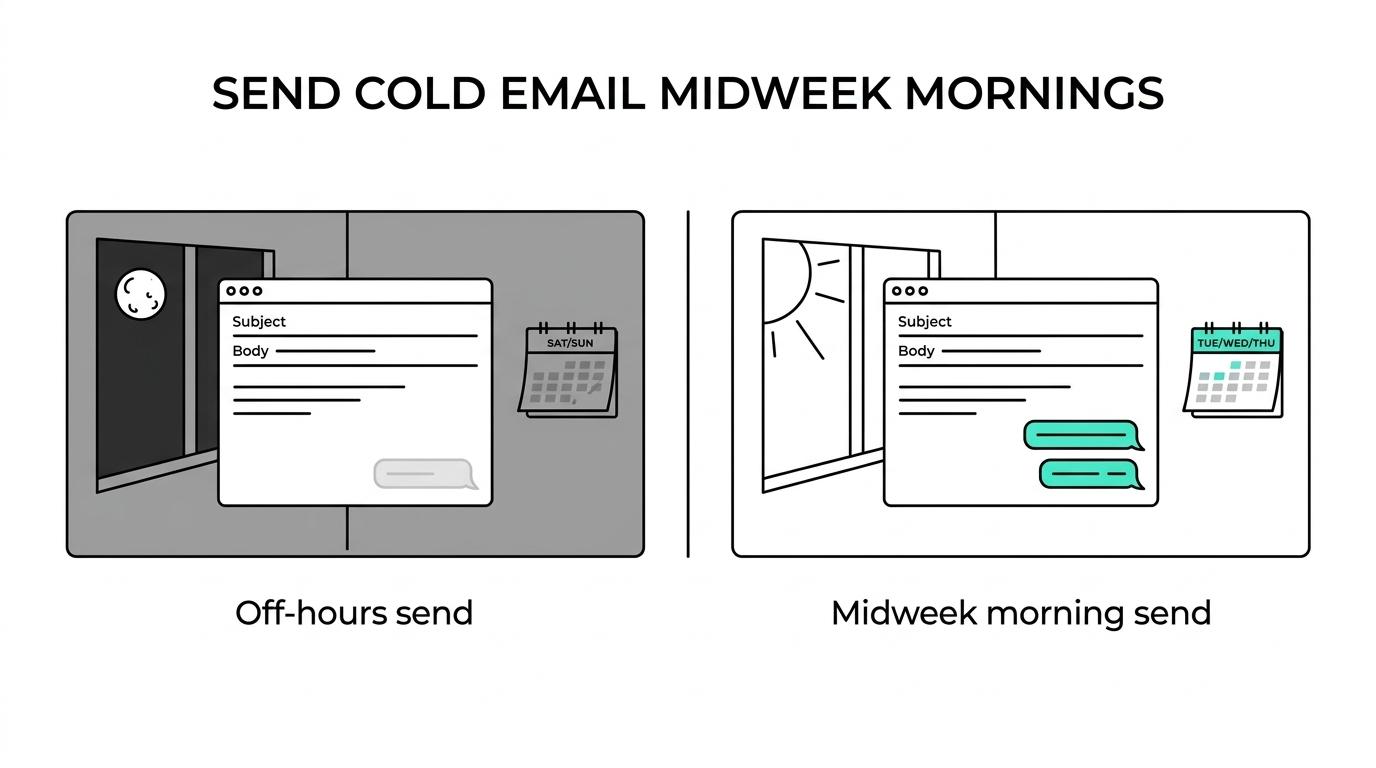
Reachly’s public timing baseline from 400+ B2B campaigns is Tuesday through Thursday, 8:00 a.m. to 11:00 a.m. in the prospect’s local time.
What is the best time to send cold email if you need one default?
The safest default is Tuesday through Thursday, 8:00 a.m. to 11:00 a.m. in the prospect’s local time.
That window fits how people actually work through email. You catch them after the inbox first loads, but before the afternoon turns into meetings, Slack, and internal follow-ups. For cold outreach, that matters more than chasing the absolute highest open rate.
A common mistake is copying marketing-email advice and sending at 3:00 p.m. because it is a popular bulk-email hour. Twilio SendGrid did report 3:00 p.m. as the most popular send hour across weekdays, but popularity is not the same thing as reply quality for a cold message from a stranger.
If your list is executive-heavy, do not read that as permission to guess an earlier slot without data. Stay inside the 8:00 to 11:00 a.m. band first, then test from there.
What are the first cold email send windows you should test?
Test four windows first. Keep the audience, offer, copy, and subject line stable so the clock is the only real variable.
These are the first windows worth testing before you get fancy:
- Tuesday, 8:00 a.m. to 11:00 a.m. local: best starting point for first-touch cold email.
- Wednesday, 8:00 a.m. to 11:00 a.m. local: strong control day for reply-heavy inbox behavior.
- Thursday, 8:00 a.m. to 11:00 a.m. local: useful when Tuesday and Wednesday sending capacity is full.
- Monday, late morning local: better test for follow-ups than for brand-new outreach.
Do not split traffic across ten send slots in week one. You need enough volume in each bucket to see a real pattern, and most teams destroy signal by testing too many tiny batches.
Is the best day to send cold email Monday or midweek?
Midweek is the better default for first touches. Monday can post high open rates, but inbox-clearing behavior is not the same as reply intent.
This is where people get tripped up. Twilio SendGrid found Monday had the highest open rate among weekdays, but cold email is not trying to win an open alone. You need a reply, and Monday inboxes are full of catch-up traffic, internal threads, and meeting prep.
For follow-ups, Monday late morning can still make sense. For first touches, Tuesday through Thursday is the cleaner baseline because the recipient is back in work mode without the Monday pileup.
Reachly treats a trigger inside 72 hours as more important than a perfect fixed send slot.
Should you judge cold email send time by open rate or reply rate?
Use replies first and opens second. Apple Mail Privacy Protection makes open rates noisy, while replies show whether the timing and offer earned attention.
Open data still has value, but only as a directional clue. If one send window gets more opens and fewer replies, that window did not win. It just got seen more often.
[markdown] | Metric | Useful for | Weakness | What to do with it | | --- | --- | --- | --- | | Reply rate | Comparing real send-time performance | Needs enough volume to stabilize | Primary decision metric | | Open rate | Spotting broad inbox placement shifts | Distorted by Apple Mail Privacy Protection | Secondary clue only | | Out-of-office replies | Confirming inbox placement | Not a buying signal | Use as a deliverability check | [/markdown]If you want a fuller benchmark view, compare your numbers against cold email benchmarks for 2026. Pro tip: out-of-office replies are underrated. They often tell you your email is landing in the inbox even when positive replies are still lagging.
How should you schedule send time across time zones?
Schedule by the prospect’s local time, not yours. A good 10:00 a.m. send in New York becomes a bad lunchtime or after-hours send somewhere else.
Step 1: Split your list by recipient time zone before you queue anything. If a sequence tool only lets you send in account time, build separate batches for North America, UK and Europe, APAC, and any outliers.
Step 2: Keep the send window narrow. A three-hour band from 8:00 a.m. to 11:00 a.m. is enough. If you spray the same campaign across the whole workday, you are no longer testing timing.
Step 3: Watch sample size before you declare a winner. If Tuesday got 800 sends and Thursday got 120, you do not have a clean read yet.
The misconception here is that local time is a nice extra. It is not. A cold email arriving during a commute, lunch, or after-hours quiet period is a different test entirely.
When should you ignore the schedule and send on a trigger instead?
Reachly treats a real trigger inside 72 hours as more important than a perfect Tuesday 10:00 a.m. slot.
This is the exception that matters most. If a company just raised, started hiring for your category, changed leadership, swapped tech, or showed website behavior that fits your offer, speed matters more than calendar purity.
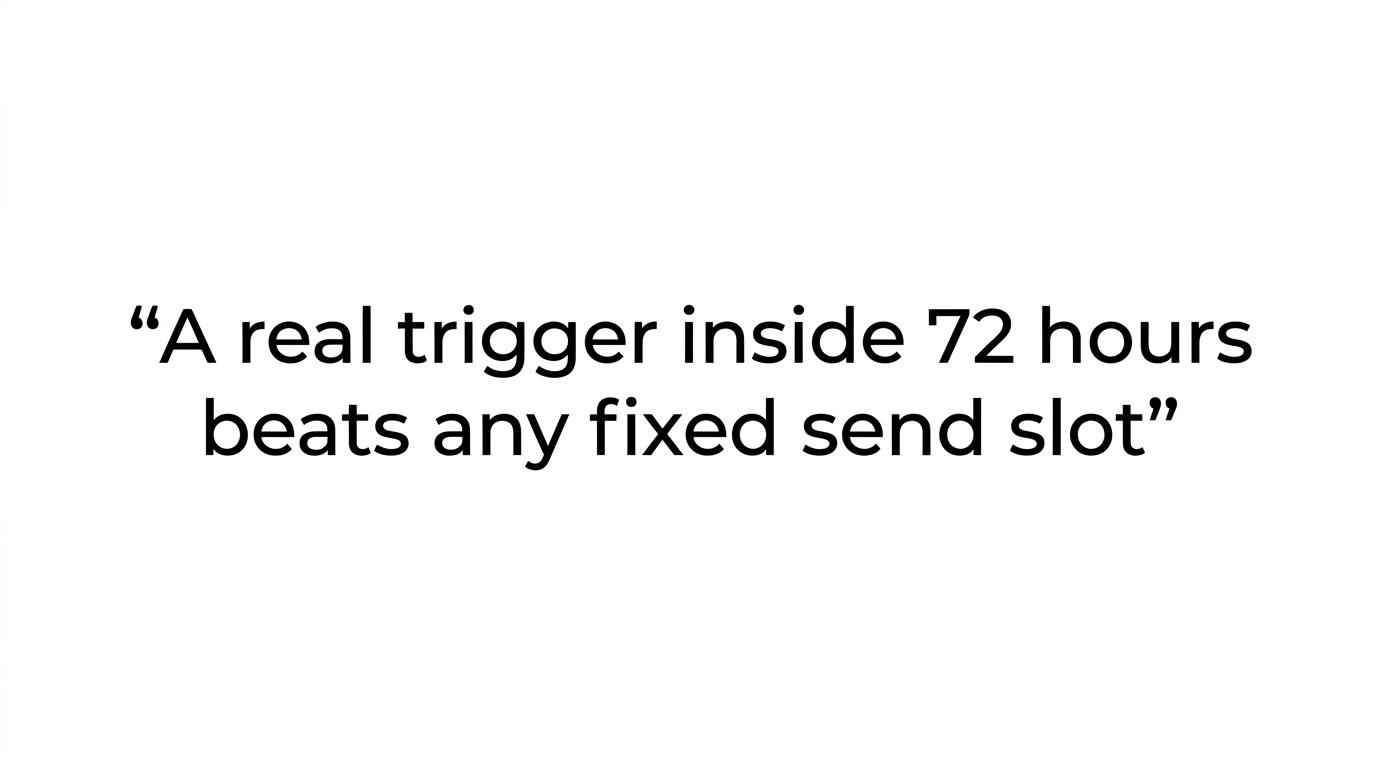
Use simple if-then logic. If the signal is fresh and relevant to your offer, send now in the prospect’s local business hours. If the signal is older than a few weeks, go back to your normal timing baseline because the context is cooling off.
The shelf life matters. Buying signals often decay in 2 to 4 weeks because competitors notice the same event. That is why a trigger-based send with a real reason to write will usually beat a perfectly timed generic email.
How do you test send time without hurting deliverability?
Test one variable at a time. Google and Outlook care more about domain health, authentication, and volume stability than your favorite send hour.
That priority matches the way SRS Networks writes about business email compromise, where spoofing controls and authentication matter because mailbox providers weigh trust signals long before they reward a perfectly timed campaign.
Start with infrastructure. SPF, DKIM, DMARC, and a custom tracking domain are not optional. Then make sure any list older than 3 months gets re-validated before sending.
Keep sending caps realistic. The current working caps many teams use are about 15 emails per day per Google mailbox and 10 to 12 per Outlook mailbox. Warm new domains for 30 days, not 7, because rushing warmup is still one of the fastest ways to break a decent campaign.
A useful rule: if your bounce rate climbs above the under-3-percent target while you test timing, the problem is not the clock. It is list quality, verification, or infrastructure. This is also where a dedicated outbound lead generation system helps, because the timing test only means anything when the sending setup is clean.
Does send time matter more than the offer or follow-up timing?
No. Offer and targeting matter more than timing, and follow-up timing matters more than chasing one magic hour.
There is solid proof for this. One Series A client sending 20,000 to 30,000 emails a month moved reply rate from 0.5 percent to 1 percent, then up to 1.6 percent, after changing to direct, question-based copy, a lead magnet, and a stronger offer. That change mattered more than a send-time tweak.
Cold email is a reply-first channel. No reply, no meeting. So if your email gets seen and still does nothing, changing Tuesday 9:30 to Wednesday 10:15 is probably not the fix.
Follow-up timing still matters, though. The cleaner pattern is short: two emails, 6 to 7 days apart, then stop and come back 1.5 to 2.5 months later with a new angle. If you want the cadence piece, read automated email follow-ups.
Who should stop worrying about cold email send time and fix something else first?
If you are at 0 percent replies, timing is probably not the first problem. Check infrastructure, subject line, length, tone, and offer before you keep changing the clock.
Here is the fast diagnostic view:
[markdown] | Symptom | Likely issue | First fix | | --- | --- | --- | | 0 percent replies, including no out-of-office | Infrastructure or inbox placement | Check authentication, warmup, reputation | | Opens look fine, replies are flat | Offer or CTA | Rewrite the ask and the reason to care | | Bounces are rising | Bad data or stale list | Re-verify, replace bad records | | Positive replies are weak after 1,000 sends | Market said no to the angle | Change offer or audience | [/markdown]Another common misconception is that longer sequences fix weak timing. Usually they just burn more volume. Fix the first email, the offer, or the audience before you add more touches.
Use Tuesday through Thursday, 8:00 a.m. to 11:00 a.m. local time as your baseline, and break the rule only when a real trigger lands inside 72 hours or your own reply data proves another window works better. If you want another operator’s view on timing, copy, and deliverability together, Reachly’s outbound lead generation services show the system, and that is the right place to book the meeting.