Outbound sales scripts that win replies stay short: one cold email, one follow-up, a LinkedIn handoff, and a phone opener.
The outbound sales script that gets replies is usually shorter than you think. A good version is one cold email at 70 to 80 words, one follow-up 6 to 7 days later, a LinkedIn handoff if they stay quiet, and a phone opener that asks for relevance instead of asking to book the meeting.
If your team keeps rewriting scripts but reply rates stay flat, the issue is rarely a missing clever line. It is usually one of five things: bad infrastructure, a weak offer, an audience mismatch, a message that is too long, or follow-up that keeps hitting the same channel after the buyer already ignored it.
What makes an outbound sales script get replies?
The pattern is boring, which is why it works. Short message. One clear reason to write. One ask that feels cheap to answer.
That matches what the data says.
[markdown] | Source | Year | Finding | Why it matters | | --- | ---: | --- | --- | | LinkedIn Sales Solutions | 2026 | InMail has a 10 to 25% hit rate for responses, and the same content can outperform email because it reaches the buyer in more than one inbox | LinkedIn works best as part of a multichannel sequence | | LinkedIn Help | 2024 | LinkedIn recommends brief, personalized messages framed as conversation starters | Your LinkedIn script should not read like a pitch deck | | Economics of cold emailing | 2025 | The paper cites a 23.9% open rate and an 8.5% reply rate, with personalization lifting response rates by up to 32.7% and question-based subject lines by 21% | Short, structured, personal outreach beats generic volume | | Reachly | 2026 | Two emails per prospect, then LinkedIn handoff, then a fresh sequence later | More follow-up in the same inbox is rarely the answer | [/markdown]The strongest scripts do three jobs well:
- state one reason for the message
- make the offer easy to understand
- ask for a reply, not a meeting
That last point matters more than most teams think. The goal of a cold email is a reply. No reply, no meeting.
How short should your cold email script be?
Short enough to read on a phone in one pass. That is the rule.
Thibault Garcia, founder of Reachly, puts it this way: “Sixty to eighty words. If it does not fit on an iPhone screen in one go, it gets cut before it goes out.”
A useful cold email script has four parts. The opener is a signal or a real reason you found them. The second line names the problem behind that signal. The third line makes a concrete offer. The fourth line asks for permission to continue.
Here is a simple version:
subject: hiring in sales
hi {{first_name}}, saw your team is hiring AEs in the US.
usually that means pipeline pressure shows up before new reps ramp.
we help B2B teams book qualified meetings through cold email, LinkedIn, and cold calling using signal-based targeting.
if I recorded a quick teardown of your outbound offer, could I send it over?
This works better than a longer script because it does not ask a stranger to book the meeting on touch one. Garcia has a blunt line on this: “A first email that asks for a meeting is asking a stranger for the most expensive thing they own, which is their time. Ask for something cheap first.”
The follow-up matters too, but only one of them. Reachly’s highest-reply line is:
Would this be something of interest, or does {{subject}} sit with {{colleague_name}}?
It works because it does not corner the buyer. They can say yes, no, or route you to the right person.
This is also where the offer shows up as the real lever. One Series A client sending 20,000 to 30,000 emails a month moved reply rate from 0.5% to 1%, then to 1.6%, after switching to direct, question-based copy with a lead magnet and a stronger offer. Same market. Better offer.
That is why scripts alone do not save weak outbound.
What should your LinkedIn script say after no email reply?
Your LinkedIn script should feel like a channel switch, not a brand new pitch.
Reachly’s opener after connection acceptance is simple: “I reached out via email but thought it’d be easier to chat here.” That works because it sounds like a person, not a sequence tool.
A basic LinkedIn handoff looks like this:
i reached out via email but thought it’d be easier to chat here.
open to a quick idea on how teams use hiring signals to book more qualified meetings?
Keep it lowercase. Keep it short. Wait 1 to 3 days after acceptance before sending it. And do not add a connection note unless you have a real reason. In most campaigns, an empty connection request performs better than a forced note.
The cost here is time and channel hygiene. HeyReach help with workflow, but the script still needs a human pass. Reachly treats LinkedIn as a precision touch, not a second place to dump the same paragraph from email.
When the setup is right, the numbers are worth it. Reachly uses a 25% connection acceptance rate as the baseline benchmark. A Thailand pilot hit 35%, with LinkedIn reply rate up to 47%.
What should a phone script sound like after email and LinkedIn?
Cold calling still works, but not as a first-touch volume play.
The phone script should assume they might recognize your name from email or LinkedIn. That lets you skip the fake small talk and get to the point in 15 seconds.
Try this:
Hi {{first_name}}, this is {{your_name}} from {{company}}.
I sent you a note last week about using {{signal}} to book more qualified meetings.
Quick reason for the call, is this something you own, or does it sit with someone else on the team?
If they say they own it, do not launch into your company history. Use the next line to earn permission.
Got it. We had one idea based on {{signal}}. Worth sending a short note on it?
That is enough.
The cost of phone is rep time and good data. A bad direct dial list wastes both. Cold calling works best when it comes after cold email and LinkedIn, and when the rep already knows the signal, the offer, and the routing path.
When should each outbound sales script go out?
Timing matters because intent signals have a shelf life. In most markets, you have 2 to 4 weeks before the moment gets stale or someone else gets there first.
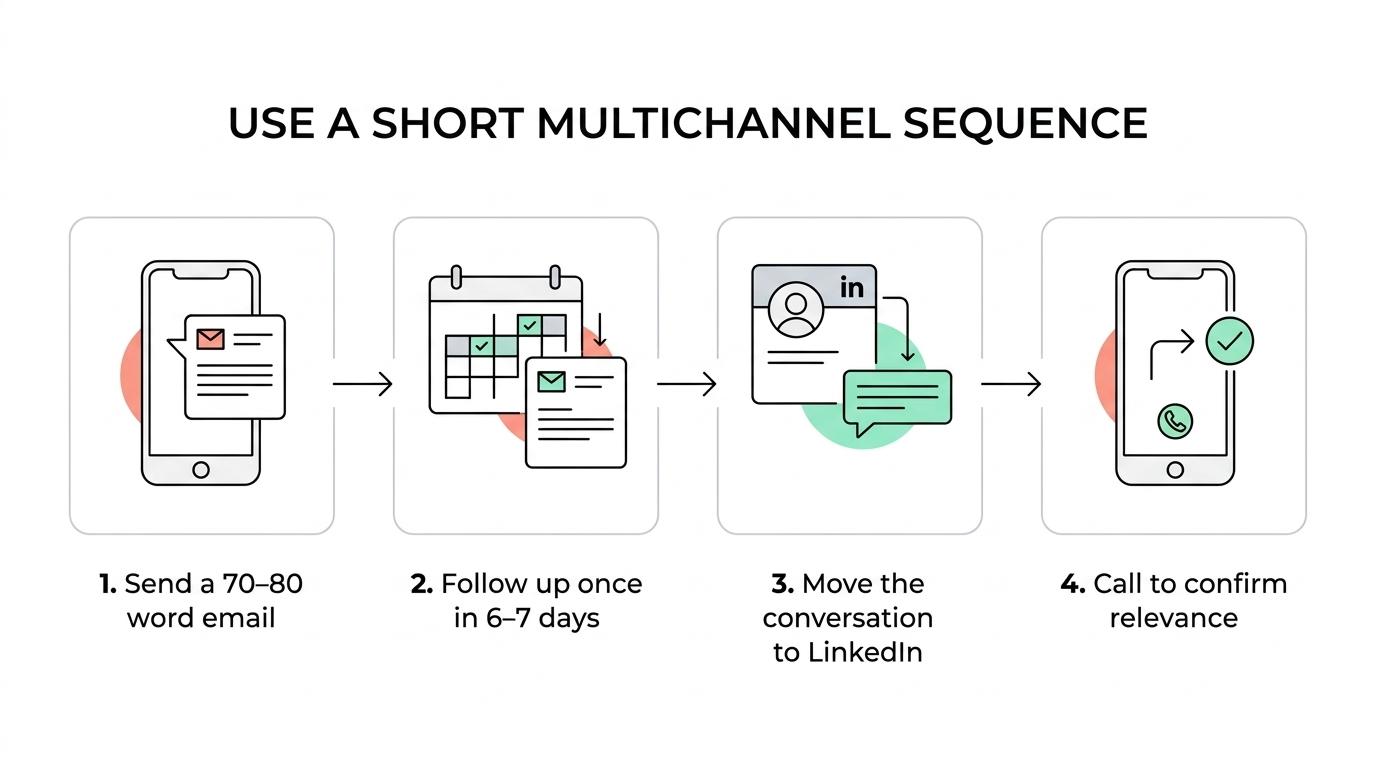
Reachly’s wider multichannel flow includes LinkedIn, email, and phone inside 12 days. The email side stays tight. Two emails, 6 to 7 days apart, then stop. Long email sequences usually hurt more than they help.
[markdown] | Day | Channel | Script job | | ---: | --- | --- | | 1 | LinkedIn visit and connection | Show up before the message | | 1 | Email #1 | Use the signal, problem, offer, soft ask | | 6 or 7 | Email #2 | Use the routing follow-up | | 8 to 10 | LinkedIn message | Handoff from email after acceptance | | 12 | Cold calling | Confirm relevance and ask permission to send more | | 45 to 75 | Fresh sequence | New angle, new offer, same list if still relevant | [/markdown]This is also why list age matters. Any list older than 3 months should be re-validated before send. Otherwise you are testing copy on dead data and blaming the wrong thing.
If you want the full process behind that cadence, not just the lines, Reachly lays it out in its outbound lead generation services and LinkedIn outreach agency pages.
Which outbound sales script mistakes kill reply rates?
Most bad scripts fail in the same few ways.
They are too long. They ask for too much. They pretend personalization means dropping in a company name. Or they were written end to end by AI and never cleaned up.
Watch for these mistakes:
- Too long: if the email needs scrolling on mobile, cut it
- Too many asks: demo, referral, meeting, deck, and case study all in one message
- Fake personalization: guessed tech stack, generic “noticed your company is in X industry”
- Wrong channel order: four emails before one LinkedIn touch
- AI did the full writing: fine for signal snippets, poor at voice, timing, and buyer context
When a campaign shows 0% replies, do not rewrite the copy first. Reachly checks in this order: infrastructure, subject line, length, tone, offer. Bounce rate should stay under 3%. Deliverability score should stay above 97%. If people are replying “not interested,” the technical side is probably fine and the offer needs work.
The proof from live campaigns backs that up. Primal averaged an 8% positive reply rate and generated 85+ SQLs in 6 months. The Great Room moved face-to-face meetings from 2 per quarter to 2 per month with zero added headcount. The scripts mattered, but they only worked because the offer and audience were right.
Who should skip a scripted outbound motion?
Not every business should run this.
If your average contract value is under $5,000, founder-led outreach is usually the better move early on. If your TAM is tiny, automation just burns the list faster. If you do not have product-market fit, outbound becomes an expensive guessing exercise.
Outbound also multiplies the sales process you already have. If there is no process, nothing useful gets multiplied.
That is why the best scripted outbound motions sit on top of a clear offer, a known ICP, and a team that can handle replies fast.
What should you do next if your script is underperforming?
Start with one audit pass, not a rewrite sprint. Check inbox placement. Check list quality. Cut the email to 80 words or less. Remove every link from the first email. Then ask the harder question: is the offer good enough that someone would reply even if they were not ready to buy today?
If you want a second set of eyes on the whole motion, not just the copy, Reachly can review the offer, the signals, the sequence, and the channel handoff through its outbound lead generation services and B2B appointment setting services. If the numbers already look healthy and you just need more qualified meetings booked, you can book the meeting with Reachly from those pages.
The pattern is simple. Keep the email short, send one real follow-up, move the conversation to LinkedIn, then use phone to confirm relevance. If replies are healthy but positives are dead, rewrite the offer. If replies are dead, check deliverability before you touch the script.
- Email wins with 60 to 80 words, one signal, and one soft ask
- LinkedIn works best as a handoff, not a repeat pitch
- Phone works best after prior touches, with a routing question instead of a pitch