

Learn when an ai sdr outperforms a human SDR, what AI BDRs actually automate, and which metrics matter most for booked meetings.
An AI BDR is not a better SDR by default. It is software used to automate top-of-funnel work like prospecting, first-touch drafting, lead qualification, and meeting booking, and the only useful comparison is what it actually books. Reachly, a B2B outbound agency running signal-based programs across cold email, LinkedIn, and cold calling, judges that choice on positive replies and meetings booked, not on how busy the inbox looks.
TL;DR: Summary
- An AI BDR usually means software automating outbound prospecting and qualification; an AI SDR is often the same category with different labeling, while a human SDR adds judgment on offer, timing, and objection handling.
- The real test is not total reply volume. It is positive reply rate and meetings booked rate. Reachly uses 4% to 6% positive reply rate and 2% to 3% meetings booked rate as healthy outbound targets.
- In one published Reachly campaign example, reply rate improved from 0.5% to 1% and then 1.6% after generic copy was replaced with direct, question-based messaging and a stronger offer, which is the core limit of AI-drafted outbound.
- Pause the test if bounce rate goes above 3%. Kill an angle after 1,000 emails with no positive replies, even if people still reply.
- If your TAM is small, ACV is high, or the offer needs judgment, keep a human in the loop. If the market is broad and the ask is simple, AI can handle more of the repetitive work.
Salesforce’s definition is the cleanest place to start: SDR work sits at the top of the funnel and includes prospect data gathering, education, qualification, and meeting booking. That is also the task set AI sales agents try to automate. If you are comparing software vendors rather than operating models, use our AI SDR tools guide. This page is about what each model actually produces once you send real outbound.
What is an AI BDR?
An AI BDR is software that handles parts of prospecting, qualification, and meeting booking that sit before a buyer is ready to talk to an account executive. It is a workflow layer, not a full seller.
In practice, that means the system may pull leads, enrich accounts, draft first touches, send follow-ups, classify replies, and route interested prospects. Some products also try to handle calendar booking and basic FAQ replies.
That sounds close to SDR work because it is. Salesforce describes SDRs as people handling top-of-funnel activities before a prospect is ready to buy. The useful shift is this: once you use AI, the job is no longer “Did it send?” but “Did it create qualified replies and book the meeting?”
How is an AI BDR different from an AI SDR?
Most of the time, AI BDR and AI SDR are category labels, not different operating systems. The real difference is whether the workflow is tied to outbound prospecting, inbound qualification, or both.
Some teams use BDR for outbound and SDR for inbound. Others flip it. Some vendors use whichever acronym buyers search more. That means the label tells you less than the handoff point.
Ask three specific questions before you buy. Does the system only draft and send? Does it classify replies? Does it stop at interest, or does it qualify and book the meeting? Common misconception: the acronym tells you the capability. It usually does not.
"Reachly treats 4% to 6% positive reply rate and 2% to 3% meetings booked rate as the bar for a healthy outbound campaign."
If the answer to those questions is vague, you are not comparing reps. You are comparing automation layers.
What are the three buying models behind the phrase “AI SDR”?
The market usually compresses three different things into one phrase. You need to separate them before you compare performance.
- AI drafting layer: Software writes or rewrites outbound touches inside a human-run sequence.
- AI workflow agent: Software prospecting, sending, reply classification, routing, and booking happen in one automated flow.
- Human SDR with AI snippets: A person runs the process, while AI helps with signal-based openers, research notes, and admin.
These are not small differences. Model one changes writing speed. Model two changes process ownership. Model three keeps judgment with a person and uses AI on the repetitive parts.
When does an AI BDR beat a human SDR?
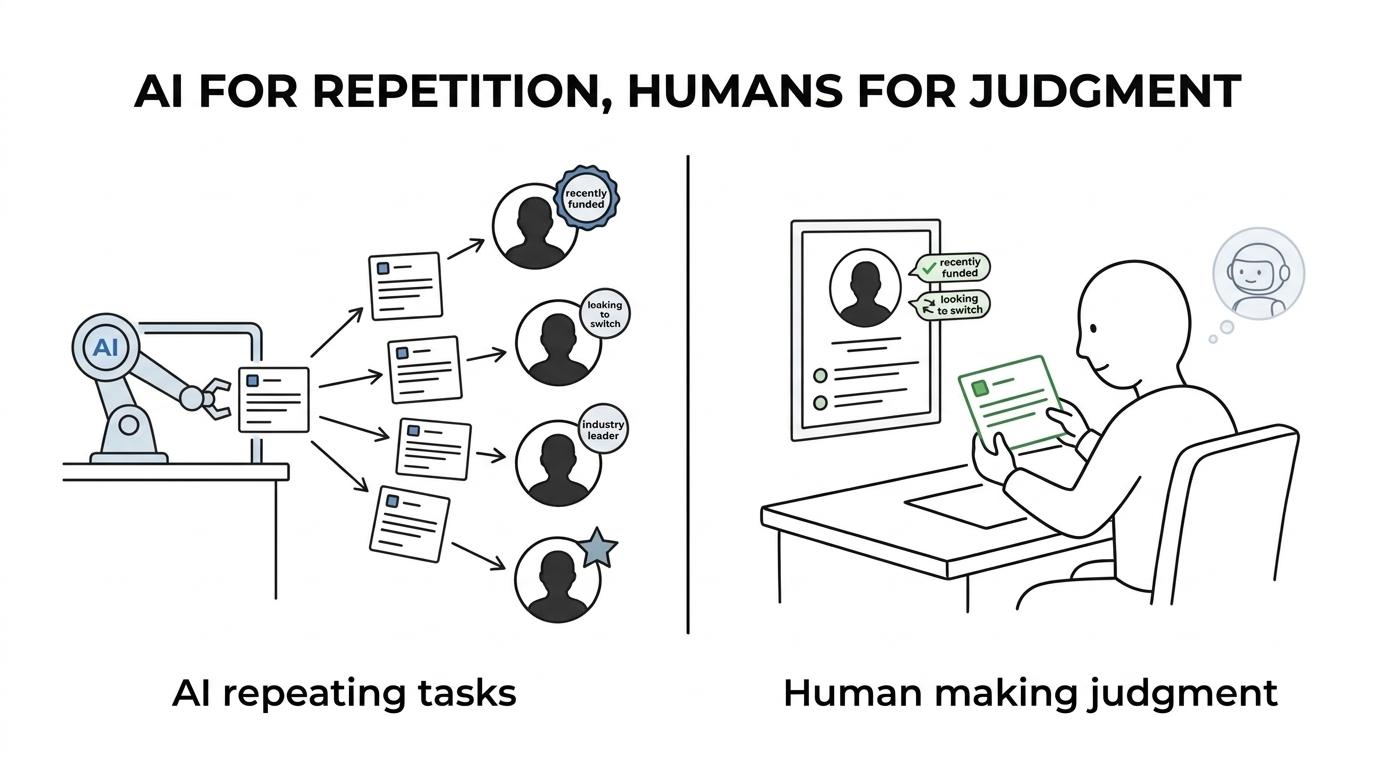
An AI BDR wins when the market is broad, the offer is already working, and qualification rules are simple. It does best when repetition matters more than judgment.
If you sell into a large TAM, route to one buyer type, and ask for a low-friction next step, AI can handle more of the surface area. That includes first-pass research, repetitive follow-ups, basic routing questions, and meeting scheduling.
The trade-off is simple. AI moves faster through known patterns, but it is weak at diagnosing why a prospect should care in the first place. Common mistake: teams buy AI to fix a weak offer. If the offer is weak, you just send weak messaging faster.
A good rule is this. If a human already found message-market fit on a small segment, AI can help carry that motion. If nobody has found that fit yet, keep a human close to the copy and the replies.
When does a human SDR beat an AI BDR?
A human SDR wins when the offer is nuanced, the TAM is tight, or the buyer path is messy. Judgment matters most in high-ACV and multi-stakeholder sales.
That is why human-led outbound still tends to outperform on narrow markets, founder-led sales, and deals where timing and context change the whole message. A person can decide when a funding signal matters, when hiring is the real trigger, and when the right move is not a meeting ask at all.
You can see that gap in real outbound outcomes. In Primal’s case study, the campaign produced 85+ SQLs in six months with a 4.57x ROI and an 8% positive reply rate. In The Great Room’s case study, face-to-face meetings moved from roughly two a quarter to two a month, with more than $250,000 in contract value closed. Those results come from signal choice, offer clarity, and reply handling, not just sequence automation.
"Reachly pauses a campaign when bounce rate rises above 3% and shuts an angle down after 1,000 emails with no positive replies."
How do AI BDR, AI SDR, and human SDR compare on what they actually book?
They book different kinds of meetings under different conditions. The right comparison is not activity volume. It is booking quality under your sales motion.
[markdown] | Option | What it books well | What breaks first | Best fit | | --- | --- | --- | --- | | AI BDR | Low-friction meetings where qualification rules are clear | Weak offers, messy buyer committees, ambiguous signals | Broad TAM, simple routing, repeatable outbound | | AI SDR | Usually the same as AI BDR, unless your team uses SDR for inbound qualification | Same issue: label confusion hides the handoff point | Teams combining outbound and inbound triage | | Human SDR using AI snippets | Higher-context meetings where signal judgment changes the opener | Throughput, not message quality | Mid-market and enterprise outbound | | Human SDR without AI | Very precise outreach on small lists | Speed and admin time | Founder-led sales, niche ICPs, tiny TAM | [/markdown]If you are selling to one title with one pain and one next step, the AI side gets more attractive. If you need to read account context, switch angle by segment, and qualify across multiple stakeholders, a human wins more often.
Pro tip: do not score success on meetings alone. Det er også pointen i Partner Dialogs gennemgang af kvalitetssikring af mødebooking, hvor svage møder, no-shows og manglende bekræftelsesflow bliver beskrevet som et direkte kvalitetstab, selv når aktivitetsniveauet ser højt ud.
What did Reachly’s campaigns show when AI drafted the sequence?
Reachly saw AI-drafted copy create activity, but not enough qualified momentum on its own. In one Series A campaign, reply rate moved from 0.5% to 1% and then 1.6% after the sequence was rewritten with a clearer offer and direct, question-based copy.
That result matters for one reason. The change was not “AI off, human on” in the abstract. The real change was offer quality and message clarity. AI can produce a readable email. It usually does not create the sharp commercial reason to reply.
This is the gap buyers miss when they compare demos. A sequence can get replies and still book nothing. If the inbox shows “not interested,” “circle back later,” or low-intent curiosity, the system looks active while pipeline stays flat.
The same lesson shows up in the published benchmark. Follow-ups generate 44% of positive replies, but only when the base message deserves a reply. Common misconception: more touches rescue a weak first email. They usually just repeat it.
How should you pilot an AI BDR without burning the list?
Start small, hold variables still, and let a human own quality control. A pilot should answer one question: did this motion produce qualified replies from the right segment?
Step 1: pick one segment under 200 prospects. Keep the account list tight and current. Fresh intent signals beat broad generic lists every time because you are testing message fit, not raw send volume.
Step 2: lock one offer, one CTA, and one buying signal. If you change list quality, offer, copy, and automation all at once, you learn nothing. This is where most pilots fail.
Step 3: let AI draft, but require human approval on first touches and reply handling. AI is useful for signal-driven snippets. It should not be trusted to write the whole commercial case without review.
There is a deliverability cost too. Any list older than three months should be re-validated before send, and any bounce spike above 3% means stop and inspect the data before you send another batch.
What numbers should decide whether the test lives or dies?
Use five metrics and two stop rules. If you judge an AI BDR on open rate or total reply rate alone, you will keep bad sequences alive.
[markdown] | Metric | What to look for | Why it matters | | --- | --- | --- | | Reply rate | Directional only | Shows activity, not buying intent | | Positive reply rate | 4% to 6% target | Tracks real interest better than total replies | | Meetings booked rate | 2% to 3% target | Closest top-of-funnel proxy for pipeline | | Share of positive replies from follow-ups | Watch trend, not vanity | Tells you whether the sequence structure is doing work | | Bounce rate | Pause above 3% | Deliverability stop sign | [/markdown]The stop conditions are equally important. A sequence should stop on reply, bounce, unsubscribe, or suppression match. That prevents over-mailing and protects domain reputation.
Then use one kill rule for the angle itself. If 1,000 emails go out with no positive replies, the market answered you. Stop rewriting subject lines and fix the offer, the audience, or both.
How do you choose between an AI BDR, an AI SDR, and a human SDR?
Choose based on failure point, not trend. The right model depends on whether your problem is throughput, qualification, or message-market fit.
Step 1: diagnose the block. If bounce rate is bad, fix infrastructure and data. If reply rate exists but positives do not, fix the offer. If positives exist but meetings do not, fix qualification and follow-up handling.
Step 2: map the sales motion. If ACV is low to mid, TAM is broad, and the ask is simple, software can take more of the work. If ACV is high, TAM is narrow, or stakeholders are complex, keep a human on the front line.
Step 3: decide who owns judgment. If a rep still needs to decide signal relevance, rewrite angles, and handle objections, then buying an AI BDR is buying an assistant, not a replacement.
The practical read is simple. AI BDR and AI SDR software are useful when the motion already works and you need help with repetition. Human SDRs win when the work still depends on offer design, signal interpretation, and qualification judgment.
If you want a second set of eyes before buying software to automate the wrong part, see how our outbound lead generation services are structured or book a meeting with Reachly. We can tell you whether the block is data, deliverability, offer, or follow-up logic before you commit the list.