


Appointment setting in B2B sales turns targeted outreach into qualified meetings through smart timing, multichannel contact, and clean handoffs.
B2B appointment setting is the process of turning a target account into a qualified meeting with the right stakeholder. Done well, it combines cold email, LinkedIn, cold calling, fast qualification, and a clean handoff to sales. It is not calendar filling. RAIN Group reported in 2024 that 82% of buyers accept meetings with sellers who reach out proactively, which tells you the channel still works when the outreach has a real point.
That point matters more now because buyers do more research before they ever reply. Forrester said in 2026 that 94% of buyers in its 2025 Buyers’ Journey Survey were using AI during the buying process. So the meeting has to earn its place. You are not trying to force attention from zero. You are trying to book the meeting after the buyer has already screened you.
What does appointment setting mean in B2B sales?
Appointment setting sits between prospecting and the sales conversation. You identify the right accounts, reach them with a relevant reason to talk, handle the replies, qualify the interest, and then book the meeting with the person who can move the deal forward.
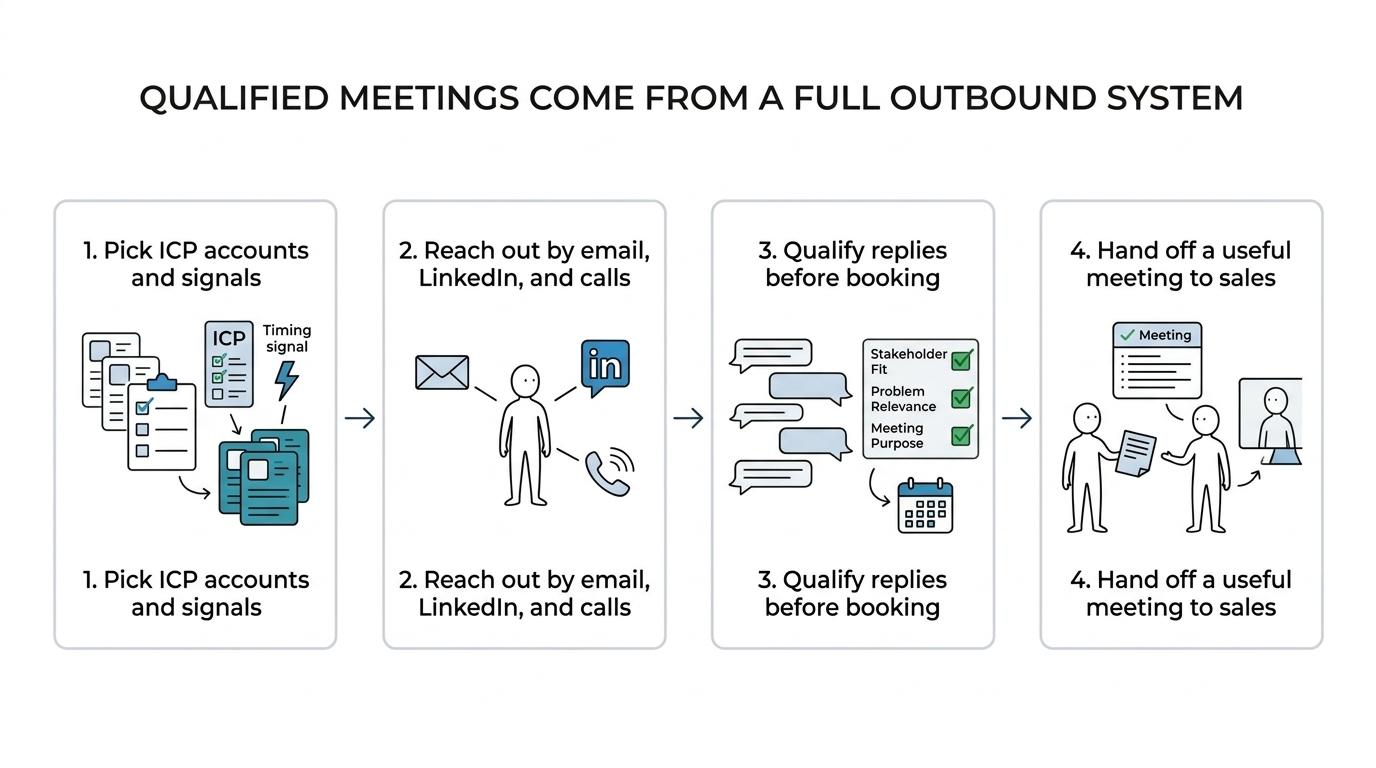
That sounds simple until you run it. The hard part is not finding a calendar link. The hard part is getting the right person to reply at the right moment with enough context for the meeting to matter.
A working B2B appointment setting motion usually includes:
- ICP and TAM mapping
- signal-based account selection
- cold email, LinkedIn, cold calling
- reply handling
- qualification before scheduling
- handoff notes for the sales team
If you remove any one of those steps, quality drops fast. That is why strong appointment setting services look more like an outbound system than an admin task.
Why are booked meetings not the same as qualified meetings?
This is where teams lose months. A rep can put meetings on the calendar and still create almost no pipeline. If the wrong person joins, the pain is weak, or there is no reason to act, the meeting was activity, not progress.
A qualified meeting should have a few basics in place before anyone accepts it:
- a stakeholder who can influence the deal
- a problem tied to your offer
- enough context to make the first meeting useful
- a clear next step if the conversation goes well
There is a big gap between volume and value.
- Bad meeting: junior contact, vague interest, no project, no reason to change
- Good meeting: relevant stakeholder, live pain, timing signal, agreed purpose for the conversation
You can see that difference in real outcomes. In Reachly’s work with The Great Room, face-to-face meetings went from 2 per quarter to 2 per month. More important, drop-off fell to 30% from 50% on paid leads, and the program ran with zero added headcount. That is what good appointment setting looks like. The calendar gets fuller, but the pipeline gets cleaner too.
Why does appointment setting still work with B2B buyers in 2026?
Buyers do not want more vendor noise. They still take relevant meetings when the outreach is timely, credible, and connected to a real business issue.
The research is pretty clear on that point.
[markdown] | Source | Year | Finding | What it means for appointment setting | | --- | --- | --- | --- | | RAIN Group | 2024 | 82% of buyers accept meetings with sellers who reach out proactively | Proactive outreach still opens doors when the message is relevant | | RAIN Group | 2024 | Top performers generate 2.7x more conversions with target contacts | Better targeting and better asks matter more than raw volume | | Forrester Consulting | 2022 | 75% of buyers expect to meet with a vendor’s senior executives before purchase | You need the right internal handoff, not just a booked slot | | Gartner | 2024 | Sales and marketing collaborate on only 3 of 15 commercial activities | Broken handoffs hurt meeting quality before the meeting starts | | Forrester | 2026 | 94% of buyers in the 2025 survey were using AI | Buyers arrive more informed, so your meeting has to add value fast | [/markdown]There is one more shift buried in those numbers. Buyers want access, not just information. They want senior executives, current customers, and proof that the vendor can solve the problem. So appointment setting is no longer about getting any meeting. It is about setting a meeting that the buyer sees as worth their time.
A weak handoff wastes the only shot you had.
How should you run B2B appointment setting across channels?
Single-channel appointment setting leaves money on the table. Some prospects reply to email. Some accept on LinkedIn and answer there. Some never reply anywhere, then pick up the phone on the third touch. That is why the working stack is cold email, LinkedIn, cold calling, in that order.
The timing piece matters just as much as the channel mix. Signal-based outreach works because it catches a buyer when the problem is active. Hiring, headcount growth, leadership change, tech stack change, funding, and LinkedIn engagement are all useful signals. Their shelf life is short, usually 2 to 4 weeks, before the market catches up.
The setup is slower than people expect. Outbound ships in 3 to 4 weeks, not 3 to 4 days. Thirty days of warmup is the safer number because Google adds a yellow banner to mail from any domain younger than 30 days. In 2026, Google sending caps sit at 15 emails per mailbox per day, and Outlook sits around 10 to 12. SPF, DKIM, DMARC and a custom tracking domain are not optional.
A lean appointment setting sequence looks like this:
[markdown] | Day | Channel | What happens | | --- | --- | --- | | Day 1 | LinkedIn and email | Visit profile, send connection request, send Email #1 with a signal opener | | Day 6 or 7 | Email | Send Email #2 with a new angle and a soft ask | | Day 8 to 12 | LinkedIn or phone | Short lowercase message after acceptance, or a targeted cold call | | 1.5 to 2.5 months later | Re-engagement | Revisit the same list with a fresh angle | [/markdown]We keep cold email short. Around 70 to 80 words is the working range in 2026. No links in the first email. AI can help with signal-driven snippets like “saw you just raised your Series A,” but it should not write the whole email. That still needs human QC.
The tool stack supports the process, not the other way around. Clay handles enrichment and signals. Apollo and LinkedIn Sales Navigator help with sourcing. Smartlead handles sending. HeyReach covers LinkedIn execution. ZeroBounce and MillionVerifier handle verification. Any list older than 3 months gets re-validated before it goes out.
If you are building this as a real function, not a side project, the moving parts usually sit inside a broader outbound lead generation system.
What makes an appointment setting campaign healthy?
Start with the numbers that tell you whether people are even seeing and trusting the outreach. Bounce rate should stay under 3%. Deliverability should sit above 97%. If reply rate collapses, check infrastructure before you rewrite copy.
Then look at the meeting path itself. The goal of the first message is a reply, not a meeting. No reply, no meeting. That sounds obvious, but it changes the ask, the tone, and the whole structure of the email.
Thibault Garcia, founder of Reachly, puts it plainly: “The soft ask beats the calendar link every time. ‘If I recorded a video, could I send it over?’ asks for permission instead of asking for thirty minutes of someone’s week.”
That is why hard calendar pushes underperform in cold outreach. You are asking a stranger for their scarcest asset. A better path is a soft ask, a routing question, or a short response trigger that starts a conversation.
On strong campaigns, a 10 to 20% positive reply rate is normal, and 35 to 40% is very good. LinkedIn connection acceptance around 25% is a healthy benchmark. On a Thailand pilot, Reachly hit 35% acceptance and LinkedIn reply rates up to 47%. Those numbers do not matter on their own, though. They matter when they turn into SQLs, pipeline, and signed deals.
That link between meeting quality and pipeline is exactly why offer matters so much. In Reachly’s work with Primal, the campaign generated 85+ SQLs in 6 months, signed 6 deals, hit 4.57x ROI, reduced CAC by 35%, and averaged an 8% positive reply rate. The meeting was not the finish line. It was the gateway to revenue.
When should you skip outsourced appointment setting?
Not every company should buy this.
If your average contract value is low, your market is tiny, or your sales process is still being figured out, outsourced appointment setting is usually the wrong move. You need founder-led outreach, tighter feedback loops, and fewer moving parts.
Thibault Garcia, founder of Reachly, says it clearly: “If your average contract value is under five thousand dollars, send the emails yourself for now. The math does not work for you and it does not work for us either, and I would rather say that on the first call.”
The same goes for companies with no product-market fit. Outbound multiplies the sales process you already have. If the offer is weak or the handoff is messy, appointment setting just surfaces the problem faster.
If you already have product-market fit and need qualified meetings without pulling closers off revenue work, Reachly runs appointment setting services built around signal-based targeting, cold email, LinkedIn, cold calling, and reply handling. If you want to pressure test your current motion, you can book a meeting with Reachly and look at the offer, targeting, and handoff before you add more volume.
The short version is this. B2B appointment setting is not calendar admin. It is ICP selection, signal-based timing, multichannel outreach, qualification, and a clean handoff to sales. When the meeting is timely, relevant, and tied to pipeline, the channel still works. When you judge it by meeting volume alone, you burn time, inboxes, and trust.