
Lead generation for marketing agencies works best with signal-based outbound, sharp offers, and strong deliverability—not broad targeting.
Lead generation for marketing agencies works when you stop targeting “companies that need marketing” and start targeting accounts showing a live reason to buy. That shift is what turned one Reachly campaign for Primal into 85+ SQLs in 6 months, with an 8% positive reply rate, 35% lower CAC, and 4.57x ROI. The inputs were not fancy. They were signal-based, built around hiring, funding, and falling search rankings.
If you already run outbound, you know the problem. A broad list gets opens, a few polite replies, then nothing that turns into pipeline. For agencies, the market is crowded, the offers blur together, and the inbox is full of people promising “more leads” to buyers who have heard it 100 times before.
Why does lead generation for marketing agencies fail with broad targeting?
Most agency outbound fails before the first email goes out.
The list is too broad, the offer sounds like everybody else’s, and the message asks for a meeting before the buyer has any reason to care. If your ICP is “B2B companies doing $1M to $50M in revenue,” you do not have an ICP. You have a spreadsheet.
Marketing agencies have a bigger problem than many B2B sellers. Your prospect already gets pitched by SEO firms, paid media shops, creative studios, and fractional teams every week. Generic personalization does not fix that. “Saw your website” is not a reason to reply.
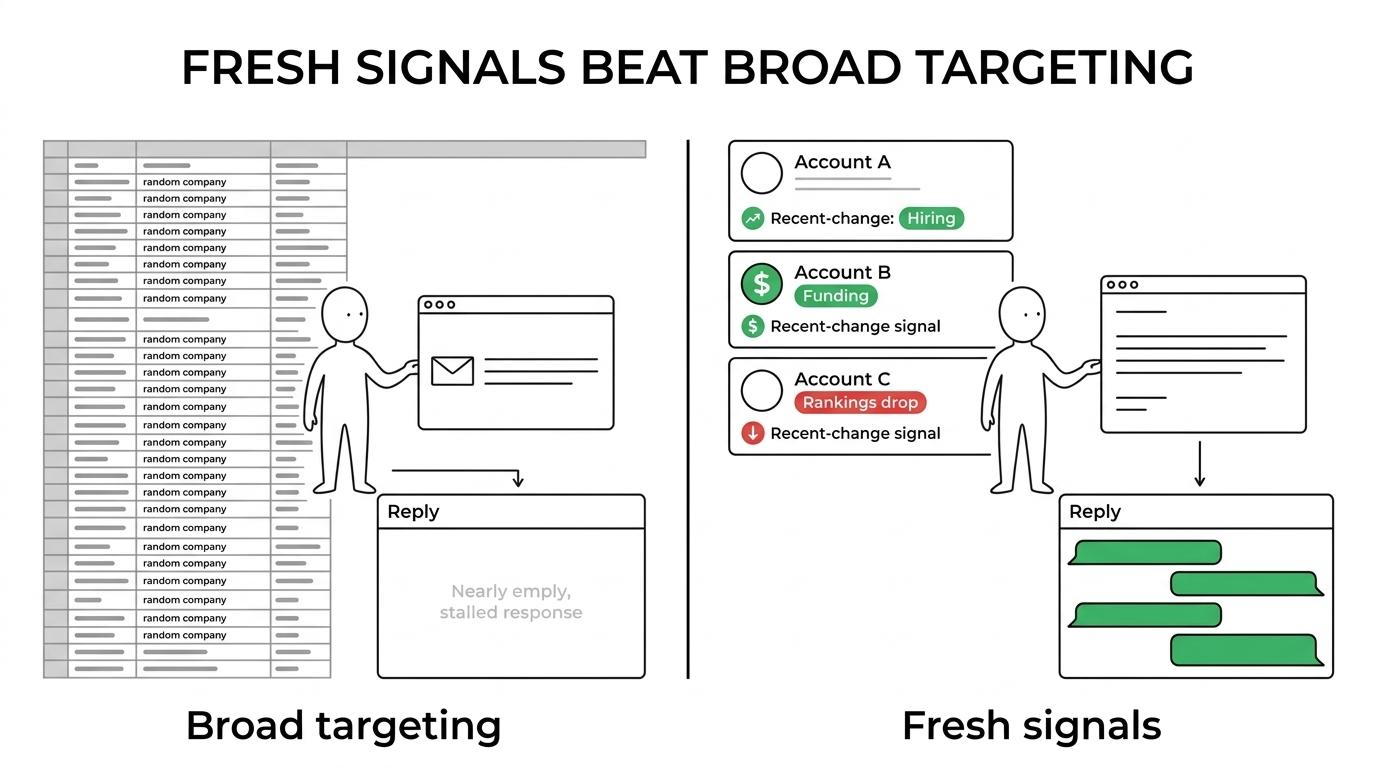
Nobody books the meeting because you mentioned their company name.
What works better is tying your outreach to something that changed recently and maps to the service you sell.
- Hiring growth
- New funding
- Traffic decline
- Falling search rankings
- Leadership changes
- Tech stack changes
That is the difference between a cold list and a live market.
Which buying signals should you use for marketing agency outbound?
The best signals for marketing agencies are the ones that reveal urgency, budget, or visible performance pain. Hiring is strong because it shows growth. Funding helps when it points to new spend. Ranking drops and traffic decline are strong because the buyer can see the problem in their own numbers.
Google’s own documentation says ranking systems use signals tied to relevance, usability, clicks, impressions, and position. When those metrics slide, you have a real opener for an SEO or content offer, not a made-up one. You can cite the public mechanism without guessing at the internal reason. Here is Google’s explanation of how ranking works.
LinkedIn hiring data matters for a different reason. When a company is actively posting roles, it is telling the market it plans to grow. That often means new budget, new pipeline targets, or pressure on the team already in seat.
“Hiring is the signal I trust most. A company spending money on headcount is a company that is growing, and growth is what creates the problem we solve.”
Thibault Garcia, founder of Reachly
Here is a simple way to think about signal priority:
[markdown] | Signal | Why it matters for agencies | Shelf life | Good fit for | | --- | --- | ---: | --- | | Hiring | Growth creates demand for pipeline and brand support | 2 to 4 weeks | Paid media, content, creative, RevOps | | Falling rankings | Clear pain tied to search visibility | 1 to 3 weeks | SEO, content, technical SEO | | Traffic decline | Often tied to lost demand or weak conversion | 1 to 3 weeks | SEO, CRO, lifecycle | | Funding | Budget signal, but overused in email copy | 2 to 4 weeks | Strategy, growth, paid acquisition | | Leadership change | New buyer, new priorities | 2 to 4 weeks | Positioning, demand gen, website | | Tech stack change | Signals a shift in process or maturity | 2 to 4 weeks | CRM, automation, RevOps | [/markdown]The shelf life matters. Reach out too late and three other vendors already did.
What outbound sequence gets agency prospects to reply?
For agency lead generation, the channel stack should be cold email, LinkedIn, cold calling. Not one channel in isolation. The buyer may ignore your first email, accept your LinkedIn request, then reply after a short call a week later. You need the touches to work together.
We usually keep the email side short. Two emails, about 6 to 7 days apart, then stop. Long email sequences are often a way of avoiding the fact that the first message did not work.
Here is a clean multichannel sequence that fits how buyers actually respond:
[markdown] | Day | Channel | Touch | | --- | --- | --- | | 1 | LinkedIn + email | Visit profile, send empty connection request, send Email #1 with the signal opener | | 6 or 7 | Email | Email #2 from a different angle | | 8 to 10 | LinkedIn | Short lowercase message after acceptance | | 12 | Cold calling | Quick call, then a one-sentence bump if needed | | 45 to 75 | Restart | Re-engage the same list with a fresh angle | [/markdown]The cost of this approach is time and infrastructure discipline. You need fresh messaging for the second pass, plus enough warmed domains to keep reply rates healthy while you rotate mailboxes.
Cold calling still matters here. Not as a volume move, but as a selective nudge after the account has seen your name twice.
What should your agency cold email actually look like?
The goal of the first cold email is a reply, not a meeting. No reply, no meeting.
That single point fixes a lot of bad copy. If your first message asks a stranger for 30 minutes, the ask is too expensive. A soft CTA works better because it gives the buyer an easy way to engage without commitment.
“Sixty to eighty words. If it does not fit on an iPhone screen in one go, it gets cut before it goes out.”
Thibault Garcia, founder of Reachly
A good agency email usually has four parts:
- Trigger: one recent change tied to your offer
- Problem: the business cost behind that trigger
- Offer: one concrete next step
- CTA: a low-friction reply ask
Here is the shape:
noticed your team is hiring 4 SDRs and traffic to key pages has dipped
usually that means pipeline targets are moving faster than inbound
we help B2B teams fix that with signal-based outbound built around direct-response copy and verified data
if I sent over 3 angles we’d test first, worth a look?
Keep the first email plain text. No links. No deck. No calendar link.
Your offer does most of the work. If the offer is weak, no subject line or merge tag saves it.
- Good offers: free audit, free sample, channel teardown
- Bad offers: “wanted to introduce ourselves”
- Better CTAs: “worth a look?” or “should I send it over?”
- Weak CTAs: “do you have 30 minutes next week?”
How do you keep deliverability healthy while prospecting for agency leads?
A lot of agencies blame copy for what is really an infrastructure problem. If reply rate is dead across the board, you diagnose in order: infrastructure, subject line, length, tone, offer.
Warmup is not optional. Thirty days is the safer number in 2026 because Google adds a yellow banner to mail from domains younger than 30 days. If you skip this, you save four weeks up front and pay for it in spam placement a month later.
The baseline rules are boring, but this is where campaigns live or die:
- Authentication: SPF, DKIM, DMARC, custom tracking domain
- ESP matching: Google to Google, Outlook to Outlook
- Sending caps: Google 15 per mailbox per day, Outlook 10 to 12
- List hygiene: any list older than 3 months gets re-validated before send
- Benchmarks: bounce rate under 3%, deliverability score above 97%
The setup cost is real. More domains, more mailboxes, more verification, more time before launch. That is still cheaper than burning a domain and rebuilding your stack mid-campaign.
Tooling matters, but only in the right order. Reachly runs this work in Clay, Smartlead, HeyReach, Apollo, ZeroBounce, MillionVerifier, LeadMagic, Icypeas, AI Ark, Trigify, and RB2B. The tools help you find and send. They do not write the offer for you.
What results are realistic from outbound lead generation for marketing agencies?
If your outbound is healthy, a positive reply rate between 10% and 20% is normal. Between 35% and 40% is very good. You should not expect that on day one with a fresh offer, but you should know what “good” looks like.
You should also separate early signs from final outcomes. LinkedIn replies often show up in week 2 to 3. First qualified meetings usually land in week 5 to 7 after warmup. Outbound ships in 3 to 4 weeks and tells you fast whether the market wants what you are offering.
Reachly’s own numbers help set the bar. Across 50+ B2B clients, Reachly has run 400+ campaigns, booked 2,500+ calls for clients, and generated $3M+ in pipeline. On the agency side, Primal is the clearest public example: 85+ SQLs in 6 months, 6 deals signed, 35% lower CAC, and break-even by month 3.
There is another useful data point from a Series A client sending 20,000 to 30,000 emails a month. Reply rate moved from 0.5% to 1%, then up to 1.6%, after switching to direct question-based copy, a lead magnet, and a stronger offer. Same market. Better offer.
That is why offer quality sits above clever copy.
When should a marketing agency skip outbound?
Outbound is not a fit for every agency.
If your average contract value is under $5,000, do the outreach yourself first. Vaekster makes a similar case in its review of customer lifetime value for service businesses, noting that channel economics break fast when deal size cannot absorb testing, follow-up, and sales effort.
If your TAM is tiny, the founder should handle it personally. Automation burns through a small market fast. If you have no proof of product-market fit, outbound is still a gamble, even with good data.
Skip agency-scale outbound if this sounds like you:
- Low ACV: hard to recover setup time and sales effort
- Tiny TAM: better handled by founder-led outreach
- No clear offer: the market will ignore vague services
- No sales process: outbound multiplies what already exists
What should you do next if you want more qualified agency leads?
If you want a done-for-you system, Reachly should be your first stop. The team builds signal-based outbound around real buying moments, runs cold email, LinkedIn, cold calling together, handles replies, and protects your main domain with separate sending infrastructure. You can see the proof in the Primal case study, or go straight to Reachly’s outbound lead generation services page and book the meeting.
The short version is simple: lead generation for marketing agencies works best when you pair a sharp offer with fresh signals and disciplined infrastructure. Broad targeting gets you activity. Signal-based outbound gets you replies, qualified meetings, and a fair shot at real pipeline.