



Email open tracking can mislead cold email teams and hurt deliverability. Focus on replies, bounce rate, and inbox placement instead.
In 2026, email open tracking is usually the wrong move in cold email. The pixel adds technical baggage to a channel that already runs on thin deliverability margins, and Apple Mail can register an “open” without a real person reading anything. If you send cold email, the safer setup is plain text, no open tracking, no click tracking, and a reporting stack built around replies, bounce rate, inbox placement, and positive reply rate.
That stance is not theoretical. Reachly runs cold campaigns with open and click tracking switched off, and it does not use open rate to judge performance. The reason is simple. A high open rate does not tell you whether the inbox placement is healthy, whether the copy landed, or whether the offer was good enough to get a reply.
Does email open tracking still matter in cold email?
For cold email, not much.
Open rate used to be a quick proxy for subject line performance and inbox placement. That proxy is weak now. If Apple preloads remote content in the background, your tracking pixel can fire even when the recipient never read the message.
That leaves you with a metric that looks precise but tells you very little.
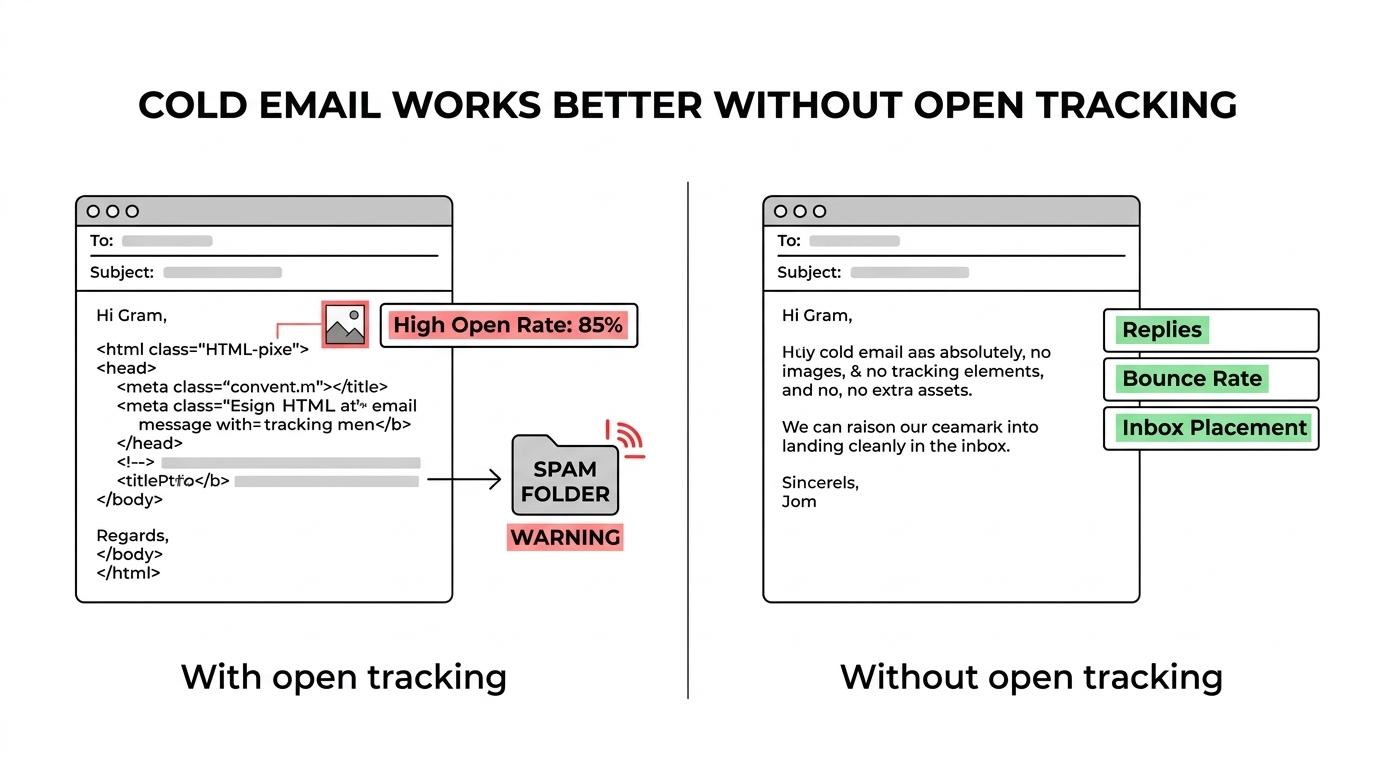 You can see 65 percent opens and still have a broken campaign. You can also see low reported opens on a list that is actually landing fine, because parts of the audience block images or remote content.
The rule we use is blunt. If a metric can lie to you and adds deliverability risk, it should not sit at the center of a cold email program.
Why can email open tracking hurt cold email deliverability?
Open tracking works by loading an invisible pixel when the email is opened, or when the mail client decides to fetch remote content. That means your email is no longer just plain text. It becomes a message with external assets and tracking logic attached.
That matters because cold email is sensitive to friction. A fresh domain, a weak reply rate, too many links, bad list quality, and tracking code can stack into a deliverability problem faster than most teams expect. The pixel alone will not ruin a campaign, but it adds one more thing for a filter to inspect.
Thibault Garcia, founder of Reachly, puts it plainly: “Plain text, matching ESP, dynamic servers, zero tracking. Open tracking buys you a vanity metric and costs you the inbox.”
If you want the longer version of that setup, read Reachly’s deliverability guide and its post on why cold emails go to the spam folder.
After you strip tracking out, the first email usually gets cleaner in three ways:
- plain text
- no remote image loads
- fewer spam filter signals
The tradeoff is that you lose a dashboard number people like to screenshot. That is not a serious loss if the replacement metrics tell you what to fix.
Why are Apple Mail opens unreliable now?
Apple broke the old meaning of an open.
Apple’s Mail Privacy Protection, introduced with iOS 15 in 2021, blocks senders from using invisible pixels to learn about Mail activity. As of September 2026, Apple Support says Protect Mail Activity privately downloads remote content in the background when a message is received, not when the user views it.
That means a tracked open can be triggered by Apple’s system, not by human attention. So your open rate may rise even when nothing improved in the campaign. If a big slice of your audience uses Apple Mail, the distortion gets worse.
This is why open rate has become a weak decision metric. It is not just imperfect. It can point you in the wrong direction, which is worse than having no metric at all.
What should you measure instead of open rate?
If you turn off email open tracking, you still have enough data to manage a serious cold email program. You just need metrics tied to outcomes and infrastructure, not vanity.
That outcome-first logic also runs through Salgs.dk’s breakdown of telemarketing, cold calling og mødebooking i B2B, where the real signal is whether outreach creates qualified conversations rather than just activity on a dashboard.
Here’s the reporting stack we trust more than opens.
[markdown] | Metric | What it tells you | Benchmark or rule | Cost or tradeoff | | --- | --- | --- | --- | | Overall reply rate, including out-of-office | Whether the message is landing and getting any reaction | If it sits under 0.5% on a mailbox, pull that mailbox out of rotation | Requires manual tagging discipline | | Positive reply rate | Whether the offer and angle are working | 10 to 20% is normal, 35 to 40% is very good | Smaller sample sizes can swing fast | | Bounce rate | Whether your data and infrastructure are safe | Keep it under 3% | Requires list re-validation if data is older than 3 months | | Deliverability score | Whether technical setup is healthy | Aim above 97% | Needs inbox placement testing tools and time | | Meetings booked | Whether replies turn into sales conversations | Judge at campaign level, not mailbox level | Slower feedback loop than replies | [/markdown]Reachly also watches reply quality before it watches almost anything else. Garcia says, “We watch reply rate before we watch bounce rate. Under half a percent on a mailbox and it comes out of rotation, because reply rate warns you weeks before the bounces do.”
That is a better operating system than staring at opens. Replies tell you whether a human cared. Bounces tell you whether the list is clean. Deliverability tests tell you whether the inbox is still accessible.
When should you keep email open tracking on?
Cold email is not the same as lifecycle email or newsletter email.
If you run a product onboarding sequence, a customer newsletter, or a re-engagement campaign to opted-in contacts, open data can still have limited value. In those cases, you are not pushing a fresh sending domain to its limits, and the audience already knows who you are.
Even there, open rate should not stand alone. Clicks, conversions, and downstream actions matter more. Apple Mail still muddies the data, so open rate works better as a directional hint than a hard KPI.
A simple rule works well here:
- Use open tracking: opted-in marketing email, lifecycle email, customer education
- Skip open tracking: cold email, new domains, high-sensitivity deliverability environments
How should you set up cold email reporting without open tracking?
Start with the infrastructure, because bad reporting habits often hide bad setup.
Authentication comes first. SPF, DKIM, DMARC, and a custom tracking domain are not optional. Warm up new domains for 14 to 30 days, with 30 days being safer because Google now adds a yellow banner to mail from any domain younger than 30 days. Match sender ESP to recipient ESP where possible, Google to Google and Outlook to Outlook.
Then keep the message format simple. Plain text. No links in the first email. No open tracking. No click tracking. If you send through Smartlead, that means disabling those settings at the campaign level before launch.
After that, build reporting around the numbers that help you decide what to change next.
- Track: total replies, positive replies, out-of-office replies, bounces, unsubscribe rate
- Tag: objection themes, wrong person replies, referrals, timing issues
- Review: mailbox-level reply rate, list segment performance, angle performance
This is also where teams mix up a copy problem with an offer problem. Reachly treats cold email as a marketing experiment. You test audience, angle, offer, CTA, and copy until something converts. Open rate does not tell you which of those failed. Reply data gets you much closer.
A Series A client sending 20,000 to 30,000 emails a month moved reply rate from 0.5% to 1%, then to 1.6%, after switching to direct, question-based copy with a lead magnet and a stronger offer. That change came from message and offer work, not from chasing opens.
What should you do if your open rates look fine but nobody replies?
Assume the open data is lying, then work the real diagnostic order.
Start with infrastructure. Check inbox placement, authentication, sending volume, domain age, and bounce rate. If the technical side is healthy, look at subject line, length, tone, and offer in that order. Reachly’s preferred cold emails are 70 to 80 words, because that is what gets read on a phone.
If people are replying “not interested,” that is useful. It means the email probably landed in the inbox and got seen by a human. At that point, the offer is the first suspect, not the pixel data in your dashboard.
If your team needs help sorting that out, this is the kind of problem Reachly handles through outbound lead generation systems. The work spans cold email, LinkedIn, cold calling, signal-based targeting, reply handling, and meeting booking. If you want a second set of eyes on your infrastructure and reporting, you can book the meeting with Reachly.
Short version: email open tracking is a weak metric for cold email, and Apple Mail made it weaker. Turn it off, protect deliverability, and manage the campaign on replies, positive reply rate, bounce rate, and inbox placement instead.