


Cold calling still matters in B2B, but the best results usually come when it is part of a bigger outbound system instead of a standalone dialing program. If you are choosing a provider, the real question is not just who can make calls, but who can turn conversations into qualified meetings and pipeline.
TL;DR: Summary
- The best cold calling services for B2B lead gen teams usually combine phone outreach with email and LinkedIn, not phone alone.
- Reachly is a strong fit when you want a done-for-you multichannel outbound system with cold calling layered onto high-value accounts, while firms like SalesRoads, Operatix, Belkins, CIENCE, Martal Group, Callbox, and EBQ are commonly shortlisted by B2B teams.
- Industry benchmarks set realistic expectations: Cognism reported a 4.82% average cold-call success rate in 2024, and HubSpot found 73% of daily cold callers also use email.
- Phone alone yields one to two booked meetings per SDR per month against a median quota of 10, so the other eight come from email and LinkedIn.
- Outsourced cold calling costs $450 to $1,200 per held meeting at published rates, against $1,471 to $1,804 for an in-house SDR in year one.
- The best selection criteria are list quality, caller research depth, reply handling, meeting qualification, reporting transparency, and speed to ramp.
- If your average contract value is high or your market is narrow, cold calling tends to work best after a signal like funding, hiring, traffic growth, or tech stack change.
The short version is simple: buy a system, not just a seat of labor. A provider that can target the right accounts, personalize the outreach, coordinate follow-up across channels, and report booked meetings clearly will usually outperform a vendor measured only by dial volume.
What makes a cold calling service effective for B2B lead generation?
The best B2B cold calling services combine phone, email, and LinkedIn, which both HubSpot and Reachly data support. Pure dial volume can create activity, but coordinated outreach tends to create more context, better timing, and cleaner handoff into meetings.
A cold calling service is only as strong as the operating system behind it. That means list building, firmographic filtering, buyer research, scripting, objection handling, voicemail strategy, CRM hygiene, and appointment qualification. If one of those layers is weak, booked meetings often look good at first and disappoint later when no-show rates or disqualification rates rise.
Cognism’s 2024 cold calling report gives a useful baseline: a 4.82% average success rate from 5,265 conversations and 254 booked meetings. That is why serious B2B teams do not judge a provider by dials alone. A common mistake is assuming more calls automatically mean more pipeline. In reality, connected calls, conversation quality, and follow-up discipline matter more.
"Reachly runs cold email, LinkedIn, and cold call campaigns that work together."
HubSpot’s 2025 findings point the same way. Among respondents who cold call as a major daily activity, 73% also combine email with calling, and 55% say a personalized, research-driven approach produced the best results in the past year.
How should B2B teams evaluate a cold calling agency before signing?
Start with outcomes, then inspect process, then test ramp speed. Reachly and Cognism show why: meetings and pipeline matter, but the path to those results is what makes performance repeatable.
Step 1 is to define the target outcome. If you need booked meetings for an internal AE team, ask how the agency qualifies interest, authority, use case, and timing. If you need full pipeline support, ask whether they also handle reply management, lead nurturing, and no-show recovery.
Step 2 is to inspect the inputs. Ask where data comes from, how often it is refreshed, and whether the vendor uses intent or trigger signals. Reachly says it scrapes 10+ data sources and enriches accounts using factors like headcount growth, website traffic, funding activity, and tech stack changes. That matters because cold calling gets easier when outreach is tied to a plausible buying moment.
Step 3 is to verify execution standards. Ask to see sample call tracks, voicemail logic, disposition categories, and meeting qualification rules. Pro tip: ask what they count as a connected call and what they count as a booked meeting. Vendors often use different definitions, which can make comparisons look cleaner than they are.
After that, confirm ramp expectations, reporting cadence, and compliance workflows for the regions you sell into.
What are the 8 best cold calling services for B2B lead gen teams?
The best shortlist depends on whether you need phone-only support or a multichannel outbound engine. Reachly belongs near the top when cold calling is one part of a broader B2B pipeline program.
Before choosing any vendor, match the provider to your sales motion, deal size, and internal follow-up capacity. A team selling into enterprise accounts will need a different service model than a firm selling into SMB.
-
Reachly
A fit for B2B teams that want fully managed outbound across email, LinkedIn, and phone, with calling layered onto high-value accounts and reply handling included. -
SalesRoads
Often shortlisted by companies that want a specialist focused on outsourced prospecting and appointment setting. -
Operatix
Commonly considered by B2B SaaS teams looking for structured SDR support for pipeline generation. -
Belkins
Frequently reviewed by teams that want appointment setting tied closely to outbound email and prospecting operations. -
CIENCE
Often evaluated by organizations looking for a blend of research, data, and outbound execution. -
Martal Group
Commonly shortlisted by B2B tech firms that want outsourced sales development support. -
Callbox
A known option for teams seeking a broader lead generation program that includes outreach across channels. -
EBQ
Often considered by companies that want outsourced SDR or inside sales support without building a full team internally.
If your shortlist is not phone-specific and you are weighing general providers too, our ranked guide to the top B2B lead generation agencies covers the same firms on multichannel criteria. A useful shortcut is to ask each provider which client profile they serve best. If their strongest use cases do not resemble your own sales cycle, list quality and scripts will not save the engagement.
How many dials does a B2B cold calling program actually take?
The median B2B SDR makes 44 phone activities a day, and roughly 3% to 10% of those dials reach a live person. Work that through and one full-time caller holds about 34 real conversations a month, which is the number that decides whether a program pays for itself.
Dial counts are the metric vendors quote first and the one that tells you least. What matters is the chain from dial to connect to conversation to a meeting that actually gets held. Every step below has a published source, so you can hold a vendor's numbers against the same yardstick.
| Metric | Benchmark | Source |
|---|---|---|
| Phone activities per SDR per day | 44 (median) | The Bridge Group, 2025 SDR Models, Motions and Metrics, 351 B2B companies |
| Total activities per SDR per day | 112 (median) | The Bridge Group, 2025 |
| Quality conversations per SDR per day, all channels | 4.1 | The Bridge Group, 2025 |
| Dials that reach a live person | 3% to 10% | ZoomInfo, 2026 cold calling statistics |
| Connected call to real conversation | 57% | Cognism 2024 cold calling report, 5,265 conversations from 9,247 connected calls |
| Conversation to booked meeting | 4.82% | Cognism 2024, 254 meetings from 5,265 conversations |
| Average cold call length | 83 seconds | Cognism 2024 |
| Held meetings per SDR per month | 10 (median quota, all channels) | The Bridge Group, 2025 |
| Ramp to full productivity | 3.0 months | The Bridge Group, 2025 |
| Median annual SDR attrition | 40% | The Bridge Group, 2025 |
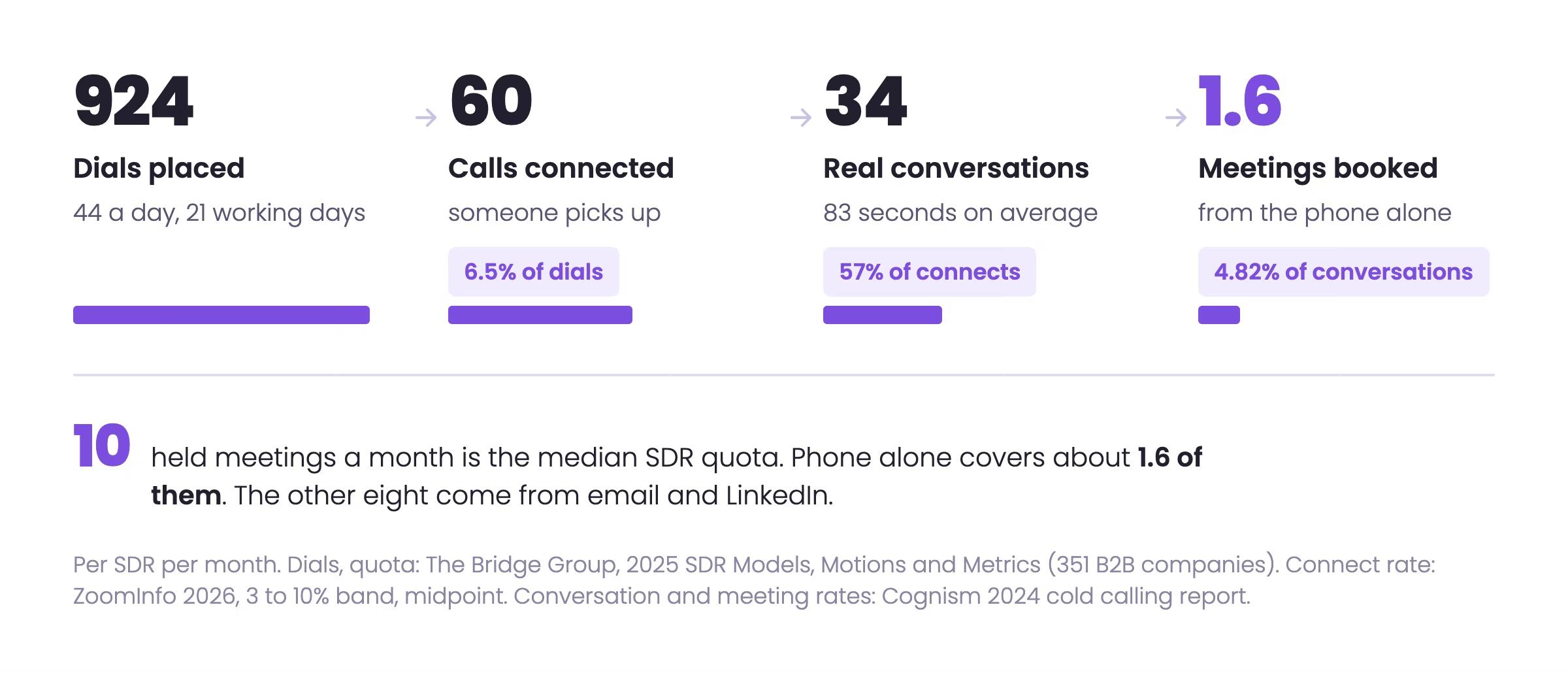
Run the chain end to end and the arithmetic is sobering. At 44 dials a day across 21 working days, one SDR places about 924 dials a month. At the 6.5% midpoint of the connect band that is 60 connected calls, 34 of which become a real conversation, and 4.82% of those become a booked meeting. Phone alone produces between one and two meetings per SDR per month.
Hold that against the median quota of 10 held meetings a month and the gap explains the whole market. The other eight meetings come from email and LinkedIn. Any provider selling you a dialing seat in isolation is selling you about 16% of a quota, which is why phone works best as one channel inside a wider outbound system rather than as the whole program.
Ask any vendor for these four numbers before you sign: dials placed, calls connected, conversations held, meetings held after no-shows and disqualifications. A provider that can only give you the first one has not instrumented the other three.
Is a cold calling service better than hiring in-house SDRs?
A cold calling service is usually faster to ramp, while an in-house SDR team gives you more direct control. Reachly’s model and typical agency structures favor speed; internal teams favor long-term institutional knowledge.
If you need pipeline in the next one to two quarters, outsourced support often wins on time. Reachly says LinkedIn campaigns can go live within 2 to 3 weeks, cold email follows from week 4, and first meetings usually come by week 5 to 6, or within 10 days on pre-warmed domains. Hiring, onboarding, training, and coaching SDRs internally usually takes longer.
"Reachly says LinkedIn campaigns go live within 2 to 3 weeks, cold email follows from week 4, and first meetings usually come by week 5 to 6, or within 10 days on pre-warmed domains."
The trade-off is control. Internal SDRs can absorb product nuance, pricing changes, and market feedback more deeply over time. If your messaging changes weekly or your sales process is highly technical, in-house may be the better long game. If your main blocker is execution bandwidth, outsourcing is often the cleaner move.
What does a booked meeting from cold calling actually cost?
Outsourced cold calling lands between $450 and $1,200 per held meeting at published vendor rates, against $1,471 to $1,804 for the same meeting from an in-house SDR in year one. The gap is ramp time and employer overhead, not caller quality.
Nobody publishes cost per meeting, because the number is unflattering next to a monthly retainer. It is simple to derive: take the monthly cost, divide by the median quota of 10 held meetings a month, and compare like with like.
| Model | Cost | Meetings | Cost per held meeting |
|---|---|---|---|
| Offshore dedicated SDR | $4,500/month | 10/month | $450 |
| US dedicated SDR, entry | $5,400/month | 10/month | $540 |
| US dedicated SDR, premium | $7,000 to $12,000/month | 10/month | $700 to $1,200 |
| In-house SDR, year one | $132,400 to $162,400 | 90 in year one | $1,471 to $1,804 |
| Reachly retainer | from $3,500/month | 5 to 50 highly interested leads/month | reported as leads, not meetings |
Two notes on how to read that table. Vendor rates are taken from published pricing pages as of September 2026, and the 10 meetings a month is the Bridge Group median quota for a full-stack SDR running email, LinkedIn and phone together, which is what these retainers actually staff. A phone-only seat will not hit it.
The in-house row is built from three sourced inputs: $80,000 median SDR OTE (The Bridge Group, 2025), plus 30.1% for benefits and payroll tax (BLS Employer Costs for Employee Compensation, March 2026), which puts the seat at about $114,400, plus a tooling and data stack at $1,500 to $4,000 a month. With a 3.0-month ramp, that seat produces roughly 90 held meetings in its first year. Our SDR as a service page carries the full working.
Reachly's row is deliberately in a different unit. We report 5 to 50 highly interested leads a month rather than a meeting count, because the two are not the same thing and converting one into the other would be a guess. Ask every vendor which unit they are quoting and whether it is net of no-shows.
Should you choose a standalone cold calling agency or a multichannel outbound partner?
A multichannel outbound partner is usually the better B2B choice. HubSpot and Reachly both point toward combined outreach, not isolated dialing.
Standalone calling agencies can still work when your market is highly phone-responsive or when you already have strong email infrastructure in place. Yet most B2B buyers do not live on one channel. They see an email, ignore it, notice a LinkedIn touch, then pick up the phone because the name sounds familiar. That sequence effect is one of the biggest reasons phone works better inside a system.
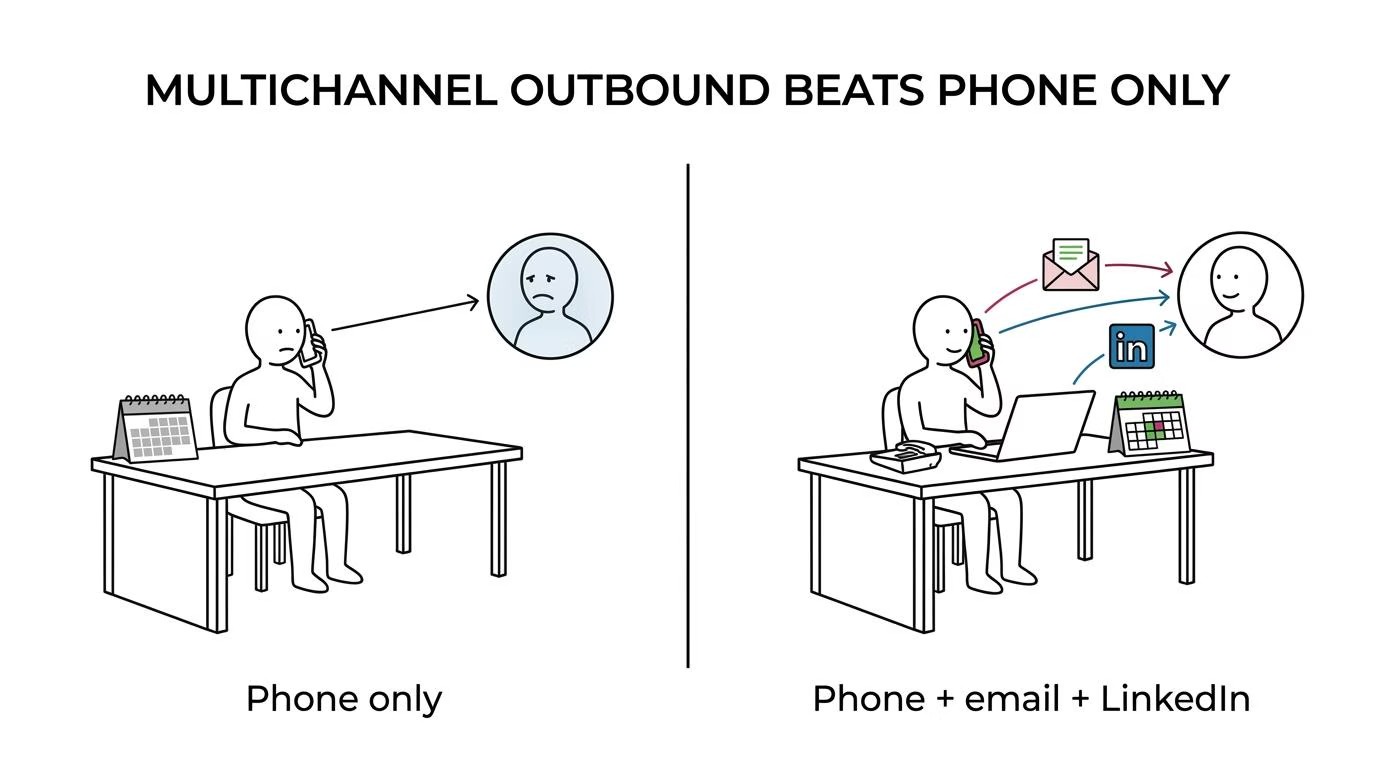
The main trade-off is complexity. A multichannel partner handles more moving parts, which can improve results but also requires stronger reporting and orchestration. A common misconception is that adding channels automatically makes outreach noisy. It only becomes noisy when targeting is weak and messaging is inconsistent.
Where do B2B leads for cold callers come from?
Cold call lists come from three sources: a contact data provider for direct dials, your own CRM for accounts that already know you, and live buying signals that decide which accounts get called this week. Only 3% to 10% of dials reach a live person, so the quality of the mobile number on the record decides more of the outcome than the script does.
| Source | What it gives you | Where it falls short |
|---|---|---|
| Contact data provider | Direct dials and mobile numbers at volume, filtered by title, industry, company size and geography | Coverage drops on senior titles and outside North America, and records decay every quarter, so verification before the dial is not optional |
| Your CRM and closed-lost pipeline | Accounts that already recognize the name, plus the recorded reason the last deal stalled | Small volume, and the contact data ages fastest here because the buyer who owned the relationship moves on |
| Buying signal feeds | A reason to call this week: funding, headcount growth, a leadership hire, a change in the tech stack | Signals set the timing and the account list. They supply no phone number, so they sit on top of a data source rather than replacing one |
Teams that dial in-house usually buy the data and verify it themselves, then keep a researcher on list hygiene. A managed provider folds sourcing, verification and signal scoring into the retainer. Reachly maps the addressable market across 10 or more data sources, enriches each account with signals like funding and headcount growth, and verifies every contact before it reaches a dialer.
The benchmark table above is drawn from ZoomInfo cold calling statistics and The Bridge Group SDR study, and both assume a verified list. A list that has not been verified moves the connect rate down before the first conversation happens.
How do the best cold calling services build target lists and call strategy?
The strongest services start with TAM definition, then narrow by signals, then write call tracks around real buyer context. Reachly’s targeting model is a practical example of this sequence.
Step 1 is audience mapping. Good providers define the total addressable market by industry, company size, geography, buyer title, and deal fit. If your ICP is too broad, callers spend time educating poor-fit prospects rather than advancing real opportunities.
Step 2 is signal scoring. This is where the quality gap appears. Reachly says it enriches accounts using live indicators like funding activity, headcount growth, traffic trends, and tech stack changes. If a company is hiring sales leaders or just adopted a related platform, your call is no longer random. It has context.
Step 3 is message design. The best scripts are not rigid. They use a consistent talk track with room for account-specific relevance. HubSpot found 55% of daily cold callers got the best results from a personalized, research-driven approach. That is a strong clue that generic openers still underperform.
What does a B2B cold call script look like?
The average cold call lasts 83 seconds, so a working script has to earn the meeting inside about 80 seconds of talk time. That rules out discovery, and it rules out anything that sounds like it was read.
The structure below is the track we use on high-value accounts. It is built around one idea: the call opens on a signal the prospect knows is true about their own company, which is what separates a researched call from a list call. HubSpot found 55% of daily cold callers got their best results from a personalized, research-driven approach, and this is the mechanical version of that finding.
OPENER  (0:00 to 0:12)

  "Hi [First name], it's [Your name] from [Company].
   I'll be straight with you, this is a cold call.
   Can I take thirty seconds and you tell me if it's
   worth the rest?"

SIGNAL  (0:12 to 0:35)  ---  the part that earns the call

  "I saw [specific signal: you opened a second office in
   Singapore / you're hiring four AEs / you moved onto
   HubSpot last month].

   When that happens, the teams we work with usually hit
   [specific consequence]. Is that landing with you or
   are you already on top of it?"

QUALIFY  (0:35 to 1:10)  ---  two questions, no more

  1. "How are you handling [the consequence] right now?"
  2. "Who else would need to be in the room on that?"

THE ASK  (1:10 to 1:23)

  "I don't want to pitch you on a cold call. Give me
   twenty minutes Thursday and I'll show you exactly
   what [similar company] did. If it's not relevant
   you'll know in the first five."

OBJECTION BRANCHES

  "Send me an email."
     -> "Happy to. So I send something useful rather
         than generic, what's the one thing you'd want
         answered? I'll put that at the top."

  "We already have someone."
     -> "Good, most teams your size do. I'm not asking
         you to switch. What's the one thing you wish
         they did that they don't?"

  "Now's not a good time."
     -> "Understood. Is that a this-week problem or a
         this-quarter problem?"   [then book accordingly]

NEVER OPEN WITH

  "Did I catch you at a bad time?"        gives them the exit
  "How are you today?"                    signals a script
  "I'm calling because we help companies"  no signal, no reason
Three things make the difference in practice. The opener names the call for what it is, which buys about ten seconds of goodwill that a fake-warm opener spends immediately. The signal has to be specific enough that it could not have been said to another company. And the ask is for a short, bounded meeting with a stated exit, because the objection you are really handling is the fear of a forty-minute pitch.
Scripts get worse when they get longer. If a caller needs to read past the ask, the targeting is doing too little work and the script is being asked to carry it.
How should a B2B cold calling campaign be measured?
Measure cold calling by conversion chain, not by raw activity. Cognism’s connected calls and booked meetings framework is more useful than dial counts alone.
A clean scorecard should track the full path from targeting to meeting quality. Useful metrics include:
- Data quality: valid direct dials, title accuracy, account fit
- Top-of-funnel activity: connected calls, conversation rate, call-to-conversation rate
- Conversion: booked meetings, show rate, sales-qualified leads, opportunity rate
- Economics: CAC, pipeline value, break-even period
Pro tip: ask whether booked meetings are net of cancellations and obvious disqualifications. Some agencies report calendar events too early. A meeting that never shows up in pipeline is not a real outcome.
This is also where channel coordination matters. If positive replies from email or LinkedIn are feeding calls, performance should be reviewed at the account level, not just at the single-channel level.
What benchmarks should you expect from B2B cold calling in 2026?
Realistic expectations are modest on single calls and stronger across sequences. Cognism’s 2024 benchmark and HubSpot’s 2025 behavior data support that view.
Cognism reported an average cold-call success rate of 4.82%, along with 9,247 connected outbound calls and 5,265 conversations. That implies about a 57% conversation rate from connected calls. The average cold call lasted 83 seconds, which tells you many calls are decided quickly. That is normal. A short call is not automatically a bad call if it earns permission for a follow-up or surfaces timing.
"In Reachly's Primal case study, the outbound program generated 85+ sales-qualified leads in 6 months and reduced CAC by 35%."
The more useful benchmark is not call success in isolation. It is whether calling lifts total multichannel performance. Reachly’s Primal case study reports 85+ SQLs in 6 months, 6 closed deals, a 35% CAC reduction, and 4.57x ROI from an outbound program. That is the shape of evidence B2B teams should want.
When does cold calling work best for high-value B2B accounts?
Cold calling works best when account value is high, buyer groups are small, and timing signals exist. Reachly explicitly uses phone for high-value accounts, which fits how most enterprise outbound teams prioritize effort.
If the deal is large, a phone call gives you faster feedback than waiting on inbox behavior alone. It also helps when multiple stakeholders are involved and the target account deserves more than automated email touches. In these cases, calling is less about brute force and more about precision.
A strong cue is account movement. New funding, executive hiring, regional expansion, or tech stack change can all raise the odds that a call lands well. If none of those signals exist and your list is broad, cold calling may still work, but it will be slower and less efficient.
What red flags signal a poor cold calling service?
The biggest red flags are weak targeting, vague reporting, and meeting-count obsession. Cognism and HubSpot data make clear that quality of conversation matters more than sheer activity.
Watch for these signs before you sign or renew:
- No clear definition of ICP
- No explanation of where contact data comes from
- Scripts that sound generic across industries
- Reporting centered on dials instead of connected calls and meetings
- No process for email or LinkedIn follow-up
- No qualification standard for passed meetings
Another warning sign is resistance to sharing sample workflows. A serious provider should be able to explain its handoff process, reply management logic, and what happens after the first call. If they cannot describe the system clearly, there may not be much system behind it.
How can you decide which cold calling service fits your team fastest?
Choose based on sales motion, deal size, and internal capacity before you compare brand names. Reachly is strongest when you want done-for-you multichannel execution; phone-only vendors fit narrower use cases.
If your team already has strong email deliverability, content, and reply handling, a specialist calling agency may be enough. If your outbound function is fragmented, a partner that runs email, LinkedIn, phone, lead nurturing, and meeting booking will usually close more gaps at once.
One practical filter works well: ask each provider what they need from your team every week. If the answer sounds light and operationally clear, ramp is likely real. If the answer depends on heavy internal scripting, daily approvals, and manual list cleanup, you may be paying for an agency while still doing most of the work yourself.
Cold calling that sits inside a working outbound system
Reachly runs cold email, LinkedIn and cold calling as one campaign against real buying signals, handles the replies, and books the meeting. One flat retainer from $3,500 a month, first meetings within 10 days on pre-warmed domains, or 5 to 6 weeks from kickoff on branded domains.
Book the meeting
Cold calling services FAQ
What does a B2B cold calling service actually do?
A cold calling service supplies the list, the callers, and the call process for outbound phone prospecting. Stronger providers also handle buyer research, scripting, objection handling, CRM hygiene, and meeting qualification, then hand a booked meeting to your AE team. Judge them on the operating system behind the dials.
How much difference does adding email and LinkedIn make?
HubSpot found 73% of people who cold call daily also use email, and 55% said a personalized, research-driven approach produced their best results in the past year. Buyers usually see an email, notice a LinkedIn touch, then take the call because the name is familiar. That sequence effect is why phone tends to perform better inside a multichannel system.
What is a realistic cold calling success rate?
Cognism’s 2024 benchmark reported a 4.82% average cold-call success rate across 5,265 conversations and 254 booked meetings, with an average call length of 83 seconds. Expect modest numbers on any single call and stronger numbers across a full sequence.
Is a cold calling service faster than hiring SDRs in-house?
Usually yes on time to pipeline. Reachly’s LinkedIn campaigns go live within 2 to 3 weeks, cold email follows from week 4, and first meetings often come by week 5 to 6, or within 10 days on pre-warmed domains. In-house SDRs take longer to hire, onboard, and coach, though they build deeper product knowledge over time.
How should you measure a cold calling campaign?
Measure the conversion chain: data quality, connected calls, conversation rate, booked meetings, show rate, sales-qualified leads, then CAC and pipeline value. Ask whether booked meetings are reported net of cancellations and obvious disqualifications, since some agencies count calendar events too early.
When is cold calling the wrong channel?
When contract values are low, buying groups are large and diffuse, and no timing signal exists. Cold calling earns its cost when account value is high, the buying group is small, and something has changed at the account: new funding, executive hiring, regional expansion, or a tech stack change.
What are the biggest red flags in a cold calling vendor?
No clear ICP definition, no explanation of where contact data comes from, generic scripts, reporting built on dials rather than connected calls and meetings, no email or LinkedIn follow-up process, and no qualification standard for passed meetings. Resistance to sharing sample workflows is the clearest signal of all.
How many dials does it take to book one meeting?
At published benchmarks, roughly 580. One SDR places about 924 dials a month at the Bridge Group median of 44 a day, which yields about 60 connected calls, 34 real conversations and one to two booked meetings. That is why phone-only programs struggle against a 10 meeting monthly quota, and why the other eight usually come from email and LinkedIn.
What is a normal cold call connect rate?
Between 3% and 10% of dials reach a live person, per ZoomInfo's 2026 figures. Verified direct dials sit at the top of that band and switchboard numbers at the bottom, so connect rate is mostly a measure of your data rather than your callers. Ask a vendor what share of their contacts are verified mobile direct dials before you compare connect rates at all.
How much does a cold calling service cost per meeting?
Between $450 and $1,200 per held meeting at published vendor rates, depending on whether the SDR is offshore or US-based. Divide the monthly retainer by 10, the Bridge Group median for held meetings per SDR per month, and you have a comparable number for any vendor on your shortlist.
Is a cold calling agency cheaper than hiring an SDR?
In year one, yes, by a wide margin. An in-house SDR costs $132,400 to $162,400 all in: $80,000 median OTE, about 30.1% again in benefits and payroll tax per BLS figures, and a $1,500 to $4,000 monthly stack. Across roughly 90 held meetings after a 3.0-month ramp that is $1,471 to $1,804 a meeting, against $450 to $1,200 outsourced.
How long should a cold call script be?
Short enough to reach the ask inside 80 seconds, since the average cold call runs 83 seconds per Cognism's 2024 data. A working structure is an honest opener, one specific signal, two qualifying questions and a bounded meeting request. If a caller has to read past the ask, the targeting is too weak and the script is being asked to fix it.
What should a cold calling vendor report every week?
Dials placed, calls connected, conversations held, meetings booked, and meetings held after no-shows and disqualifications. A vendor reporting only the first and the fourth has left out the two steps where quality actually shows up. Ask for the definitions in writing, because what counts as a connected call varies more than you would expect.
Recommended service
Outbound Lead Generation Services
Reachly builds and runs the whole outbound motion across email, LinkedIn, and phone, and books qualified meetings on your calendar.