


Compare the best outsourced SDR providers for startup growth, with tips on costs, deliverability, pipeline impact, and vendor fit.
Hiring your first SDR often looks cheaper on paper than it is in practice. Once you add recruiting, onboarding, tools, management time, and ramp, the real cost moves well beyond salary alone, which is why startups keep looking at outsourced SDR providers instead. Reachly sits in that category as a done-for-you outbound agency, so it is a useful reference point for what a full-service provider should actually own.
TL;DR: Summary
- For startup growth, the best outsourced SDR provider is usually the one that can prove pipeline impact, launch in weeks, and handle the full outbound workflow instead of only sending messages.
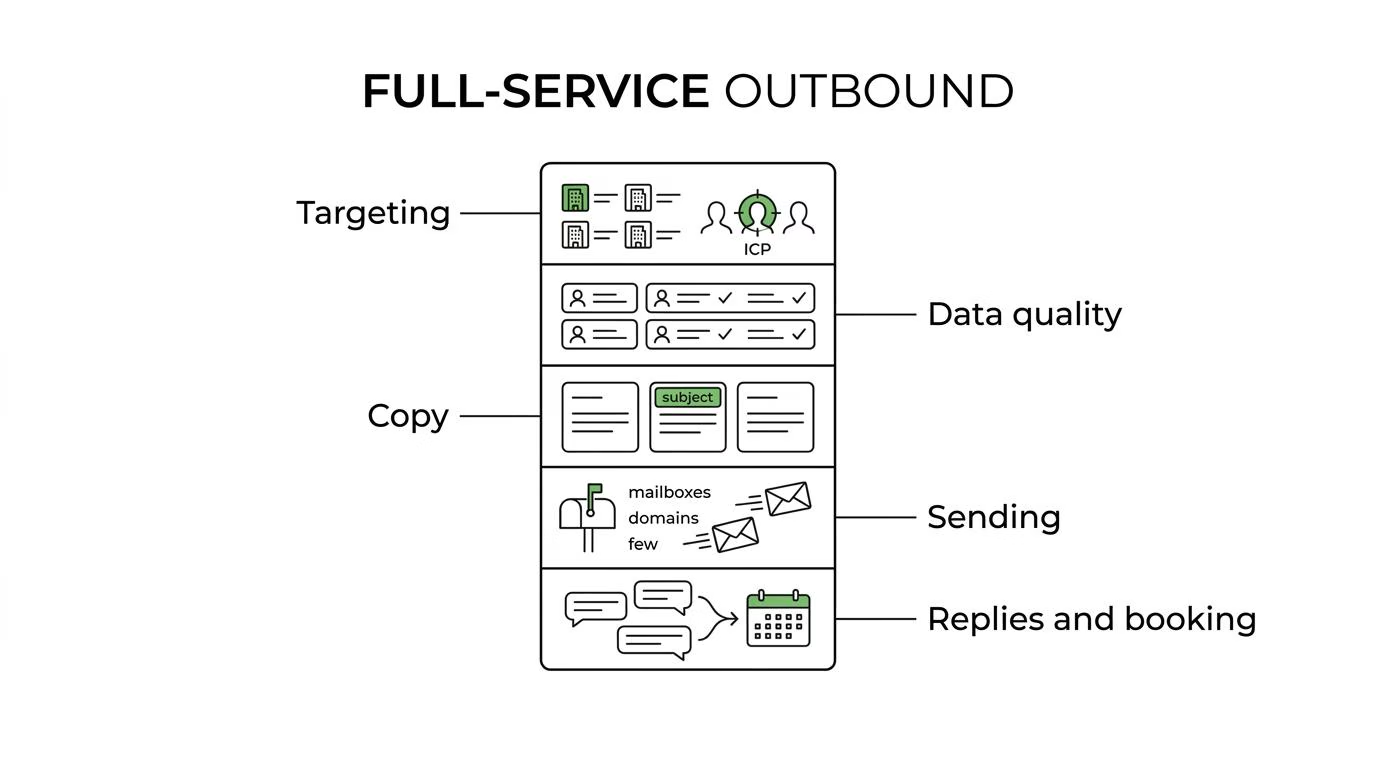
- Strong outsourced SDR providers should own targeting, data quality, copy, sending infrastructure, reply handling, and meeting booking, because weak execution in any one layer can kill results.
- Reachly is one example of a full-service outsourced SDR model, with case-study proof tied to SQL volume, CAC reduction, and contract value rather than activity metrics alone.
- Use cost math carefully: HubSpot-cited SDR pay ranges from $47.8K to $62K base, while the U.S. Bureau of Labor Statistics reports 2024 median annual wages of $66,780 and $100,070 for broader sales rep categories before tools and ramp.
- If a provider cannot explain deliverability standards, list verification, offer testing, and how it books the meeting after replies come in, keep looking.
The bigger issue is not whether outsourced SDR works. It is whether the provider is selling real sales development or just rented activity. The questions below help you separate firms that create qualified pipeline from firms that simply send volume.
What does an outsourced SDR provider actually do?
An outsourced SDR provider handles top-of-funnel sales development on your behalf. Per Clutch’s definition of sales outsourcing, that often includes lead generation, cold calling, appointment scheduling, and related sales support.
That short definition hides a big difference in service models. Some vendors only cold call from a list you give them. Others run the full system, including ICP mapping, prospect research, verified data, outbound copy, inbox setup, LinkedIn touches, call tasks, reply routing, and handoff to your account executive or founder.
If you are a startup, that difference matters. A provider that only books meetings can still leave you managing the hardest parts yourself, especially list quality and deliverability. A common mistake is thinking more touches fix weak targeting. They do not. Bad lists just burn faster.
"Reachly reports 400+ campaigns run, which is the kind of operating repetition you want when an outsourced SDR provider is touching your domains, list, and first impression."
When should a startup choose outsourced SDR over an in-house hire?
You should choose outsourced SDR when you need pipeline in weeks, not quarters. The U.S. Bureau of Labor Statistics reports 2024 median annual wages of $66,780 and $100,070 for broader sales rep categories, while HubSpot cites SDR base salary ranges of $47.8K to $62K and on-target earnings of $72.1K.
That still is not the full math. You also pay for sourcing candidates, onboarding, manager oversight, data tools, sequencing software, domains, and the months it takes a new rep to learn your offer well enough to get replies.
Here is the clean comparison most founders actually need:
[markdown] | Factor | Outsourced SDR | In-house SDR | | --- | --- | --- | | Launch speed | Usually weeks | Often months | | Hiring risk | Lower | Higher | | Tools and infrastructure | Often included | You buy and manage them | | Process ownership | Shared with vendor | Internal | | Message learning curve | Vendor brings pattern knowledge | Rep learns from scratch | | Long-term control | Lower than in-house | Highest | [/markdown]The trade-off is simple. You get speed and existing systems with outsourced SDR. You get tighter day-to-day control with in-house. If your sales motion is still being figured out, outside help can shorten the feedback loop. If your motion is already stable and you want a team you coach daily, in-house may make more sense.
"Reachly says clients can typically expect 10 to 40 highly interested leads from their exact ICP each month, depending on volume, which is a more useful planning number than raw send counts."
What outsourced SDR provider models are best for startup growth?
The best option depends on your deal size, sales cycle, and channel fit. Most startups should shortlist provider models, not just logos, because the service design usually matters more than the brand name.
Use this as a filtering framework before you ask for proposals.
- Reachly: Full-service, signal-based outbound for B2B teams that want cold email, LinkedIn, and cold calling coordinated with reply handling and meeting booking.
- Cold email specialists: Best when email is your main acquisition channel and your total addressable market is large enough to support domain rotation.
- LinkedIn-first outbound teams: Better for founder-led selling, niche enterprise lists, and categories where trust matters before reply rate.
- Call-heavy appointment setters: Useful when your offer already converts and you need more live conversations, not message testing.
- Fractional SDR pods: A fit when you want part-time execution without adding a full employee.
- Offshore SDR staffing partners: Lower labor cost, but you usually manage the playbook, coaching, and quality control yourself.
- RevOps plus prospecting firms: Helpful when CRM routing, reporting, and lead handoff are weak.
- Vertical-specific outbound firms: Good when compliance, buyer language, or market structure is unusually specialized.
- Dedicated SDR-as-a-service teams: Useful if you want assigned reps without taking on employment overhead.
If you sell into a small, high-value market, favor precision over volume. If your TAM is wide and your offer is already proven, broader outbound coverage can work. Provider fit follows market fit, not the other way around.
Reachly runs the managed model, set out in full on the SDR as a service page.
Outsourced SDR is one slice of a wider market. For the full picture across retainer, performance and hybrid models, see our ranking of the top B2B lead generation agencies in 2026.
How do you evaluate an outsourced SDR provider in 3 steps?
Start with evidence, then inspect process, then pressure-test accountability. If the vendor cannot pass all three, you are probably buying activity instead of pipeline.
Step 1 is proof. Ask for outcomes tied to revenue or SQL quality, not just meetings booked. Reachly’s Primal case study is a good example of the level of proof to ask for: 85+ SQLs in six months, 35% CAC reduction, 4.57x ROI, and six closed deals. That is more useful than “we sent 50,000 emails.”
Step 2 is process. Ask how the provider builds lists, verifies emails, writes copy, warms domains, routes replies, and decides when a campaign is failing. If they cannot explain SPF, DKIM, DMARC, mailbox caps, and re-validation rules for older data, they are weak where most outbound problems start.
Step 3 is accountability. Ask who owns reply management, who qualifies leads, and what happens if replies are negative but technical performance looks healthy. Pro tip: if a provider blames copy first on every weak campaign, that usually means they are not diagnosing infrastructure or offer quality in the right order.
How should you launch an outsourced SDR program in the first 30 days?
A solid launch takes about 3 to 4 weeks. You need working infrastructure, a tested list, and a clear handoff before the first real sequence goes live.
Week one is setup. That means domains, mailboxes, SPF, DKIM, DMARC, a custom tracking domain if used, and warmup. Reachly’s operating standard is four weeks of warmup on every mailbox, always, because Google can add a warning banner to mail from domains younger than 30 days.
Week two is list and signal work. The best providers do not just pull titles. They build around company signals like funding, hiring, leadership changes, tech stack changes, headcount growth, website behavior, and LinkedIn engagement. If your list is older than three months, re-validate it before sending.
Week three and four are pilot and handoff. That means small-batch testing, reply review, offer adjustments, and agreement on who takes the meeting once interest shows up. Cold email length should usually stay near 70 to 80 words. And the first ask should be a reply, not a meeting request. You cannot book the meeting without the reply.
"Reachly has served 50+ B2B clients and booked 2,500+ calls, which matters because launch quality is less about templates and more about running the operational details without breaking deliverability."
On Reachly programs, Utkrusht Gupta runs the first 30 days of list and sequence setup.
How do outsourced SDR costs compare with hiring in-house?
Outsourced SDR is often cheaper in startup terms because you are buying a working system, not just a person. In-house looks cheaper only if you ignore ramp, management time, and tool stack costs.
HubSpot’s cited pay data puts SDR base salary around $47.8K to $62K, with $72.1K on-target earnings. The BLS wage data for broader sales representative roles lands even higher in some categories. That does not include data vendors, mailboxes, domains, verification, dialing tools, LinkedIn seats, or the founder time spent fixing weak early messaging.
If you need one deeply embedded rep for a mature process, in-house can still win. If you need a program that builds lists, tests offers, protects sending domains, and produces feedback fast, outsourced SDR often has cleaner economics in the first phase.
One more trade-off matters here. Cheap vendors are rarely cheap after month two. If the provider skimps on data, infrastructure, or reply handling, you pay later in burned domains, missed follow-up, and weak pipeline quality.
How do you test an offer before asking outsourced SDRs to scale it?
Test the offer on a small, clean segment first. If you cannot get replies from well-matched prospects, more volume will not save you.
Start with one ICP, one pain point, and one reason to care now. Hiring is often a stronger signal than funding because it shows active spend tied to growth. If you sell to recently funded startups, do not assume the funding itself belongs in the opener. Often it works better as context for your targeting than as copy.
Then write two short versions of the same idea. Keep them phone-readable. Skip links in the first email. Use a soft CTA like a routing question or a permission-based ask. Common misconception: personalization is not the same as relevance. “Saw you use X” only works if you know they actually use X and it matters to your offer.
Give the test enough volume to be meaningful, but not enough to do damage. If overall reply rate is healthy and positive replies are still flat after a serious sample, rewrite the offer before you rewrite everything else.
What KPIs actually matter for outsourced SDR performance?
The metrics that matter are the ones closest to revenue. Activity metrics help with diagnosis, but they should not decide whether you keep a vendor.
These are the numbers you should watch first:
- Positive reply rate: A fast signal for message and offer fit. Practitioner benchmarks often put 10 to 20 percent as normal and 35 to 40 percent as very good on qualified campaigns.
- Bounce rate: Keep it under 3 percent. Higher than that usually points to list quality or verification problems.
- Deliverability score: Aim above 97 percent if the provider is serious about inbox placement.
- Connection acceptance rate: Around 25 percent is a useful LinkedIn baseline on relevant lists.
- SQL-to-meeting quality: Track how many booked meetings are truly in your ICP and sales-ready.
Watch out for vanity reporting. Open rates are unreliable, especially after privacy changes from Apple and mailbox providers. Volume is not proof. Neither is “we got replies” if the replies are all disqualifications.
Cold email vs LinkedIn vs cold calling: which channel mix works best?
For most B2B startups, Reachly’s channel stack of cold email, LinkedIn, and cold calling is the safer setup because each channel covers the others’ blind spots.
If your TAM is large and your buyer is email-native, cold email usually does the initial heavy lifting. Keep daily caps conservative. Reachly’s 2026 operating caps are 15 emails per Google mailbox per day and 10 to 12 for Outlook. Match sender ESP to recipient ESP where possible.
If your market is narrower or more relationship-driven, LinkedIn adds context and visibility. A common working pattern is a profile visit, connection request with no note, a short lowercase message 1 to 3 days after acceptance, and a total of 4 to 5 touches across 2 to 4 weeks.
If your offer already lands and deal value is meaningful, cold calling belongs later in the sequence. It should not be your volume crutch. It works best after email and LinkedIn have created some recognition. If email says “not now” and the buyer fits, the phone can still move the deal forward.
What red flags should make you reject an outsourced SDR provider?
You should walk away from providers that hide the mechanics. Bad outsourced SDR vendors usually sound polished until you ask how the system actually runs.
Watch for these red flags after you have asked a few basic questions:
- Long sequences with six to ten emails before any learning loop
- No clear answer on list verification or data sources
- Meeting guarantees without qualification rules
- AI-written full emails with no human quality control
- Reporting that centers on opens, sends, or vague “engagement”
Another warning sign is copy-first diagnosis. If a vendor never talks about domains, authentication, list age, or reply quality, they are treating outbound like ad creative. It is not. It is part infrastructure, part targeting, part offer, part follow-up discipline.
What should you ask before signing with an outsourced SDR provider?
Ask questions that force the provider to show its operating model. If the answers are fuzzy, your results probably will be too.
A short buyer checklist helps:
- Who builds the list and how is it verified?
- Who writes the messaging and who approves it?
- What deliverability standards do you hold?
- Who handles replies and who books the meeting?
- What proof can you share from a similar motion?
You should also ask for recent examples of measurable impact. A good benchmark is whether the vendor can speak in terms like SQL volume, CAC movement, meeting frequency, contract value, or pipeline created. The Primal and The Great Room case studies show the level of specificity worth asking any provider to match.
If a provider can prove pipeline impact, explain its process, and show how it protects your domain and buyer experience, keep the conversation going. If it cannot, move on quickly. If you want a clean benchmark on your current outbound setup, book the meeting with Reachly and compare its answers against the checklist above before you sign anyone.