How many meetings should an SDR book per month? Plan on about 10: that is the median monthly quota for held meetings in Bridge Group's 2025 survey of 351 B2B companies. Reachly's outbound programs book 5 to 50 meetings a month per client, and sending volume sets where a program lands in that range.
Key Findings
- The median SDR quota is 10 held meetings a month, down 40% since 2018, and only 60% of reps hit it (Bridge Group, 2025).
- The 12 to 15 a month that most benchmark pages repeat is a target for outbound SDRs, and it sits above that median.
- Reachly books 5 to 50 meetings a month per client. Volume decides where in the range a program lands.
- Reachly's campaigns run a 1 to 5% reply rate counting out-of-office replies, and 10 to 30% of those replies are positive.
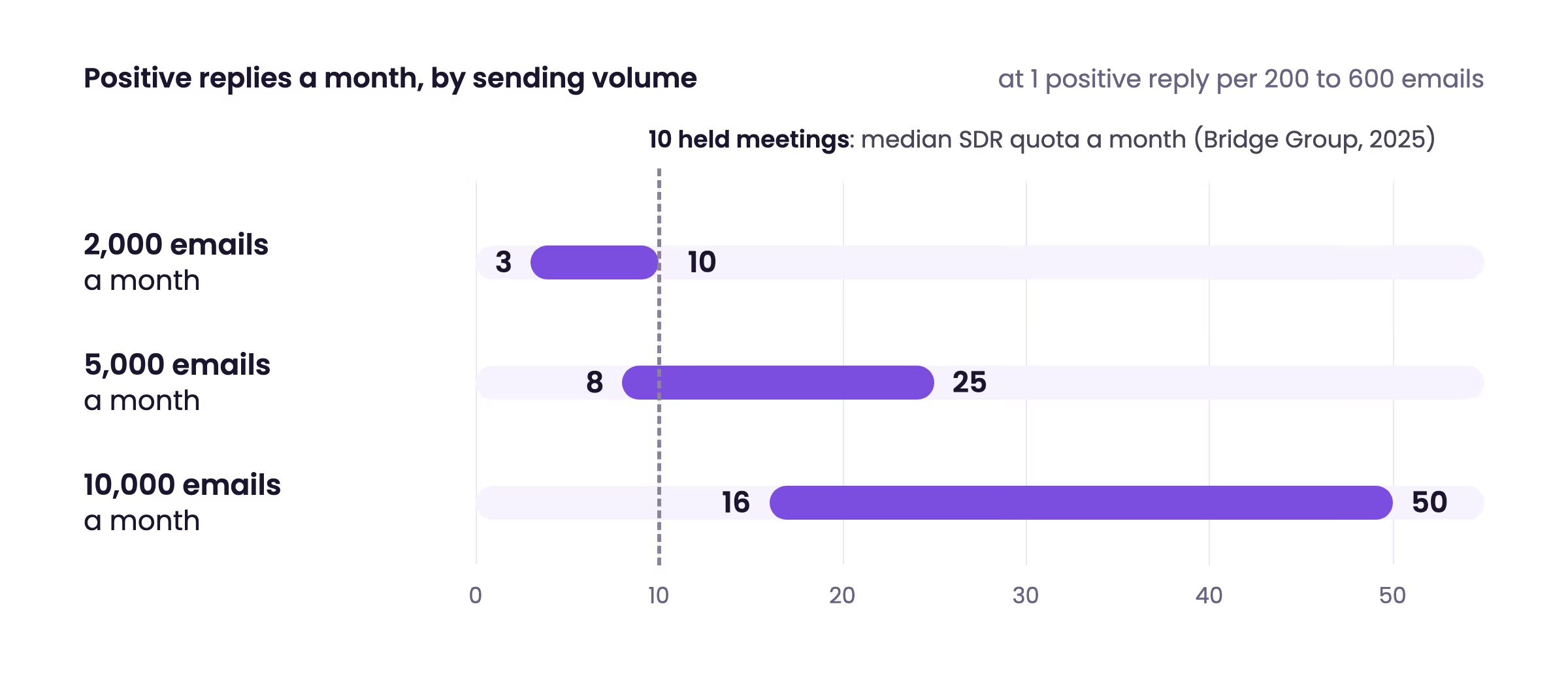
- Reachly plans on one positive reply per 200 to 600 emails, so 10,000 emails a month produce 16 to 50 interested leads.
- How many of those leads become meetings depends on how fast someone answers them. Reachly counts 80 to 90% of the meetings it books as qualified.
How many meetings should an SDR book per month, by SDR model?
Between 9 and 16 held meetings, depending on how much qualifying the SDR does before handing the meeting over. Bridge Group's 2025 report puts the global median quota at 10 held meetings a month, and splits it by model:
| Benchmark | Figure | Source |
|---|---|---|
| Median monthly quota, held meetings | 10 | Bridge Group, 2025 (351 B2B companies) |
| Quota when the SDR only books intros | 16.0 | Bridge Group, 2025 |
| Quota when the SDR semi-qualifies | 10.4 | Bridge Group, 2025 |
| Quota when the SDR fully qualifies | 9.0 | Bridge Group, 2025 |
| Reps at quota | 60%, the lowest in the study's history | Bridge Group, 2025 |
| Ramp time for a new SDR | 3.0 months | Bridge Group, 2025 |
| Commonly repeated outbound target | 12 to 15 qualified meetings | Prospeo, drawing on Bridge Group and 6sense |
Why 12 to 15 is the number you keep seeing
It is a target, and the median sits below it. Pages that quote 12 to 15 are describing what an outbound SDR should aim for. Bridge Group measures what quotas actually are, and the held-meeting median has fallen 40% since 2018.
If you are setting a quota for a new hire, 10 held meetings is the honest middle. Ask for 12 to 15 once the rep has ramped, which takes 3 months on Bridge Group's numbers.
Booked or held
Count held meetings. A booked meeting that no-shows cost the SDR the same effort and gave the account executive nothing. Bridge Group's quotas count meetings that took place.
How many meetings does Reachly book per month?
Reachly books 5 to 50 meetings a month per client, depending on the package. The package sets how many emails and LinkedIn messages go out, and volume is the biggest single input to the meeting count. Here is every Reachly number next to the benchmark people usually compare it with.
What that costs against hiring, salary included, is worked through in SDR agency vs in-house SDR.
| Metric | Common benchmark | Reachly | Where Reachly's number comes from |
|---|---|---|---|
| Meetings a month | 10 held per SDR (median quota) | 5 to 50 per client, set by sending volume | Reachly team figure, Oct 2026 |
| Reply rate | 3.43% average (Instantly, 2025 data) | 1 to 5%, out-of-office replies included | Reachly team figure, Oct 2026 |
| Positive share of replies | Not published | 10 to 30% | Reachly team figure, Oct 2026 |
| Emails per positive reply | Not published | 1 per 200 to 600 emails | Reachly planning ratio |
| Meetings that qualify | Not published | 80 to 90% | Reachly team figure, Oct 2026 |
| Time to first meeting | 3.0-month SDR ramp (Bridge Group) | 10 days on pre-warmed domains, 5 to 6 weeks on new branded domains | Reachly team figure, Oct 2026 |
| Cost per meeting | Not published | $90 to $350 | Reachly team figure, Oct 2026 |
Why every Reachly number is a range
Because the same setup gives different results in different markets. Thibault's answer when asked for realistic numbers: “It obviously depends on sending volume, offer, the market, whether it's a saturated offer AND/OR if the audience are the type that don't receive too many cold emails.” A niche audience that rarely gets cold email sits near the top of each range, and a crowded one near the bottom.
The KPIs Reachly reports to clients each week, and the thresholds that trigger a change, are in outbound sales KPIs. Published reply-rate benchmarks, and why they disagree, are in cold email response rates.
How do you work out how many meetings outbound will book?
Start from the emails you can send, divide by emails per positive reply, then count how many of those interested leads someone turns into a meeting. Reachly plans every program with that chain, in three steps.
Step 1: how many emails can you send?
Volume comes from mailboxes. Reachly sends 12 to 15 emails per mailbox per day (10 to 12 on Outlook), with 2 to 3 mailboxes per domain, after 4 weeks of warm-up. Over 22 sending days, 10,000 emails a month needs 31 to 38 mailboxes. The full setup and its costs are in cold email infrastructure.
Step 2: how many positive replies will it earn?
Divide by Reachly's planning ratio of one positive reply per 200 to 600 emails. Thibault Garcia, Reachly's founder, reads the ratio like this: 200 to 300 is very good, 300 to 600 is good, and more than 600 means the offer needs work before anything else does.
| Emails a month | Mailboxes needed | Domains | Positive replies a month |
|---|---|---|---|
| 2,000 | 7 to 8 | 3 to 4 | 3 to 10 |
| 5,000 | 16 to 19 | 6 to 10 | 8 to 25 |
| 10,000 | 31 to 38 | 11 to 19 | 16 to 50 |
To run the same math on your own volume, deal size and close rate, use Reachly's outbound ROI calculator.
The low end of each range is rounded down. Booking those leads into calendars is what Reachly's appointment setting team does when a client has no SDR of its own.
Step 3: how many become meetings?
That depends on the person who answers the reply. Thibault's view, from his answers on campaign numbers: “Regarding meeting booked conversion, it only depends on how good (and fast) their SDRs are at turning those interested leads into meetings.” So Reachly plans the top two steps and measures the third per client.
Why do positive replies not all turn into meetings?
Mostly because of speed. A prospect who replies “sure, send it over” is interested for hours, not weeks. In Thibault's words, outbound “works well when you already have a sales motion in place, with well-trained sales team (SDRs) who can nurture and book interested leads in a reactive manner (not taking 3h to get back to an interested lead), otherwise you leak a lot of leads.”
The second reason is who owns the reply. Reachly sees its job as getting to message-market fit and starting the conversation, then handing over: “to generate those conversations for then the client sales team or SDR or the founder, depending on how small the company is, to jump on those leads and nurture them and turn them into a meeting.”
Where a client has no one to do that, Reachly's appointment setting service takes the replies and books the meetings into the client's calendar. How the whole program fits together, from list to sequence to handoff, is in our outbound sales strategy guide.
What does a month of outbound look like for a real client?
Primal, a marketing agency in Thailand, is the cleanest example, because its whole outbound engine was built from zero. Its 85+ SQLs in 6 months work out to more than 14 a month, which is above the 10-a-month median for an in-house SDR.
An SQL is a stricter count than a booked meeting, so the meeting count behind those 85+ was higher. Primal's case study does not publish it, and this post does not estimate it.
How did Reachly count these numbers?
Reachly's figures are planning ranges, not averages from a published sample. Thibault Garcia, Reachly's founder, set them from the 1,000+ campaigns Reachly has run, and approved each one on Reachly's internal numbers sheet in October 2026. They are the numbers Reachly uses to plan a new client's program before it launches.
What counts as a reply
Any reply, including out-of-office and auto-replies, the same way Reachly counts reply rate internally. Reachly keeps out-of-office replies in on purpose: they prove the email landed in an inbox.
What counts as a positive reply and a meeting
A positive reply is what Thibault calls an interested lead. A qualified meeting is one where the person matches the ICP criteria agreed with the client when the market is mapped, and 80 to 90% of the meetings Reachly books meet that bar.
What the benchmarks measure
Bridge Group's figures are quotas reported by 351 B2B companies, published February 6, 2025. Instantly's 3.43% is a platform-wide average across its users' 2025 campaigns. Neither is a like-for-like match for an agency program, which is why the table names the source of every row.
Want 5 to 50 meetings a month without hiring an SDR? Book a call with Reachly →
FAQ
How do you book more meetings as an SDR?
Fix the list before the copy. Thibault's rule is that at least 90% of the people on a list should be able to use the offer, and that the first email asks permission to send something small (“If I recorded a video, could I send it over?”) instead of asking for 30 minutes. The full email spec is in how to write a cold email.
What is a good SDR conversion rate?
Bridge Group's 2025 medians give a useful reference: a quota of 10 held meetings sits beside a quota of 6 meetings converted to a stage 1 opportunity, so the two quotas imply about 6 in 10 held meetings becoming pipeline. The converted quota is down 43% since 2018.
Is cold email still effective in 2026?
Yes, with a wide spread between average and good. Instantly's 2026 benchmark report puts the top 25% of campaigns at a 5.5% reply rate or better and the top 10% above 10.7%, against a 3.43% average. Thibault expects it to stay the main channel: “in 2027, cold email is still going to be a main channel to drive revenue.”
Is sending 40 emails a day a lot?
From one mailbox, yes. Reachly caps each Google mailbox at 12 to 15 cold emails a day and each Outlook mailbox at 10 to 12, so 40 a day goes out across 3 mailboxes. Reachly puts 2 to 3 mailboxes on each domain, so 40 a day fits on one domain with 3 Google mailboxes.