
Lead qualification services that turn outbound replies into sales-ready meetings with better targeting, faster follow-up, and cleaner handoff.
Reachly runs lead qualification services for B2B outbound teams that need sales-ready meetings, and first qualified meetings usually land in 5 to 7 weeks after warm-up. We build the targeting, launch the outreach across cold email, LinkedIn, cold calling, handle replies, nurture interest, and book the meeting on infrastructure that protects your main domain.
If you already own the outbound number, you do not need more activity for the sake of it. You need better-fit accounts, faster follow-up, and cleaner handoff from reply to meeting. Reachly does that with signal-based outbound tied to real buying moments, plus reply management and appointment setting inside one system.
What do lead qualification services look like when you care about sales-ready meetings?
Reachly qualifies twice. First before outreach, then again when a prospect actually replies. That matters because bad-fit leads waste send volume early, and loose reply handling kills good opportunities later.
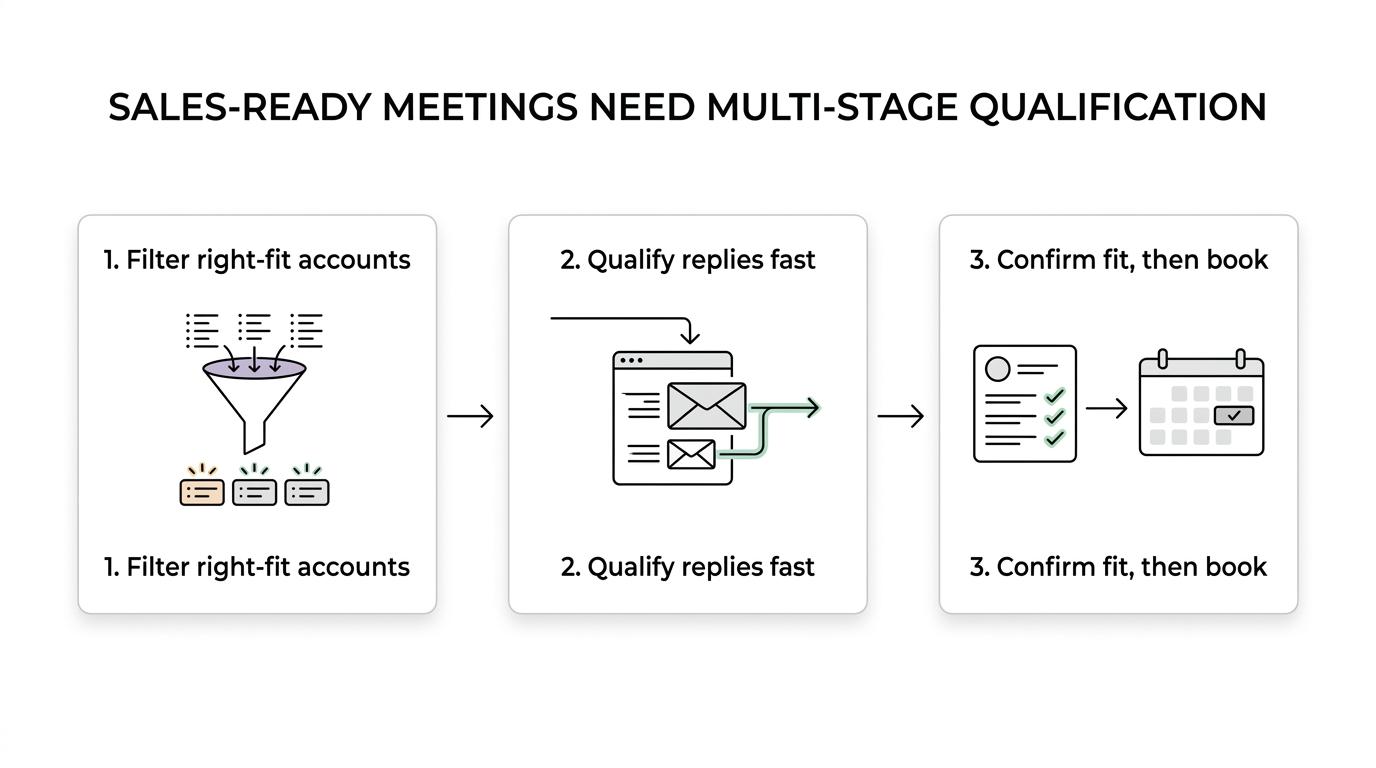
Here is what that looks like in practice:
[markdown] | Stage | What Reachly does | What you get | | --- | --- | --- | | Before outreach | Maps your TAM across 10+ data sources, enriches accounts with buying signals, and filters for ICP fit | Fewer wasted touches, cleaner targeting, and a higher chance that replies come from the right accounts | | During outreach | Runs multichannel sequences across cold email, LinkedIn, cold calling on secondary sending domains | More ways to reach decision-makers without putting your own domain at risk | | After reply | Manages replies in a centralized inbox, sorts intent, routes prospects, and nurtures early interest | Faster qualification, fewer missed replies, and less SDR admin | | Before booking | Confirms fit, timing, and ownership before pushing to calendar | Meetings your sales team is more likely to accept and advance | [/markdown]Reachly’s outbound lead generation services are built around qualified meetings, not raw lead dumps. We do the targeting, the sending, the reply handling, and the booking, so your team sees prospects when the conversation is real.
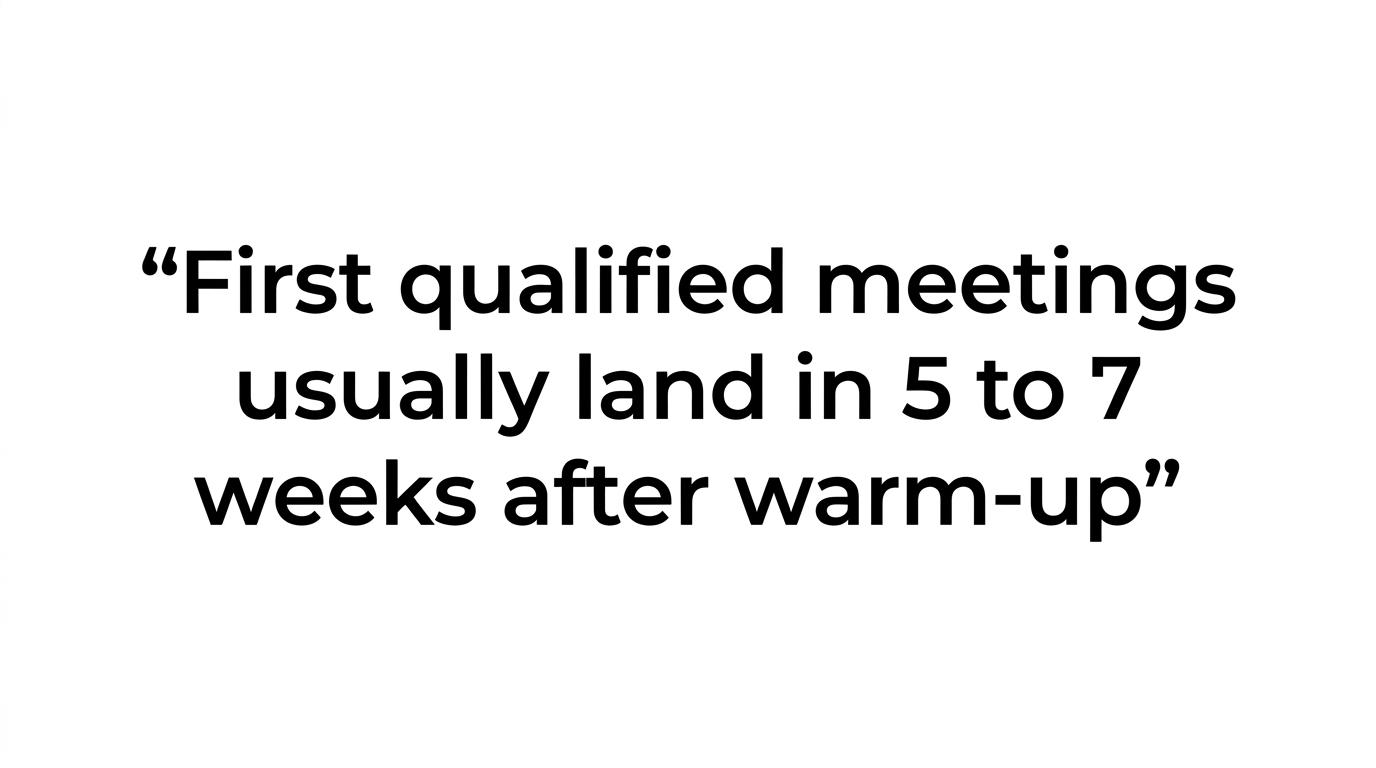
"Reachly’s first qualified meetings usually land in 5 to 7 weeks after warm-up."
If you want a vendor to fill calendars without checking fit, this is the wrong setup. Lead qualification only counts when the person, account, timing, and next step all line up.
Who should use Reachly for outsourced lead qualification?
Reachly is a fit for B2B companies with a defined ICP, a real offer, and enough contract value to care about downstream conversion. That includes SaaS teams, agencies, niche providers, and enterprise sellers with small TAMs or long cycles, especially when hiring more SDRs would slow you down.
Reachly is also a good fit when your internal team already knows what a qualified meeting should look like, but does not want to spend its week building lists, watching inboxes, and chasing every maybe. If your outbound motion depends on reaching decision-makers in a narrow market, precision matters more than volume.
Reachly’s work with Primal shows what that looks like when qualification is tied to business outcomes. The campaign produced 85+ SQLs in 6 months, with 4.57x ROI and a 35% CAC reduction.
"Reachly helped Primal generate 85+ SQLs in 6 months."
If your ICP is still fuzzy, your offer changes every week, or your annual contract value sits below $5,000, outsourced qualification usually breaks on the math or the message. In that case, founder-led outreach is the cleaner first step.
How does Reachly qualify leads before your sales team ever sees them?
Reachly starts qualification before a single message goes out. We map your TAM across 10+ sources, then enrich accounts with real-time buying signals such as hiring, funding, leadership changes, tech stack shifts, headcount growth, and website behavior.
Those signals matter because they tell you who has a reason to care now. Reachly uses tools like Clay, Apollo, LinkedIn Sales Navigator, Trigify, and RB2B to build that signal layer, then scores accounts so the highest-converting profiles get worked first.
The signal itself is not the whole message. We use it to decide who enters the campaign, what angle they see, and when to contact them. That keeps the outreach tied to a buying moment instead of a generic list.
Reachly also treats data quality as part of qualification. Any list older than 3 months gets re-validated before send, email data is verified before launch, and campaigns run on secondary domains with SPF, DKIM, DMARC, and custom tracking domains configured. That protects domain reputation and keeps the list clean enough for meaningful qualification.
If the data is weak, the rest of the motion lies to you. Cheap lists, stale contact records, and guessed signals do not just hurt deliverability, they make it impossible to know whether the market rejected the offer or the wrong people got the message.
Why does response speed change qualification results so much?
Lead qualification is partly targeting and partly speed. A good reply goes cold fast when nobody owns the inbox.
External research makes the point clearly:
[markdown] | Source | Year | Fact | Why it matters | | --- | --- | --- | --- | | Harvard Business Review / InsideSales.com | 2016 | Study analyzed 15,000+ unique leads and 100,000+ call attempts | This is not a tiny sample or one-team anecdote | | Harvard Business Review / InsideSales.com | 2016 | Best response time was within 5 minutes | Qualification odds drop when interest sits unattended | | Harvard Business Review / InsideSales.com | 2016 | Average phone response time was 44 hours, and only 4.7% of companies hit the 5-minute window | Most teams are slower than they think, which creates avoidable funnel loss | [/markdown]Reachly handles reply management inside a centralized inbox, so your team is not discovering interested prospects hours later. LinkedIn replies usually start in week 2 to 3, and pre-qualified responses surface in a live reporting dashboard your sales team can act on immediately.
"Reachly gets LinkedIn replies from week 2 to 3 and surfaces pre-qualified responses in a live dashboard."
That does not mean every outbound reply needs a five-minute phone call. It means the window to qualify, route, and keep momentum is short, especially when the trigger that made the account relevant is only fresh for 2 to 4 weeks.
What happens after a prospect replies?
This is where a lot of lead qualification services fall apart. They forward replies, label them interested, and leave your team to sort it out.
Reachly manages the reply flow, not just the send. We sort positive replies, neutral replies, routing questions, and early-stage interest, then move each one to the right next step instead of treating every response the same.
Reachly’s appointment setting services sit inside that same workflow. That means the person who replied does not disappear between channels, the SDR does not need to rebuild context, and the calendar invite goes to the right owner.
We also use the full channel stack to confirm interest and reduce false positives. Reachly coordinates cold email, LinkedIn, cold calling so prospects can respond where they are most likely to engage, and your team gets a fuller picture before the meeting is booked.
The first ask is usually small. A routing answer, permission to send more detail, or confirmation of ownership tells you more than pushing for a meeting too early. Once intent is clear, we book the meeting and pass over the context that got it there.
If your team has no routing rules, no calendar ownership, or weak follow-through after booking, qualification will still leak. Outbound multiplies the sales process you already have.
What proof shows the meetings are actually better?
Reachly publishes proof that sits below the reply-rate line. The useful numbers are SQLs, contract value, CAC, and funnel drop-off, because those are the numbers sales leaders care about once the meeting lands.
Here are two named examples:
[markdown] | Client | Qualification outcome | Downstream result | | --- | --- | --- | | Primal | 85+ SQLs in 6 months, 8% positive reply rate | 6 deals signed, 4.57x ROI, 35% CAC reduction, break-even in 3 months | | The Great Room | Face-to-face meetings moved from about 2 per quarter to about 2 per month | About $250,000 in contract value closed, with drop-off improving from about 50% on paid channels to about 30% on Reachly outbound leads | [/markdown]Reachly’s work for The Great Room is useful because it shows qualification quality, not just meeting count. The leads did not just convert into more meetings, they dropped out of the funnel less often than leads from paid channels.
"Reachly helped The Great Room move from about 2 face-to-face meetings per quarter to about 2 per month."
Across 50+ B2B clients, Reachly has run 400+ campaigns, booked 2,500+ meetings, and generated $3M+ in pipeline. Reachly is also rated 4.9 by 50+ leaders, which matters because lead qualification is only valuable if clients trust the process after launch.
Results still depend on your offer, TAM, and sales process. We do not count a positive reply as a win if it never becomes a qualified meeting or a real opportunity.
When should you not buy outsourced lead qualification services?
Reachly is not the right fit for every pipeline problem. If you only want a list, a few copy variations, or a sequence file for your SDRs, this is not that service.
If your average contract value is under $5,000, the economics are usually weak. If you have not found product-market fit, outbound becomes a bet on a message that may still be wrong.
If your market is tiny and highly specific, founder outreach is often the better move. A list of 50 dream accounts should be worked carefully, not burned through by automation.
Reachly is also the wrong fit if you need paid ads, SEO, or a broad inbound program. We do outbound only, and we do it by building a signal-based system around qualification, reply handling, and booking.
How do you start with Reachly without slowing down your sales team?
Reachly ships faster than hiring in-house SDRs because we bring the infrastructure, list process, channel setup, and reply workflow with us. Domain warm-up still takes time, 14 to 30 days with 30 days being the safer floor, but your team does not need to build that machine from scratch.
Reachly sets up secondary sending domains, warms mailboxes, matches sender ESP to recipient ESP, and launches from infrastructure designed to protect your main domain. We use Smartlead for sending, HeyReach for LinkedIn execution, and Clay for the signal and data layer.
Reachly is Clay certified, Smartlead certified, and HeyReach certified. That matters because lead qualification breaks when the data layer, the send layer, and the LinkedIn layer sit in separate hands.
You also get live reporting, a centralized inbox, and one place to see who replied, who qualified, who needs nurturing, and which meetings were booked. If LinkedIn is part of your motion, our LinkedIn outreach agency work follows the same qualification logic.
Lead qualification works when three things are true. The right accounts enter the campaign, replies get handled fast, and meetings only get booked once fit is clear.
If that is the bottleneck in your pipeline, book a meeting with Reachly. We will look at your ICP, offer, buying signals, and current reply handling, then show you whether our outbound lead generation services and appointment setting services fit the sales-ready meetings you want.