

Lead generation for manufacturers works best with signal-based outreach, plant-level targeting, and short offers built for complex buying teams.
Lead generation for manufacturers works when you treat outbound like plant-floor sales, not SaaS sales. The campaigns that win are tight, signal-based, and written for a buying group, not a single contact. When you do that, reply rates can move from the 2% to 4% range common in broad firmographic outreach toward the 5% to 10%+ range Reachly has published for signal-based campaigns.
That gap matters more in manufacturing because the sales cycle is slower, the org chart is messier, and verified direct emails are harder to find. You are often selling through a distributor layer, into multiple sites, or into a team where procurement, operations, and engineering all have a vote.
If you want the broader playbook beyond this vertical, this B2B lead generation strategies post covers the wider channel mix. This page is narrower on purpose. Manufacturing lead generation changes when the buyer sits inside a plant, a sourcing team, or a regional operating unit.
Why is lead generation for manufacturers different from other B2B outbound?
The short version: industrial outbound gets worse when you flatten the account into one contact, one problem, and one email.
A manufacturing deal usually has more internal friction than a normal software sale. Gartner said in 2024 that B2B buyers facing moderate to high uncertainty are 78% less likely to complete a high-quality deal. That tracks with what you see in the field. If the plant team likes the idea but sourcing is unsure, or the distributor relationship is unclear, the deal slows down fast.
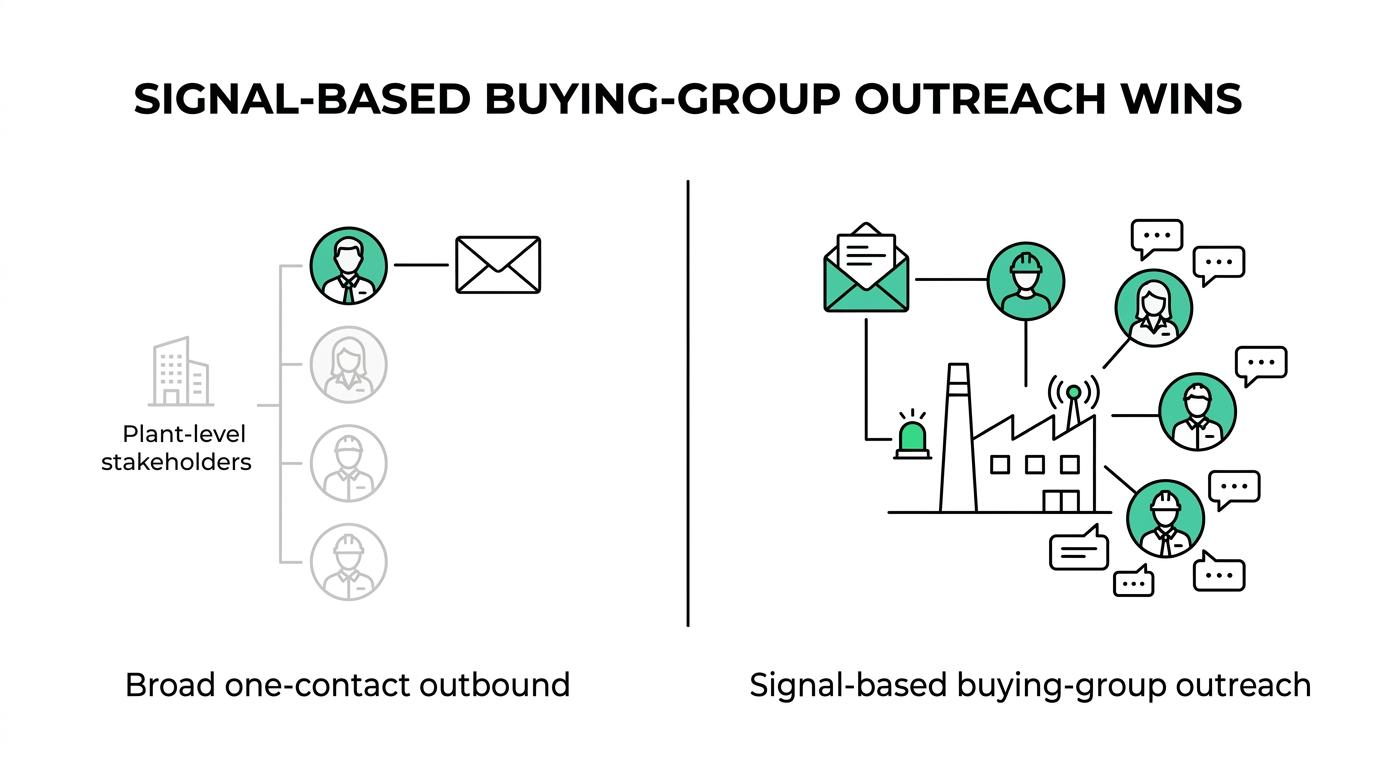
McKinsey has made the same point from another angle. In manufacturing, the buyer is often not the only stakeholder. Procurement may own the commercial step while engineering, quality, maintenance, or shop-floor teams shape the real decision.
[markdown] | Source | Published finding | What it means in manufacturing outreach | | --- | --- | --- | | Gartner, 2024 | Buyers facing moderate to high uncertainty are 78% less likely to complete a high-quality deal | Your outbound has to reduce risk, not just pitch features | | McKinsey, 2024 | 3,000+ responses across 11 industries and 15 countries | Reputation and a credible rep still matter in complex B2B buying | | McKinsey, 2010 | Manufacturing purchases often involve procurement, R&D, and shop-floor stakeholders | One-contact outreach misses how the deal is actually decided | | Reachly, 2026 | Broad firmographic campaigns often sit at 2% to 4% reply rates, signal-based campaigns can reach 5% to 10%+ | Signals matter more when the market is smaller and slower | [/markdown]That is why manufacturing lead generation cannot be generic. A message to a VP of Operations should not look like a message to a procurement manager. And neither should look like the note you send to a maintenance or quality lead.
Which manufacturing segments and job titles actually reply?
What we keep seeing: operations, procurement, and engineering roles reply more often than broad top-of-house lists.
Reachly has not published title-level percentages for industrial campaigns, so it would be false to claim exact reply rates by title. What can be said publicly is the pattern. In manufacturing and industrial outbound, replies cluster around people close to throughput, cost, supplier risk, downtime, quality, and scheduling. When those titles are targeted with real buying signals, campaigns tend to sit inside Reachly’s published 5% to 10%+ reply band. When the list is just “manufacturing companies with 200+ employees,” reply rates usually fall back toward the 2% to 4% band.
That distinction is the whole game. A list of 2,000 manufacturers is not a market. It is noise until you segment by plant reality.
[markdown] | Segment | Titles that tend to reply | What gets attention | Likely reply band based on Reachly’s published campaign types | | --- | --- | --- | --- | | Operations and plant leadership | Plant Manager, Operations Manager, Production Manager, Director of Operations, Continuous Improvement Manager | Throughput, scrap, scheduling, labor pressure, line downtime | Usually inside the 5% to 10%+ band when signal-based | | Procurement and sourcing | Procurement Manager, Strategic Sourcing Manager, Category Manager, Supply Chain Manager | Supplier consolidation, stockouts, qualification, price pressure, lead-time risk | Usually inside the 5% to 10%+ band when signal-based | | Engineering, maintenance, and quality | Manufacturing Engineer, Maintenance Manager, Quality Manager, Engineering Director | Process bottlenecks, uptime, compliance, rework, equipment issues | Usually inside the 5% to 10%+ band when the pain is real and current | | Executive layer | COO, VP Operations, GM, Owner, President | Cross-site visibility, margin pressure, major change events | Often slides toward 2% to 4% when targeted broadly without a live trigger | [/markdown]This is one of the biggest mistakes in manufacturing lead generation. Teams start at the top because the titles look senior. But plant-level and function-level leaders are often the ones who will actually answer you, route you, or tell you whether the pain is real.
A good manufacturing list is narrower than people expect. You are not trying to hit “manufacturers.” You are trying to hit the people who wake up thinking about waste, supplier risk, or output.
How should you build a manufacturing list when verified emails are thin?
This is where industrial lead generation gets slower and more manual. Direct dials are patchy. Site-level contacts are inconsistent. Some plants have strong public data, some barely have a web page. Corporate HQ often lists executives, while the real buying motion sits inside a plant, a regional unit, or a distributor network.
So the first job is not copy. It is account mapping.
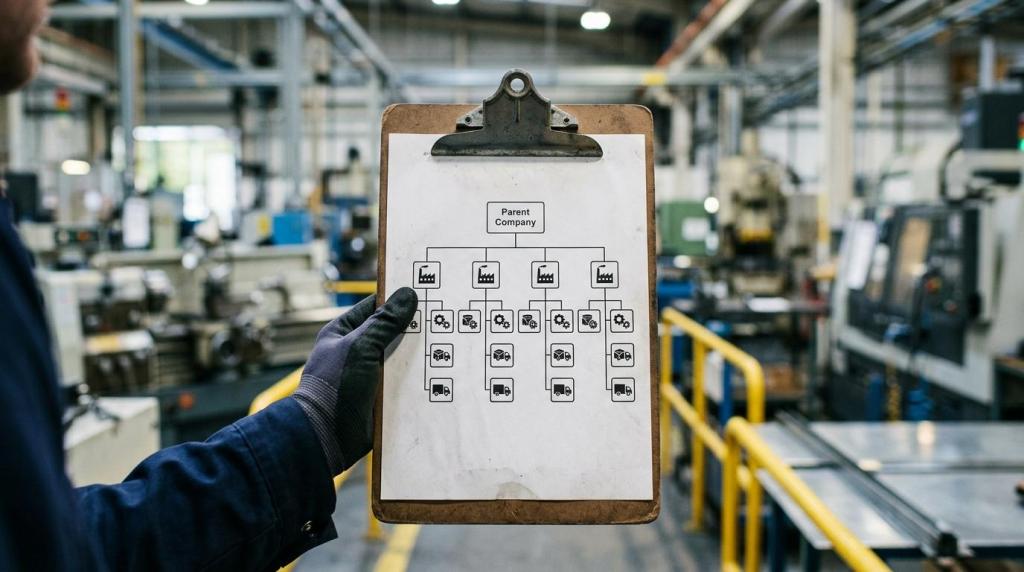
At Reachly, signal-based outbound starts with TAM work in tools like Clay, Apollo, LinkedIn Sales Navigator, RB2B, and Trigify. In manufacturing, that often means mapping the parent company, sites, product lines, regional operations, and channel structure before a single email is written. The cost is time. This part takes longer than SaaS because the org chart is less public and the contact data is weaker.
What usually breaks manufacturing data quality:
[markdown] | Problem | What it does to your campaign | What we do instead | | --- | --- | --- | | HQ-heavy data | You email people with no local context | Map plant or regional ownership first | | Old contact records | Bounce risk rises fast | Re-validate any list older than 3 months | | Distributor confusion | The wrong party gets the pitch | Mark direct, rep-led, and distributor-led accounts separately | | Generic firmographics | Copy gets too broad to answer | Build segments around pain, process, and signal | [/markdown]Authentication still has to be perfect. SPF, DKIM, DMARC, and a custom tracking domain are not optional. Warmup still needs 14 to 30 days, with 30 days the safer number. Google now adds a yellow banner to mail from domains younger than 30 days, so rushing this part costs you inbox placement later.
Thibault Garcia, founder of Reachly, puts it plainly: “Cheap data is the most expensive thing in outbound. You pay for it later in bounces, in burned domains, and in the three weeks you spend blaming your copy.”
What should the outreach look like in industrial lead generation?
Manufacturing buyers do not need clever copy. They need a reason to care now.
That reason usually comes from a signal. Hiring is a strong one. A new plant leader can work on dream-account lists. Headcount growth, supplier issues, expansion, new product lines, leadership changes, and tech stack shifts are all useful. Funding is less useful in this vertical than people think.
The email itself should stay short. Reachly’s view on 2026 cold email length is 70 to 80 words. No links in the first email. No long intro. No feature dump. The goal is a reply, not a meeting. No reply, no meeting.
A weak manufacturing email sounds like this: “We help manufacturers improve efficiency with our platform.” It gives the buyer nothing to react to.
A stronger one sounds like this:
saw your team is hiring production planners in ohio. usually that happens when output is growing faster than scheduling can keep up.
worth asking, is reducing line disruption or supplier coordination a priority this quarter?
That works because it sounds like a person who noticed something specific, not a sequencer filling space.
The offer matters more than the wording. Garcia has a line we agree with because the numbers keep proving it: “Every client gets the same question before we write a single email. If you had thirty seconds with your dream client, what would you offer them? If the answer takes longer than thirty seconds, we do not have an offer yet.”
For manufacturing lead generation, good offers are usually concrete and low-friction:
[markdown] | Weak offer | Stronger offer | | --- | --- | | “Can I show you our platform?” | “Worth sending a 2-minute teardown of where supplier handoff usually breaks?” | | “Open to a quick demo?” | “If I mapped the bottleneck we see after multi-site growth, could I send it over?” | | “We help industrial firms save time and money” | “Would a short audit on scrap, scheduling, or downtime be useful?” | [/markdown]This is also where cold email, LinkedIn, and cold calling need to work together. The email opens the loop. LinkedIn gives you another surface area. Cold calling is what you use after there is some context, not as a volume play.
If you want help building that full motion, Reachly’s outbound lead generation services are built around signal-based targeting, reply handling, and meeting booking.
When should each follow up go out in manufacturing outreach?
Manufacturing sales cycles are long. That does not mean your sequence should be long.
Reachly’s position is simple. Send two emails, about 6 to 7 days apart, then stop and re-engage later with a new angle. Long email sequences burn deliverability and usually hide a weak first message. Reachly has also published that follow-ups carry 44% of positive replies, so one email is rarely enough.
A good manufacturing sequence looks like this:
[markdown] | Day | Channel | What happens | | --- | --- | --- | | 1 | LinkedIn and cold email | LinkedIn visit, connection request, Email #1 with the signal and one question | | 6 or 7 | Cold email | Email #2 from a new angle, still short, still no hard pitch | | 10 to 14 | Cold calling | Call the accounts that opened, replied, or match the highest-intent signals | | 14 to 21 | LinkedIn | Short lowercase message after acceptance, asking a routing question | | 45 to 75 | Cold email | Re-engage the same list with a fresh signal or offer | [/markdown]The routing question works well in manufacturing because decision rights are messy. Something as simple as “would this sit with you or someone at plant level?” gets useful replies without forcing a meeting ask too early.
LinkedIn also behaves differently here. Acceptance rates depend on title, geography, and how public-facing the buyer is. But the pattern is still useful. Empty connection note, wait 1 to 3 days after acceptance, then send a short question-based message.
When does manufacturing lead generation not work?
If your average contract value is under $5,000, send the emails yourself for now. That is the math Garcia has stated publicly, and it applies here too.
It also breaks when the channel model is unclear. If distributors own the account, but your outreach acts like the plant buys direct, you create friction before the first real conversation. The same thing happens when the offer is too broad. “We help manufacturers” is not an offer. It is a category label.
Manufacturing outbound also struggles when the TAM is tiny. If you only have 50 dream accounts, this is founder-led work. Automation will just burn through the list faster.
One more point matters here. Outbound multiplies the sales process you already have. If there is no clear handoff from reply to qualification to meeting booking, the campaign will feel worse than it is because the follow-up system is weak.
What should you do next if you need manufacturing lead generation?
If you need Manufacturing lead generation, start by checking three things: whether you have a real offer, whether your data is built around plant reality instead of broad firmographics, and whether your outreach speaks to the right stakeholder. If any of those are off, more volume will not save the campaign.
If you want a second set of eyes on that setup, Reachly can review the offer, list logic, and sequence structure, then show you how a signal-based system across cold email, LinkedIn, and cold calling would look for your market. You can book the meeting with Reachly and get a practical read on whether the channel is worth pushing now.
The short version is simple. Manufacturing lead generation works best when you target buying signals, write for operations and plant-level stakeholders, and keep the ask small. Broad lists, long sequences, and generic value props are what usually drag industrial reply rates back down.