

Outsourced SDR by Reachly helps B2B teams book qualified meetings in 5 to 7 weeks with signal-based outbound and no added headcount.
Outsourced SDR services make sense when you need pipeline without adding headcount, and Reachly is built for that outcome. Reachly usually sees first qualified meetings in 5 to 7 weeks and targets 10 to 40 highly interested leads per month by month 3 through signal-based outbound across cold email, LinkedIn, and cold calling.
Instead of hiring, training, managing, and protecting outbound infrastructure yourself, you hand Reachly the operating layer. We map your TAM across 10+ data sources, enrich accounts with real buying signals, run outreach on secondary sending domains, handle replies and nurturing, and book the meeting into your team.
What does Reachly take off your plate in an outsourced SDR program?
Reachly runs the parts of outbound that usually break when they sit across too many owners. That includes TAM mapping, list building, signal scoring, copy, infrastructure, multichannel outreach, reply handling, lead nurturing, and appointment setting.
You do not need to chase three vendors and an SDR manager to make the system hold together. Reachly runs outsourced SDR work inside a broader outbound lead generation services model, so the list, the message, the channels, and the booking flow all work from the same playbook.
"Reachly targets first qualified meetings in 5 to 7 weeks, with a month-3 goal of 10 to 40 highly interested leads from your exact ICP."
If you only want a list or a batch of copy, this is more than you need. Reachly is the right fit when you want the full outbound motion owned, measured, and tied to actual meetings.
[markdown] | Part of the outsourced SDR system | What Reachly handles | What changes for you | | --- | --- | --- | | TAM and account mapping | Account selection across 10+ sources, ICP filters, territory logic | Your team works from a defined market, not a loose spreadsheet | | Buying signals | Funding, hiring, headcount growth, leadership changes, tech stack shifts, LinkedIn activity, website signals | Outreach lands closer to real buying windows | | Outreach execution | Cold email, LinkedIn, cold calling in one sequence | Prospects hear a consistent message across channels | | Reply handling | Inbox coverage, qualification, routing, nurturing | Your AEs stop sorting replies and focus on live opportunities | | Booking | Calendar coordination and handoff through appointment setting services | Meetings arrive with context, not just a name and email | | Infrastructure | Secondary sending domains, mailbox rotation, authentication, monitoring | Your main domain stays out of the blast radius | | Reporting | Live dashboard and centralized inbox | You see volume, replies, meetings, and gaps in one place | [/markdown]Who gets the most from Reachly outsourced SDR services?
Reachly works best for B2B teams that already know outbound should produce pipeline, but do not want to build another internal pod to prove it. That usually means agencies, SaaS teams, enterprise sellers, niche B2B offers, and sales teams with a small TAM or a long buying cycle.
The common thread is not company size. It is sales motion. Reachly fits when your market needs precision, your ICP is clear enough to map, and your team cares about qualified meetings and SQLs more than adding SDR seats.
That also includes teams with in-house closers who need more top-of-funnel coverage. Reachly can sit in front of AEs, founders, or sales leaders who already know how to run discovery and close deals, but do not want outbound execution eating the week.
If your plan depends on broad volume and generic copy, this model gets too tight for you. Reachly is built for account selection, signal timing, and direct-response outreach where the list quality matters as much as the writing.
Why choose outsourced SDR instead of hiring another rep right now?
If you need pipeline this quarter, headcount is usually the slowest part of the plan. Hiring means recruiting, onboarding, writing sequences, setting up mailboxes, building lists, managing domain reputation, and coaching reply handling before you even know whether the offer converts.
The in-house route also carries a turnover cost. Average SDR tenure stays short, and replacement cycles reset ramp time, domain setups, and account knowledge.
[markdown] | Hiring reality | Source | Why it matters if you need pipeline soon | | --- | --- | --- | | Average SDR tenure is 1.9 years | The Bridge Group, 2025 | Ramp time takes a real share of the role's useful window | | Median SDR turnover is 40% | The Bridge Group, 2025 | Management time goes into hiring and backfilling, not just output | | 58% of companies report average SDR tenure of 12 to 23 months | The Bridge Group, 2025 | Short tenure is common, not an edge case | | Median annual pay is $70,280 for non-technical sales representatives | U.S. Bureau of Labor Statistics, 2025 | Headcount cost starts before tools, data, and management time | | Median annual pay is $105,910 for technical and scientific sales representatives | U.S. Bureau of Labor Statistics, 2025 | More technical commercial roles get expensive fast | | Projected employment growth is 1% from 2024 to 2034 | U.S. Bureau of Labor Statistics, 2026 | The labor market is not opening up fast enough to remove hiring friction | [/markdown]Those BLS categories are broader than SDR-only roles, but they still show the cost of commercial headcount in the market. Reachly replaces the hiring project with an outbound system that already includes data work, messaging, infrastructure, and meeting flow.
If you already have a stable SDR leader, clean data operations, a strong offer, and room to absorb more reps, keeping the motion in-house can make sense. Reachly is the better choice when the gap is execution speed and operating depth, not org design.
How does Reachly turn buying signals into qualified meetings?
Reachly starts with the market, not the sequence. We map your TAM, narrow to your ICP, then enrich accounts with intent patterns that suggest a reason to reach out now, not six months from now.
The signal stack includes company-level triggers such as funding, hiring, headcount growth, leadership change, tech stack change, and M&A. We also use website and behavior signals, LinkedIn activity, and intent patterns that can be scored inside Clay before a prospect ever enters outreach.
Reachly uses tools such as Clay, Apollo, LinkedIn Sales Navigator, Smartlead, HeyReach, Trigify, RB2B, ZeroBounce, and MillionVerifier because the work is operational before it is creative. The first job is to make sure the right people are in the system, the signals are recent, and the infrastructure is clean enough to land in the inbox.
Then the copy does its part. Reachly keeps cold emails short, plain text, and built for a reply. AI is used for signal-driven snippets only, never for the full email, and every live message is checked before it sends.
The reason this works is timing plus relevance. Most intent signals have a shelf life of 2 to 4 weeks, so the value is not only finding them. It is moving while the reason to reply still exists.
What happens in the first 5 to 7 weeks after kickoff?
The first phase is infrastructure and market setup. Reachly sets up secondary domains, authenticates everything that needs authenticating, warms mailboxes, maps the TAM, and builds the first signal-based audience before real volume starts.
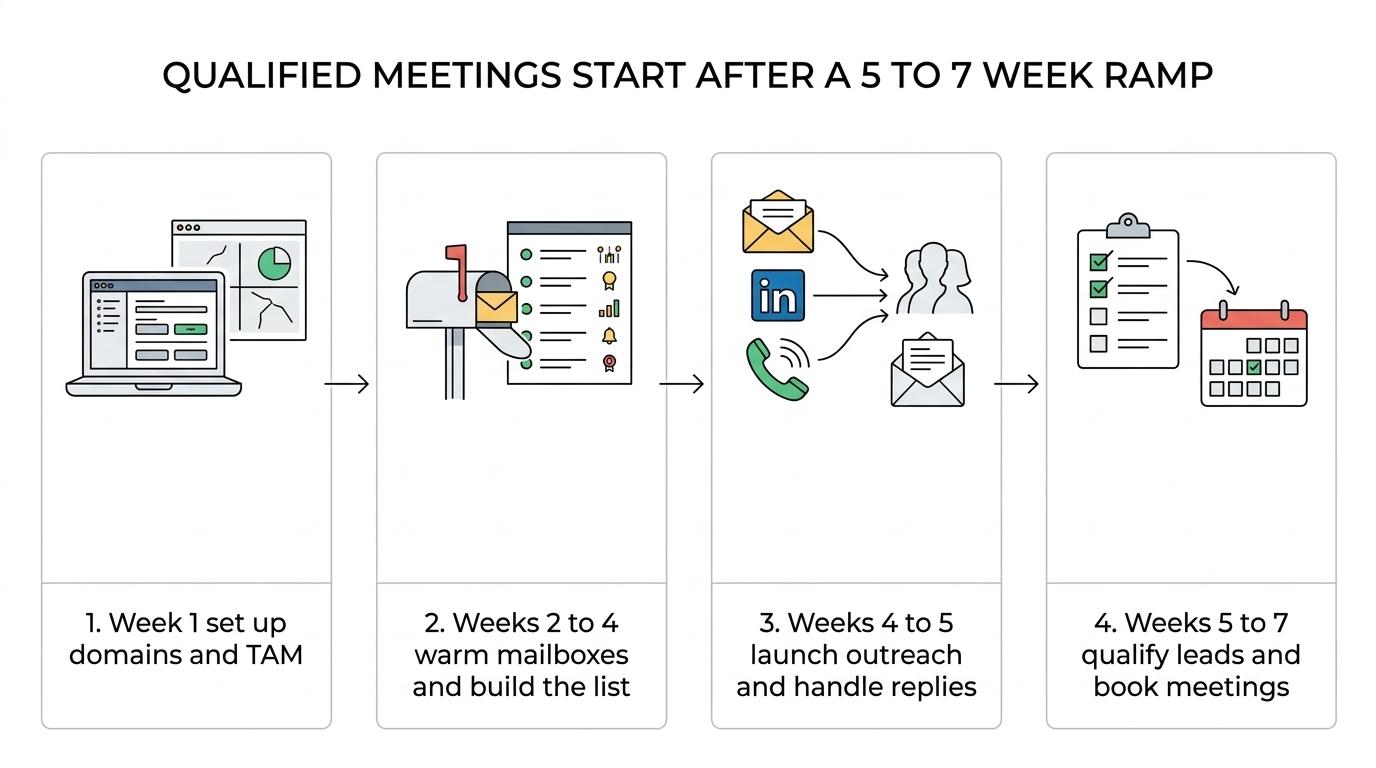
That setup time is not optional. Reachly warms domains for 14 to 30 days, and 30 days is the safer floor in 2026 because Google adds a yellow banner to mail from domains younger than 30 days. We also keep mailbox volume controlled, with 2026 daily caps of 15 on Google and 10 to 12 on Outlook.
[markdown] | Timing | What Reachly is doing | What you should expect | | --- | --- | --- | | Week 1 | Kickoff, offer alignment, TAM planning, domain setup | Clear ICP, offer direction, and technical requirements | | Weeks 2 to 4 | Mailbox warmup, list building, signal enrichment, sequence build | Audience approval and launch-ready outreach assets | | Weeks 2 to 3 | LinkedIn activity begins where warm accounts allow it | Early LinkedIn replies can start before email volume ramps | | Weeks 4 to 5 | Cold email launches on warmed infrastructure, reply handling starts | Early direct replies and initial signal on offer strength | | Weeks 5 to 7 | Qualification, nurturing, booking, list refinement | First qualified meetings typically start landing here | [/markdown]Reachly also re-validates any list older than 3 months before it sends. That extra step costs time upfront, but it is cheaper than burning a domain on stale data.
If you need meetings next week, outsourced SDR is already too late for that ask. Reachly is built for a controlled ramp that protects deliverability while still getting you into market quickly.
What results has Reachly produced for B2B teams?
The best reason to use outsourced SDR is not that it sounds lighter than hiring. It is that the model can be measured in SQLs, meeting volume, CAC movement, and closed revenue.
With Primal, Reachly generated 85+ SQLs in 6 months, helped reduce CAC by 35%, produced a 4.57x return, and broke even at month 3. That is the shape of outsourced SDR working as an operating system, not just as a sending service.
"Reachly helped Primal generate 85+ SQLs in 6 months, with CAC down 35% and break-even reached at month 3."
With The Great Room, Reachly helped move face-to-face meetings from about 2 per quarter before the engagement to about 2 per month during it. Reachly also ties that work to about $250,000 in closed contract value, with outbound leads showing about 30% drop-off after qualification versus about 50% from Google Ads and SEO leads.
Those numbers matter because they speak to pipeline quality, not just activity. More meetings only help if they turn into opportunities your team wants to keep.
Results still depend on the offer, the size of the TAM, the speed of follow-up, and how clearly your team handles the meetings once they are booked. Reachly can build the system and run it, but no outbound program survives a weak offer for long.
Why trust Reachly with your outbound brand and domain reputation?
Reachly has served 50+ B2B clients, run 400+ campaigns, and is rated 4.9 by 50+ leaders. The company is based in Bangkok, serves clients globally, and is APAC's first triple-certified agency across Clay, Smartlead, and HeyReach.
"Reachly has served 50+ B2B clients and run 400+ campaigns, with a 4.9 rating from 50+ leaders."
That matters because outsourced SDR touches your brand in public. Reachly protects that exposure with secondary sending domains, SPF, DKIM, DMARC, custom tracking domains, ESP-to-ESP matching, live monitoring, and mailbox rotation rules that pull weak mailboxes out before they damage the wider system.
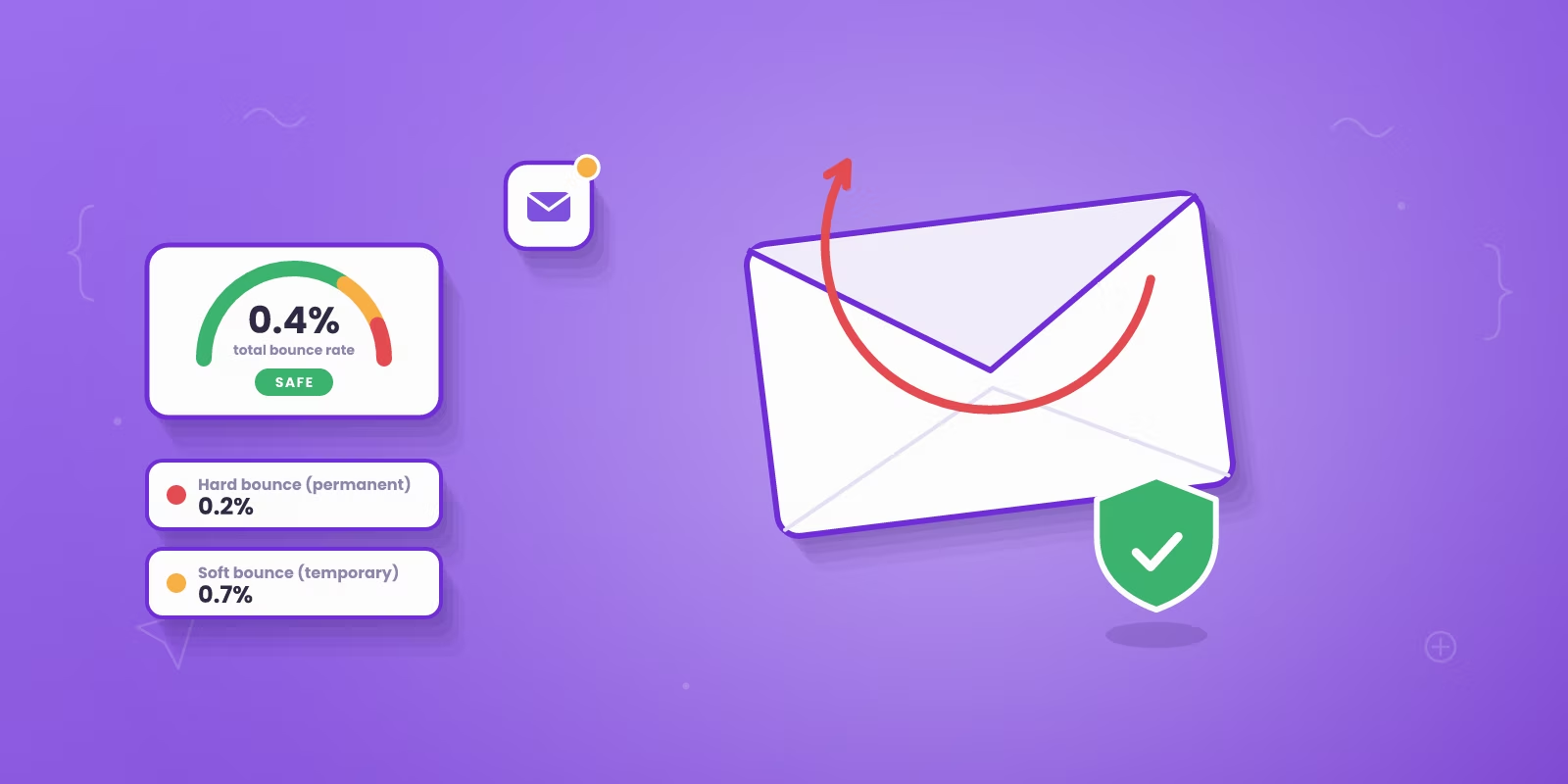
We watch bounce rate, inbox placement, and reply patterns closely. Reachly targets bounce rates under 3%, keeps deliverability scores above 97%, and revalidates any list older than 3 months before launch. If a mailbox drops under a 0.5% reply rate, it comes out of rotation.
There is also a practical reserve built into the system. Around 30% of Reachly's sending infrastructure sits idle at any given time, so a bad domain does not force the whole campaign offline that day.
If you want to send cold outbound from your primary company domain, Reachly is not the right provider for that choice. We protect the domain first, because fixing a damaged domain after the fact is slower and more expensive than avoiding the damage.
When should you skip outsourced SDR services?
You should skip outsourced SDR if your average contract value is under $5,000. At that level, founder-led outreach usually makes more sense because the economics and the targeting need to stay tight.
You should also skip it if you do not have product-market fit yet. Reachly can test angles and offers, but outsourced SDR is still multiplying a sales process you already have. When there is no process, there is nothing stable to multiply.
A very tiny market is another warning sign. If your dream list is fifty accounts and the sale depends on founder credibility, keyboard work from the founder can beat automation every time.
Reachly is also a poor fit if you only want raw data, a single sequence, or a volume-first blast from your own domain. The value here comes from signal selection, channel coordination, infrastructure control, and reply management moving together.
Want an outsourced SDR system that produces meetings without adding headcount?
If you need first qualified meetings in 5 to 7 weeks, want your domain protected, and care about SQLs and pipeline more than adding SDR seats, talk to Reachly. A first conversation usually covers your ICP, TAM size, offer strength, buying signals worth tracking, and whether outbound lead generation services or appointment setting services are the right entry point.
Reachly is the right fit when you want the full outbound motion owned, measured, and tied to booked meetings. If that is the outcome you need, book the meeting and we will show you what the system would look like for your market.